Paper packet. Every task here also exists on screen, where it is checked automatically; answers written on paper are not assessed by Nydus. When you are back at a device, enter your answers there.
1. What you will learn
Analyze scarcity, production possibilities and exchange using explicit assumptions, calculated results and a stated limit of the model.
2. Starting point
A trade exchanges one thing for another. Before comparing alternatives, identify the decision maker, the available resources, the time period and what must be forgone. Ratios let us compare different outputs in a common unit.
3. Terms and units
Term
What it means
Scarcity
Resources are insufficient to satisfy every competing use at once.
Opportunity cost
The value of the next-best feasible alternative forgone.
Production possibility frontier
The maximum combinations of two outputs feasible with stated resources and technology.
Comparative advantage
The ability to produce an output at a lower opportunity cost.
Absolute advantage
The ability to produce more output from the same resource input.
Terms of trade
The quantity of one good exchanged for a unit of another.
4. A constraint makes a choice necessary
Scarcity does not mean that everything is rare, expensive or about to run out. A school can possess hundreds of chairs and still face scarcity when the same workers and materials could repair desks, prepare meals or improve lighting. Each use has a benefit, but the resources cannot perform all uses simultaneously. The economic question is how to choose among feasible alternatives. Naming a desirable outcome alone does not identify a feasible plan. We must connect the plan to resources, technology and time.
An economic model deliberately leaves things out to make a particular relationship visible. In this lesson the production possibility frontier, or PPF, compares two outputs. Holding resources and technology fixed does not claim that they never change. It asks what the feasible combinations would be during a specified comparison if they did not change. When a later question introduces a new machine, that is a different model state with a different frontier. Keeping those two comparisons separate prevents a productivity improvement from being mistaken for a costless movement along the original frontier.
Scarcity remains relevant in several allocation systems. A market system uses decentralized exchanges and prices to coordinate many decisions. A centrally directed system uses an authority's production and allocation instructions. Custom and household arrangements can also allocate work and output. Real economies combine institutions. These descriptions concern how decisions are made; they do not repeal resource constraints. A price is one possible signal of scarcity, but scarcity can also appear as waiting, rationing or an opportunity forgone without any money changing hands.
Positive analysis asks what follows from specified conditions, or what an observation supports. Normative analysis asks what ought to be chosen using a value judgment. The statement that a particular production plan sacrifices twelve chairs is a positive claim within an identified model. The statement that providing desks is more important than providing those chairs introduces a priority. A calculation can inform that priority without deciding it. Our activities grade the resource comparison and arithmetic, not a learner's preferred social objective.
Another way: Reading a frontier rather than a wish list
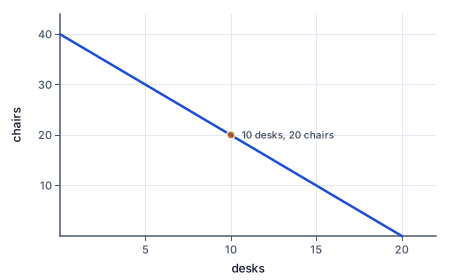
Chairs against desks for a workshop that can make 20 desks and no chairs, or 40 chairs and no desks, at constant productivity. The frontier is the straight line chairs = 40 − 2 × desks. Each extra desk costs two chairs, wherever the workshop is on the line: the slope is the opportunity cost.
The figure draws the workshop's frontier: a straight line from 40 chairs to 20 desks, whose slope is the two chairs each desk costs.
Put desks on the horizontal axis and chairs on the vertical axis. Suppose a workshop can produce twenty desks and no chairs, or forty chairs and no desks. If workers and equipment can move between uses at constant productivity, the frontier connects those intercepts with a straight line. The equation is chairs = 40 - 2 times desks. Making five desks leaves resources for thirty chairs. The coordinates of that plan are (5,30), with the first coordinate always belonging to the horizontal axis.
A point on the frontier uses the available resources productively under the model. A point inside it is feasible but does not produce the maximum possible output combination. Unemployed resources, avoidable disruption or an inefficient production method can explain such a point. A point beyond the frontier is infeasible with current resources and technology. These labels do not tell us which feasible combination people most want. Productive efficiency means there is no way to increase one output without reducing the other, given the constraint. Choosing the socially preferred combination also requires information about benefits and priorities.
Moving from five desks and thirty chairs to six desks and twenty-eight chairs is a movement along the same frontier. Resources switch uses; the intercepts do not change. Better chair-making technology may shift only the chair intercept, rotating the frontier outward. An improvement that raises productivity in both uses may shift both intercepts. Restoring idle equipment can move actual production from an interior point to the existing frontier without moving the frontier itself. Ask whether the change affects actual use of capacity or the capacity available.
The straight line is an assumption about constant opportunity cost, not a universal picture of production. If resources differ in their suitability for the two tasks, the workshop may first transfer workers who are relatively good at desks and give up few chairs. Making still more desks then requires transferring workers especially good at chairs. The number of chairs forgone per additional desk rises. With the usual axes, the frontier bows outward from the origin. Its slope becomes steeper as desk output increases. This describes increasing opportunity cost along a frontier, distinct from the short-run diminishing marginal product of a single input that we will study later.
Another way: Cost is an alternative, not simply a payment
Opportunity cost requires a counterfactual: what is the best feasible alternative if this choice is not made? If a room can host either a study group or a rehearsal during an hour, holding the study group forgoes the rehearsal when that is the next-best available use. It does not forgo every imaginable event added together. Nor does the opportunity cost necessarily equal a rental payment. The room might be provided without charge, yet its use still excludes another valued activity.
For a linear frontier, the magnitude of the slope supplies an output opportunity cost. Forty chairs divided by twenty desks is two chairs per desk. Reversing the question reverses the ratio: one chair costs half a desk. Write the units before calculating. Dividing desks by chairs while labeling the result chairs per desk gives a numerically plausible but conceptually inverted answer. On a nonlinear frontier, use the outputs at the two relevant points to find the cost over that interval rather than treating the intercept ratio as every local slope.
A cost-benefit comparison should also match the size of the decision. Suppose one additional desk brings a benefit valued at three chair-equivalents while producing it sacrifices two chairs. Under that expressly supplied valuation, the increment has positive net benefit. That is a marginal comparison, not a comparison of all desks' benefits with one desk's cost. If the next desk has a lower benefit or a higher opportunity cost, it requires a new comparison. A worthwhile first unit does not establish that every further unit is worthwhile.
Already incurred costs that cannot be recovered do not differ between present feasible alternatives. They are sunk for that decision. If a workshop has already paid a nonrefundable setup charge, the payment should not be counted again as a reason to make an additional desk today. Future materials, workers' time and forgone chair production can still matter. Calling the setup payment sunk does not mean the original decision to incur it was sensible; it means today's alternatives cannot change that past payment.
Another way: Comparative advantage and the boundaries of mutual gain
Consider two workshops with straight frontiers. Alder can make twenty desks or forty chairs; Birch can make twenty desks or twenty chairs. Alder's desk costs two chairs, whereas Birch's desk costs one chair. Birch has comparative advantage in desks. Alder has comparative advantage in chairs because its chair costs half a desk, compared with Birch's one desk. Alder's higher maximum chair output also gives it absolute advantage in chairs, but absolute output levels alone do not establish the direction of mutually beneficial specialization.
To ask whether exchange can benefit both workshops, compare the trading rate with each opportunity cost. A rate of one and a half chairs for a desk lies strictly between one and two chairs. Birch gives up one chair's production to make the exported desk and receives one and a half chairs. Alder obtains a desk by surrendering one and a half chairs instead of sacrificing two through its own production. Each obtains the imported output more cheaply in opportunity-cost terms. The gain is measured against producing that same output at home, not against receiving a good for nothing.
At a boundary rate, one workshop is indifferent. If one desk trades for exactly one chair, Birch receives precisely its own production cost. Alder gains, but the arithmetic does not show a strict gain for Birch. If one desk trades for exactly two chairs, Alder is indifferent while Birch gains. Therefore a question asking for strict gains to both parties requires a trading rate strictly between their opportunity costs. A question asking that neither lose may include the boundaries. The distinction matters whenever an exercise specifies an inequality or asks who benefits.
Comparative advantage identifies a possibility for gains, not a guarantee that every person benefits from a real change in trade. The simple model omits transport, adjustment costs, unemployment during transition, differing ownership and bargaining power. Even where aggregate gains exist, their distribution can vary. In a classroom frontier exercise, state the assumptions that permit the result: unchanged productivity, feasible specialization, an agreed trading rate and any specified absence of transaction costs. If transport consumes one extra chair per imported desk, add that cost before deciding whether the trade is advantageous. An omitted cost cannot be wished away by naming comparative advantage.
5. A joint workshop plan
Two fictional community workshops prepare desks and chairs for a learning center. Alder's weekly frontier is twenty desks or forty chairs; Birch's is twenty desks or twenty chairs. Each initially plans to make ten desks, leaving Alder twenty chairs and Birch ten chairs. Their combined output is twenty desks and thirty chairs. The coordinator proposes that Birch make all twenty desks and Alder make all forty chairs. The new plan produces the same number of desks and ten more chairs using unchanged resources. This gain comes from reallocating production toward comparative advantage, not from a new machine or extra working hours.
Production and consumption are separate questions. To give each workshop access to both goods, the coordinator suggests exchanging ten Birch desks for fifteen Alder chairs. Birch ends with ten desks and fifteen chairs, compared with its original ten desks and ten chairs. Alder ends with ten desks and twenty-five chairs, compared with ten desks and twenty chairs. Both have the same desks as before and five additional chairs. The exchange rate is one and a half chairs per desk, strictly between their two opportunity costs.
The coordinator should also record what was assumed. The frontier must describe feasible weekly output. Moving workers must not consume the entire gain. The exchange must actually take place, and the workshops must value the extra chairs rather than face an unmentioned storage constraint. If delivering the desks costs twelve chairs' worth of resources, the initial ten-chair production gain would not establish a net gain for this plan. The model is useful because it shows exactly where to look for those missing conditions. It supplies a transparent comparison for a decision, while leaving the final priorities and distributional agreement to the participants.
6. Check the tempting shortcut
A producer with higher output in both goods can still benefit from exchange. Compare opportunity-cost ratios, not merely output totals. A trading rate equal to one party's opportunity cost leaves that party indifferent; it does not show strict gains to both parties.
7. In the fictional Alder model, one workshop can produce 22 desks or 44 chairs per week, with a linear frontier. A second workshop can produce 22 desks or 22 chairs. Resources and technology are fixed, goods divisible, and trade has no cost. For the first workshop calculate chairs forgone per desk, chairs remaining after making 1 desks, and its gain in chairs from exchanging 2 chairs for 2 desks instead of making those desks itself.
Locate the intercepts.
desks 22; chairs 44
Each intercept uses all resources on one output.
Compute the opportunity cost.
44/22 = 2 chairs per desk
The straight frontier holds the ratio constant.
Price the proposed production.
1 desks cost 2 chairs
A movement along the frontier uses unchanged resources.
Find the remaining output.
44 - 2 = 42
Subtract forgone chairs from the chair intercept.
Compare home production with exchange.
Home cost 4; exchange cost 2; saved 2
The comparison holds the acquired desks constant.
8. In the fictional Birch model, one workshop can produce 24 desks or 48 chairs per week, with a linear frontier. A second workshop can produce 24 desks or 24 chairs. Resources and technology are fixed, goods divisible, and trade has no cost. For the first workshop calculate chairs forgone per desk, chairs remaining after making 2 desks, and its gain in chairs from exchanging 4 chairs for 4 desks instead of making those desks itself.
Locate the intercepts.
desks 24; chairs 48
Each intercept uses all resources on one output.
Compute the opportunity cost.
48/24 = 2 chairs per desk
The straight frontier holds the ratio constant.
Price the proposed production.
2 desks cost 4 chairs
A movement along the frontier uses unchanged resources.
Find the remaining output.
48 - 4 = 44
Subtract forgone chairs from the chair intercept.
Compare home production with exchange.
Home cost 8; exchange cost 4; saved 4
The comparison holds the acquired desks constant.
9. In the fictional Cedar model, one workshop can produce 26 desks or 52 chairs per week, with a linear frontier. A second workshop can produce 26 desks or 26 chairs. Resources and technology are fixed, goods divisible, and trade has no cost. For the first workshop calculate chairs forgone per desk, chairs remaining after making 3 desks, and its gain in chairs from exchanging 6 chairs for 6 desks instead of making those desks itself.
Locate the intercepts.
desks 26; chairs 52
Each intercept uses all resources on one output.
Compute the opportunity cost.
52/26 = 2 chairs per desk
The straight frontier holds the ratio constant.
Price the proposed production.
3 desks cost 6 chairs
A movement along the frontier uses unchanged resources.
Find the remaining output.
52 - 6 = 46
Subtract forgone chairs from the chair intercept.
Compare home production with exchange.
Home cost 12; exchange cost 6; saved 6
The comparison holds the acquired desks constant.
Check the partner's incentive.
Partner gives up 6 chairs to make 6 desks and receives 6 chairs: gain 0
This trading rate is the partner's opportunity cost, so it makes the partner indifferent rather than strictly better off.
10. In the fictional Dune model, one workshop can produce 28 desks or 56 chairs per week, with a linear frontier. A second workshop can produce 28 desks or 28 chairs. Resources and technology are fixed, goods divisible, and trade has no cost. For the first workshop calculate chairs forgone per desk, chairs remaining after making 4 desks, and its gain in chairs from exchanging 8 chairs for 8 desks instead of making those desks itself.
Locate the intercepts.
desks 28; chairs 56
Each intercept uses all resources on one output.
Compute the opportunity cost.
56/28 = 2 chairs per desk
The straight frontier holds the ratio constant.
Price the proposed production.
4 desks cost 8 chairs
A movement along the frontier uses unchanged resources.
Your turn: work this step out. Its working is at the end of the packet.
Find the remaining output.
Your turn: work this step out. Its working is at the end of the packet.
Compare home production with exchange.
11. Guided practice
In the fictional Elm model, one workshop can produce 30 desks or 60 chairs per week, with a linear frontier. A second workshop can produce 30 desks or 30 chairs. Resources and technology are fixed, goods divisible, and trade has no cost. For the first workshop calculate chairs forgone per desk, chairs remaining after making 5 desks, and its gain in chairs from exchanging 10 chairs for 10 desks instead of making those desks itself.
Calculated value
Chairs per desk
Chairs remaining
Chairs saved through exchange
12. Guided practice
In the fictional Dune model, one workshop can produce 28 desks or 56 chairs per week, with a linear frontier. A second workshop can produce 28 desks or 28 chairs. Resources and technology are fixed, goods divisible, and trade has no cost. For the first workshop calculate chairs forgone per desk, chairs remaining after making 4 desks, and its gain in chairs from exchanging 8 chairs for 8 desks instead of making those desks itself.
Calculate chairs per desk.
g0
The straight frontier holds the ratio constant.
Calculate chairs remaining.
g1
Subtract forgone chairs from the chair intercept.
Calculate chairs saved through exchange.
g2
The comparison holds the acquired desks constant.
13. Guided practice
In the fictional Fern model, one workshop can produce 32 desks or 64 chairs per week, with a linear frontier. A second workshop can produce 32 desks or 32 chairs. Resources and technology are fixed, goods divisible, and trade has no cost. For the first workshop calculate chairs forgone per desk, chairs remaining after making 6 desks, and its gain in chairs from exchanging 12 chairs for 12 desks instead of making those desks itself.
Chairs per desk: b0
Chairs remaining: b1
Chairs saved through exchange: b2
14. Practice
In the fictional Grove model, one workshop can produce 34 desks or 68 chairs per week, with a linear frontier. A second workshop can produce 34 desks or 34 chairs. Resources and technology are fixed, goods divisible, and trade has no cost. For the first workshop calculate chairs forgone per desk, chairs remaining after making 7 desks, and its gain in chairs from exchanging 14 chairs for 14 desks instead of making those desks itself.
Chairs per desk: b0
Chairs remaining: b1
Chairs saved through exchange: b2
15. Practice
A fictional workshop can make 24 desks or 48 chairs per week. Its frontier is linear with fixed resources. Plot the three frontier points at desk quantities 0, 12 and 24; desks belong on the horizontal axis.
Plot your answer on the grid:
16. Somewhere new
A joint exhibition needs furniture, and a coordinator proposes exchanging output between two workshops instead of requiring each to make its own complete set. Compare the proposed exchange with home production, keeping the number of desks acquired fixed. In the fictional Island model, one workshop can produce 38 desks or 76 chairs per week, with a linear frontier. A second workshop can produce 38 desks or 38 chairs. Resources and technology are fixed, goods divisible, and trade has no cost. For the first workshop calculate chairs forgone per desk, chairs remaining after making 9 desks, and its gain in chairs from exchanging 18 chairs for 18 desks instead of making those desks itself.
Calculated value
Chairs per desk
Chairs remaining
Chairs saved through exchange
17. Lesson test
Lesson test: one question per skill, one attempt each, no hints. Your answers are checked when you submit.
18. Test question
In the fictional Juniper model, one workshop can produce 40 desks or 80 chairs per week, with a linear frontier. A second workshop can produce 40 desks or 40 chairs. Resources and technology are fixed, goods divisible, and trade has no cost. For the first workshop calculate chairs forgone per desk, chairs remaining after making 10 desks, and its gain in chairs from exchanging 20 chairs for 20 desks instead of making those desks itself.
Calculated value
Chairs per desk
Chairs remaining
Chairs saved through exchange
19. What you can do now
Reconstruct the model without the worked example. Explain each requested measure's units and identify an assumption that the conclusion depends on.
Working for the steps left to you
10. In the fictional Dune model, one workshop can produce 28 desks or 56 chairs per week, with a linear frontier. A second workshop can produce 28 desks or 28 chairs. Resources and technology are fixed, goods divisible, and trade has no cost. For the first workshop calculate chairs forgone per desk, chairs remaining after making 4 desks, and its gain in chairs from exchanging 8 chairs for 8 desks instead of making those desks itself., step 4
56 - 8 = 48
Subtract forgone chairs from the chair intercept.
10. In the fictional Dune model, one workshop can produce 28 desks or 56 chairs per week, with a linear frontier. A second workshop can produce 28 desks or 28 chairs. Resources and technology are fixed, goods divisible, and trade has no cost. For the first workshop calculate chairs forgone per desk, chairs remaining after making 4 desks, and its gain in chairs from exchanging 8 chairs for 8 desks instead of making those desks itself., step 5