Any rock can become any other, by one of three processes, and the cycle has no start, no order and no direction.
Paper packet. Every task here also exists on screen, where it is checked automatically; answers written on paper are not assessed by Nydus. When you are back at a device, enter your answers there.
1. What you will learn
By the end of this lesson you will be able to name the process that turns a rock of any type into a rock of any other type, point at the rock a process leads to on a diagram of the cycle, and explain why the cycle has no start: any rock can go through any of the processes next, and the arrows point both ways along every side.
2. What you already have
You know the three ways a rock forms and the texture each leaves: a melt cools into interlocking crystals, grains are cemented into layers, and heat and pressure rebuild a rock into bands or sheets. What this lesson adds is that the three are not three separate stories. Any rock can go into any of them, and the material has been going round for as long as there has been an Earth.
3. Words for this lesson
The rock cycle is the set of processes by which any rock can become any other. Weathering breaks rock down where it lies; erosion carries the pieces away; deposition drops them; burial and cementing turn them into sedimentary rock. Metamorphism is heat and pressure short of melting. Melting turns any rock into magma, and cooling turns magma into igneous rock. Uplift is what brings deep rock back to the surface to start again.
4. Three histories, joined every way round
Put the three histories side by side and a pattern appears: each one starts from a rock. Sediment is the broken pieces of some earlier rock. A metamorphic rock was some earlier rock before it was squeezed. Magma is some earlier rock, melted. Nothing starts from nothing.
So the three types are joined, and they are joined in every direction:
Any rock at the surface is weathered into grains, the grains are carried away, dropped, buried and cemented — and it is now sedimentary rock.
Any rock buried deep enough is heated and squeezed short of melting — and it is now metamorphic rock.
Any rock heated far enough melts, and when the melt cools — and it is now igneous rock.
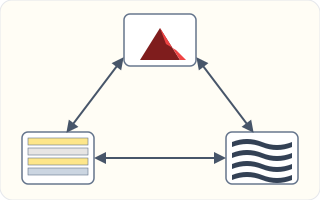
Three processes, three products, and the starting rock never matters. That is what the arrows on the diagram are saying: every line between two boxes has an arrowhead at both ends, and every box is joined to every other.
The rock cycle is not a list of stages a rock goes through in order. It is a set of processes, and any rock can go through any of them next: a sedimentary rock can melt, an igneous rock can be worn down into sediment, a metamorphic rock can be squeezed again. There is no first rock and no last one, and a diagram with arrows going every way is drawn that way on purpose.
What keeps it going is uplift. Rock made deep underground — granite, gneiss — only becomes sediment if it is brought back to the surface, and mountain-building does that, lifting deep rock into the weather. Take uplift away and the cycle would stop with everything buried.
Another way: picture
Three white boxes at the corners of a triangle, joined by three straight lines that have an arrowhead at both ends. The box at the top has a dark cone drawn in it with a red tongue running down its right-hand side. The box at the bottom left has four flat coloured strips drawn one above another. The box at the bottom right has four dark wavy bands drawn one above another.
Three boxes at the corners of a triangle, each marked with a symbol rather than a word: a cone with a flow for igneous, flat strips for sedimentary, wavy bands for metamorphic. Every side of the triangle is a line with an arrowhead at both ends, so that from any box you can reach either of the others directly.
Another way: steps
To trace a rock through the cycle:
Name the type it has to become.
Name the one process that makes that type: melting and cooling for igneous, weathering through to cementing for sedimentary, heat and pressure for metamorphic.
Ignore where the rock came from; any starting type will do.
If the rock is deep, remember uplift has to bring it up before weathering can touch it.
5. Where this goes wrong
The cycle is read as a sequence. Igneous, then sedimentary, then metamorphic, then round again — as if a rock had to visit each type in turn. It does not. A sedimentary rock can melt without ever being metamorphic; a metamorphic rock can be worn down without ever melting. The diagram's arrows point both ways along every side because there is no order.
The cycle is given a start. Usually igneous, because the first rocks on Earth cooled from a melt. That is the planet's history, not the cycle's order; today every route is open and there is no first rock.
The cycle is read as running one way round. "Sandstone cannot become granite" — it can, if it is buried deep enough to melt. Every rock can become every type; the only question is which process gets it there.
A good test of whether you have the cycle right is to draw it from memory, with every arrow that belongs. If your drawing has a start, or arrows that go only one way, it is a sequence and not the cycle.
6. A grain of sand on a beach, and where it might go
The grain is quartz that was weathered out of a granite in the hills and carried down by a river.
Igneous to sediment: weathering, erosion, deposition.
Buried under more sand and cemented, it is part of a sandstone. Buried deeper and squeezed under a mountain range, that sandstone is quartzite.
Sediment to sedimentary to metamorphic.
Deeper still, it melts, and the melt cools into a new granite — from which, after uplift, a grain of sand will one day be weathered. The same atoms, round the whole cycle, and they could have taken any other route.
7. Limestone under a volcano
A limestone lies in the ground, and magma pushes up through it towards a volcano.
Sedimentary rock meets heat.
The limestone in the rim round the magma is baked into marble without melting: sedimentary straight to metamorphic, with no igneous step in between.
One arrow, not two.
Some of the limestone nearest the magma melts and joins it, and when the volcano's lava sets, that limestone is now igneous rock: sedimentary straight to igneous. Two neighbouring pieces of the same layer took two different routes.
8. Your turn: what has to happen to a gneiss on a mountain top for it to become part of a sandstone?
Name the type it has to become — sedimentary — and the process that makes sedimentary rock: weathering, then erosion, deposition, burial and cementing…
Type first, then the one process that makes it.
…so the gneiss is weathered into grains, the grains are carried down by rivers and dropped, buried under more sand…
Your turn: work this step out. Its working is at the end of the packet.
…and cemented into sandstone. It did not need to melt or be squeezed first; metamorphic straight to sedimentary is one arrow.
9. Guided practice
Each process on the left ends in one of the three types of rock on the right. Sort them. Two processes go to each type.
igneous rock
sedimentary rock
metamorphic rock
molten rock cools slowly deep underground
lava sets hard at the surface
buried sand is pressed and cemented
shells pile up on a sea floor and are cemented
a rock is squeezed and heated under a mountain range without melting
a rock is baked in the rim round a body of magma
10. Guided practice
The picture is the rock cycle drawn as three boxes, each marked with a symbol: a cone with a flow for igneous rock, flat strips for sedimentary rock, wavy bands for metamorphic rock. Every line between them has an arrowhead at both ends. Mark the box for the rock that forms when a rock is squeezed and heated without melting.
This task has no paper form; do it on a device.
11. Practice
Which type of rock does the rock cycle start with?
None of them: any rock can go through any of the processes next, so there is no start
Igneous, then sedimentary, then metamorphic, and round again
Igneous, because the first rocks on Earth cooled from a melt
Sedimentary, because sediment is loose and rock has to be made from something
12. Practice
What has to happen to basalt for it to become a metamorphic rock?
It must be squeezed and heated without melting
It must melt, and the melt must cool and harden
Its grains must be pressed together and cemented again
It cannot happen: the cycle only runs one way round
13. Practice
Each process on the left ends in one of the three types of rock on the right. Sort them. Two processes go to each type.
igneous rock
sedimentary rock
metamorphic rock
molten rock cools slowly deep underground
lava sets hard at the surface
buried sand is pressed and cemented
shells pile up on a sea floor and are cemented
a rock is squeezed and heated under a mountain range without melting
a rock is baked in the rim round a body of magma
14. Somewhere new
Five things seen on a walk through a town. Each is a rock somewhere in the cycle. Match each one to the process it shows.
weathering
erosion and transport
deposition
heat and pressure without melting
melting, then cooling
a granite kerbstone crumbling at the edges after fifty winters
grit from the kerbstone washing down the gutter in the rain
dredged sand being dumped offshore, settling in layers
a roof of slate tiles, which were once mud on a sea floor
a kerb of basalt, which was once lava
15. Lesson test
Lesson test: one question per skill, one attempt each, no hints. Your answers are checked when you submit.
16. Test question
The picture is the rock cycle drawn as three boxes, each marked with a symbol: a cone with a flow for igneous rock, flat strips for sedimentary rock, wavy bands for metamorphic rock. Every line between them has an arrowhead at both ends. Mark the box for the rock that forms when molten rock cools and hardens.
This task has no paper form; do it on a device.
17. What you can do now
You can trace any rock to any type and say which process gets it there. Now close this page and draw the rock cycle from memory: three boxes, every process, and every arrow that belongs — then check it against the picture in the lesson. Say out loud why a drawing with a start is wrong. Next: the first of those processes, weathering, and how it differs from erosion.
Working for the steps left to you
8. Your turn: what has to happen to a gneiss on a mountain top for it to become part of a sandstone?, step 3