Dams, drained wetlands and jetties: finding every benefit and cost of a human change, saying who feels it and where, and weighing the trade-off.
Paper packet. Every task here also exists on screen, where it is checked automatically; answers written on paper are not assessed by Nydus. When you are back at a device, enter your answers there.
1. What you will learn
You will sort the effects of a real human change into benefits and costs, say where and for whom each happens, and describe the change as a trade-off.
2. What you already know
You know how rivers carry silt, how coasts erode, and how people turn nature into resources. When people take a resource such as a river's water, the river, the land and other people all feel it. This lesson follows those effects.
3. Words for this lesson
Term
What it means
Benefit
A good effect of a change.
Cost
A harmful effect of a change.
Trade-off
A choice that brings benefits and costs together, often to different people in different places.
Upstream
Toward a river's source.
Downstream
Toward a river's mouth.
Silt
Fine mud carried by a river and dropped where it slows.
Reservoir
A lake made behind a dam to store water.
4. Every big change has winners and losers, somewhere
When people change a place, the effects spread out, and they rarely all point the same way. A geographer asks three questions of each effect: is it a benefit or a cost, for whom, and where?
Egypt finished the Aswan High Dam across the Nile in 1970. Before it, the Nile flooded every summer: the floods brought fresh silt to the fields but could also wreck crops and homes. The dam stopped the floods and stored water in Lake Nasser, so farmers could grow two or three crops a year, and its power station made, at first, about half of Egypt's electricity.
But the lake flooded the land of the Nubian people, and more than 100,000 of them had to move. The silt now settles in the lake instead of reaching the fields, so farmers buy fertilizer. And with no new silt arriving, the delta on the Mediterranean coast is being worn away by the sea. Benefits and costs, spread from the lake to the coast.
Another way: steps
To judge a change fairly: 1. List every effect you can find. 2. Mark each one a benefit or a cost. 3. Say who feels it and where: upstream, downstream, at the coast, or everywhere. 4. Only then weigh them up.
Another way: diagram
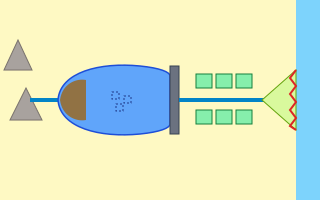
A river seen from above, flowing from gray mountains on the left to the sea on the right. Partway along, the river widens into a big blue lake held back by a thick gray bar across its right-hand end. A brown patch covers the left end of the lake, where the river flows in, and some dotted squares lie under the water in the middle of the lake. After the gray bar, the river runs on between green squares of fields and ends in a fan of land where it meets the sea; the edge of the fan is marked with a red zigzag.
The river runs from the mountains, into the lake behind the dam, past the fields and out to the sea. The brown patch is trapped silt, the dotted squares are villages now under the water, and the red zigzag is the delta coast wearing away.
5. Why the same storm can cause different harm
A hazard is a potentially harmful event; exposure means people or buildings are in its path. Vulnerability concerns how easily they can be harmed and what support they have. Two neighborhoods can receive similar rain but face different outcomes. Paving soil can speed runoff, while a wetland can hold some water. Low homes may flood before higher ones; warning systems, accessible transport and shelter can reduce harm. This is not a reason to blame residents. Money, housing availability and public decisions can limit their options. Compare the storm, land cover, housing and support separately. No single protective measure guarantees safety, and a dam can reduce one risk while changing flows or sediment elsewhere.
6. A second case: the Aral Sea
The Aral Sea, between Kazakhstan and Uzbekistan, was once one of the largest lakes in the world. From the 1960s its two rivers were used to water vast cotton fields. The cotton brought work and money, but by the 2010s the sea had shrunk to a small part of its old size. Fishing towns such as Moynaq were left far from the water, and dust from the dry sea bed blew over the land.
Change
Benefit
Cost
Aswan High Dam
fewer floods, stored water, electricity
Nubian homes flooded, silt trapped, delta wearing away
Aral Sea rivers used for cotton
cotton, work and money
the sea shrank, fishing ended, dust storms
7. Dams on American rivers
The United States has tens of thousands of dams. Hoover Dam on the Colorado River, finished in 1936, stores water for Nevada, Arizona and California, controls floods and makes electricity for millions of people.
Dams bring costs too. Glen Canyon Dam, upstream of the Grand Canyon, traps the river's sand, so the sandbars and beaches in the canyon below have shrunk. Salmon in the Pacific Northwest cannot swim up past many dams to lay their eggs.
8. Draining wetlands
Wetlands such as swamps and marshes were long treated as wasted land. In the 1900s canals drained much of Florida's Everglades, making new land for sugarcane farms and growing cities such as Miami.
The costs showed up later: birds and alligators lost habitat, and less fresh water flowed south to Florida Bay. Since 2000, a huge federal and state project has tried to restore some of the Everglades' flow.
9. Walls against the sea
People build seawalls, jetties and groins to protect beaches, harbors and buildings. Each one changes how sand moves along the coast, because waves carry sand sideways along the shore.
A jetty that traps sand on one side starves the beach on the other side. Protecting one town can speed erosion at the next, which is why coastal planners must look at a whole stretch of shoreline, not just one beach.
10. Effects travel
The effects of a change often appear far from where it was made. Glen Canyon Dam is in Arizona; the beaches it starves are hundreds of miles downstream. Water taken from the Colorado River means that, in most years, the river no longer reaches the sea in Mexico.
That is why a geographer always asks where an effect happens. The people who gain and the people who pay may live far apart, and may never meet.
11. Winners and losers
The same change can help one group and harm another. A dam may give farmers irrigation water and cities cheap electricity while flooding the homes of people who lived in the valley.
A fair judgment names both groups. It does not ignore the people who paid the costs, and it does not pretend the benefits were not real.
12. Changes that build slowly
Some costs grow over decades. Silt fills a reservoir little by little, shrinking the water it can store. Pumping groundwater lowers the water table a few feet a year until wells run dry.
Because such costs are slow, they are easy to overlook when a project is new. Dividing the space left by the yearly loss shows how long a reservoir or an aquifer can last, which is how planners spot slow costs early.
13. The method, step by step, and how to check it
List every effect.
Mark each a benefit or a cost.
Locate it: for whom, and where.
Measure slow costs: amount lost each year times years.
Weigh the trade-off.
Checking an answer. A trade-off statement names at least one benefit and one cost, and says where each falls.
14. Why each step is allowed
Listing effects before judging is allowed, and needed, because a judgment made from half the evidence is not a judgment at all. Marking each effect separately keeps the benefits from hiding the costs, or the other way around.
Multiplying a yearly loss by the years is allowed when the loss is steady, as silt settling in a reservoir roughly is. It turns a slow change into a number people can plan with.
15. Undoing changes
Sometimes people decide a change cost too much and try to undo it. In 2011 and 2014, two dams on the Elwha River in Washington were torn down, the largest dam removals in American history at the time.
Within a few years, trapped sediment rebuilt beaches at the river's mouth, and salmon returned to swim upstream. Undoing a change can bring back benefits that were lost, though it has costs of its own.
16. Common slips
The most common slip is calling a change wholly good or wholly bad by looking at only one side of the evidence. Another is assuming an effect happens where the change was made, when it may appear far downstream or along the coast.
A third is assuming everyone feels a change the same way. A fourth is forgetting slow costs, such as silt, that grow for decades after a project is finished.
17. In the world: flooding the Grand Canyon on purpose
Glen Canyon Dam, finished in 1966 just upstream of the Grand Canyon, created Lake Powell, which stores water for the Southwest and makes electricity. But the dam also traps almost all the sand the Colorado River once carried.
Below the dam, the river runs clear and cold. The sandbars and beaches that lined the canyon, used by rafters and by plants and fish, began to wash away with no new sand to replace them, and some native fish declined in the colder water.
Since 1996, scientists have run planned floods, releasing extra water from the dam for a few days to stir up sand from the river bed and spread it onto the sandbars. It is an attempt to win back one of the dam's costs while keeping its benefits, and a clear example of weighing a trade-off that falls on a place hundreds of miles from the dam itself.
18. In the world: Owens Lake and a thirsty city
In 1913 Los Angeles opened an aqueduct more than 200 miles long to bring water from the Owens Valley, east of the Sierra Nevada, to the growing city. The water let Los Angeles grow into one of the largest cities in the country.
The cost fell on the valley. With the Owens River diverted, Owens Lake dried up by the 1920s, and farms in the valley withered. Winds lifting dust from the dry lake bed made it one of the largest sources of dust pollution in the United States, harming the health of people living nearby.
After lawsuits, Los Angeles has spent more than a billion dollars controlling the dust, by spreading shallow water, planting grasses and laying gravel on the lake bed. The story shows a benefit in one place, a cost two hundred miles away, and the long, expensive work of paying back a cost that was ignored at the start.
19. Where this goes wrong
Any human change is either wholly good or wholly bad. The Aswan High Dam has real benefits and real costs. Pretending either side does not exist is not a judgment; it is leaving out evidence.
An effect happens where the change was made. The dam is at Aswan; the delta it harms is about six hundred miles away at the coast.
Everybody feels a change the same way. A farmer who gained a third harvest and a Nubian family who lost their village lived through the same dam.
20. Locating one effect
The Nile delta is wearing away. Name the effect.
$\text{delta erosion}$
What happened.
Decide benefit or cost.
$\text{cost}$
It harms coastal farms and towns.
Say where it happens.
$\text{at the coast}$
Far downstream of the dam.
Say what causes it.
$\text{silt trapped behind the dam}$
An effect far from its cause.
21. Weighing the Everglades
Canals drained much of the Everglades. Name the change.
$\text{wetland drained}$
What people did.
Name a benefit.
$\text{land for farms and cities}$
Who gained.
Name a cost.
$\text{wildlife lost habitat}$
What paid.
Name another cost.
$\text{less fresh water to Florida Bay}$
Far to the south.
Describe the change.
$\text{a trade-off, now partly being undone}$
Restoration since 2000.
22. A reservoir filling with silt
A reservoir held $2000$ thousand acre-feet when new. Record it.
$2000$
Thousand acre-feet.
Silt settles at $10$ thousand acre-feet a year. Find $40$ years of silt.
$10 \times 40 = 400$
Thousand acre-feet.
Find the storage left.
$2000 - 400 = 1600$
Thousand acre-feet.
Find the percent lost.
$\dfrac{400}{2000} \times 100 = 20\%$
A fifth.
Say where that silt should have gone.
$\text{downstream fields and beaches}$
A cost far away.
Name the kind of cost.
$\text{slow and growing}$
Easy to overlook at first.
23. Your turn: one more Aswan effect
Name the effect.
$\text{farmers buy fertilizer}$
Along the Nile.
Your turn: work this step out. Its working is at the end of the packet.
Decide benefit or cost.
Your turn: work this step out. Its working is at the end of the packet.
Say where and why.
24. Guided practice
Match each real change people made to a place with what followed.
new land for farms and towns
the sea shrank far below its old size
animals lose their homes and soil washes away
silt trapped, so the delta wears away
the Aral Sea's rivers taken to water cotton
the Aswan High Dam built across the Nile
much of Florida's Everglades drained by canals
Amazon rainforest cleared for cattle ranches
25. Guided practice
Complete the worked solution: when a dam was finished, its reservoir held $1200$ thousand acre-feet of water. Silt settles in it at about $8$ thousand acre-feet a year. After $30$ years, find how much silt has settled, how much storage is left, and the percent of the storage lost.
Find the silt so far.
$\text{yearly silt} \times \text{years} =$ l
Thousand acre-feet.
Find the storage left.
$\text{storage when new} - \text{silt} =$ r
Room for water.
Find the percent lost.
$\dfrac{\text{silt}}{\text{storage when new}} \times \text{a hundred} =$ p
A slow, steady cost.
Say where the silt should have gone.
$\text{downstream to fields and the delta}$
A cost felt far away.
26. Guided practice
In 1933 a hurricane cut an inlet through the sandy island at Ocean City, Maryland, and stone jetties were built to keep the inlet open for boats. The inlet and the town's harbor were protected. But the jetties trapped sand drifting south along the shore, and Assateague Island, just to the south, lost sand and moved far to the west. Which is the best description of this change?
A complete success, because the inlet stayed open.
A complete failure, because an island lost sand.
A trade-off: an open inlet for Ocean City, but a starved, retreating island to the south.
Nothing changed, because sand was already moving.
27. Guided practice
The Aral Sea, between Kazakhstan and Uzbekistan, was once the fourth-largest lake in the world. Put the chain of events that followed the 1960s in order.
Number the steps in order (write the number in the box):
The sea shrinks.
Fishing boats are left stranded on dry sand, and jobs are lost.
Water is taken from the rivers to water cotton fields.
The water left grows saltier and most of the fish die.
Much less water reaches the sea.
28. Guided practice
One student says the Aswan High Dam was a wholly good idea, because it stopped floods and makes electricity. Another says it was wholly bad, because it trapped the silt and flooded villages. Which statement is the most accurate?
It was wholly good, because the benefits are real.
It was wholly bad, because the costs are real.
It is a trade-off: real benefits and real costs, for different people in different places.
It is impossible to say anything about it at all.
29. Guided practice
Read this short report about the Aswan High Dam. Select the sentence that describes a **cost** of the dam.
This task has no paper form; do it on a device.
30. Guided practice
This picture shows a river with a big dam, from the mountains on the left to the sea on the right, like the Nile and the Aswan High Dam. Before the dam, the river carried rich mud called silt all the way to the fields and the coast. Click the place where most of that silt ends up **now**.
This task has no paper form; do it on a device.
31. Practice
Here are six real effects of the Aswan High Dam. For each, say whether it is a benefit or a cost, and where it happens.
Benefit or cost?
Where?
floods no longer ruin the crops
water is stored for dry years
electricity from the dam's power station
Nubian villages flooded and their people moved
farmers must buy fertilizer because no new silt arrives
the delta wears away into the sea
32. Practice
Silt settles on the bottom of an invented reservoir at about $4$ inches a year. The silt has $328$ inches still to rise before it reaches the pipes that take water out through the dam. About how many years will that take?
Answer:
33. Somewhere new
In two invented riverside neighborhoods the same storm brings 4 hours of heavy rain. In A, a paved parking lot sends runoff quickly toward low homes; residents have no evacuation transport. In B, a wetland stores some water, homes stand higher and a bus route reaches a shelter.
Read the field-note analysis below. Select the observations explaining runoff/exposure and unequal access to help, AND the statement limiting what can be predicted. Leave unsupported claims unmarked.
This task has no paper form; do it on a device.
34. Lesson test
Lesson test: one question per skill, one attempt each, no hints. Your answers are checked when you submit.
35. Test question
Silt settles on the bottom of an invented reservoir at about $7$ inches a year. The silt has $287$ inches still to rise before it reaches the pipes that take water out through the dam. About how many years will that take?
Answer:
36. What you can do now
You can judge a change fairly. Tell somebody one benefit and one cost of the Aswan High Dam, and where each is felt. Next: putting everything together to explain a pattern with evidence.