Back to the on-screen lesson ·
Why something in nature becomes a resource only when people have a use and the know-how, and the difference between renewable and non-renewable resources.
Paper packet. Every task here also exists on screen, where it is checked automatically; answers written on paper are not assessed by Nydus. When you are back at a device, enter your answers there.
You will explain why a material became a resource at a particular time, sort resources into renewable and non-renewable, and work out how long a resource would last at a given rate of use.
Butte grew around a copper mine and Kiruna around an iron mine: people go where there is something valuable in the ground. This lesson asks what makes a thing in the ground valuable in the first place.
| Term | What it means |
|---|---|
| Resource | Something people use to meet their needs. |
| Renewable | Replaced by nature within a human lifetime, like wind, sunshine or a replanted forest. |
| Non-renewable | Not replaced in any human lifetime, like coal, oil, gas and metal ores. |
| Technology | The know-how and tools people use to get and use things. |
| Reserve | The amount of a resource that people know is there and can get out. |
| Sustainable | Used no faster than it can be replaced, so it lasts. |
Something in nature becomes a resource only when people have a use for it and the technology to get it and use it. Change either, and something worthless can become precious, or the other way around.
Bauxite is a common rock. Aluminum can be made from it, but for a long time nobody knew how to do it cheaply, and in the 1850s aluminum was worth more than gold. In 1886 a cheap way of making it with electricity was found, and now we wrap sandwiches in it. The rock never changed; the know-how did.
Resources are renewable or non-renewable. Wind, sunshine, flowing water and forests that are replanted are renewed by nature. Coal, oil and gas formed from living things buried millions of years ago, and metal ores took just as long, so what we use is gone for good. Even renewable resources can run out if they are used faster than nature replaces them.
Another way: steps
To decide whether something is a resource, ask: 1. What is it used for? 2. Do people have the technology to get it and use it? 3. Will nature replace it within a lifetime? Then it is renewable.
Another way: story
A pile of old cell phones was once trash. Now factories take them apart for the gold, copper and lithium inside, because the know-how exists. The trash heap has become a resource without changing at all.
A warm, wet forest can supply timber, foods and water-related services. Which become resources depends on people's knowledge, tools, needs and rules. Two communities in similar forest conditions might choose different uses: one protects a watershed, another harvests some trees, and another combines uses. Protection is itself a decision about a valued place, not an absence of human activity. Climate helps explain the forest, while history and decisions help explain its use. Ask who receives the benefit and who bears a cost, and whether regrowth can keep up with removal.
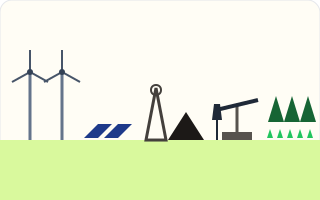
Wind turbines and solar panels use resources that are renewed every day. A forest where young trees are planted as old ones are cut is renewable too. The coal mine and the oil pump take resources that formed over millions of years and will not come back.
| Material | What made it a resource |
|---|---|
| Oil | lamps from 1859, then engines |
| Aluminum from bauxite | a cheap way to make it, from 1886 |
| Uranium | nuclear power plants, from the 1950s |
| Lithium | rechargeable batteries |
A thing becomes a resource when people want it and can get it. Oil sat in Pennsylvania's ground for ages as a nuisance; when people learned to refine it into lamp oil, it became precious.
The reverse happens too. Whale oil lit American lamps in the 1800s, and whaling ships sailed from New Bedford, Massachusetts, around the world. Once kerosene from petroleum was cheaper, whale oil stopped being much of a resource.
Technology can turn useless rock into something valuable. Bauxite waited until 1886, when Charles Martin Hall in Ohio and Paul Héroult in France found a cheap way to make aluminum with electricity.
New drilling methods in the 2000s let companies reach oil and gas locked in hard shale rock in North Dakota, Texas and Pennsylvania. The rock had been there all along; the know-how made it a resource.
Renewable resources are replaced by nature quickly enough to use again: sunshine, wind, flowing rivers, forests that are replanted, fish that breed, soil that is cared for.
Wind turbines across Texas, Iowa and Oklahoma, and solar farms in California and Arizona, make a growing share of American electricity from resources that do not run out, however much of them we use.
Coal, oil and natural gas formed from plants and sea creatures buried and squeezed for millions of years. Metal ores formed over similar spans. Once we burn or use them, they are gone for any time that matters to people.
That makes the question for non-renewable resources how long they will last and what will replace them, since nature will not make more in time.
A reserve is the amount of a resource people know is there and can get out. Dividing the reserve by the amount used each year gives how many years it would last at that pace.
Such estimates change. New discoveries and better technology can grow a reserve, and faster use shrinks the years left. So a reserve's lifetime is an estimate for planning, not a countdown clock.
Renewable does not mean unlimited. A fish stock, a forest or an underground water supply can be used faster than nature replaces it. Then it runs down, year after year, just like a non-renewable resource.
The rule for keeping a renewable resource is simple: use no more each year than nature puts back. Fishing limits, replanting after logging and rules on pumping groundwater all try to keep that balance.
Checking an answer. A reserve divided by yearly use gives years, not tons. A renewable stock shrinks only when the catch is bigger than the regrowth.
A resource is defined by people's needs and abilities, so asking about use and know-how tests whether something is a resource right now.
Dividing a reserve by yearly use is allowed because the same amount is taken each year: the number of years is how many yearly amounts fit into what is left. For a renewable stock, the yearly change is what is taken minus what grows back.
Recycling turns used materials back into resources. An aluminum can can be melted and remade again and again, using far less energy than making new metal from bauxite.
Recycling stretches non-renewable resources. Scrap steel, copper wire and old batteries are sorted and melted down, so some metal dug up decades ago is still in use today.
Where resources are found shapes where people live and work. Coal built towns in Appalachia; iron ore from Minnesota's Mesabi Range fed the steel mills of the Great Lakes; oil made Houston and Tulsa grow.
When a resource runs out or loses its use, those places must change. Many former mining towns now depend on tourism, retirees or new industries instead.
The most common slip is thinking anything in nature is automatically a resource. Another is thinking renewable means a resource can never run out.
A third is thinking a resource stays a resource forever, when uses change. A fourth is dividing the yearly use by the reserve instead of the reserve by the yearly use.
In 1859, near Titusville in northwestern Pennsylvania, Edwin Drake drilled a well and struck oil about seventy feet down. People had long known oil seeped from the ground there, and some bottled it as medicine, but nobody had found a way to get large amounts of it.
At the same time, people needed a cheap fuel for lamps, and refiners had learned to turn oil into kerosene. With a use and the know-how together, oil suddenly became valuable. Towns sprang up across the valley almost overnight, and oil derricks crowded the hillsides.
Later, engines for cars, ships and planes made oil even more important, and the search spread to Texas, Oklahoma and California. The oil in Pennsylvania's ground had been the same for millions of years; what changed in 1859 was what people could do with it.
Beneath the Great Plains, from South Dakota to Texas, lies the Ogallala Aquifer, a vast layer of sand and gravel soaked with water. Farmers pump it up to water crops such as corn and wheat, and it supplies a large share of the irrigation water used in the United States.
Rain refills the aquifer, so in a sense its water is renewable. But the refilling is very slow, while pumping since the 1950s has been fast. In parts of Kansas and the Texas Panhandle, the water level has dropped by more than a hundred feet, and some wells have run dry.
The Ogallala shows that renewable is a matter of pace. Used faster than it refills, the aquifer is being mined like coal. Farmers and water districts now try to slow pumping, grow crops that need less water and use more careful irrigation, so the water lasts for the next generation.
Anything found in nature is automatically a resource. Oil in Pennsylvania was a nuisance until people had a use for it. A resource needs a use and the know-how.
Renewable means it can never run out. The cod of the Grand Banks were renewable, and they were fished almost to nothing by 1992.
Once a resource, always a resource. Whale oil lit lamps in the 1800s; now almost nobody wants it. Uses change, and resources change with them.
Nevada's Thacker Pass has a great deal of lithium in its clay. Record where it is.
$\text{in nature}$
Not yet enough.
A hundred years ago almost nobody needed it. Ask about a use then.
$\text{no use}$
Not a resource then.
Now phones and electric cars need it. Ask about a use now.
$\text{batteries}$
A use has appeared.
Give the verdict.
$\text{a resource today}$
The use made it one.
A country has $600$ million tons of coal it can mine. Record the reserve.
$600$
Million tons.
It mines $20$ million tons a year. Record the use.
$20$
Million tons a year.
Divide the reserve by the use.
$600 \div 20 = 30$
Years.
Say what would shorten it.
$\text{mining faster}$
Fewer years.
Say what would lengthen it.
$\text{new finds, less use, recycling}$
More years.
A fishing ground holds $600$ thousand tons of fish. Record the stock.
$600$
Thousand tons.
Boats catch $90$ thousand tons a year and $60$ thousand grow back. Find the loss.
$90 - 60 = 30$
Thousand tons a year.
Find the stock after five years.
$600 - 5 \times 30 = 450$
Thousand tons.
Find the years until it is gone.
$600 \div 30 = 20$
At this pace.
Find the catch that keeps it steady.
$60$
No more than the regrowth.
State the rule.
$\text{use no faster than nature replaces}$
Then it lasts.
Say what the turbines do.
$\text{turn wind into electricity}$
A use.
Ask whether the wind runs out.
Name the kind of resource.
Aluminum is made from a rock called bauxite. Put the story of how it became a resource in order.
Number the steps in order (write the number in the box):
Complete the worked solution: a fishing ground holds about $500$ thousand tons of fish. Boats catch $80$ thousand tons a year, and the fish breed and grow back only $55$ thousand tons a year. Find the stock lost each year, the stock left after five years, and the years until it is gone at this pace.
Find the yearly loss.
$\text{catch} - \text{regrowth} =$ l
Taken faster than it grows back.
Find the stock after five years.
$\text{stock} - \text{five years of loss} =$ f
Thousand tons left.
Find the years until it is gone.
$\dfrac{\text{stock}}{\text{yearly loss}} =$ y
If nothing changes.
Say what would save it.
$\text{catch no more than the regrowth}$
Then the stock stays steady.
For hundreds of years, fishing boats caught cod on the Grand Banks, off Newfoundland in Canada, not far from New England. Fish breed, so they are a renewable resource. But in 1992 there were so few cod left that Canada banned cod fishing there, and tens of thousands of people lost their jobs. How can a renewable resource run out?
Each of these materials became valuable when people found a use for it. Match each one to that use.
| rechargeable batteries | fuel for engines | making aluminum | fuel for nuclear power plants | |
|---|---|---|---|---|
| oil | ||||
| uranium | ||||
| lithium | ||||
| bauxite |
In Pennsylvania, oil had seeped out of the ground for thousands of years, and farmers mostly thought of it as a nuisance that spoiled their water. After the first oil well was drilled there in 1859, oil became one of the most valuable things in the world. What changed?
Read this short report about a real place. Select the sentence that explains why the lithium there has **become a resource**.
This task has no paper form; do it on a device.
This landscape shows five ways of getting energy and materials: wind turbines, solar panels, a coal mine, an oil pump and a forest where young trees are planted as old ones are cut. Click **every** one that uses a renewable resource.
This task has no paper form; do it on a device.
Say whether each resource is renewable or non-renewable.
| Renewable or non-renewable? | |
|---|---|
| coal | |
| wind | |
| oil | |
| sunshine | |
| iron ore | |
| wood from a forest that is replanted | |
| natural gas |
An invented country has about $512$ million tons of coal left underground that could be mined, and it mines $8$ million tons a year. If it keeps mining at the same speed, about how many years will the coal last?
Answer:
Two invented warm, rainy districts have forest vegetation and rivers. After 5 years, one community maintains a protected forest and uses its river for drinking water; another harvests timber and replants selected areas. Read the field-note analysis below. Select the environmental observation, the contrasting resource-use observation, AND the bounded explanation that accounts for both. Leave unsupported claims unmarked.
This task has no paper form; do it on a device.
Lesson test: one question per skill, one attempt each, no hints. Your answers are checked when you submit.
An invented country has about $154$ million tons of coal left underground that could be mined, and it mines $7$ million tons a year. If it keeps mining at the same speed, about how many years will the coal last?
Answer:
You can say what makes something a resource. Tell somebody why aluminum was once worth more than gold, and how a renewable resource can still run out. Next: how people change the places they live, for better and for worse.
24. Your turn: a wind farm, step 2
$\text{it keeps blowing}$
However much we use.
24. Your turn: a wind farm, step 3
$\text{renewable}$
Nature replaces it.