Back to the on-screen lesson ·
How the Sun's heat and gravity move the same water between the sea, the sky and the land, and why some places get so much more rain than others.
Paper packet. Every task here also exists on screen, where it is checked automatically; answers written on paper are not assessed by Nydus. When you are back at a device, enter your answers there.
You will name each change in the water cycle, put a drop's journey in order, account for where a storm's rain goes, and explain why a real place gets heavy rain.
You know that water can be a liquid, a solid (ice) or a gas (water vapor), and that heating ice makes it melt. The water cycle is those same changes happening outdoors, on a giant scale, all the time.
| Term | What it means |
|---|---|
| Evaporation | Liquid water turning into vapor when it is warmed. |
| Condensation | Vapor cooling back into tiny droplets, as in a cloud. |
| Precipitation | Water falling from clouds as rain, snow, sleet or hail. |
| Transpiration | Water vapor given off by plants through their leaves. |
| Runoff | Rain flowing over the ground into streams and rivers. |
| Groundwater | Water that has soaked into the ground and fills the spaces in soil and rock. |
The water in your glass today may once have been in a dinosaur's lake, because Earth's water is not used up and new water is not made. It goes around and around in the water cycle.
Two forces drive it. The Sun's heat lifts water up: it warms the sea, lakes and wet ground, and water evaporates into the air as vapor. Gravity brings it back down: when moist air rises it cools, the vapor condenses into droplets that make clouds, and when the droplets grow heavy they fall as precipitation. Some of that water runs off into rivers and back to the sea; some soaks into the ground and moves slowly underground; some is drawn up by plants and transpired back into the air.
Where it rains depends on where moist air is forced to rise and cool: over hills and mountains, over land heated by the Sun, and where warm and cold air meet.
Another way: steps
Another way: story
Breathe on a cold window. Your warm breath carries vapor; the cold glass cools it; droplets appear. That misty patch is condensation, exactly the change that makes every cloud in the sky.
Air arriving from a sea can carry water vapor. A mountain may force that air upward, where cooling can lead to clouds and precipitation. Some water enters soil and groundwater; some runs downhill into channels. Moving water can carry weathered material, cut a valley and leave sediment where the flow slows. Air descending on the far side can become warmer and relatively drier. This helps explain a rain shadow, but not every mountain has identical winds or rainfall. Compare observations over many years to describe climate; a storm on one afternoon is weather. The river's downhill direction follows the land, not whichever side of the map happens to be at the bottom.
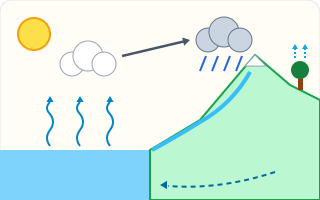
The wavy arrows show water evaporating from the sea. The wind carries the moist air toward the mountain, where it rises, cools and condenses into the gray cloud, and rain falls on the slope. The river carries it back to the sea, a dashed arrow shows some moving slowly underground, and the tree transpires some back into the air.
| Where Earth's water is | Out of every 100 liters |
|---|---|
| Oceans, salty | about 97 |
| Ice sheets and glaciers, fresh | about 2 |
| Lakes, rivers and underground, fresh | about 1 |
Two forces keep the cycle turning. Sunlight gives water the energy to escape into the air as vapor; that is why wet clothes dry faster on a sunny day.
Gravity pulls water back down as rain and snow, and pulls it downhill in streams and rivers. Without the Sun the water would stay put; without gravity it would never come down. Together they move water around the planet.
Water evaporates from oceans, lakes, rivers, wet soil and puddles whenever it is warmed. Warm, dry, windy weather speeds it up, because the wind carries the moist air away and brings drier air in its place.
About nine tenths of the water vapor in the air evaporated from the oceans. The salt stays behind, which is why rain is fresh even though most of it began in salty seawater.
Warm air can hold more water vapor than cold air. When moist air rises it expands and cools, and once it is cool enough the vapor condenses onto tiny specks of dust or salt, forming droplets.
A cloud is billions of those droplets, or tiny ice crystals, so small they float. Fog is simply a cloud at ground level, which is why walking through fog feels damp.
Cloud droplets bump together and grow. When they are too heavy for rising air to hold up, they fall as precipitation: rain, or snow, sleet and hail when the air is cold enough.
A raindrop is about a million times bigger than a cloud droplet. That is why a cloud can hang in the sky for hours before any rain falls, and why only some clouds produce rain at all.
Rain that reaches the ground takes one of three paths. Some evaporates straight back into the air or is drawn up by plants and transpired. Some soaks into the ground to become groundwater. The rest runs off over the surface into streams.
How it splits depends on the ground. Pavement sends almost all rain into runoff; a forest floor soaks up most of it. That is why cities flood more easily than woodland.
Plants pull water from the soil through their roots and give it off through tiny pores in their leaves. This transpiration adds a great deal of vapor to the air: a large oak tree can give off hundreds of liters on a hot summer day.
Over a rainforest, much of the rain comes from water the forest itself transpired. Cutting the forest can make the region drier, because it removes part of the cycle.
Checking an answer. Water is never created or destroyed in the cycle, so any account of where it went must add back to the amount you started with.
Water changes state but is not destroyed, so every drop that evaporates must come down somewhere, and every drop that falls must go somewhere. That is why the parts of a rainfall, what evaporates, soaks in and runs off, add up to the whole.
Rising air cools because it expands as the air pressure around it falls. Cooler air holds less vapor, so condensation follows rising air as surely as a puddle follows a storm.
When wind pushes moist air up a mountain, the air cools and drops its rain on the windward side, the side facing the wind. By the time the air crosses the top and sinks down the other side, it has lost much of its water and warms as it sinks.
So the far side, called the rain shadow, is often dry. That is why the western slopes of the Cascades in Washington are soaked while the eastern side is dry enough for sagebrush.
In the mountains of the American West much of the winter's precipitation falls as snow and stays there until spring. The snowpack is a frozen reservoir.
As it melts in spring and summer, it feeds rivers such as the Colorado and the Sacramento just when farms and cities need water most. A winter with little snow means a dry summer, even if the total precipitation was normal.
Water moves through some parts of the cycle quickly and others slowly. A water molecule stays in the air for about nine days on average before falling again.
In a river it may stay for weeks; in a large lake, decades; deep underground or in the ice of Antarctica, thousands of years. The same water that fell as snow on Antarctica long ago is still locked there today.
The most common slip is thinking water disappears when it evaporates. Another is calling a cloud vapor or steam, when it is liquid droplets, since vapor is invisible.
A third is thinking rain is new water, when every drop evaporated earlier. A fourth is forgetting the water that soaks in or is transpired, and counting only the runoff you can see.
Washington's Olympic Peninsula shows the water cycle at work in a small space. Moist winds from the Pacific Ocean blow in from the west and are forced up the Olympic Mountains. The air cools, its vapor condenses, and the western valleys get some of the heaviest rain in the lower 48 states.
The Hoh Rain Forest, on the western side, gets about $140$ inches of rain in a year, enough to grow giant spruce and moss-covered maples. Sequim, less than $50$ miles away on the northeastern side, gets only about $16$ inches, because it sits in the mountains' rain shadow, where the air has already dropped its water.
Dividing $140$ by $16$ shows the Hoh gets nearly nine times as much rain. The difference is not caused by the ocean being closer or the Sun being stronger. It comes from where the air rises and cools, which is exactly what the water cycle predicts.
Every winter, storms from the Pacific drop snow on the Sierra Nevada in eastern California. The snow piles up for months, storing water that fell as precipitation but will not reach a river until it melts.
In spring and summer the snowpack melts, feeding streams and rivers that fill reservoirs and supply farms in the Central Valley and cities such as Los Angeles and San Francisco. State water managers measure the snowpack every spring, because it tells them how much water the summer will bring; on average it supplies about a third of California's water.
Warmer winters change the cycle. When more precipitation falls as rain instead of snow, it runs off at once instead of waiting until summer, and reservoirs may not be able to hold it all. The total water may be the same, but its timing changes, which is why a warming climate matters so much to places that depend on snow.
Water disappears when it evaporates. It does not. It becomes vapor, which is invisible, and it stays in the air until it cools and condenses.
Clouds are made of vapor or smoke. Vapor is invisible. A cloud is liquid droplets, or tiny ice crystals, so small that they float.
Rain is new water. Every raindrop is old water that evaporated earlier, often from a sea far away. Mawsynram's record rains are water from the Bay of Bengal.
Wet washing hangs outside on a warm, breezy day. Name the water.
$\text{liquid water in the cloth}$
Where it starts.
Say what the Sun does.
$\text{evaporation}$
Warmth turns liquid into vapor.
Say what the breeze does.
$\text{carries the moist air away}$
So more water can evaporate.
Say where the water is now.
$\text{in the air, on its way to a cloud}$
Changed, not destroyed.
A field gets $50$ mm of rain in a storm. Record the total.
$50\ \text{mm}$
All the water to account for.
About $20$ percent evaporates. Find it.
$50 \times \dfrac{20}{100} = 10\ \text{mm}$
Back to the air.
About $50$ percent soaks in. Find it.
$50 \times \dfrac{50}{100} = 25\ \text{mm}$
Into the ground.
Find the runoff.
$50 - 10 - 25 = 15\ \text{mm}$
To the stream.
Check the total.
$10 + 25 + 15 = 50$
Nothing lost.
Wind blows moist air from the sea toward a mountain. Name the source.
$\text{vapor evaporated from the sea}$
Where the water comes from.
Say what the mountain does.
$\text{forces the air upward}$
Rising means cooling.
Say what cooling does.
$\text{condensation into cloud}$
Colder air holds less vapor.
Say where the rain falls.
$\text{the windward slope}$
Facing the wind.
Describe the far side.
$\text{a dry rain shadow}$
The air has lost its water.
Name an American example.
$\text{wet western Cascades, dry east}$
The same process.
Name what the bath water does.
$\text{evaporation}$
It fills the air with vapor.
Say what the cool mirror does.
Name the mist on the mirror.
Put the journey of one drop of water in order, starting in the sea.
Number the steps in order (write the number in the box):
Complete the worked solution: a hillside gets $800$ mm of rain in a year. About $50$ percent evaporates or is transpired by plants, and $30$ percent soaks into the ground. Find the millimeters that go back into the air, the millimeters that soak in, and the millimeters left to run off into streams.
Find the water that goes back into the air.
$\text{rain} \times \dfrac{\text{percent}}{100} =$ a
Evaporation and transpiration.
Find the water that soaks in.
$\text{rain} \times \dfrac{\text{percent}}{100} =$ b
Into the ground.
Find what is left to run off.
$\text{rain} - \text{air} - \text{ground} =$ c
The rest flows to streams.
Check that nothing was lost.
$\text{the three parts add to the rain}$
Water is moved, never used up.
In summer, wet winds blow from the warm Bay of Bengal toward the Khasi Hills in India, and Mawsynram, high in those hills, is one of the rainiest places on Earth. Why does so much rain fall there?
Match each word to the change it names.
| plants give off water vapor through their leaves | vapor cools and turns into tiny droplets | liquid water is warmed and turns into vapor | water falls from clouds as rain, snow or hail | |
|---|---|---|---|---|
| evaporation | ||||
| condensation | ||||
| precipitation | ||||
| transpiration |
After a morning shower there is a big puddle on the playground. By the afternoon, in warm sunshine, it has gone. Where is the water now?
In this picture of the water cycle, click **every** place where water vapor is cooling and turning back into tiny droplets of water.
This task has no paper form; do it on a device.
Put each label on the part of the picture that shows it.
This task has no paper form; do it on a device.
Imagine all the water on Earth poured into 100 equal buckets. Complete the table: how many buckets for the last row, and is each kind salty or fresh?
| Buckets out of 100 | Salty or fresh? | |
|---|---|---|
| the oceans | 97 | |
| ice sheets and glaciers | 2 | |
| lakes, rivers and water underground |
Mawsynram, in the Khasi Hills of northeast India, gets about $11{,}900$ mm of rain in an average year. Seattle, Washington, a famously rainy American city, gets about $1{,}000$ mm. To the nearest whole number, about how many times as much rain falls on Mawsynram?
Answer:
In an invented coastal valley, moist winds rise over a mountain, rain falls on its seaward slope, and streams carry sediment into a flatter valley. Across 2 years of observations, the far side receives less rain. Read the field-note analysis below. Select the two observations supporting uplift/rainfall and runoff/sediment connections, AND the defensible limit on the climate claim. Leave unsupported claims unmarked.
This task has no paper form; do it on a device.
Lesson test: one question per skill, one attempt each, no hints. Your answers are checked when you submit.
Over the same 30-year period, an invented mountain's seaward station averages 442 mm of rain per year and its inland station averages 221 mm. How many times as much annual rain does the seaward station receive?
Answer:
You can follow water around its cycle. Tell somebody where a puddle goes when it dries, and why rising air makes rain. Next: what happens to the rain once it lands, and how rivers gather it.
25. Your turn: the misty mirror after a hot bath, step 2
$\text{cools the vapor}$
Colder air holds less.
25. Your turn: the misty mirror after a hot bath, step 3
$\text{condensation}$
Tiny droplets.