Back to the on-screen lesson ·
Rock broken where it stands, carried away by water, ice, wind and gravity, and dropped somewhere new.
Paper packet. Every task here also exists on screen, where it is checked automatically; answers written on paper are not assessed by Nydus. When you are back at a device, enter your answers there.
You will tell weathering from erosion and deposition in real landscapes, put freeze-thaw in order, and work out how fast a canyon deepens and a coastline wears back.
Rivers carry water downhill through their basins, and the water in them is moving fast enough to push things along. You have also seen a sidewalk crack or a puddle freeze. This lesson puts those two facts together.
| Term | What it means |
|---|---|
| Weathering | Rock breaking down where it is, without being moved. |
| Erosion | Broken material being carried away by water, ice, wind or gravity. |
| Deposition | Carried material being dropped where the carrier slows down. |
| Freeze-thaw | Weathering by water freezing and expanding in cracks, again and again. |
| Chemical weathering | Rock broken down by chemistry, such as rain dissolving limestone. |
| Sediment | Pieces of rock, sand and mud that are carried and dropped. |
Even the hardest mountain is slowly being taken apart, in two separate jobs.
The first job is weathering: breaking rock into smaller pieces without moving it. Water that freezes in a crack grows by about a tenth, and night after night the ice forces the crack wider. Plant roots grow into cracks and pry them apart. Rainwater is very slightly acidic, and over thousands of years it dissolves limestone, which is how caves form.
The second job is erosion: carrying the pieces away. Rivers roll pebbles and carry sand and mud; waves batter cliffs and drag the rubble along the shore; glaciers scrape and drag rock as they creep downhill; wind lifts sand in deserts; and gravity pulls loose rock down slopes. When the carrier slows down, it drops its load, and that is deposition: a delta at a river's mouth, a beach, a sand dune.
Another way: steps
To name the process, ask: 1. Is rock being broken while it stays where it is? Weathering. 2. Is material being picked up and carried? Erosion. 3. Is carried material being put down? Deposition.
Another way: story
Think of a sandcastle. Poking holes in it with your finger is like weathering: the sand is loosened but still there. Then a wave arrives and carries the sand away down the beach: erosion. Where the wave slows and leaves the sand in a new heap, that is deposition.
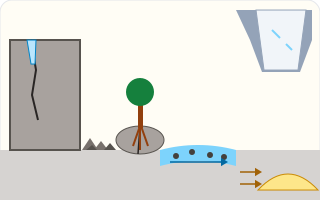
On the left, ice in a crack and tree roots in a boulder are breaking rock in place: weathering. The river rolling stones, the glacier in the valley and the wind blowing sand at the dune are carrying material away: erosion. The pile at the foot of the cliff is rock that weathering loosened and gravity brought down.
Slow processes add up. The Colorado River has cut the Grand Canyon about a mile deep over roughly five to six million years. The sandy cliffs of the Outer Cape on Cape Cod lose about $3$ feet a year.
Water is unusual: it expands when it freezes, by about a tenth. Water that seeps into a crack and freezes pushes the sides apart with great force. When it thaws, water runs deeper into the widened crack, and the next freeze pushes harder.
In mountains where the temperature swings above and below freezing day after day, freeze-thaw shatters rock quickly. The same process opens potholes in roads every spring in states such as Michigan and Minnesota.
Plants and animals weather rock too. Tree roots grow into cracks and widen them as they thicken. Lichens, the crusty growths on bare rock, release chemicals that slowly eat into its surface.
Burrowing animals, from earthworms to prairie dogs, break up soil and loosen stones. Look at an old sidewalk lifted by a tree's roots and you are looking at weathering by a living thing.
Rainwater picks up a little carbon dioxide from the air and soil and becomes very weakly acidic. It slowly dissolves limestone, a rock made of the shells of ancient sea creatures.
Over hundreds of thousands of years, water seeping underground has dissolved huge caves this way. Mammoth Cave in Kentucky, the longest known cave system in the world, has more than $400$ miles of mapped passages, all hollowed out by water.
A river carries sediment in three ways: rolling and bouncing pebbles along its bed, carrying sand and silt floating in the water, and carrying dissolved rock that you cannot see.
The faster the river, the bigger the pieces it can move. That is why mountain streams tumble boulders while the lower Mississippi carries mostly fine mud. As a river cuts down into its bed, it carves a V-shaped valley.
A glacier is a river of ice that creeps downhill, often only a few feet a day. It freezes onto rock and plucks it out, and the rocks frozen into its base scrape the valley like sandpaper.
Glaciers carve broad U-shaped valleys such as Yosemite Valley. During the last Ice Age, ice sheets covered much of the northern United States and left rocks and gravel scattered across states such as Wisconsin and New York.
Wind can only lift small grains, so it works best where the ground is dry and bare, in deserts and on beaches. It bounces sand along and piles it into dunes, like those at Great Sand Dunes National Park in Colorado.
Waves pound coasts day and night. They break up cliffs, carry sand along the shore and carve caves and arches from rocky headlands, such as the arch at Natural Bridges State Beach in Santa Cruz, California.
Checking an answer. A rate of erosion times a time gives a distance. A slow yearly rate multiplied by many years can give a very large change.
Weathering and erosion are defined by movement, so asking whether anything moved sorts every case. Breaking without moving is weathering by definition; moving is erosion; stopping and dropping is deposition.
Multiplying a yearly rate by years is allowed when the rate is steady on average. Real erosion comes in bursts, a big storm one year and calm the next, so the result is an average estimate, not a prediction for any single year.
Everything eroded must go somewhere. Where a river slows at its mouth, it drops sediment and builds a delta, as the Mississippi has in Louisiana. Where waves slow in a bay, they drop sand and build beaches.
Deposition also fills reservoirs behind dams with mud, slowly shrinking the water they can hold. The same sediment that builds new land in one place was taken from the land somewhere else.
People change the rate of erosion. Plowing leaves soil bare, and in the 1930s drought and wind stripped topsoil from farms across the Great Plains in the Dust Bowl.
Building on coasts can speed erosion next door, since seawalls reflect waves onto neighboring beaches. Farmers now plant cover crops and leave crop stubble on fields to hold the soil in place.
The most common slip is calling any change to rock erosion, even when nothing moved. Another is thinking erosion only happens in storms, when most is slow and steady.
A third is thinking weathering needs weather, when roots and chemistry weather rock underground too. A fourth is forgetting deposition: every grain eroded ends up dropped somewhere.
The Cape Hatteras Lighthouse on North Carolina's Outer Banks was built in 1870 about 1,500 feet from the ocean. Waves carried the beach sand away year after year, and by the 1990s the sea was only about $120$ feet from its base.
Engineers had a choice: build seawalls to hold back the ocean, or move the lighthouse. In 1999 the National Park Service lifted the whole 4,800-ton tower onto rails and rolled it about 2,900 feet inland over several weeks. It still stands at its new site, a safe distance from the waves.
The story is erosion measured in feet per year. The barrier islands of the Outer Banks are made of loose sand that waves and storms carry away and redeposit. Moving the lighthouse accepted that the coast would keep moving, rather than fighting it with walls that would have sped erosion on the beaches nearby.
In the 1930s a long drought struck the southern Great Plains. Farmers had plowed up the deep-rooted prairie grasses to plant wheat, and when the crops failed, the dry soil lay bare.
The wind did the rest. Great clouds of dust, called black blizzards, carried topsoil from Oklahoma, Texas and Kansas hundreds of miles away; one storm in 1934 dropped dust on Chicago and even ships off the Atlantic coast. Soil that had taken thousands of years to form was eroded in a few seasons, and it was deposited far from the farms that needed it.
Congress created the Soil Conservation Service in 1935. Farmers learned to plant rows of trees as windbreaks, plow along the contours of the land and keep plant cover on the soil. Those practices slow erosion by wind and water, and they are still used across the Plains today.
Weathering and erosion are the same process. They are two jobs. Weathering breaks; erosion carries. A cracked boulder that has not moved has only been weathered.
Erosion only happens in storms. Big storms do a lot of damage at once, but most erosion is slow and steady, like the Colorado River cutting a little deeper every year.
Weathering needs weather. The name is confusing: roots and chemistry weather rock too, and so does water underground where no weather ever reaches.
In a limestone cave, rainwater has dissolved the rock over thousands of years. Name what happened.
$\text{rock dissolved}$
Broken down by chemistry.
Ask whether solid pieces were carried away.
$\text{no}$
It broke down where it stood.
Name the process.
$\text{chemical weathering}$
By water, not by force.
Name an American example.
$\text{Mammoth Cave, Kentucky}$
Hollowed out by water.
Waves hit a cliff, and chunks fall onto the beach. Name the breaking.
$\text{weathering and falling}$
Rock loosened, gravity drops it.
The next tide drags the rubble away. Name it.
$\text{erosion}$
Carried away.
Farther along, calm water drops sand. Name it.
$\text{deposition}$
A new beach.
The cliff wears back $3$ feet a year. Find $20$ years.
$20 \times 3 = 60\ \text{feet}$
Rate times time.
Say what that means for a house $50$ feet from the edge.
$60 > 50$
The edge would reach it.
A canyon is $6000$ feet deep. Record it.
$6000\ \text{ft}$
The total cut.
The river took about $6$ million years. Convert to thousands.
$6 \times 1000 = 6000$
Thousands of years.
Divide the depth by the time.
$\dfrac{6000}{6000} = 1$
Foot per thousand years.
Convert to inches per century.
$1 \times 12 \div 10 = 1.2$
About an inch a century.
Name the process.
$\text{erosion by a river}$
Rock carried away.
Say what the result shows.
$\text{slow rates, huge results}$
Given enough time.
Say what the wind does first.
$\text{picks up and bounces sand}$
Grains are moved.
Name that process.
Name what builds the dune.
High in the mountains, a rock is broken by freeze-thaw weathering. Put the steps in order.
Number the steps in order (write the number in the box):
Complete the worked solution: suppose a river has cut a canyon $3000$ feet deep over about $5$ million years. Find how many thousands of years that is, how many feet the river cut per thousand years, and how many inches per century.
Turn millions of years into thousands.
$\text{millions} \times 1000 =$ y
Thousands of years.
Divide the depth by the time.
$\dfrac{\text{depth}}{\text{thousands of years}} =$ r
Feet per thousand years.
Turn it into inches per century.
$\text{feet} \times 12 \div 10 =$ c
Twelve inches a foot, ten centuries in a thousand years.
Say what the rate shows.
$\text{slow, steady erosion adds up}$
A little each century makes a canyon.
Each carrier of erosion leaves its own shape in the land. Match each carrier to a real American landform it made.
| a rock arch at Natural Bridges State Beach, California | Yosemite Valley, a wide U-shaped valley | the Grand Canyon, a deep, steep-sided gorge | the sand dunes of Great Sand Dunes National Park | |
|---|---|---|---|---|
| a river | ||||
| a glacier | ||||
| the wind | ||||
| sea waves |
High on a mountain, a big boulder has cracked into four pieces, and all four are still lying exactly where the boulder was. Is this weathering or erosion?
In this landscape, click **every** place where rock, stones or sand are being carried away, which is erosion.
This task has no paper form; do it on a device.
For each process, say whether it is weathering, erosion or deposition.
| Which process? | |
|---|---|
| Water freezes in a crack and splits the rock | |
| A river rolls pebbles downstream | |
| Rainwater slowly dissolves limestone, making caves | |
| Wind blows sand across White Sands in New Mexico | |
| A river drops mud where it slows down at its mouth | |
| Tree roots grow into a crack and widen it |
The same landscape. This time click **every** place where rock is being broken where it stands, which is weathering.
This task has no paper form; do it on a device.
The sandy cliffs of the Outer Cape on Cape Cod, Massachusetts, wear back by about $3$ feet a year on average. About how far back will the cliff edge move in $38$ years, in feet?
Answer: unit: m / ft / yd
Here is part of a report about Rodanthe, a real village on the Outer Banks of North Carolina. Select the sentence that describes **erosion**.
This task has no paper form; do it on a device.
Lesson test: one question per skill, one attempt each, no hints. Your answers are checked when you submit.
The sandy cliffs of the Outer Cape on Cape Cod, Massachusetts, wear back by about $3$ feet a year on average. About how far back will the cliff edge move in $35$ years, in feet?
Answer: unit: m / ft / yd
You can separate breaking from carrying. Tell somebody the one question that decides between weathering and erosion. Next: the moving plates that build the mountains all this wears away.
23. Your turn: a sand dune in the Colorado desert, step 2
$\text{erosion by wind}$
The sand is carried.
23. Your turn: a sand dune in the Colorado desert, step 3
$\text{deposition}$
Where the wind slows.