Back to the on-screen lesson ·
Greenhouse gases shift Earth's energy balance; burning fossil fuels adds carbon dioxide that the carbon cycle shares among air, oceans and land.
Paper packet. Every task here also exists on screen, where it is checked automatically; answers written on paper are not assessed by Nydus. When you are back at a device, enter your answers there.
By the end of this lesson you will be able to link greenhouse gas sources to the carbon cycle and the energy balance, and measure emissions by sector and per person.
You know that the Sun warms the Earth, that plants take in carbon dioxide, and that burning fuel releases gases. You can find a percent and a per-person figure. This lesson connects those ideas into a system that explains why the climate is warming.
| Term | What it means |
|---|---|
| Radiative balance | The balance between the energy Earth receives from the Sun and the heat it sends back to space. |
| Greenhouse gas | A gas, such as carbon dioxide, methane or water vapor, that absorbs heat leaving Earth's surface. |
| Carbon cycle | The movement of carbon among the air, oceans, living things, soils and rocks. |
| Source | Anything that adds carbon dioxide to the air, such as burning fuel. |
| Sink | Anything that removes carbon dioxide from the air, such as oceans and forests. |
| Parts per million | The number of carbon dioxide molecules in every million molecules of air. |
| Fossil fuel | Coal, oil or natural gas, formed from ancient plants and animals over millions of years. |
Earth's temperature settles where the heat it sends to space balances the sunlight it absorbs. Greenhouse gases absorb some of the outgoing heat and send part of it back down:
$$\text{C} + \text{O}_2 \rightarrow \text{CO}_2, \qquad \text{mass of CO}_2 = \dfrac{44}{12} \times \text{mass of C}.$$
Another way: picture
Picture a bathtub with the tap running and the drain open. The water level is steady when the drain carries away as much as the tap brings in. Partly blocking the drain makes the level rise until the deeper water pushes out enough to balance again. Greenhouse gases partly block Earth's drain for heat.
Another way: steps
Sunlight carries energy to Earth. About thirty percent is reflected straight back to space by clouds, ice and bright surfaces; the rest warms the land, oceans and air. The warm Earth gives off heat as infrared radiation, which we cannot see.
If Earth absorbs more energy than it sends out, it warms; if it sends out more, it cools. Over the long run the temperature settles where the two balance, which is why a change to either side changes the climate.
Some gases let sunlight through but absorb the infrared heat rising from the surface, then send part of it back down. Without them Earth's average surface temperature would be well below freezing; with them it is about fifteen degrees Celsius.
This natural greenhouse effect makes Earth livable. The problem is adding more of these gases, which strengthens the effect and shifts the balance toward a warmer surface.
In 1856 the American scientist Eunice Foote showed that a glass cylinder of carbon dioxide warmed more in sunlight than one of ordinary air. A few years later John Tyndall in Britain measured how carbon dioxide and water vapor absorb heat.
In 1896 the Swedish chemist Svante Arrhenius calculated that doubling carbon dioxide would warm the Earth by several degrees. The basic physics has been known for more than a century; what has changed is how much gas people add.
Carbon dioxide is the most important gas people add, from burning coal, oil and natural gas and from clearing forests. Methane, from livestock, rice fields, landfills and leaks from gas wells, traps far more heat per ton but lasts about a decade in the air.
Nitrous oxide comes mainly from fertilized soils. Water vapor is the most abundant greenhouse gas, but its amount is set by temperature, so it amplifies warming caused by the others rather than starting it.
When carbon burns, each carbon atom joins two oxygen atoms from the air. A carbon atom has a mass of $12$ and an oxygen atom $16$, so a molecule of carbon dioxide has a mass of $44$.
So every ton of carbon burned makes $44/12$, about $3.67$ tons of carbon dioxide. The extra mass is oxygen taken from the air. Emission figures are usually given in tons of carbon dioxide, which is why they are larger than the carbon in the fuel.
The Environmental Protection Agency's inventory divides United States greenhouse gas emissions by sector. For 2022 it reported transportation as the largest, at about $28$ percent, followed by electricity generation at about $25$ percent and industry at about $23$.
Homes and businesses, mostly heating, made up about $13$ percent and agriculture about $10$. The shares differ by state: a state that makes electricity from coal has a larger electricity share than one that uses hydropower.
Total emissions mostly measure a place's size and wealth. Dividing by population gives emissions per person, which allows fair comparisons. The United States emits far more carbon dioxide per person than the world average, though China emits the most in total.
Both views matter. Total emissions set how fast carbon dioxide builds up in the air; per-person emissions show whose way of life drives it.
Carbon moves constantly among the air, oceans, living things, soils and rocks. Plants take in carbon dioxide as they grow and release it when they decay. The oceans absorb it from the air and release it again.
Before industry, these flows roughly balanced. Burning fossil fuels adds carbon that was locked in rock for millions of years, faster than the slow parts of the cycle can put it back.
Of the carbon dioxide people emit each year, roughly a quarter dissolves in the oceans and roughly a quarter to a third is taken up by plants and soils. The rest, a little under half, stays in the air.
Each $7.8$ billion metric tons of carbon dioxide that stays raises the air's concentration by one part per million. The ocean's share is not harmless: it makes seawater more acidic, which harms corals and shellfish.
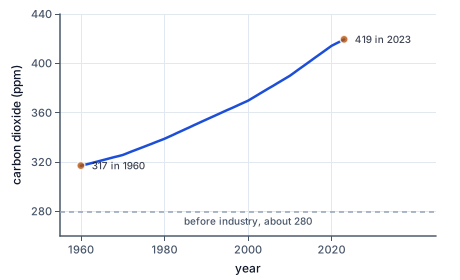
In 1958 Charles David Keeling began measuring carbon dioxide on Mauna Loa, Hawaii, far from local sources. He found about $315$ parts per million. Air bubbles trapped in ice cores show that before industry the level was about $280$.
The National Oceanic and Atmospheric Administration's measurements put the 2023 average at about $420$ parts per million, rising by more than two a year. The record also shows a yearly wiggle, as northern forests draw carbon dioxide down each summer.
Checking an answer. Carbon dioxide always weighs more than the carbon burned. Sector shares add to one hundred. The part that stays plus the part taken up equals the emissions.
Converting carbon to carbon dioxide is allowed because mass is conserved: the carbon and the oxygen that joins it end up in the gas, so the gas's mass is fixed by the ratio of the molecules' masses.
Splitting emissions into what stays and what is taken up is allowed because the carbon must go somewhere. Every ton emitted either stays in the air or moves into the oceans or onto land; the budget has to balance.
Clearing forests releases the carbon stored in trees and soils and removes a sink that would have kept absorbing carbon dioxide. Deforestation in the tropics is a large source worldwide.
Land can also help. Growing forests, restored wetlands and healthy soils take carbon out of the air. But land sinks can be reversed by fire, drought or clearing, so they are less secure than keeping fossil carbon in the ground.
Climate has changed before, driven by slow shifts in Earth's orbit, volcanic eruptions and changes in the Sun. Scientists have measured these. The Sun's output has been steady or slightly lower in recent decades, and eruptions cool the climate for only a year or two.
Neither can explain the warming since the mid-twentieth century. The rise of carbon dioxide can, and its source is shown by its chemical fingerprint: the added carbon has the signature of ancient plant material, as fossil fuels do.
The most common slip is treating a ton of carbon as a ton of carbon dioxide. Another is confusing the greenhouse effect with the ozone hole, a separate problem caused by different gases.
A third is thinking the oceans and forests simply remove added carbon; they take up only part of it, and the rest builds up in the air. A fourth is comparing total emissions of places of very different sizes instead of emissions per person.
In 1958 the chemist Charles David Keeling set up an instrument near the summit of Mauna Loa on the island of Hawaii, chosen because the air there is far from factories and forests. He measured carbon dioxide continuously, and the National Oceanic and Atmospheric Administration and the Scripps Institution of Oceanography still do.
The record, now called the Keeling curve, climbs every year: from about $315$ parts per million in 1958 to about $420$ in 2023. It also rises and falls each year, because the forests of the Northern Hemisphere, where most land is, draw carbon dioxide down as they grow each summer and release it in winter.
Ice cores from Antarctica extend the record back hundreds of thousands of years, and show the level never rose above about $300$ parts per million in all that time before industry. The curve connects the carbon cycle to the energy balance: it measures how much of the carbon people release stays in the air, where it traps heat.
Every year the Environmental Protection Agency publishes an inventory of United States greenhouse gas emissions, submitted to the United Nations. It adds up emissions from power plants, vehicles, factories, farms, landfills and homes, using fuel sales and measurements.
Transportation became the largest sector in 2017, overtaking electricity, as power plants switched from coal to natural gas, wind and solar while Americans kept driving. Cars and light trucks make up most of transportation's share, which is why the miles people drive and the fuel their vehicles use matter so much.
The inventory also shows how sectors differ in what can be done. Electricity can be made from sources that emit little, while cutting emissions from farms, cement and steel is harder. Knowing the sector shares lets a state or city decide where its efforts will count most, which is the subject of a later lesson on mitigation.
It is natural to think that burning a ton of carbon makes a ton of gas, as if the fuel simply turned into smoke. But each carbon atom joins two oxygen atoms taken from the air, and oxygen is heavier than carbon. The carbon dioxide weighs $44/12$, about $3.67$ times the carbon burned.
This is why emissions figures, given in tons of carbon dioxide, are so much larger than the carbon in the fuel, and why a gallon of gasoline, weighing about six pounds, produces nearly twenty pounds of carbon dioxide.
A furnace burns fuel containing $2.4$ metric tons of carbon. Write the reaction.
$\text{C} + \text{O}_2 \rightarrow \text{CO}_2$
Carbon joins oxygen.
Write the mass ratio.
$\dfrac{44}{12}$
Carbon dioxide to carbon.
Multiply the carbon by the ratio.
$2.4 \times \dfrac{44}{12} = 8.8$
Metric tons of carbon dioxide.
Say where the extra $6.4$ tons came from.
$\text{oxygen from the air}$
Not from the fuel.
A state emits $150$ million metric tons of carbon dioxide. Record the total.
$150\ \text{million}$
All sources.
It has $10$ million people. Record the population.
$10\ \text{million}$
Who shares it.
Divide the total by the people.
$\dfrac{150}{10} = 15$
Metric tons per person.
Transportation is $45$ million tons. Find its share.
$\dfrac{45}{150} \times 100 = 30\%$
Part over whole.
Name the sector to act on first.
$\text{transportation, the largest}$
The biggest share gives the most room to cut.
Suppose people emit $39$ billion metric tons of carbon dioxide and $45$ percent stays in the air. Find the part that stays.
$39 \times 0.45 = 17.55$
Billions of tons.
Find the rise in concentration.
$\dfrac{17.55}{7.8} = 2.25$
Parts per million.
Find the part the oceans and land took up.
$39 - 17.55 = 21.45$
Billions of tons.
Say what the ocean's share does.
$\text{acidifies seawater}$
The carbon does not vanish.
Link the rise to the heat balance.
$\text{more gas, less heat escapes}$
The surface warms.
Say what would stop the rise.
$\text{emissions no larger than the sinks take up}$
Then nothing is added to the air.
Write the mass ratio.
$\dfrac{44}{12}$
Carbon dioxide to carbon.
Multiply the carbon by it.
$6 \times \dfrac{44}{12}$
Metric tons of carbon dioxide.
Evaluate the emissions.
A power plant burns coal containing $9$ metric tons of carbon. About how many metric tons of carbon dioxide does it release?
Complete the worked solution: suppose people emit $39$ billion metric tons of carbon dioxide in a year and $40$ percent of it stays in the air. Each $7.8$ billion metric tons that stays raises the concentration by one part per million. Find the billions of tons that stay, the rise in parts per million, and the billions of tons taken up by the oceans and land.
Find the carbon dioxide that stays in the air.
$\text{emissions} \times \dfrac{\text{percent}}{100} =$ a
Billions of metric tons.
Turn it into a rise in concentration.
$\dfrac{\text{stays}}{7.8} =$ p
Parts per million.
Find what the oceans and land took up.
$\text{emissions} - \text{stays} =$ u
The sinks' share.
Say what the ocean's share does there.
$\text{it makes seawater more acidic}$
The carbon does not vanish.
Match each part of the climate system to what it does.
| releases carbon stored underground for millions of years | takes carbon dioxide out of the air into plants | absorb about a quarter of the carbon dioxide people emit | absorb heat leaving the surface and send part of it back | |
|---|---|---|---|---|
| burning fossil fuels | ||||
| photosynthesis | ||||
| the oceans | ||||
| greenhouse gases |
A state's greenhouse gas emissions in one year were $54$ million metric tons from transportation, $72$ million from electricity and $54$ million from all other sectors. Fill in each part's percent of the total.
| share | |
|---|---|
| transportation (%) | |
| electricity (%) | |
| all other sectors (%) |
Suppose the air holds $415$ parts per million of carbon dioxide and the level rises by $2.2$ parts per million each year. Write the concentration as a function of the years $t$ from now, if that rise stays steady.
Answer:
A state emits $33$ million metric tons of carbon dioxide a year and has $3$ million people. How many metric tons does it emit per person?
Answer: metric tons
The Environmental Protection Agency estimates that a typical passenger car emits about $0.4$ kilograms of carbon dioxide per mile. Suppose a family in suburban Atlanta drives $12000$ miles a year in such a car. About how many metric tons of carbon dioxide does that emit?
Answer: metric tons
Lesson test: one question per skill, one attempt each, no hints. Your answers are checked when you submit.
Suppose the air holds $420$ parts per million of carbon dioxide and the level rises by $2.4$ parts per million each year. Write the concentration as a function of the years $t$ from now, if that rise stays steady.
Answer:
You can explain the causes of warming. Explain why burning a ton of carbon makes more than a ton of carbon dioxide.
26. Your turn: a truck burns fuel containing $6$ metric tons of carbon in a year. How many metric tons of carbon dioxide does it emit?, step 3
$22$
Metric tons.