Back to the on-screen lesson ·
Urbanization is a rising urban share, not just growing cities; it is measured as a percent of the whole, and its change in percentage points.
Paper packet. Every task here also exists on screen, where it is checked automatically; answers written on paper are not assessed by Nydus. When you are back at a device, enter your answers there.
By the end of this lesson you will be able to find a percent urban and its change, and tell urbanization apart from urban growth.
You can account for a population change with births, deaths and migration, and you know that people move toward jobs, family and safety. This lesson follows those moves into cities, and separates two ideas people often run together: cities growing, and a country becoming more urban.
| Term | What it means |
|---|---|
| Urban area | A densely settled place. The Census Bureau counts an area as urban if it has at least $5000$ people or $2000$ housing units. |
| Percent urban | Urban population divided by total population, times 100. |
| Urbanization | A rise in the share of a population living in urban areas. |
| Urban growth | A rise in the number of people living in urban areas. |
| Megacity | An urban area of ten million people or more. |
| Suburbanization | The movement of people and jobs from a city's center to its edges. |
| Informal settlement | Housing built without legal title or planning permission, often without piped water or sewers. |
Urbanization is measured as a share:
$$\text{percent urban} = \dfrac{\text{urban population}}{\text{total population}} \times 100.$$
Cities grow through natural increase, migration from the countryside, and the reclassification of places that become large enough to count as urban.
Another way: picture
Picture a country as a jar of marbles, some red for city dwellers and some green for country dwellers. Adding marbles of both colors in the same proportion makes the jar fuller without changing its color. Only adding more red than green, or moving green to red, makes the jar redder.
Another way: steps
Urban population change combines natural increase, migration and administrative reclassification. A place can be redesignated urban without anyone moving. To separate these mechanisms, compare births and deaths, origin-destination records and boundary definitions for the same interval. Demographic-transition stages summarize changing birth and death rates; they do not measure migration and do not force every country along one timetable.
Work an invented urban balance: start with 20000 residents; add 600 births and subtract 200 deaths; add 900 arrivals and subtract 500 departures. The boundary-constant end population is 20800. If another 2000 people become urban through a boundary extension, the published urban total is 22800. Calling all 2800 additional residents migrants would confuse three processes. Also compare the national denominator: a growing urban count can coexist with a falling urban percentage if total population grows faster.
A census is a dated stock, whereas registration and migration records count events over an interval. Check missed registrations, survey sampling and changed definitions before using a difference between stocks to infer a flow. A larger city may reflect opportunity, household networks, displacement or several causes together; demographic arithmetic constrains explanations without selecting one cause by itself.
Every country draws its own line between urban and rural. For the 2020 census, the U.S. Census Bureau counted an area as urban if it held at least $5000$ people or $2000$ housing units, densely settled. Other countries use thresholds from a few hundred people to many thousands.
So comparing the percent urban of two countries means checking their definitions first. A country with a low threshold looks more urban than one with a high threshold, even if their people live in exactly the same kinds of places.
The percent urban divides the urban population by the total and multiplies by one hundred. A region with $360$ thousand urban and $240$ thousand rural residents is $60$ percent urban.
Dividing by the rural population instead gives a ratio, not a share, and can be far above one hundred. A share of the whole can never exceed one hundred percent, which is a quick check on any answer.
A city can double in size while its country becomes no more urban, if the countryside doubles too. Urbanization means the urban share rises, which happens only when urban areas grow faster than the population as a whole.
This matters for explanation. Many cities in Africa and South Asia are growing fast partly because their whole countries are growing fast. The share tells you how much of that growth reflects people moving to cities.
Cities grow in three ways. People are born in them, adding natural increase. People move to them from the countryside or from abroad. And places on their edges grow until they are reclassified as urban, adding their whole population at once.
In the early stages of urbanization migration from the countryside usually leads. In countries that are already mostly urban, natural increase and migration between cities matter more.
When the percent urban rises from $40$ to $60$, it has risen by $20$ percentage points. It would be wrong to say it rose by $20$ percent: as a percent of the starting share, the rise is $50$ percent.
Percentage points compare two percents by subtraction. Percent change compares two quantities by division. A careful report says which one it means, because the two numbers can be very different.
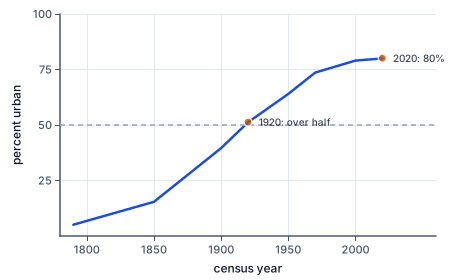
The first census, in 1790, found only about $5$ percent of Americans living in urban places. The 1920 census was the first to find more than half the population urban.
By 2020 the share had reached $80$ percent under the Census Bureau's new definition. The United States urbanized as factories drew workers from farms, as immigrants settled in cities, and as farm machinery let fewer people grow more food.
After World War II American cities grew outward. New highways, cheap mortgages for veterans and mass-built housing such as Levittown on Long Island, begun in 1947, drew families from city centers to suburbs. The Interstate Highway Act of 1956 sped the change.
Suburbanization spreads a city's population over more land, lowering its density. It lengthens commutes, increases driving, and can leave older city centers with fewer taxpayers to support their schools and services.
Population density is people per unit of area, such as people per square mile. New York City had about $29000$ people per square mile in 2020, the highest of any large American city. Many Sun Belt cities have only a few thousand.
Density is an average. A city's figure blends apartment towers with parks, rail yards and airports, so two cities with the same density can feel very different on the ground.
Checking an answer. A share lies between $0$ and $100$. Urban and rural shares add to $100$. A city's growth over a decade is rarely more than about fifty percent.
A share divides a part by the whole it belongs to, so the urban share must divide by the total population. Multiplying by one hundred only changes the unit to a percent.
Subtracting two shares is allowed because both are measured against the whole population at their own date. The difference says how much the balance between town and country shifted, independent of how much the whole population grew.
An urban area of ten million people or more is called a megacity. The United Nations counted $33$ in 2018, most of them in Asia. Tokyo, with about $37$ million people, is the largest.
The New York and Los Angeles metropolitan areas are the two American entries. Megacities concentrate jobs, universities and trade, but also traffic, pollution and the cost of housing, which falls hardest on those with the lowest incomes.
When a city grows faster than it can build legal housing, newcomers build their own on land they do not own, often without piped water, sewers or paved roads. UN-Habitat estimates that about one billion people live in such settlements worldwide.
Informal settlements are not only a problem. They house people close to work, and many are improved over time as residents add rooms and cities add water and power. Upgrading them in place is often cheaper than moving their residents.
Rapid urban growth strains water supply, sewers, schools, roads and housing. Paved surfaces and buildings absorb heat, so cities are often several degrees warmer than the countryside around them, an effect called the urban heat island.
Growth also brings benefits. Cities make it cheaper to provide clean water, health care and schooling to many people at once, and they concentrate the jobs that draw migrants in the first place.
More than half the world's people have lived in urban areas since about 2007. The United Nations estimated the share at $55$ percent in 2018 and projected $68$ percent by 2050.
Nearly all of that projected growth is expected in Asia and Africa, where many countries are still in the early stages of urbanization. In North America and Europe, which are already mostly urban, the share is rising only slowly.
The most common slip is dividing urban by rural instead of by the total. Another is reporting a change in a share as a percent change, or the reverse.
A third is to read a growing city as proof of urbanization without checking the rural population. A fourth is comparing two countries' percent urban without checking that they define urban the same way.
Every ten years the census counts where Americans live, and every ten years the Census Bureau draws the boundaries of the nation's urban areas from the new count. For 2020 it changed its rules: an area needed at least $5000$ people or $2000$ housing units to count as urban, instead of the $2500$ people used before. Some small towns were reclassified as rural as a result.
Under the new rules about $80$ percent of Americans lived in urban areas in 2020. The share varies widely by state: California, New Jersey and Nevada are more than $90$ percent urban, while Vermont and Maine are less than half urban.
The classification matters beyond statistics. Federal transportation and housing programs set aside money differently for urban and rural places, and hospitals in rural areas can qualify for different payments. So a change in a definition can move money as well as numbers, which is why geographers always state which definition a figure uses.
Along the Texas border with Mexico lie more than two thousand colonias, communities that grew up from the 1950s onward outside city limits. Developers sold small lots on cheap land, often without water lines, sewers or paved roads, to families who could not afford housing in the cities where they worked.
Colonias show how urban growth can outrun planning even in a wealthy country. Their residents built homes a room at a time, hauled water, and used septic tanks or cesspools. Flooding on unpaved streets and disease from contaminated water were long-standing problems.
Since the late 1980s Texas and federal programs have extended water and sewer service to many colonias and required developers to provide basic services before selling lots. The story is a small-scale version of the informal settlements around fast-growing cities elsewhere, and of the choice to upgrade communities in place rather than move their residents.
It is natural to think that a country with fast-growing cities must be urbanizing. But urbanization is a rising share, and the share rises only when urban areas grow faster than the whole population. If the countryside grows just as fast, cities can double while the percent urban stays the same.
So always compare the urban count with the total. Report the change in the share in percentage points, and the growth of the count as a percent, and keep the two apart.
A region has $450$ thousand urban and $150$ thousand rural residents. Find the total.
$450 + 150 = 600$
Urban plus rural.
Divide urban by total.
$\dfrac{450}{600} = 0.75$
The urban fraction.
Convert it to a percent.
$0.75 \times 100 = 75\%$
Percent urban.
Check against the rural share.
$\dfrac{150}{600} \times 100 = 25\%;\ 75 + 25 = 100$
The shares add to the whole.
In 2000 a country had $300$ thousand urban and $700$ thousand rural residents. Find its percent urban.
$\dfrac{300}{1000} \times 100 = 30\%$
Urban over total.
In 2020 it had $540$ thousand urban and $660$ thousand rural. Find the new total.
$540 + 660 = 1200$
Urban plus rural.
Find the new percent urban.
$\dfrac{540}{1200} \times 100 = 45\%$
Urban over total.
Find the change in percentage points.
$45 - 30 = 15$
Points, by subtraction.
Find the urban growth in percent.
$\dfrac{540 - 300}{300} \times 100 = 80\%$
The count grew much faster than the share.
A country has $200$ thousand urban and $800$ thousand rural residents. Find its percent urban.
$\dfrac{200}{1000} \times 100 = 20\%$
Urban over total.
Both grow by half in a decade. Find the new urban population.
$200 \times 1.5 = 300$
Up by half.
Find the new rural population.
$800 \times 1.5 = 1200$
Up by half as well.
Find the new percent urban.
$\dfrac{300}{1500} \times 100 = 20\%$
Unchanged.
Name what happened.
$\text{urban growth, no urbanization}$
Cities grew, but no faster than the country.
Say what evidence would show urbanization.
$\text{urban growth faster than rural}$
A rising share.
Find the total population.
$280 + 120 = 400$
Urban plus rural.
Divide urban by the total.
$\dfrac{280}{400} = 0.7$
The urban fraction.
Convert it to a percent.
A region has $90$ thousand people living in urban areas and $210$ thousand in rural areas. What percent of its people are urban?
Complete the worked solution: a country has $900$ thousand urban and $1100$ thousand rural residents. Over a decade both grow by $30$ percent. Find the urban and rural populations after, and the percent urban after.
Grow the urban population.
$900 \times \left(1 + \dfrac{30}{100}\right) =$ c
The cities grew.
Grow the rural population.
$1100 \times \left(1 + \dfrac{30}{100}\right) =$ d
The countryside grew just as fast.
Find the percent urban after.
$\dfrac{\text{urban}}{\text{total}} \times 100 =$ s
Urban over total.
Compare it with the share before.
$\text{unchanged: growth without urbanization}$
Both parts grew at the same rate.
Match each term to its meaning.
| a rise in the share of people living in urban areas | a rise in the number of people living in urban areas | an urban area of ten million people or more | people and jobs moving to the edges of a city | |
|---|---|---|---|---|
| urbanization | ||||
| urban growth | ||||
| megacity | ||||
| suburbanization |
In 2000 a region had $200$ thousand urban and $300$ thousand rural residents. In 2020 it had $330$ thousand urban and $220$ thousand rural. Fill in its percent urban in each year and the change in percentage points.
| value | |
|---|---|
| percent urban in 2000 | |
| percent urban in 2020 | |
| change (percentage points) |
A region has $200$ thousand people in all. Write its percent urban as a function of its urban population $u$, in thousands.
Answer:
A city grew from $64$ thousand people in 2010 to $80$ thousand in 2020. By what percent did its population grow?
Answer: %
Suppose a college city in Colorado has $96000$ residents on $40$ square miles of land. What is its population density, in people per square mile?
Answer: per sq mi
A fictional city starts with 5 thousand people. During a year, births exceed deaths by 200, arrivals exceed departures by 300, and a boundary extension adds 700 residents. Which report correctly explains its urban increase?
Lesson test: one question per skill, one attempt each, no hints. Your answers are checked when you submit.
A region has $250$ thousand people in all. Write its percent urban as a function of its urban population $u$, in thousands.
Answer:
You can measure urbanization. Explain how a country's cities can double in size while the country becomes no more urban.
27. Your turn: a region has $280$ thousand urban and $120$ thousand rural residents. What is its percent urban?, step 3
$70\%$
Times one hundred.