Back to the on-screen lesson ·
Waves erode cliffs and headlands, carry sand along the shore by longshore drift, and build beaches, spits and barrier islands where it is dropped.
Paper packet. Every task here also exists on screen, where it is checked automatically; answers written on paper are not assessed by Nydus. When you are back at a device, enter your answers there.
By the end of this lesson you will be able to explain how waves erode, carry and deposit along a coast, and measure the changes they make.
You know how rivers erode, carry and deposit, and how to turn a rate into a change over time. Coasts work the same way, but the moving water is the sea's waves, and the direction they push sand is along the shore as well as up and down it.
| Term | What it means |
|---|---|
| Longshore drift | The movement of sand and pebbles along a coast by waves arriving at an angle. |
| Swash | The rush of water up a beach after a wave breaks. |
| Backwash | The water draining back down the beach. |
| Headland | A point of hard rock sticking out into the sea. |
| Spit | A long ridge of sand or shingle built out from the coast by longshore drift. |
| Wave-cut platform | A flat rock shelf left at the foot of a retreating cliff. |
Waves are driven by wind blowing over the sea. When they reach the shore they do three jobs.
Hard rock resists and stands out as headlands; soft rock wears back into bays.
Another way: picture
Picture throwing a ball up a slanted driveway at an angle and letting it roll straight back down. Each throw lands it a little farther along. Waves do that to every grain of sand on a beach, thousands of times a day.
Another way: steps
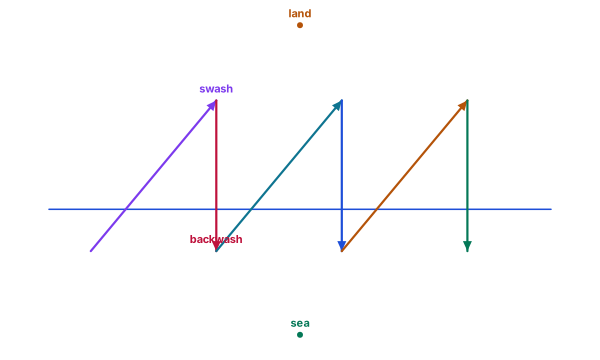
Land is above the shoreline; sea is below. Start at the leftmost arrow. Swash carries a grain obliquely up the beach; backwash returns it downslope under gravity. Each pair ends farther right, producing net transport along the coast. The model assumes a consistent wave approach on a simple beach. Changing waves can reverse transport, and nearshore currents also move sediment. A barrier across this path can accumulate sand updrift and reduce supply downdrift; it does not create new sand for the whole system.
Coastal landforms fall into two families.
| Made by erosion | Made by deposition |
|---|---|
| cliffs | beaches |
| wave-cut platforms | spits |
| caves, arches, stacks | barrier islands |
| headlands and bays | tombolos |
Rocky coasts, such as much of Maine and the Pacific shore, show the first column; sandy coasts, such as the Atlantic and Gulf shores from New Jersey to Texas, the second.
A breaking wave slams water against a cliff and forces air into its cracks, which then bursts out as the wave retreats, prying rock loose. Pebbles thrown by the waves grind the cliff's foot like a hammer. Sea water also slowly dissolves some rocks, such as limestone.
The waves cut a notch at the base of the cliff; the rock above collapses, and the cliff retreats, leaving a flat wave-cut platform exposed at low tide.
On a headland, waves find weak spots, such as cracks, and wear them into caves. When caves on both sides of a narrow headland meet, they form an arch. When the arch's roof collapses, a pillar of rock is left standing alone in the sea: a stack.
The coast of California and Oregon has many sea stacks, such as those along Cannon Beach, Oregon, including Haystack Rock.
Where bands of hard and soft rock meet the sea side by side, the soft rock wears back faster into bays, and the hard rock is left jutting out as headlands. A headland retreating $0.1$ m a year and a bay retreating $1.2$ m a year pull $55$ m apart in fifty years.
Once headlands stick out, waves bend around them and attack them from the sides, while the sheltered bays gather sand into beaches.
Waves usually arrive at an angle set by the wind. The swash carries sand up the beach at that angle; the backwash drags it straight back down under gravity. Each wave moves each grain a little way along the coast.
Over a day, a painted pebble can travel tens of meters. Over a year, drift can carry hundreds of thousands of cubic meters of sand along a busy coast, always roughly in the same direction.
Where the coast turns sharply, as at the mouth of a bay, drift keeps carrying sand in its old direction and drops it in deeper water, building a spit out into the sea. Its tip often curves as waves bend around it.
Sandy Hook in New Jersey is a spit built northward by longshore drift along the Jersey Shore. Along much of the Atlantic and Gulf coasts, long barrier islands, such as the Outer Banks of North Carolina, protect lagoons and marshes behind them.
Waves differ. Gentle waves that arrive perhaps six to eight times a minute, with a strong swash and weak backwash, push sand up the beach and build it: constructive waves. Steep storm waves, perhaps ten to fourteen a minute, with a strong backwash, drag sand away: destructive waves.
Many beaches are wider in summer, when gentle waves rebuild them, and narrower in winter, when storms carry sand offshore.
Structures built across a beach interrupt longshore drift. Groins and jetties trap sand on their up-drift side, widening that beach, but starve the beaches down-drift, which then erode faster.
At Ocean City, Maryland, jetties built to keep an inlet open have trapped sand that used to feed Assateague Island to the south, which has moved hundreds of meters landward.
Checking an answer. Soft rock should always retreat farther than hard rock over the same time. A spit's length should grow, not shrink, while drift supplies it.
Multiplying a rate by time is allowed when the process is roughly steady, which holds on average even though storms do most of the work. Comparing hard and soft rock over the same years is allowed because the waves attacking them are the same.
Dividing a distance by a rate to find a time is allowed because it asks how many years of growth fit into the distance.
Sea level along much of the U.S. coast has risen by roughly a foot over the last century, and the rise is speeding up. Higher water lets waves reach farther up beaches and cliffs, so erosion reaches places that were once safe.
Barrier islands respond by moving landward, as storms wash sand over them from the sea side to the lagoon side. The next lesson measures that retreat and asks how people respond.
The most common slip is thinking waves only move sand up and down a beach, and missing longshore drift. Another is expecting a spit to grow toward the land rather than across the mouth of a bay.
A third is assuming a groin protects the whole coast, when it starves the beach down-drift. A fourth is reading hard rock's slow retreat as no retreat at all.
Sandy Hook is a sandy spit about six miles long at the northern tip of the Jersey Shore, reaching toward New York Harbor. Longshore drift along the New Jersey coast carries sand northward, and where the coast ends at the mouth of the harbor, the sand is dropped, extending the spit.
Old maps and lighthouse records show the spit has grown northward over the last few centuries. The Sandy Hook Lighthouse, first lit in 1764 and the oldest working lighthouse in the United States, was built near the tip; the spit has since grown well beyond it.
Today the spit is part of Gateway National Recreation Area. Beaches along its southern end erode while its tip grows, and engineers periodically pump sand back onto the eroding beaches. The spit shows longshore drift at work on a scale you can see from an airplane window.
Haystack Rock at Cannon Beach, Oregon, rises about 235 feet from the sand, one of the most photographed sea stacks in the country. It is made of hard volcanic basalt, the remains of lava flows millions of years old, which has resisted the waves while softer rock around it wore away.
All along the Oregon and northern California coast, waves of the Pacific Ocean attack headlands, carving caves and arches, and leaving stacks behind when arches collapse. The same process that made Haystack Rock is still at work: arches form and fall within human memory.
Tide pools around the base of the stacks, on the wave-cut platform exposed at low tide, are home to sea stars, anemones and puffins nesting above. Park rangers remind visitors that the platform is also where waves strike hardest, and to watch for sneaker waves that surge farther up the beach than the rest.
Watching waves wash up a beach and drain back, it looks as if they only move sand up and down. But most waves arrive at an angle, and each one carries sand a little way along the shore, so over months drift can move enormous amounts of sand.
That sideways movement builds spits and barrier islands, and it is why a groin or jetty on one beach can starve the next one down the coast.
A painted pebble drifts $5$ m a day along a beach. Name the process.
$\text{longshore drift}$
Waves at an angle.
Find how far it goes in $14$ days.
$5 \times 14 = 70\ \text{m}$
Rate times days.
Say which way it goes.
$\text{with the usual wind}$
The waves' angle.
Say where the sand ends up.
$\text{where the coast bends}$
Building a spit.
A headland retreats $0.2$ m a year. Find its retreat in $40$ years.
$0.2 \times 40 = 8\ \text{m}$
Hard rock.
The bay retreats $1.5$ m a year. Find its retreat.
$1.5 \times 40 = 60\ \text{m}$
Soft rock.
Find the difference.
$60 - 8 = 52\ \text{m}$
The bay falls back.
Say what the coast looks like.
$\text{a headland jutting out}$
Between bays.
Say what waves do to the headland.
$\text{bend around and erode its sides}$
Caves, arches, stacks.
A spit is $1200$ m long and grows $15$ m a year. Write its length after $t$ years.
$1200 + 15t$
Today plus growth.
Find its length in $20$ years.
$1200 + 15 \times 20 = 1500\ \text{m}$
Substitute.
It must reach $1800$ m to close a bay. Find the gap.
$1800 - 1200 = 600\ \text{m}$
Still to grow.
Find the years to close it.
$\dfrac{600}{15} = 40\ \text{years}$
Gap over growth.
Name what forms behind it.
$\text{a lagoon}$
Calm water.
Say what could stop it.
$\text{a jetty up the coast}$
Cutting the sand supply.
Find the seconds in an hour.
$3600$
Sixty times sixty.
Divide by the wave period.
$\dfrac{3600}{8} = 450$
Waves in an hour.
Judge the waves.
Waves reach a beach at an angle, and a painted pebble moves along the shore about $4$ m a day. About how far along the beach will it travel in $25$ days?
Complete the worked solution: a headland retreats $0.1$ m a year and the bay beside it $2$ m a year. Over $30$ years, find the headland's retreat, the bay's retreat, and how much farther the bay goes back.
Find the headland's retreat.
$\text{headland rate} \times \text{years} =$ p
Meters.
Find the bay's retreat.
$\text{bay rate} \times \text{years} =$ q
Meters.
Find the difference.
$\text{bay} - \text{headland} =$ d
How far the bay falls back.
Say what the waves do next.
$\text{attack the headland from the sides}$
Waves bend around it.
Match each coastal landform to how it forms.
| sand carried by longshore drift past a bend in the coast | caves on both sides of a headland wearing through | a flat rock shelf left as a cliff wears back | resistant rock left standing as softer rock wears away | |
|---|---|---|---|---|
| a spit | ||||
| a sea arch | ||||
| a wave-cut platform | ||||
| a headland |
A headland of hard rock retreats $0.1$ m a year; the bay beside it, in soft rock, retreats $1.2$ m a year. Over $50$ years, fill in each one's retreat and how much farther the bay goes back.
| value | |
|---|---|
| headland's retreat (m) | |
| bay's retreat (m) | |
| how much farther the bay goes back (m) |
A sand spit is $2500$ m long and grows about $10$ m a year as longshore drift adds sand to its tip. Write its length, in meters, as a function of the years $t$ from now.
Answer:
Waves break on a beach every $8$ seconds. How many waves reach the beach in an hour?
Answer: waves
Suppose a spit near Dauphin Island, Alabama has $900$ m of water still to grow across before it closes off a small bay, and it grows about $30$ m a year. About how many years will that take, if nothing changes?
Answer: years
Lesson test: one question per skill, one attempt each, no hints. Your answers are checked when you submit.
A sand spit is $600$ m long and grows about $30$ m a year as longshore drift adds sand to its tip. Write its length, in meters, as a function of the years $t$ from now.
Answer:
You can explain coastal landforms. Explain how longshore drift builds a spit across the mouth of a bay.
24. Your turn: waves break every $8$ seconds. How many reach the beach in an hour?, step 3
$7.5 \text{ a minute: constructive}$
Gentle and building.