Back to the on-screen lesson ·
Each step of magnitude is ten times the ground motion and about thirty-two times the energy; the P-to-S wave gap gives distance, and deaths per million compare impact.
Paper packet. Every task here also exists on screen, where it is checked automatically; answers written on paper are not assessed by Nydus. When you are back at a device, enter your answers there.
By the end of this lesson you will be able to compare earthquakes by magnitude, find how far away one struck, and compare their impacts fairly.
You know that earthquakes happen at plate margins where strain builds and releases. This lesson measures earthquakes: how big they are, how far away they struck, and why the same size of earthquake can harm very different numbers of people.
| Term | What it means |
|---|---|
| Magnitude | A number measuring an earthquake's size; each whole step is ten times the ground motion. |
| Intensity | How strongly shaking is felt at a particular place. |
| Focus | The point underground where the rock first breaks. |
| Epicenter | The point on the surface directly above the focus. |
| Seismograph | An instrument that records ground motion. |
| P and S waves | The two main kinds of seismic wave; P waves travel faster and arrive first. |
Earthquake magnitude is measured on a scale where each whole step is a big jump.
Another way: picture
Picture a staircase where each step is ten times taller than the one before. Walking up from step 5 to step 7 is not two small steps; it is a climb a hundred times as high. The magnitude scale works like that, which is why a single step matters so much.
Another way: steps
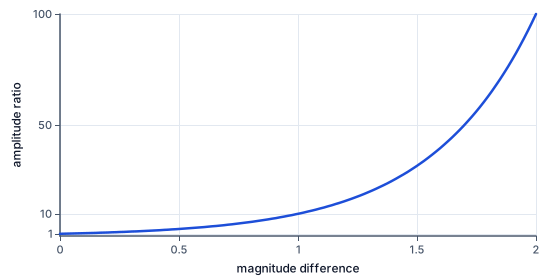
Read magnitude difference horizontally and corrected wave-amplitude ratio vertically. One step corresponds to ten times the amplitude, two to one hundred times. Energy release follows a different approximate relation, about 32 times per step. Modern moment magnitude is based on seismic moment rather than one wave's amplitude. This classroom amplitude model does not predict shaking at arbitrary sites: distance, depth, propagation and local ground conditions matter. Neither ratio predicts casualties or damage without information about exposure and vulnerability.
Compare earthquakes with a magnitude 5.
| Magnitude | Ground motion | Energy |
|---|---|---|
| 5 | 1 | 1 |
| 6 | 10 times | about 32 times |
| 7 | 100 times | about 1000 times |
| 8 | 1000 times | about 32,000 times |
| 9 | 10,000 times | about 1,000,000 times |
A magnitude 9, like the 1964 Alaska earthquake, released roughly a million times the energy of a magnitude 5.
Magnitude is one number for the whole earthquake: how much it released. Intensity describes the shaking at a particular place, on the Modified Mercalli scale from I, not felt, to XII, total destruction.
One earthquake has one magnitude but many intensities: strong near the epicenter, weaker farther away, and stronger on soft ground than on solid rock.
An earthquake sends out P waves, which travel fastest, and S waves, which follow. A seismograph records both. The farther the station from the earthquake, the longer the gap between them, about eight kilometers for every second in typical crust.
One station gives a distance, a circle around it. Three stations give three circles, and the epicenter is where they meet. The U.S. Geological Survey locates earthquakes this way within minutes.
The same magnitude can harm very different numbers of people. A shallow earthquake shakes harder than a deep one. One under a city harms more than one under empty land or the sea. Soft ground shakes more than bedrock, and can even turn to liquid.
Above all, buildings matter. Most deaths in earthquakes come from collapsing buildings, so strong building codes save lives.
Raw death tolls cannot compare places of very different size. Dividing deaths by the population in millions gives a rate. An earthquake killing $500$ people in a region of $2$ million is $250$ deaths per million.
In 2010, a magnitude 7.0 earthquake near Port-au-Prince, Haiti, killed more than 100,000 people, while a magnitude 8.8 earthquake in Chile weeks later, releasing hundreds of times more energy, killed about 500. Chile's strict building codes and preparation made the difference.
Most American earthquakes strike along the West Coast and in Alaska. California's Northridge earthquake of 1994, magnitude 6.7, struck under the San Fernando Valley, killing about 60 people and causing tens of billions of dollars of damage.
Alaska has the most earthquakes of any state. Its 1964 magnitude 9.2 earthquake, the second largest ever recorded worldwide, shook for about four minutes and raised a tsunami that reached as far as California.
Because P waves arrive before the damaging S waves, a warning can be sent in the seconds between. The ShakeAlert system in California, Oregon and Washington detects P waves and sends alerts to phones, so people can drop, cover and hold on, and trains can slow.
The farther from the epicenter, the longer the warning, which can be tens of seconds for distant cities.
Checking an answer. A one-step difference should give ten times the motion, not one or two. Deaths per million should be larger than the deaths when the population is under a million.
Multiplying by ten per step is allowed because the magnitude scale was built that way: it counts powers of ten in recorded ground motion. Multiplying the P-to-S gap by a fixed distance is allowed because the two waves travel at steady, different speeds, so their gap grows evenly with distance.
Dividing deaths by population is allowed because it puts places of different size on the same footing.
Southern California expects a large earthquake on the San Andreas Fault in the coming decades. Schools and families practice the Great ShakeOut drill: drop, cover and hold on. Cities have strengthened older concrete and brick buildings, and bridges have been retrofitted.
These measures cannot change an earthquake's magnitude, but they change its impact, which is the part people can control.
The most common slip is reading the magnitude scale as evenly spaced, so that a magnitude 8 seems only a little bigger than a 7. Another is confusing magnitude with intensity.
A third is assuming the biggest earthquake always does the most harm. A fourth is comparing raw death tolls between places of very different size.
Magnitudes are often given to one decimal place, such as 6.7 or 9.2. The rule still works: a difference of 2.5 means ten raised to the power 2.5, about 316 times the ground motion.
A calculator's power key does this directly. Half a step is about three times the motion, since three times three is close to ten.
On March 27, 1964, a magnitude 9.2 earthquake struck southern Alaska, the largest in North American history and the second largest ever recorded. The ground shook for about four and a half minutes. In Anchorage, soft clay slid toward the sea, carrying away a whole neighborhood.
The earthquake raised or lowered large areas of land by several meters and set off tsunamis that struck coastal towns in Alaska and traveled down the Pacific coast, killing people as far away as Crescent City, California. Most of the roughly 130 deaths were caused by tsunamis rather than shaking.
The earthquake helped scientists understand subduction zones, and it led to the creation of tsunami warning centers. Compared with the Northridge earthquake thirty years later, its larger magnitude did not translate into a proportional increase in deaths. Exposure, construction, ground conditions and tsunami impacts differed; the magnitude difference alone cannot isolate the contribution of each factor.
The U.S. Geological Survey's ShakeAlert system watches hundreds of seismograph stations along the West Coast. When an earthquake begins, stations near the epicenter detect the fast P waves, computers estimate the magnitude and location in seconds, and alerts go out before the slower, stronger S waves arrive farther away.
Alerts reach cell phones, trains, hospitals and schools. A few seconds lets people drop, cover and hold on, lets surgeons pause, and lets trains brake. A city about 160 km from the epicenter might get twenty seconds of warning, the same gap that lets a seismograph measure the distance.
The system cannot predict earthquakes; it detects them once they have started. Its value comes entirely from the difference in speed between two kinds of wave.
It is natural to read magnitudes like a ruler, so that a magnitude 8 is twice a 4, or a 7 only a little more than a 6. But each step is ten times the ground motion and about thirty-two times the energy, so small differences in magnitude are huge differences in size.
It is also tempting to think the biggest earthquake always does the most harm. How many people are hurt depends on where it strikes, how deep it is, and above all how buildings are made and how prepared people are.
Compare a magnitude 7 with a magnitude 5. Count the steps.
$7 - 5 = 2$
Whole steps.
Find the ground motion factor.
$10 \times 10 = 100$
Ten per step.
Find the energy factor.
$32 \times 32 = 1024$
About a thousand.
Say what that means.
$\text{far more than twice as big}$
Not an even scale.
S waves arrive $20$ s after P waves. Recall the rule.
$8\ \text{km per second}$
Typical crust.
Find the distance.
$8 \times 20 = 160\ \text{km}$
From the station.
Say what one station gives.
$\text{a circle of radius 160 km}$
Any point on it.
Say what two more stations add.
$\text{circles meeting at one point}$
The epicenter.
Estimate a warning time for a city 160 km away.
$\text{about 20 seconds}$
Before the S waves.
Earthquake A kills $3000$ people in $6$ million. Find deaths per million.
$\dfrac{3000}{6} = 500$
Per million.
Earthquake B kills $90$ people in $0.5$ million. Find its rate.
$\dfrac{90}{0.5} = 180$
Per million.
Compare the two results.
$500 > 180$
A hit harder, per person.
A was magnitude 6.5 and B magnitude 7.5. Compare their motion.
$10^{1} = 10$
B was ten times the motion.
Explain the mismatch.
$\text{A struck a city with weak buildings}$
Vulnerability, not size.
State the lesson.
$\text{magnitude alone does not predict harm}$
People and buildings matter.
Count the steps.
$8 - 6 = 2$
Whole steps.
Multiply by ten per step.
$10 \times 10 = 100$
Ground motion.
Estimate the energy factor too.
How many times more ground motion does a magnitude $8$ earthquake record on a seismograph than a magnitude $7$ earthquake at the same distance?
Complete the worked solution: compare a magnitude $6$ earthquake with a magnitude $4$. Find the whole steps between them, how many times more ground motion the larger records, and about how many times more energy it releases.
Count the whole steps.
$\text{larger} - \text{smaller} =$ d
Steps of magnitude.
Find the ground motion factor.
$\text{ten, once per step} =$ m
Times more motion.
Find the energy factor.
$\text{thirty-two, once per step} =$ e
Times more energy.
Say what the numbers do not tell you.
$\text{how many will be hurt}$
That depends on people and buildings.
Match each earthquake term to its meaning.
| the size of the earthquake, one number for the whole event | how strongly the shaking is felt at a particular place | the point underground where the rock first breaks | the point on the surface directly above where the rock breaks | |
|---|---|---|---|---|
| magnitude | ||||
| intensity | ||||
| focus | ||||
| epicenter |
Each whole step of magnitude releases about $32$ times more energy. Fill in about how many times more energy a bigger earthquake releases for each gap in magnitude.
| times more energy | |
|---|---|
| one step larger (for example, 5 to 6) | |
| two steps larger (for example, 5 to 7) | |
| three steps larger (for example, 5 to 8) |
At a seismograph station, the slower S waves arrive after the faster P waves, and in this region each second of that gap means about $7.5$ km of distance to the earthquake. Write the distance, in kilometers, as a function of the gap $g$ in seconds.
Answer:
An earthquake kills $40$ people in a region of $0.25$ million people. How many deaths per million people is that?
Answer: per million
The 1964 earthquake in Alaska had a magnitude of $9.2$; the 1994 Northridge earthquake in Los Angeles had a magnitude of $6.7$. Use their difference as an input to the classroom amplitude model, ten to the power of the magnitude difference. What ratio does that model give, rounded to the nearest whole number? This is not a measured site-shaking ratio for these moment magnitudes.
Answer: times
Lesson test: one question per skill, one attempt each, no hints. Your answers are checked when you submit.
At a seismograph station, the slower S waves arrive after the faster P waves, and in this region each second of that gap means about $8$ km of distance to the earthquake. Write the distance, in kilometers, as a function of the gap $g$ in seconds.
Answer:
You can measure earthquakes. Explain why a magnitude 7 is far more than a little bigger than a magnitude 6.
24. Your turn: how many times more ground motion does a magnitude 8 record than a magnitude 6?, step 3
$32 \times 32 \approx 1000$
Energy.