Back to the on-screen lesson ·
Discharge is the volume of water passing each second: the channel's width times its mean depth times the water's velocity, measured by survey or by stream gauge.
Paper packet. Every task here also exists on screen, where it is checked automatically; answers written on paper are not assessed by Nydus. When you are back at a device, enter your answers there.
By the end of this lesson you will be able to measure and calculate a river's discharge from a survey, in metric and American units.
You know how rivers erode and deposit, and that they do most of their work in floods. To say how big a flood is, you need to measure how much water a river carries. This lesson shows how a survey does that, with a tape, a measuring stick and a float.
| Term | What it means |
|---|---|
| Discharge | The volume of water passing a point in a river each second. |
| Cross-sectional area | The area of a slice across the channel's water: its width times its mean depth. |
| Velocity | How fast the water moves: distance traveled divided by time. |
| Mean depth | The average of depths measured at even steps across the channel. |
| Wetted perimeter | The length of the bed and banks in contact with the water. |
| Stream gauge | A station that records a river's height and discharge continuously. |
Discharge measures how much water a river carries:
$$\text{discharge} = \text{cross-sectional area} \times \text{velocity}.$$
In meters and seconds the answer is in cubic meters a second; American gauges report cubic feet a second, often written cfs.
Another way: picture
Picture the river's water sliding past you as a long block. Each second, a slice of that block as long as the water's speed moves past. The slice's face is the channel's cross-section, so the volume passing each second is the face's area times the length that slides by.
Another way: steps
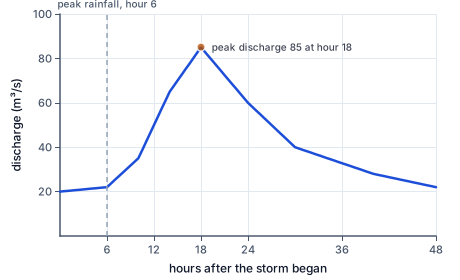
This invented record plots discharge against hours, not channel depth. Read 20 cubic meters per second at the start and 85 at hour 18. A survey of area times mean velocity estimates one point on such a record. The graph cannot tell us whether area, velocity or both caused the increase; collect both measurements to explain it. Discharge is a rate: multiply by a duration in seconds to estimate volume only while that rate holds. Changing discharge requires separate intervals. The next lesson examines the delay after rainfall in more detail.
Here is a small stream measured by a class.
| Measurement | Value |
|---|---|
| width | 10 m |
| mean depth | 0.6 m |
| float's distance | 10 m |
| float's time | 20 s |
The area is $10 \times 0.6 = 6$ m², the velocity $10 \div 20 = 0.5$ m/s, and the discharge $6 \times 0.5 = 3$ m³/s: three cubic meters of water, about three metric tons, every second.
A river is rarely the same depth all the way across. It is usually shallow near the banks and deepest where the current is fastest. So a survey measures depth at even steps, every meter across a small stream, and averages them.
Using only the deepest reading makes the area, and the discharge, too big. Using only the edges makes them too small.
The simplest method drops a float, such as an orange or a stick, upstream of a marked stretch and times it between two markers. Distance over time is the velocity.
Water at the surface and in the middle flows fastest, because the bed and banks slow the water beside them by friction. So a float gives a slightly high value; hydrologists use flow meters, spinning propellers or sound pulses, to measure speed at several depths.
Area is in square meters and velocity in meters a second. Their product is in cubic meters a second: a volume each second, which is exactly what discharge means.
A cubic meter of water weighs about a metric ton. A discharge of $3$ m³/s means three tons of water passing every second, over ten thousand tons an hour.
U.S. Geological Survey stream gauges report discharge in cubic feet per second, written cfs. The method is the same: width in feet times mean depth in feet gives square feet, and times velocity in feet per second gives cubic feet per second.
One cubic meter is about $35.3$ cubic feet, so $3$ m³/s is about $106$ cfs.
The Mississippi River near its mouth carries on average about 600,000 cubic feet per second, roughly 17,000 cubic meters per second. The Amazon, the largest river in the world by discharge, carries more than ten times as much.
A small creek might carry only a few cubic feet per second. Discharge lets rivers of every size be compared on one scale.
The U.S. Geological Survey runs thousands of stream gauges across the country. Most record the river's height, called the stage, every few minutes. Hydrologists visit to measure the discharge directly at many different stages, and draw a rating curve that turns any stage into a discharge.
The gauges' readings appear online within minutes, and flood forecasters, farmers, boaters and water managers all use them.
In a channel with steep sides, such as a concrete flood channel, the area is the width times the depth, so the discharge is the width times the velocity times the depth. Doubling the depth doubles the discharge, if the speed stays the same.
In a real river, deeper water also flows faster, so discharge rises even faster than depth. That is why a river a little above its banks can carry far more water than one a little below them.
Checking an answer. Check the units come out as a volume per second. A small stream should give a few cubic meters a second or less; a big river thousands.
Multiplying width by mean depth is allowed because a channel's cross-section is close to a rectangle of the same width and the average depth. Multiplying area by velocity is allowed because each second a slice of water as long as the velocity passes the section.
Averaging several float timings is allowed, and wise, because a single float can be caught by an eddy or blown by wind.
As a river flows downstream, tributaries join it and groundwater seeps in, so its discharge usually grows. Its channel grows wider and deeper, and, surprisingly, its velocity often grows too, even though its gradient falls, because a big smooth channel wastes less energy on friction.
In dry places a river can lose water downstream instead, to evaporation, to irrigation and into the ground.
The most common slip is stopping at the area and calling it the discharge. Another is leaving the depth out and multiplying the width by the velocity.
A third is using the deepest reading instead of the mean depth. A fourth is mixing units, such as a width in meters with a velocity in feet per second.
Discharge changes through a storm: it rises as rain drains into the river and falls again afterward. The next lesson draws that change as a graph, the storm hydrograph, and asks why some rivers flood faster than others.
In an average year the Mississippi River carries about 600,000 cubic feet of water a second past New Orleans, draining about forty percent of the lower forty-eight states. In the great flood of 1927 its discharge rose far above that, broke levees in more than a hundred places, and covered about 27,000 square miles of land.
After the flood, the U.S. Army Corps of Engineers designed the river's flood controls around discharge. Spillways such as the Bonnet Carré, upstream of New Orleans, open to divert part of the flow into Lake Pontchartrain when the river's discharge would otherwise threaten the city's levees.
Engineers decide when to open the spillway by watching stream gauges upstream, which report the river's stage and discharge in cubic feet per second. The same arithmetic a class uses on a creek, area times velocity, protects one of the country's largest cities.
The U.S. Geological Survey operates thousands of stream gauges across all fifty states, and anyone can look up their readings online, updated every few minutes. Each gauge shows the river's stage in feet and its discharge in cubic feet per second, with a graph of the last few days.
To build each gauge's rating curve, hydrologists wade into the river, or lower instruments from bridges and cableways, and measure width, depths and velocities across the channel, several times a year and during floods. From those surveys they calculate discharge as area times velocity, and match it to the stage.
Whitewater rafters check gauges before a trip, because a river that is fun at 1,000 cfs can be deadly at 10,000. Farmers check them for irrigation, and the National Weather Service uses them to forecast floods.
It is easy to stop once you have the channel's area, or to multiply the width by the speed and forget the depth. But a wide, shallow, slow stream can carry less water than a narrow, deep, fast one.
Discharge needs all three: width and mean depth for the area, and velocity for how fast that area of water moves past. Check that your answer's units are a volume each second.
A stream is $8$ m wide with a mean depth of $0.5$ m. Find the area.
$8 \times 0.5 = 4\ \text{m}^2$
Width times mean depth.
A float travels $10$ m in $12.5$ s. Find the velocity.
$\dfrac{10}{12.5} = 0.8\ \text{m/s}$
Distance over time.
Find the discharge.
$4 \times 0.8 = 3.2\ \text{m}^3/\text{s}$
Area times velocity.
Check the units.
$\text{m}^2 \times \text{m/s} = \text{m}^3/\text{s}$
A volume each second.
Depths across a stream read $0.2$, $0.6$, $0.9$, $0.7$ and $0.1$ m. Add them.
$0.2 + 0.6 + 0.9 + 0.7 + 0.1 = 2.5$
Five readings.
Find the mean depth.
$\dfrac{2.5}{5} = 0.5\ \text{m}$
Their average.
The stream is $6$ m wide. Find the area.
$6 \times 0.5 = 3\ \text{m}^2$
Width times mean depth.
The velocity is $0.4$ m/s. Find the discharge.
$3 \times 0.4 = 1.2\ \text{m}^3/\text{s}$
Area times velocity.
Say what using the deepest reading would do.
$6 \times 0.9 \times 0.4 = 2.16$
Nearly double: too big.
A river is $120$ ft wide with a mean depth of $4$ ft. Find the area.
$120 \times 4 = 480\ \text{ft}^2$
Square feet.
Its velocity is $2.5$ ft/s. Find the discharge.
$480 \times 2.5 = 1200\ \text{cfs}$
Cubic feet a second.
Convert to cubic meters a second.
$\dfrac{1200}{35.3} \approx 34$
About 35.3 cubic feet per cubic meter.
Find the volume in an hour, in cubic feet.
$1200 \times 3600 = 4320000$
Seconds in an hour.
Picture the hour's water.
$\text{a football field about 75 ft deep}$
A field is about 57,600 square feet.
Say what a doubling of the depth would roughly do.
$\text{more than double the discharge}$
Deeper water also flows faster.
Find the area.
$15 \times 0.8 = 12\ \text{m}^2$
Width times mean depth.
Find the velocity.
$\dfrac{10}{10} = 1\ \text{m/s}$
Distance over time.
Find the discharge.
A stream is $20$ m wide with a mean depth of $1.5$ m, and its water flows at $0.8$ m a second. What is its discharge, in cubic meters a second?
Complete the worked solution: a stream is $10$ m wide with a mean depth of $0.6$ m. An orange peel dropped in it floats $10$ m downstream in $20$ s. Find the cross-sectional area, the velocity and the discharge.
Find the area.
$\text{width} \times \text{mean depth} =$ a
Square meters.
Find the velocity.
$\dfrac{\text{distance}}{\text{time}} =$ v
Meters a second.
Find the discharge.
$\text{area} \times \text{velocity} =$ q
Cubic meters a second.
Say how to improve the survey.
$\text{repeat the float and average}$
One timing can mislead.
Match each term from a river survey to what it means.
| the volume of water passing a point each second | the width of the channel times its mean depth | the distance a float travels divided by its time | the length of bed and banks in contact with the water | |
|---|---|---|---|---|
| discharge | ||||
| cross-sectional area | ||||
| velocity | ||||
| wetted perimeter |
A class surveys a stream. It is $12$ m wide with a mean depth of $0.75$ m, and a float takes $25$ s to travel $10$ m downstream. Fill in the area, the velocity and the discharge.
| value | |
|---|---|
| cross-sectional area (m²) | |
| velocity (m/s) | |
| discharge (m³/s) |
A concrete flood channel has steep sides and is $6$ m wide. Water flows through it at $1.25$ m a second. Write its discharge, in cubic meters a second, as a function of the water's depth $d$ in meters.
Answer:
A river's discharge is $4.5$ cubic meters a second. How many cubic meters of water pass the gauge in one hour?
Answer: m³
Suppose U.S. Geological Survey hydrologists measure a river in Virginia. At the gauge it is $120$ feet wide with a mean depth of $4$ feet, and the water flows at $2.5$ feet a second. What is its discharge, in cubic feet a second?
Answer: cfs
Lesson test: one question per skill, one attempt each, no hints. Your answers are checked when you submit.
A concrete flood channel has steep sides and is $6$ m wide. Water flows through it at $1.25$ m a second. Write its discharge, in cubic meters a second, as a function of the water's depth $d$ in meters.
Answer:
You can find a river's discharge. Explain why a wide, shallow stream can carry less water than a narrow, deep one.
25. Your turn: a stream is $15$ m wide with a mean depth of $0.8$ m, and a float travels $10$ m in $10$ s. What is its discharge?, step 3
$12 \times 1 = 12\ \text{m}^3/\text{s}$
Area times velocity.