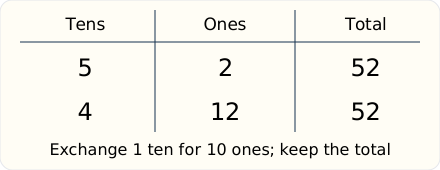
 Now fifty-two is four tens and twelve ones. Remove seven ones and two tens, leaving two tens and five ones, or twenty-five. The exchange changed both place counts but kept the original fifty-two. You did not add ten extra ones to the collection.
Back to the on-screen lesson ·
Add and subtract within 100 with regrouping, work by place within 1000, and solve stories that take two steps.
Paper packet. Every task here also exists on screen, where it is checked automatically; answers written on paper are not assessed by Nydus. When you are back at a device, enter your answers there.
In this lesson you add and subtract two-digit numbers with regrouping, take the same method up to three digits, and solve word problems where two things happen one after the other. By the end you can say what a carried ten is and where it goes.
You can make ten, use related facts, and read hundreds, tens and ones. Bring those ideas to larger calculations. Adding combines amounts; subtraction can remove a part or find a difference. A written method should show why the result is correct, not only where to put digits. We will choose between mental jumps, expanded parts and aligned columns, then check with an inverse calculation.
| Term | What it means |
|---|---|
| regroup | Exchange equal values between places without changing the total. |
| partial sum | A total for some parts of an addition. |
| missing addend | An unknown part that must join another part to make a given total. |
| inverse operation | An operation that undoes another, such as subtraction undoing addition. |
| compensate | Adjust a convenient calculation to correct a deliberate change in an amount. |
For 52 - 27, two separate ones are not enough to remove seven ones. Exchange one of the five tens for ten ones.
Another way: equation
52 = 50 + 2 = 40 + 12. Then 52 - 27 = (40 - 20) + (12 - 7) = 25.
To add 47 + 36, separate tens and ones. Four tens plus three tens make seven tens. Seven ones plus six ones make thirteen ones. The partial sums are seventy and thirteen, giving eighty-three. Since thirteen ones include one full ten, the standard grouping is eight tens and three ones. Both the expanded method and the aligned-column method describe the same exchange.
In columns, line up ones below ones and tens below tens. The ones sum thirteen is recorded as three ones with one new ten carried to the tens column. That small carried one means one ten, not one loose object. The tens total is four tens plus three tens plus the regrouped ten, or eight tens. Labeling places makes the meaning clearer than saying write one above the next digit without explanation.
If the ones total is exactly ten, zero ones remain and one ten moves to the tens place. For 26 + 34, six plus four makes ten. Two tens plus three tens plus one exchanged ten make six tens, so the answer is sixty. The zero is needed in the ones place. If the ones total is less than ten, no exchange is required.
Check the result against the original amounts. A sum of two positive numbers must exceed each addend. You can also subtract one addend from the result to recover the other. For 47 + 36 = 83, checking 83 - 36 = 47 tests the whole calculation. A rough check near fifty plus forty suggests a total near ninety, which can catch an answer such as thirteen or eight hundred.
For 63 - 28, three ones are fewer than the eight ones to remove. Exchange a ten so that sixty-three is five tens and thirteen ones. Thirteen minus eight is five ones, and five tens minus two tens is three tens. The difference is thirty-five. Every part removed belongs to the original twenty-eight: two tens and eight ones.
Do not change the ones subtraction to eight minus three just because eight is larger. Subtraction describes removing the second amount from the first, so the direction of the operation must stay consistent. Switching only one column changes the question. Regroup the first amount instead, keeping its total equal. Then there are enough separate ones to remove the required ones.
Record the reduced tens count as well as the increased ones count. If you turn three ones into thirteen but leave six tens unchanged, you have changed sixty-three into seventy-three. That mistaken extra ten makes the final difference too large. Before removing anything, check that your regrouped parts still add to the starting amount.
A zero ones digit can be regrouped too. Seventy can be written as six tens and ten ones. To find 70 - 46, remove six ones from the ten and four tens from the six tens. The result is two tens and four ones, or twenty-four. Check with 46 + 24 = 70. Zero means no separate ones in the standard grouping, not that the number cannot be opened into ones.
Sometimes a number-line route is simpler than columns. To add 38 + 25, add twenty to reach fifty-eight, then five to reach sixty-three. The second addend was split into twenty and five. To subtract 63 - 25, remove twenty to reach forty-three, then five to reach thirty-eight. The two stages preserve the original operation and account for the full change.
Counting on is useful for a small gap. For 72 - 68, count two from sixty-eight to seventy and two more to seventy-two. The difference is four. A long subtraction layout can still work, but the nearby values make counting on efficient. Explain that the two jumps add to the missing part in 68 + blank = 72. The landing seventy-two is the whole, not the difference.
A nearby round number can also help. For 49 + 27, use fifty plus twenty-seven to make seventy-seven, then remove the one you deliberately added. The result is seventy-six. The correction is necessary because fifty is one more than the original forty-nine. You may instead move one from twenty-seven to forty-nine, giving fifty plus twenty-six directly. That rearrangement keeps the total unchanged from the start.
For subtraction, think carefully about the adjustment. To calculate 83 - 29, subtract thirty to get fifty-three, then add one back because you removed one too many. The answer is fifty-four. Say what changed and how to undo it. A memorized instruction to always add one or always subtract one would fail when the convenient replacement changes in the other direction.
The unit relationships continue in three-digit work. For 268 + 157, the ones total fifteen, which becomes one ten and five ones. Six tens plus five tens plus that new ten make twelve tens, which become one hundred and two tens. Two hundreds plus one hundred plus the new hundred make four hundreds. The total is 425. Both exchanges preserve the value of the partial sums.
Expanded form provides a clear check: 200 + 100 is 300, 60 + 50 is 110, and 8 + 7 is 15. Combining 300 + 110 + 15 gives 425. You can see why both the tens and hundreds places change. Write each partial sum with its value, not just its digit, so the hundred inside twelve tens is not lost.
Subtraction across a zero needs a chain of exchanges. For 402 - 168, there are no separate tens available to open immediately. Exchange one hundred for ten tens, giving three hundreds, ten tens and two ones. Then exchange one of those tens for ten ones, giving three hundreds, nine tens and twelve ones. Now remove one hundred, six tens and eight ones. The remainder is two hundreds, three tens and four ones, or 234.
Check 234 + 168 = 402. If a result is ten too large, inspect whether the tens count was reduced when a ten became ones. If it is one hundred too large, inspect the hundreds-to-tens exchange. These errors have specific value causes. Keeping a before-and-after place chart helps locate the cause instead of crossing out digits without understanding why.
A total may contain more than two addends. For 24 + 18 + 36 + 22, look for useful pairs. Twenty-four plus thirty-six is sixty; eighteen plus twenty-two is forty. Sixty plus forty is one hundred. You may change the order and grouping of addends because the same four amounts are still being combined. Check the original list so no amount is omitted or used twice.
Another method combines all tens and all ones. The tens contribute twenty, ten, thirty and twenty, totaling eighty. The ones contribute four, eight, six and two, totaling twenty. Eighty plus twenty is one hundred. Agreement between the two methods is a useful check. A written record of the pairings or partial sums lets a partner verify that all four addends were included.
In a two-step story, the first answer becomes information for the next step. If a class has forty-eight sheets, receives twenty-seven more and uses thirty-six, first find seventy-five available sheets and then thirty-nine remaining. Label the intermediate amount available so it is not mistaken for the final answer. You could also subtract the used amount from the original stock first when the quantities allow, but explain that the final count still includes the delivery.
Read the situation before deciding whether to add or subtract. A question containing more may ask how many more are needed, which is a difference. A question about a total may have a missing starting amount. Identify the whole, the known parts and the unknown. Write an equation with a blank in the appropriate place. After calculating, include the unit and check that the answer fits the question, rather than reporting an unlabeled number from the middle of the work.
Four groups contribute twenty-four, eighteen, thirty-six and twenty-two sheets to an art project. Pairing twenty-four with thirty-six gives sixty, while eighteen with twenty-two gives forty, so one hundred sheets are available. After the class uses twenty-seven sheets, seventy-three remain. The teacher can check the total by collecting the tens and ones separately, then check the remaining stock with 73 + 27 = 100. The record should label one hundred as the starting combined stock and seventy-three as the final remainder. Both numbers are useful, but only the second answers how many sheets are left after the activity.
A classroom has sixty-three counters and lends twenty-eight to another group. A learner opens one ten, recording five tens and thirteen ones before removing anything. Removing two tens and eight ones leaves three tens and five ones, or thirty-five counters. A partner checks by adding the lent twenty-eight back to thirty-five and recovering sixty-three. If a written answer says forty-five, inspect whether the original six tens were incorrectly kept after the exchange. The difference of ten points to a specific bookkeeping error in the model. Explaining that cause helps the learner repair future calculations instead of only replacing one incorrect answer. Keep the corrected place chart beside the inventory record so the next group can verify the remaining supply.
A carried one represents one unit of the next place, not one extra object. When a ten is opened, reduce the tens count as the ones increase. Do not reverse digits inside a subtraction. With four addends, track every contribution once. A correct intermediate total is not a final answer if the story includes another change.
Align the unit places.
47 + 36 has tens under tens and ones under ones.
Only like units are combined.
Combine the ones.
7 + 6 = 13 ones.
The result contains a complete ten.
Exchange ten ones.
13 ones become 1 ten and 3 ones.
The exchange preserves thirteen.
Combine all the tens.
4 + 3 + 1 = 8 tens, giving 83.
The new ten must be included.
Check the inverse.
83 - 36 = 47.
Removing one addend recovers the other.
Read the starting units.
52 is 5 tens and 2 ones.
Twenty-seven must be removed from this amount.
Identify the needed exchange.
2 ones are fewer than 7 ones.
The ones must be regrouped before removal.
Preserve the starting value.
52 becomes 4 tens and 12 ones.
One ten was exchanged for ten ones.
Remove the required ones.
12 - 7 = 5 ones.
The direction of subtraction stays unchanged.
Remove the required tens.
4 - 2 = 2 tens, so the result is 25.
Use the reduced tens count.
Check by addition.
25 + 27 = 52.
The difference and removed part rebuild the whole.
List every contribution.
24, 18, 36 and 22 sheets.
Each contribution must be counted once.
Choose a convenient first pair.
24 + 36 = 60.
Their ones make a whole ten.
Combine the remaining pair.
18 + 22 = 40.
These are the two unused contributions.
Add the pair totals.
60 + 40 = 100.
The partial sums cover all four amounts.
Check the tens separately.
20 + 10 + 30 + 20 = 80.
This alternative grouping includes every tens part.
Check the ones separately.
4 + 8 + 6 + 2 = 20.
The ones together make two tens.
Confirm the full total.
80 + 20 = 100 sheets.
Both methods agree on the same collection.
Read the subtraction.
Find 76 - 39.
Thirty-nine is near forty.
Remove the convenient amount.
76 - 40 = 36.
This removes one more than requested.
Correct the deliberate change.
Check the original equation.
What is 27 + 39?
Answer:
Find 52 - 16 by regrouping one ten.
Check the ones needed.
2 ones are fewer than 6 ones.
Open a ten before removing the ones.
Record both sides of the exchange.
The starting amount becomes tens tens and 12 ones.
Adding ten ones requires removing one ten.
Continue with the regrouped counts.
Remove 1 tens and 6 ones from the new grouping.
The original subtraction amount has not changed.
What is 60 - 19?
Answer:
What is 46 + 47?
Answer:
What is 42 - 27?
Answer:
A class has 32 sheets and needs 82 altogether. Fill in the additional sheets needed.
32 + n = 82
A school has 503 sheets and uses 156. How many sheets remain? Explain your unit exchanges on paper, then enter the remainder.
Answer:
Lesson test: one question per skill, one attempt each, no hints. Your answers are checked when you submit.
Four groups bring 20, 30, 14 and 26 paper squares. The class then uses 39. Record the combined stock and the final remainder.
| Combined stock | Final remainder | |
|---|---|---|
| Supply record |
You can add and subtract within 100 with regrouping, work through three-digit numbers column by column, and solve a story that takes two steps.
16. Use a round-number correction, step 3
36 + 1 = 37.
Return the extra one removed.
16. Use a round-number correction, step 4
37 + 39 = 76.
The inverse check confirms the correction.