Working with hundreds, tens and ones, and regrouping between them.
Paper packet. Every task here also exists on screen, where it is checked automatically; answers written on paper are not assessed by Nydus. When you are back at a device, enter your answers there.
1. What you will learn
In this lesson you add and subtract numbers up to a thousand, breaking them into hundreds, tens and ones and regrouping when a column runs out. It is the same idea you used within a hundred with one more place, which is the point: place value keeps working however far you extend it, and noticing that is worth more than the practice.
2. Bring your place-value knowledge
A hundred is ten tens, and a ten is ten ones. You can build a number with blocks, sketch it, or record its parts in a chart. Before starting, show 243 as two hundreds, four tens and three ones. Read your representation back as two hundred forty-three. Keep an eye on the units: four tens means forty, not four. In this lesson the numbers and answers stay within one thousand. You will add and subtract by keeping track of those units, including trades that change the grouping without changing the value.
3. Words for the work
Term
What it means
sum
The total when amounts are combined.
difference
The amount left or the gap found by subtraction.
regroup
Rename an amount using different place-value units.
exchange
Trade equal amounts, such as one ten for ten ones.
check
Use another relationship or representation to test an answer.
4. Trade equal values
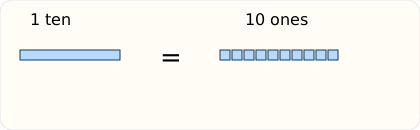
The bar and the ten small squares represent the same amount. If you exchange one for the other, you have neither gained nor lost anything. This is the important idea behind regrouping. A written mark above a column records an actual change in the way the number is grouped. It is not a decoration or an extra number to add whenever you remember it.
For example, 243 can be two hundreds, four tens and three ones. It can also be two hundreds, three tens and thirteen ones. The second description has one fewer ten and ten more ones. Both total 243. You might use the second form when you need to remove more than three ones. For addition, the exchange works in reverse: ten ones can become one ten. Explain each exchange in words before trying to make the written method short.
Another way: table
Representation
Hundreds
Tens
Ones
First grouping of 243
2
4
3
Same value regrouped
2
3
13
The rows describe equal values, not two different answers.
5. Add like units first
To add 214 and 132, combine ones with ones, tens with tens, and hundreds with hundreds. Four ones and two ones make six ones. One ten and three tens make four tens. Two hundreds and one hundred make three hundreds. The sum is 346. You can begin with the hundreds if you keep the units clear, but working from the ones makes it easier to record exchanges before moving to a larger unit.
Now consider 246 plus 137. The ones make thirteen, so exchange ten of them for one ten. Three ones remain. The tens are four tens, three tens, and the newly made ten: eight tens altogether. The hundreds are two hundreds plus one hundred, which makes three hundreds. The result is 383. The extra ten belongs in the tens column because it stands for ten ones, not for one one or one hundred.
Line up place values when you write vertically. In 326 plus 45, put the five below the six and the four below the two. Forty-five has no hundreds, so its hundreds place is empty or zero. Lining up the first written digits would put the four under the three and would turn forty-five into a different amount. A place-value chart can prevent that mistake. When you finish, read the resulting hundreds, tens and ones as a number rather than treating them as separate answers.
6. Subtract only what the representation contains
Subtraction removes an amount or compares two amounts. To find 465 minus 231, remove one one from five ones, three tens from six tens, and two hundreds from four hundreds. You have four ones, three tens and two hundreds left: 234. The parts were already convenient, so no exchange was necessary. A correct method should not force a trade when none is needed.
For 452 minus 126, the two ones are not enough to remove six ones. Do not reverse that column and write six minus two. That would answer a different question. Instead, rename one of the five tens as ten ones. Now 452 is four hundreds, four tens and twelve ones. Removing six ones leaves six. Removing two tens from the four tens leaves two tens. Removing one hundred leaves three hundreds. The answer is 326.
The tens changed when you made the trade. If you keep five tens after adding ten ones, you have increased the starting amount by ten. This is why regrouping needs two connected changes. Cross out or rewrite the old tens count clearly so that you do not use it again by accident. The value check 400 + 40 + 12 = 452 shows that the renamed amount is still the original amount. You can use that check before doing any subtraction.
7. When a hundred must be opened
Sometimes there are not enough tens to remove the tens in the other number. In 634 minus 281, the ones subtraction is easy: four minus one leaves three. But three tens cannot supply eight tens. Exchange one hundred for ten tens. The six hundreds become five hundreds, and the three tens become thirteen tens. Thirteen tens minus eight tens leaves five tens; five hundreds minus two hundreds leaves three hundreds. The difference is 353.
Zero in the tens place needs the same careful reasoning. In 403 minus 156, there are no tens to exchange directly for ones. Open one hundred first. That gives three hundreds, ten tens and three ones. Then exchange one of those tens for ten ones. You now have three hundreds, nine tens and thirteen ones. The total has remained 403 through both exchanges. Subtract six ones, five tens and one hundred to get 247.
Do not make the zero disappear without showing where its replacement came from. The zero originally says there are no separate tens in that grouping, not that the number has no value available to regroup. Four hundreds contain forty tens if all of them are opened. You need to open only enough to make the subtraction possible. If the marks become crowded, start a fresh chart with columns labeled hundreds, tens and ones. A clear representation is more useful than a fast but unreadable page.
8. Compare two ways to think
A place-value method is one way to calculate; counting on can be another. For 503 minus 278, ask how far it is from 278 up to 503. From 278 to 280 is two. From 280 to 300 is twenty. From 300 to 500 is two hundred. From 500 to 503 is three. Combining those distances gives 225. The jumps fill the whole gap without overlaps or missing pieces.
A regrouping method reaches the same answer by removing 278 from 503. Rename 503 as four hundreds, nine tens and thirteen ones. Remove eight ones, seven tens and two hundreds. Five ones, two tens and two hundreds remain: 225. The two methods describe the same relationship, 278 + 225 = 503. One builds the missing part; the other removes the known part.
Choose a method you can explain. When the numbers are close, counting on may involve fewer changes. When the place-value parts are easy to subtract, removing each part may be convenient. Being able to describe why a method works is more important than copying a particular arrangement of marks. If two methods disagree, find the first place where their represented values differ. Do not simply vote for the shorter solution. A short line of writing can hide an incorrect exchange just as easily as a long one.
9. Check an answer without starting blindly again
Addition and subtraction can check one another. If 452 minus 126 is 326, then 326 plus 126 should rebuild 452. Add six ones and six ones to make twelve ones, exchange ten for a ten, and continue. The result is four hundreds, five tens and two ones. This confirms both the difference and the exchange. If the check gives 462, the answer is ten too large, so inspect the tens record.
Use a rough size check as well. Removing a little more than one hundred from a number a little above four hundred should leave a number a little above three hundred. An answer such as 726 cannot fit because taking away a positive amount cannot make the number larger. An answer such as 36 is also suspicious here because it removes far more than 126. A size check catches large mistakes quickly, but an answer can be close and still wrong by one or ten.
When checking someone else's work, locate the exact step that changes the value incorrectly. Suppose a writer changes five tens and two ones into five tens and twelve ones. Ask where the additional ten came from. The corrected grouping must have four tens. Write both totals if needed: 50 + 2 = 52, while 50 + 12 = 62. The problem is not that twelve ones are forbidden; the problem is failing to exchange away a ten at the same time.
10. Counting classroom supplies
An invented Arizona classroom has 246 sheets of blue paper and receives 137 more. The teacher wants the new total before planning projects. Treat all sheets as the same counting unit. Six loose sheets and seven loose sheets make thirteen. If supplies are counted in bundles of ten, exchange ten loose sheets for a new bundle and keep three loose sheets. Four tens plus three tens plus the new ten make eight tens. The hundreds total three. There are 383 sheets. A count of 373 misses the new bundle made from the ones. To check the delivery, subtract the 137 new sheets from 383; the original 246 should remain. The bundles help us count, but fastening a band around ten sheets does not create an extra sheet.
11. Checking an equipment return
A school started with 403 counters and lent 156 to another classroom. How many should still be in storage? Use 403 minus 156 rather than adding the two numbers just because the story mentions a new classroom. The counters lent out leave the storage collection. Rename 403 as three hundreds, nine tens and thirteen ones, remove the loaned amount, and find 247 left. Now check that 247 stored counters plus 156 loaned counters total 403. If a child reports 257, the ten-too-large answer suggests that a traded ten may have been used twice. This calculation assumes none were lost or added during the loan. A real inventory should compare the calculated remainder with a count, and any difference needs investigation rather than being hidden by changing the arithmetic.
12. Explain the mistake, then repair it
Regrouping does not always mean adding a one above the next column. In addition you may compose a ten; in subtraction you may decompose a ten. Name the unit each written one represents. Another error is subtracting the smaller digit from the larger digit in every column. In 52 minus 26, that habit gives the wrong difference because it reverses the ones subtraction. Keep the order of the whole subtraction and rename 52 as four tens and twelve ones. Finally, a zero does not block all subtraction. It tells you that the current grouping has no separate units in that place. Open a larger unit when needed, and confirm that the regrouped parts still total the starting number.
13. Combine without exchanging
Name the place-value parts.
214 = 200 + 10 + 4; 132 = 100 + 30 + 2.
This keeps equal units together.
Add the ones first.
4 + 2 = 6 ones.
Fewer than ten ones need no exchange.
Combine the tens next.
10 + 30 = 40.
One ten plus three tens is four tens.
Combine the hundreds next.
200 + 100 = 300.
Both amounts are whole hundreds.
Record and check the sum.
300 + 40 + 6 = 346; 346 - 132 = 214.
Removing one addend should recover the other.
14. Add and form a new ten
Separate the two amounts.
246 + 137 = (200 + 40 + 6) + (100 + 30 + 7).
Each digit retains its place value.
Combine the loose ones.
6 + 7 = 13 ones.
There are enough ones to form a ten.
Exchange equal amounts.
13 ones = 1 ten + 3 ones.
The value is unchanged.
Add every available ten.
40 + 30 + 10 = 80.
Include the ten made from the ones.
Add the hundreds.
200 + 100 = 300.
No further hundred is formed here.
Join and test the parts.
300 + 80 + 3 = 383; 383 - 137 = 246.
The inverse restores the first amount.
15. Subtract across an empty tens place
Read the subtraction.
403 - 156
We must remove six ones but have only three separate ones.
Open one hundred.
403 = 300 + 100 + 3.
One hundred can supply ten tens.
Open one of those tens.
403 = 300 + 90 + 13.
Nine tens remain after trading a ten for ones.
Remove the ones.
13 - 6 = 7.
The renamed ones are now sufficient.
Remove the tens.
90 - 50 = 40.
Use nine tens, not ten tens.
Remove the hundreds.
300 - 100 = 200.
Only three hundreds remained after the first exchange.
Rebuild the original amount.
200 + 40 + 7 = 247; 247 + 156 = 403.
The check confirms that no value was invented or lost.
16. Your turn: subtract 235 from 621
Rename the starting amount.
621 = 500 + 110 + 11.
Two exchanges provide enough tens and ones.
Subtract matching units.
11 - 5 = 6; 110 - 30 = 80; 500 - 200 = 300.
Use the renamed amounts.
Your turn: work this step out. Its working is at the end of the packet.
Combine the remaining parts.
Your turn: work this step out. Its working is at the end of the packet.
Check with addition.
17. Guided practice
A number has 7 tens and 6 ones. To take away 7 ones, what should you do first?
Trade one ten for ten ones
Trade one hundred for ten tens
Subtract the ones anyway
18. Guided practice
Complete a place-value subtraction: 861 - 127.
Regroup without changing value.
Exchange one ten for ten ones.
The ones must supply seven.
Subtract each place-value part.
The difference is difference.
Use one fewer ten after the exchange.
Check by rebuilding the start.
Add the removed amount to the difference.
The sum should equal the starting number.
19. Guided practice
What is 215 + 435?
Answer:
20. Practice
What is 984 - 331?
Answer:
21. Practice
A number has 2 tens and 0 ones. To take away 1 ones, what should you do first?
Trade one ten for ten ones
Trade one hundred for ten tens
Subtract the ones anyway
22. Practice
What is 429 + 218?
Answer:
23. Somewhere new
What is 440 + 300?
Answer:
24. Somewhere new
A classroom has 362 counters and lends 17. Jo changes the 2 ones into 12 ones but leaves 6 tens in the record. Before subtracting, how many tens SHOULD the renamed starting amount have?
Answer:
25. Lesson test
Lesson test: one question per skill, one attempt each, no hints. Your answers are checked when you submit.
26. Test question
Calculate 541 - 217, then check by adding 217 to your difference. Enter the two results.
Difference
Difference plus removed amount
Results
27. What you can do now
You can add and subtract within 1000 with regrouping. Without looking: what do you do when the ones column does not have enough to subtract from?
Working for the steps left to you
16. Your turn: subtract 235 from 621, step 3
300 + 80 + 6 = 386.
Hundreds, tens and ones make one difference.
16. Your turn: subtract 235 from 621, step 4
386 + 235 = 621.
The removed part and remaining part rebuild the start.
 The bar and the ten small squares represent the same amount. If you exchange one for the other, you have neither gained nor lost anything. This is the important idea behind regrouping. A written mark above a column records an actual change in the way the number is grouped. It is not a decoration or an extra number to add whenever you remember it.