Compare and order three-digit numbers by looking at the hundreds first, then the tens, then the ones.
Paper packet. Every task here also exists on screen, where it is checked automatically; answers written on paper are not assessed by Nydus. When you are back at a device, enter your answers there.
1. What you will learn
In this lesson you compare three-digit numbers by starting at the left and working right, and you put a list of them in order from least to greatest. By the end you can explain why 199 is less than 201.
2. Compare values, not isolated digits
You can read a numeral as hundreds, tens and ones and write its expanded form. Use those place values to compare two whole numbers. Align the ones with ones, tens with tens and hundreds with hundreds. We will decide which amount is greater, explain the first place that settles the comparison, and construct numbers that satisfy a comparison rule.
3. Words and symbols for comparisons
Term
What it means
greater than
Larger in value; written with the symbol >.
less than
Smaller in value; written with the symbol <.
equal to
Exactly the same value; written with =.
least
The smallest value in a collection being compared.
greatest
The largest value in a collection being compared.
4. Start with the largest place
Compare 456 and 465. Their hundreds match, so compare tens. Five tens is less than six tens; therefore 456 is less than 465. The six ones in 456 do not overturn that decision. One extra ten is worth more than any difference between single ones digits. Place value explains why the first different place, read from the largest place downward, decides the comparison.
Another way: steps
Align by place. Compare hundreds first. If they match, compare tens. If those match too, compare ones. If every place matches, the values are equal.
5. Let the hundreds decide when they differ
A number with seven hundreds is greater than a three-digit number with four hundreds, whatever their tens and ones digits may be. For 704 and 470, seven hundred already exceeds all four hundred seventy. Compare the full values, not the digit four that appears in different places. In 704, that four contributes four ones; in 470, it contributes four hundreds.
Why can the smaller places not catch up? The largest possible tens and ones part in a standard three-digit numeral is ninety-nine. Thus a number with four hundreds is at most 499, which is still less than 500. Any number with five hundreds is at least 500. That boundary proves the rule. You do not need to add every possible tens and ones combination to know that five hundreds exceed four hundreds with any standard smaller parts.
Use a nearby boundary as a check. The number 399 is one less than 400, even though both its tens and ones digits are nine. The number 401 is greater than 399 because it has passed four hundred. A large ones digit does not make a number large enough to cross the next hundred on its own.
This method assumes the units have already been written in standard form. A description such as three hundreds and twelve tens must first be regrouped to 420. Comparing only its three named hundreds with the four hundreds in 405 would lead to the wrong decision. Compare the complete amounts after regrouping, or compare their expanded sums carefully.
6. Move to tens and ones only when needed
When hundreds match, their equal contributions do not decide which whole number is greater. Compare 382 and 375. Both contain three hundreds. Eight tens is greater than seven tens, so 382 is greater. The five ones in 375 are more than the two ones in 382, but that difference of three ones cannot overcome an extra ten.
If both hundreds and tens match, compare ones. For 628 and 623, both have six hundreds and two tens. Eight ones is greater than three ones, so 628 is greater. Here the ones do decide because all larger places are equal. Saying always ignore the ones would be wrong; ignore them only after an earlier place has already settled the comparison.
If all places match, the values are equal. The expressions 500 + 40 + 2 and 542 name the same amount, even though their written forms look different. Expand or regroup the forms until you can compare their values. An equals sign says the two sides have the same amount, not that they contain the same number of written symbols.
A useful explanation names the first different place and its values. For 607 and 670, say both have six hundreds, but zero tens is less than seven tens, so 607 is less. Do not say the seven is bigger than zero without naming its place. The number 607 also has a seven, but that seven is in the ones place and has a different value.
7. Write and read the comparison symbols
The symbol < means less than, and > means greater than. Write 375 < 382 to say three hundred seventy-five is less than three hundred eighty-two. Read the complete sentence from left to right. The wide side of either symbol faces the larger value, and the pointed side faces the smaller. This can help you remember the shape after you have decided which amount is larger.
The reversed statement 382 > 375 describes the same relationship. Swapping the numbers requires reversing the symbol. Writing 382 < 375 would say the opposite and would be false. Check your written comparison by reading it aloud in words and pointing to the larger value. A correct mental decision can still be recorded with the wrong symbol if the positions are not checked.
Use = when the amounts are equal. The statements 608 = 600 + 8 and 700 = 7 hundreds are true descriptions of the same amounts. Neither < nor > belongs between equal values. A longer written expression is not automatically larger than a shorter numeral. Its value, not its printed width, decides the comparison.
Keep units consistent in a story. Comparing 35 centimeters with 40 centimeters uses the same unit, so the numerical comparison works directly. Comparing 35 centimeters with 4 meters requires understanding the units before comparing bare numbers. In this lesson's supply counts, both sides count the same kind of object. The place-value method then applies directly to the whole-number quantities.
8. Order several numbers and check neighbors
To arrange a list from least to greatest, first group numbers by their hundreds. Numbers in the two hundreds come before numbers in the three hundreds. Within a group sharing the same hundreds, compare tens. If tens match, compare ones. This organizes the task instead of repeatedly guessing which printed number looks smallest.
For 407, 374, 470 and 347, both numbers in the three hundreds come first. Among them, 347 has four tens and 374 has seven tens, so 347 precedes 374. Among the four-hundred numbers, 407 has zero tens and 470 has seven tens. The complete order is 347, 374, 407, 470. Every listed number must appear exactly once.
Check the finished list by comparing each neighboring pair. Each next number should be greater than or equal to the one before it for a least-to-greatest order. A pair out of order identifies where a repair is needed. If a list contains the same value twice, keep both entries when the task asks to arrange all entries. Equality is allowed in an ordered list.
Greatest to least uses the reverse direction. Read that instruction before beginning. On a number line increasing to the right, smaller values lie left of larger ones, so the line can help you check the direction. Do not confuse which direction you are reading with which number has greater value. The relationship between the amounts stays the same when you view the list from the other end.
9. Construct a number under a comparison rule
You can use place value to build a greatest or least number from given digits. With 2, 5 and 8 used exactly once, put eight in the hundreds place to make the greatest possible value. Then put five in tens and two in ones, giving 852. For the least value, use two hundreds, five tens and eight ones, giving 258. Choosing the hundreds first matters most; rearranging tens and ones cannot make up for a smaller hundreds digit.
Zero needs special attention when a three-digit number is required. Using 0, 4 and 7 once each, the greatest number is 740. The least three-digit number is 407, not 047. A leading zero does not create hundreds; 047 names forty-seven, a two-digit value. Use the smallest nonzero digit for hundreds, then put zero in tens to keep the remaining value as small as possible.
A missing digit can be constrained by a comparison. Suppose 4 blank 7 must be less than 457. The hundreds match, so the tens digit must be less than five, unless the ones could settle an equality. Here equal tens would give 457 exactly, which is not less than 457. The possible tens digits are zero through four. If the task asks for the greatest possible missing digit, choose four. If it asks for any possible digit, several answers are valid. Read that difference carefully.
Check every condition in a construction. The number may need three digits, each supplied digit used once, and a value below a stated boundary. A number can satisfy one condition while breaking another. Write the completed numeral and compare it back to the rule. Explain why a larger or smaller choice in the first important place would fail. This shows that the answer is justified by the place values, not found by chance.
10. Compare supply inventories
Two classrooms report paper-clip inventories in different forms. One records 500 + 60 + 4 clips; the other records 546 clips. Rewrite the first as 564, then compare. Both have five hundreds, but six tens exceeds four tens, so the first room has more clips. The six ones in 546 do not change that conclusion. The difference is eighteen clips, which can be checked by adding eighteen to 546. Using a common unit and standard numerals makes the records comparable. If one room had reported boxes instead of individual clips, the contents per box would be needed before comparing the numbers.
11. Order numbered materials
A library activity uses boxes labeled 407, 374, 470 and 347. To arrange them from least label to greatest, first place the two three-hundred labels before the two four-hundred labels. Compare tens within each pair to obtain 347, 374, 407, 470. A partner checks each neighboring comparison and confirms that no box was omitted. These labels use numerical order; they do not tell how many books each box contains. If the task instead asked which box had the most books, the labels alone would not supply that evidence. Read what the numbers represent before using a correct comparison to answer the wrong question.
12. The first different place is decisive
A larger ones digit does not override fewer hundreds or tens. Compare values only after regrouping unusual unit descriptions. Equal expressions may look different, and leading zeros do not create a larger place value. When building a number, check whether the instruction asks for any valid answer or the greatest or least possible answer.
13. Compare different hundreds
Read both place values.
704 has 7 hundreds; 470 has 4 hundreds.
The largest places are different.
Compare the hundreds.
7 hundreds is greater than 4 hundreds.
The larger unit is considered first.
Check the boundary reason.
Any four-hundred number is below 500.
Its tens and ones cannot reach seven hundred.
Write the relationship.
704 > 470.
The greater amount is on the left.
Read it back.
704 is greater than 470.
Reading the symbol confirms the intended direction.
14. Compare equal hundreds and tens
Align the numerals.
628 and 623.
Like places must be compared.
Check the hundreds.
Both have 6 hundreds.
Equal hundreds do not decide the result.
Check the tens.
Both have 2 tens.
Equal tens also leave the result undecided.
Compare the ones.
8 ones is greater than 3 ones.
This is the first different place.
Write the comparison.
628 > 623.
The first difference decides the whole-number order.
Verify the gap.
628 - 623 = 5.
The positive difference agrees with the larger left value.
15. Build the least three-digit number with zero
Read the conditions.
Use 0, 3 and 8 once each to make the least three-digit number.
Both size and digit-use conditions matter.
Check the first place.
The hundreds digit cannot be zero.
A leading zero would not give a three-digit value.
Choose the least allowed hundred.
Use 3 hundreds.
Three is the smallest nonzero supplied digit.
Choose the least remaining ten.
Use 0 tens.
The tens place matters before the ones place.
Place the final digit.
Use 8 ones, giving 308.
Every supplied digit is now used once.
Compare the closest alternative.
308 < 380.
Zero tens is less than eight tens.
Check alternatives with eight hundreds.
308 is also less than 803 and 830.
A larger hundreds digit cannot make a smaller number.
16. Find a greatest missing digit
Read the comparison rule.
5 blank 8 must be less than 568.
The requested number must be strictly smaller.
Compare the matching hundreds.
Both numbers have 5 hundreds.
The tens decide next.
Your turn: work this step out. Its working is at the end of the packet.
Exclude equal or larger tens.
Your turn: work this step out. Its working is at the end of the packet.
Choose and check the digit.
17. Guided practice
Use the digits 4, 2 and 7 exactly once each. Construct the greatest and least three-digit numbers.
Greatest
Least
Constructed numbers
18. Guided practice
Match each comparison fact to what it proves about the two numbers.
is the greater number
is the lesser number
settles the comparison before tens or ones
626 has 6 hundreds
127 has 1 hundreds
6 hundreds is more than 1 hundreds
Audio transcript: None
19. Guided practice
Match each comparison fact to what it proves about the two numbers.
means move to the tens place
is the lesser number
is the greater number
Both numbers have 9 hundreds
937 has 3 tens
953 has 5 tens
Audio transcript: None
20. Guided practice
A number has 5 hundreds and 7 ones. Find the greatest possible tens digit that keeps it less than 587.
Compare the matching hundreds.
Both have 5 hundreds.
Equal hundreds leave the tens to decide.
Use a strictly smaller tens digit.
The greatest allowed tens digit is digit.
Equal tens would also leave equal ones and give equality.
Check the completed numeral.
Its tens count must be below 8.
The first different place decides the comparison.
21. Guided practice
Use the digits 4, 3 and 8 exactly once each. Construct the greatest and least three-digit numbers.
Greatest
Least
Constructed numbers
22. Practice
Use the digits 4, 1 and 9 exactly once each. Construct the greatest and least three-digit numbers.
Greatest
Least
Constructed numbers
23. Practice
Use the digits 4, 3 and 7 exactly once each. Construct the greatest and least three-digit numbers.
Greatest
Least
Constructed numbers
24. Somewhere new
Put these numbers in order, from least to greatest.
Number the steps in order (write the number in the box):
182
194
201
217
Audio transcript: None
25. Somewhere new
One room has 500 + 30 + 6 clips. Another has 542 clips. How many clips are in the larger inventory?
Answer:
26. Lesson test
Lesson test: one question per skill, one attempt each, no hints. Your answers are checked when you submit.
27. Test question
Use 0, 8 and 3 exactly once each. Construct the greatest and the least THREE-DIGIT numbers.
Greatest
Least
Three-digit constructions
28. What you can do now
You can say which of two three-digit numbers is greater or less by comparing place by place from the left, and you can put four of them in order.
Working for the steps left to you
16. Find a greatest missing digit, step 3
Six tens would give equality; greater tens would be too large.
Neither satisfies less than.
16. Find a greatest missing digit, step 4
The greatest possible digit is 5, giving 558 < 568.
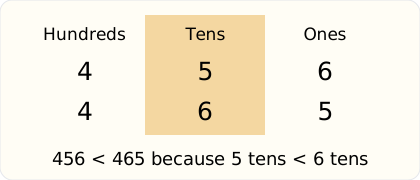 Their hundreds match, so compare tens. Five tens is less than six tens; therefore 456 is less than 465. The six ones in 456 do not overturn that decision. One extra ten is worth more than any difference between single ones digits. Place value explains why the first different place, read from the largest place downward, decides the comparison.