Whether a number can be split into two equal groups, or paired up with none left over.
Paper packet. Every task here also exists on screen, where it is checked automatically; answers written on paper are not assessed by Nydus. When you are back at a device, enter your answers there.
1. What you will learn
In this lesson you decide whether a number is even or odd, and see two ways of saying the same thing: it can be split into two equal groups, or its objects can be paired up with none left over. Then you notice what happens when you add two evens or two odds — a pattern children find genuinely surprising, and one that comes back years later as modular arithmetic.
2. Make partners
Count a small collection of counters, then put two together. Two objects together make a pair. Keep making pairs until every object has a partner or only one remains. You can draw circles if counters are not available. Do not break an object into pieces: we are counting whole objects. Today you will connect this pairing action with two equal groups and with an addition equation. You will explain your answer, not just memorize a label.
3. Words for grouping
Term
What it means
pair
A group of exactly two objects.
even number
A whole number that can be grouped in pairs with no object left over.
odd number
A whole number that leaves one object when paired completely.
equal groups
Groups containing the same number of objects.
double
The sum of two equal whole-number addends.
4. An even collection has a partner for everyone
Count the upper collection. Five pairs contain ten counters, and none is left alone. Ten is even. The lower collection has those same five pairs plus one counter without a partner. Eleven is odd. The difference is the leftover after all possible pairs have been made. A collection is not odd just because you happened to leave one counter away from the others before finishing.
Move the objects from each pair into two rows, one object above and one below. The upper collection becomes two rows of five, so 5 + 5 = 10. This shows why an even number can be expressed as a sum of two equal whole-number addends. For eleven, one row must have an extra counter if all counters are included. You can make rows of five and six, but not two equal whole-counter rows. Pairing and equal sharing describe the same number relationship.
Another way: steps
Count the collection once. Make as many pairs as possible. Count any leftover. Use no leftover to justify even and one leftover to justify odd. For an even total, write the equal-addend equation.
5. Check a pairing carefully
A useful pairing uses each object exactly once. If a counter belongs to two drawn loops, it has been counted twice. If a loop contains three counters, it is not a pair. You can avoid these mistakes by moving completed pairs into a tidy row and leaving unpaired counters in a separate space. When you finish, count by twos along the pairs, then include a possible leftover. The result should match the original collection count.
For fourteen counters, seven pairs give 2 + 2 + 2 + 2 + 2 + 2 + 2 = 14. Nothing remains, so fourteen is even. For fifteen counters, the same seven pairs account for fourteen, and one extra makes fifteen. That total is odd. The extra counter is not a mistake to erase. It is part of the original collection and the evidence needed to name the number correctly.
There cannot be two unpaired counters after you have made every possible pair. If two are left, they can partner each other. Three left can become one more pair and one leftover. Keep pairing until fewer than two remain. This explains why the final leftover is either zero or one. It also gives a way to check a classmate's drawing: a claimed leftover of two means the pairing is unfinished, not that the number belongs to a third category.
6. Turn pairs into equal addends
Pairs and two equal groups can look different while representing the same total. Arrange twelve counters in six vertical pairs. Take the top counter from every pair to make one group and the bottom counter to make another. Each group has six. The equation 6 + 6 = 12 records the equal groups. The repeated-addition equation 2 + 2 + 2 + 2 + 2 + 2 = 12 records the pairs. Both equations count the same twelve objects using different groupings.
Be clear about what a number describes. Six is the number of pairs in this arrangement and also the number of counters in each of the two rows. Two is the number of counters in a pair and the number of equal rows. Twelve is the total number of counters. If the question asks for the total, six is not the answer. If it asks for how many pairs, twelve is not the answer. Label the quantities while learning the relationship.
An odd collection can be written as a double plus one. Thirteen is 6 + 6 + 1. The equal groups account for twelve, and the remaining one completes the collection. Do not write 6 + 6 = 13. The equals sign requires the same total on both sides. You could write 6 + 7 = 13, but those are unequal addends. That equation is true while providing a different description of the collection.
7. See the alternating pattern
Begin with zero counters. There is no object left without a partner, and zero can be written as 0 + 0. Zero is even. Add one counter. It has no partner, so one is odd. Add another counter and the two can pair, so two is even. Add a third and one is left over, so three is odd. Continue this action rather than merely chanting the labels. Each new object either creates a leftover or partners the leftover already there.
That action explains why even and odd alternate as you count whole numbers. Four is even, five odd, six even, seven odd, and so on. Adding two preserves the kind of total because the two new objects can be paired with each other. Starting at an even number and counting on by twos stays even. Starting at an odd number and counting on by twos stays odd. The lone counter still lacks a partner while the added objects arrive in complete pairs.
You can use this pattern as a check after making a model. If your drawings say that fourteen and fifteen are both even, inspect the drawings. Consecutive whole numbers cannot both have complete pairings. One extra object changes whether a leftover remains. A pattern is convincing when you can connect it to that action. The alternating words alone are not an explanation of why the pattern continues.
8. Why the last digit is useful
Ten is even because ten objects make five pairs. Twenty is two groups of ten, so those tens can each be paired completely. The same is true for any whole number of tens. This lets the ones decide whether a larger collection leaves a partnerless object. In twenty-three, the twenty can be paired completely and the three ones make one pair plus one leftover. Twenty-three is odd.
The ones digits zero, two, four, six and eight can themselves be paired without a leftover. A whole number ending in one of these digits is even. The ones digits one, three, five, seven and nine leave one after pairing, so numbers ending with those digits are odd. This is a useful shortcut that comes from the structure of tens. It is not a rule about how curved or straight a printed digit looks.
Our main pairing work uses collections through twenty. The explanation about tens shows how the idea extends when a written number is larger than a collection you want to draw. For example, forty-six has complete pairs within its four tens and within its six ones. You do not need to draw forty-six individual objects to justify even. But if you forget the shortcut, rebuild a small example with counters. Understanding the grouping makes the shortcut dependable.
9. Combine collections and check the result
What happens when two even collections are combined? Each collection already has complete pairs. Putting them together leaves all those pairs complete, so the combined number is even. Six and eight demonstrate the idea: three pairs join four pairs, giving seven pairs and fourteen objects. The model explains the even result without relying on the final digit of fourteen.
Two odd collections have one leftover each. When combined, those two leftovers can make a new pair. The original pairs stay complete, so the combined total is even. For example, five has two pairs and one leftover; seven has three pairs and one leftover. Together the leftover counters make a sixth pair, and 5 + 7 = 12. An even collection and an odd collection leave just the odd collection's one leftover, so their sum is odd.
These are explanations about whole-object counts. They do not say that an odd number cannot be shared in any setting. A cake can be cut, but a team assignment requiring whole children cannot split a child. State what is being counted and whether pieces are allowed. In this lesson, counters represent whole counted objects. To check an answer, reconstruct the total from pairs and leftover: two objects for every pair, plus zero or one. The reconstruction must equal the original number.
10. Choosing game partners
A class in an invented Maine school has eighteen children present for a partner game. Two children per team make nine pairs with nobody waiting. If one more child arrives, there are nineteen. The nine original pairs can stay, but one child still needs a partner. The new total is odd. If another child joins, the two waiting children can pair and twenty children form ten pairs. This situation gives a reason to care about the leftover. Counting only teams would miss whether someone was unpaired. The arithmetic describes a possible arrangement, while the teacher still decides how to organize the actual game fairly. A label such as odd describes the count, not any child.
11. Packing two equal display rows
A classroom display uses sixteen paper stars. The group wants two rows with the same number of whole stars. Pairing the stars gives eight pairs. Put one star from each pair in the top row and the other in the bottom row; each row has eight. The equation 8 + 8 = 16 checks that all stars were used. If the class later finds a seventeenth star, putting it into one row makes the rows unequal. They can leave that star for another display or add a matching eighteenth star to restore two equal rows. The changed arrangement follows the changed count. Calling seventeen even would not solve the practical problem of where the extra whole star belongs.
12. Make the grouping prove the label
An odd number is not a number drawn with uneven spacing. Moving the same counters closer together does not change their count. A number is not even merely because you can draw two groups: those groups must be equal and include all the objects. Eleven can become groups of five and six, but those groups are unequal. Another mistake is to count pairs as though each were one original object. Five pairs contain ten counters. State whether you are counting pairs or counters. Finally, an unfinished arrangement with two loose counters can be repaired by pairing them. Only the leftover after all possible pairs matters.
13. Pair a small collection
Count the objects first.
8 counters.
This is the total we must preserve.
Make groups of two.
2 + 2 + 2 + 2 = 8.
Every group is a pair.
Check the remaining objects.
0 counters are left over.
All eight have been used exactly once.
Name the number's kind.
8 is even.
A complete pairing is the definition of even.
Record two equal addends.
4 + 4 = 8.
One counter from each pair goes in each equal group.
14. Account for a leftover
Read the collection total.
15 counters.
The model must include every counter.
Build complete pairs.
7 pairs contain 14 counters.
Two counters belong to each pair.
Find what remains.
15 - 14 = 1.
Only one counter has no partner.
Name the number's kind.
15 is odd.
A final leftover of one establishes odd.
Write a double and the extra.
7 + 7 + 1 = 15.
The equal rows account for fourteen, with one more.
Check the full count.
14 + 1 = 15.
Pairs and leftover reconstruct the original collection.
15. Combine two odd collections
Model the first collection.
5 = 2 + 2 + 1.
Five has two pairs and one leftover.
Model the second collection.
7 = 2 + 2 + 2 + 1.
Seven has three pairs and one leftover.
Keep the existing pairs.
2 + 3 = 5 pairs.
Combining collections does not break their pairs.
Partner the two leftovers.
1 + 1 = 2 objects, one new pair.
Both formerly lone objects now have partners.
Count every complete pair.
5 + 1 = 6 pairs.
The new pair joins the original five.
Recover the total objects.
6 + 6 = 12; 5 + 7 = 12.
Six pairs contain twelve objects.
Explain the even result.
No counter is left over.
The model, not just the last digit, justifies even.
16. Your turn: arrange nineteen counters
Make complete pairs.
9 pairs contain 18 counters.
Two counters belong to each pair.
Find the leftover.
19 - 18 = 1.
One of the original counters remains.
Your turn: work this step out. Its working is at the end of the packet.
Name and explain the kind.
Your turn: work this step out. Its working is at the end of the packet.
Reconstruct the total.
17. Guided practice
Every even number is a double. 10 is double which number?
Answer:
18. Guided practice
Match the pairing facts for 14.
can be arranged into 7 pairs
is the number of pairs
means the number is even
14 counters
7 pairs
nothing left over
19. Guided practice
A collection makes 5 complete pairs and one leftover. Complete the total.
Count the paired objects.
Each pair contains two objects.
Pairs are not single counters.
Include the unpaired object.
The collection has total objects.
The leftover belongs to the total too.
Check the number's kind.
One final leftover makes the collection odd.
A complete pairing would leave no object.
20. Guided practice
Every even number is a double. 12 is double which number?
Answer:
21. Practice
Every even number is a double. 18 is double which number?
Answer:
22. Practice
Every even number is a double. 16 is double which number?
Answer:
23. Practice
Every even number is a double. 20 is double which number?
Answer:
24. Somewhere new
A classroom packs these counters two per game bag. How many full bags are there, and how many counters are left over?
●●●●●●●●●●●●●●●●●
Groups of 2: Left over:
Audio transcript: None
25. Lesson test
Lesson test: one question per skill, one attempt each, no hints. Your answers are checked when you submit.
26. Test question
Arrange 13 whole counters into as many pairs as possible. Complete the record without reusing a counter.
Complete pairs
Leftover counters
Pairing record
27. What you can do now
You can say whether a number is even or odd and why. Without looking: what do you get when you add two odd numbers, and why does that happen?
Working for the steps left to you
16. Your turn: arrange nineteen counters, step 3
19 is odd.
Exactly one object is without a partner.
16. Your turn: arrange nineteen counters, step 4
9 + 9 + 1 = 19.
The two equal rows and leftover include every object.
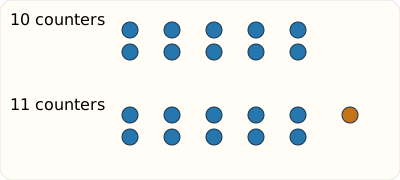 Count the upper collection. Five pairs contain ten counters, and none is left alone. Ten is even. The lower collection has those same five pairs plus one counter without a partner. Eleven is odd. The difference is the leftover after all possible pairs have been made. A collection is not odd just because you happened to leave one counter away from the others before finishing.