Writing 347 as 300 plus 40 plus 7, and what that shows.
Paper packet. Every task here also exists on screen, where it is checked automatically; answers written on paper are not assessed by Nydus. When you are back at a device, enter your answers there.
1. What you will learn
In this lesson you write a number as the sum of what each digit is worth: 347 as 300 + 40 + 7. It looks like extra work and it is the whole idea of place value made visible — the same digit means different amounts in different places, and expanded form is where you can see it. Every addition and subtraction method you learn later relies on it.
2. Bundles and loose objects
Ten loose ones can be bundled into one ten. Ten tens can be bundled into one hundred. The number of objects does not change when you bundle them. Today we will write a number in a way that shows the value of every place. Keep a few drawings of bundles beside your writing until the digits and their values make sense together.
3. Names for the same amount
Term
What it means
digit
One of the ten symbols 0 through 9 used to write numbers.
place value
The value a digit has because of its position in a number.
expanded form
A sum that shows the value of each nonzero digit separately.
standard form
The usual numeral with digits in their places, such as 406.
placeholder
A zero that keeps an empty place in a numeral.
4. One amount, several useful names
The number 347 names three hundreds, four tens and seven ones. Expanded form writes those values as 300 + 40 + 7. The equals sign in 347 = 300 + 40 + 7 says the two sides name the same amount. It does not say that the digits 3, 4 and 7 are being added without their places. That would make fourteen, a very different amount. Say each digit with its place before writing its value.
Another way: table
Place
Digit
Value
Hundreds
3
300
Tens
4
40
Ones
7
7
5. Read a place before writing a part
Start with a number such as 582. Read from the right: two ones, eight tens and five hundreds. Reading from the right is useful because the ones place always comes first there. You may then say the number in the usual order, five hundred eighty-two. Either way, every digit has a place. Write a small H, T and O above the three positions if it helps you keep track.
Five hundreds have a value of five hundred. Eight tens have a value of eighty. Two ones have a value of two. The expanded form is therefore 500 + 80 + 2. Each part counts objects, not written symbols. Imagine five packets of one hundred beads, eight bundles of ten beads and two loose beads. There are fifteen packages or loose pieces on the table, but there are 582 beads. The question about the total needs the number of beads, not the number of packages.
Compare 582 and 528. Both use the same three digits, but the eight and two have changed places. In 582, the eight is worth eighty. In 528, the eight is worth eight. Their expanded forms make this change visible: 500 + 80 + 2 and 500 + 20 + 8. A digit does not carry the same value wherever it goes. Point to its column and name the unit before deciding what it contributes.
6. Give zero its proper job
Look at the place chart for 406. Four hundreds are worth four hundred, there are no separate tens, and six ones are worth six. You can write 406 = 400 + 0 + 6 to show all three columns. You can also write 406 = 400 + 6 because adding zero does not change the total. Both equations are true. When a task provides three boxes, use zero for the tens box; when it asks only for nonzero parts, leave that zero part out.
The numeral itself still needs the zero. Writing 46 would move the four into the tens place and change its value to forty. Omitting a zero addend from a sum is different from erasing a placeholder in a numeral. Check this with bundles: four hundred-packets and six loose objects cannot suddenly become four ten-bundles and six loose objects. Keeping the amount the same is the test for any change in the writing.
Zeros can appear in other places too. The number 730 is 700 + 30; it has no separate ones. The number 800 has eight hundreds and no separate tens or ones. A chart can show 800 + 0 + 0, while the shortest expanded form is simply 800. Do not invent a nonzero part because you expect every answer to contain three addends. Read what the digits actually say. At one thousand, the next place is thousands, so 1000 has one thousand and zero hundreds, tens and ones.
7. Build the numeral from its values
To go back from 600 + 20 + 9, identify what each part contributes. Six hundred belongs in the hundreds column, twenty means two tens, and nine belongs in the ones column. The numeral is 629. You are not joining the written strings 600, 20 and 9 into a longer string. You are combining their amounts and recording how many units belong in each place.
The order of addends can change without changing the total. The sum 9 + 600 + 20 still makes 629. Sort the values by place before writing the numeral if they appear in an unfamiliar order. This is why a rule such as copy the first digit from each part can fail. It relies on how a question is arranged rather than on the amounts. Naming hundreds, tens and ones works in either order.
A missing place needs attention. From 500 + 8, there are five hundreds and eight ones, with no separate tens. Place a zero between the five and eight to write 508. From 70 + 300, there are three hundreds, seven tens and no ones, so write 370. You can check by expanding your answer again. If the expansion returns the original values, the digits are in the right places. If you get 50 + 8 after starting with 500 + 8, your hundreds place was lost.
Number names offer another check. Say three hundred seventy while pointing to 300 and then 70. The spoken word hundred should match the hundreds part, not the tens part. A clear written equation lets someone else check the amount even if the spoken number is hard to hear.
8. Keep equal regroupings separate from standard expanded form
There is more than one way to split an amount. For example, 462 = 400 + 60 + 2, and 462 = 300 + 160 + 2. Both are true equations. The first is the usual expanded form because it shows each digit's value separately. The second has exchanged one hundred for ten tens. It is useful when regrouping, but it does not directly list the values of the digits 4, 6 and 2. Read which kind of description the task requests.
Suppose you have three hundred-packets, fourteen ten-bundles and five loose counters. Writing 3145 would not describe that collection. Fourteen tens do not fit as a single digit in the tens column. Trade ten of those tens for one more hundred. There are now four hundreds, four tens and five ones. The total is 445. You changed the packaging, not the number of counters. Write 300 + 140 + 5 = 400 + 40 + 5 = 445 to show the same amount at each stage.
This also explains why the phrase no tens needs care. The numeral 406 has zero in its tens place, so its standard place-value description has no separate tens. Its four hundreds could still be opened into forty tens. We are describing the chosen grouping, not claiming that the whole number is smaller than ten. If someone asks how many complete groups of ten can be made from 406, the answer is forty, with six left over. If someone asks for the tens digit, the answer is zero. The question decides which quantity you need.
9. Use expansion to compare and diagnose
Expanded form helps you see why one number is larger than another. Compare 615 and 651. Both have six hundreds, so that part is equal. One has ten and the other has fifty before the ones are included. The difference in tens is enough to make 651 larger. Five ones cannot make up for four missing tens. Compare from the largest place where the numbers differ, rather than choosing the number with the largest ones digit.
Now examine a claim: 704 = 70 + 4. The four ones are correct, but the seven has been given the value of seven tens instead of seven hundreds. The right side makes 74, so it is much too small. Repair the claim by writing 700 + 4. Naming the wrong place explains the error more clearly than saying that a zero is missing somewhere. You know both where the error happened and how it changed the value.
For a final check, recombine the expanded parts. Count the hundreds, then add the tens, then the ones. Check that each digit has its correct value and that any empty position remains visible in standard form. You can use a rough size check too: a number beginning with seven in the hundreds place must be at least seven hundred and less than eight hundred. A proposed total of seventy-four cannot fit. If a sum has an unusual grouping such as 600 + 120 + 3, regroup it before comparing its standard digits.
When you explain your answer to a partner, point to one digit and finish the sentence, This digit is in the blank place, so its value is blank. Then point to the matching expanded part. Let your partner try the same explanation for another digit. This gives a reason that can be checked, instead of asking your partner to trust a memorized pattern.
10. Count the art-room stock
An art room has four unopened boxes of one hundred paper squares, seven bundles of ten squares and three loose squares. Record the stock as 400 + 70 + 3 = 473 squares. A helper counts fourteen things on the shelf because there are four boxes, seven bundles and three loose pieces. That count describes the packages and loose pieces, not the number of squares available for artwork. Label the unit on the record so another class knows which amount you mean. If one box is opened and its contents tied into ten bundles, the stock is still 473 squares. Only the packaging has changed; the record should not show a new purchase.
11. Check a delivery record
A classroom receives six packets of one hundred stickers and eight loose stickers. The delivery form mistakenly lists 68 stickers. Draw a hundreds, tens and ones chart and enter six, zero and eight. Explain that 68 describes six tens and eight ones, while the actual packets contain six hundreds. The corrected total is 608, with expanded form 600 + 8. Ask a partner to check the corrected record by rebuilding the packet amounts from the numeral. The zero is useful information: there are no separate ten-packets in this delivery. It is not a sticker and does not add an extra object to the count. Keeping the unit and packaging description beside the number makes the correction clear.
12. Value is not a digit count
Adding 3 + 4 + 7 counts the digit values without their places; it does not expand 347. A missing tens addend still needs a zero placeholder when you rebuild a three-digit numeral. Thirteen tens must be regrouped before they can be written with one digit in each column.
13. Expand a number with three nonzero digits
Locate the places.
538 has 5 hundreds, 3 tens and 8 ones.
Position gives each digit its unit.
Value the hundreds.
5 hundreds = 500.
Each hundred contains one hundred ones.
Value the tens.
3 tens = 30.
Each ten contains ten ones.
Keep the ones.
8 ones = 8.
Ones are already single units.
Join and check.
538 = 500 + 30 + 8.
The sum accounts for all three places.
14. Rebuild a number with an empty tens place
Read the given values.
9 + 600.
The addends may appear in either order.
Locate the largest part.
600 is 6 hundreds.
The six belongs in the hundreds column.
Locate the smallest part.
9 is 9 ones.
The nine belongs at the right.
Check the middle column.
There are 0 separate tens.
No tens addend has been supplied.
Write the numeral.
609.
Zero holds the empty tens place.
Reverse the process.
609 = 600 + 0 + 9 = 600 + 9.
The expansion returns the original amount.
15. Repair a grouping that cannot fit in one digit
Read the collection.
2 hundreds, 13 tens and 6 ones.
The tens count is larger than nine.
Write its value.
200 + 130 + 6.
Thirteen tens are worth one hundred thirty.
Separate ten of the tens.
130 = 100 + 30.
Ten tens can become one hundred.
Combine the hundreds.
200 + 100 = 300.
The regrouped hundred joins the existing hundreds.
Retain the other places.
3 tens and 6 ones remain.
Those parts were not exchanged.
Write standard and expanded forms.
336 = 300 + 30 + 6.
Every column now has a single digit.
Check the original total.
200 + 130 + 6 = 336.
Regrouping preserves the number of objects.
16. Finish a zero-place repair
Read the claim.
A learner writes 802 = 80 + 2.
Each side must name the same amount.
Identify the misplaced value.
The 8 is in the hundreds place.
Its value must count hundreds, not tens.
Your turn: work this step out. Its working is at the end of the packet.
Replace the incorrect part.
Your turn: work this step out. Its working is at the end of the packet.
Check your repair.
17. Guided practice
Write 731 in expanded form.
731 = a + b + c
18. Guided practice
Build the numeral from 600 + 8.
Locate the given values.
There are 6 hundreds and 8 ones.
The addends name place values.
Keep the empty place.
Use zero in the tens column to write number.
Moving hundreds next to ones without a placeholder changes their value.
Check by expanding.
The hundreds and ones values should match the original sum.
Reversing the process tests the placement.
19. Guided practice
What number is 900 + 80 + 4?
Answer:
20. Practice
Write 199 in expanded form.
199 = a + b + c
21. Practice
What number is 400 + 80 + 2?
Answer:
22. Practice
Write 995 in expanded form.
995 = a + b + c
23. Somewhere new
An art-room inventory records 804 paper squares in hundred-packets and loose squares. Write the inventory in expanded form using its two nonzero parts.
804 = a + b
24. Lesson test
Lesson test: one question per skill, one attempt each, no hints. Your answers are checked when you submit.
25. Test question
A class has 3 packets of 100 beads, 16 bundles of 10 beads and 9 loose beads. Regroup to standard places. Enter the VALUE in each place and the total beads.
Hundreds value
Tens value
Ones value
Total beads
Regrouped collection
26. What you can do now
You can write a number in expanded form and back again. Without looking: write 405 in expanded form, and say what the 0 is doing there.
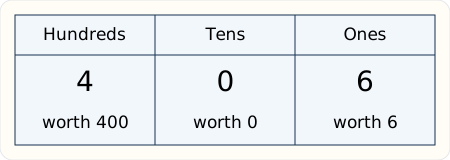 Four hundreds are worth four hundred, there are no separate tens, and six ones are worth six. You can write 406 = 400 + 0 + 6 to show all three columns. You can also write 406 = 400 + 6 because adding zero does not change the total. Both equations are true. When a task provides three boxes, use zero for the tens box; when it asks only for nonzero parts, leave that zero part out.