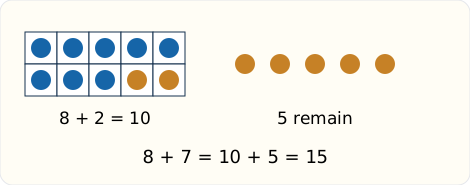
 The total is ten and five more, or fifteen. Moving counters has changed their arrangement, not their number. The equation 8 + 7 = 8 + 2 + 5 = 15 shows both parts of the seven, so none is lost or counted twice.
Back to the on-screen lesson ·
Add and subtract within twenty by going through ten, and decide whether a number is even or odd by pairing it up.
Paper packet. Every task here also exists on screen, where it is checked automatically; answers written on paper are not assessed by Nydus. When you are back at a device, enter your answers there.
In this lesson you make the facts within twenty quick by going through ten on the way, and you learn to tell an even number from an odd one by pairing it up. By the end you can answer a fact to twenty without counting on your fingers and say why seventeen is odd.
You can find sums and differences by counting. Keep that method available while you learn ways to use known facts. A full ten, a double, or a related addition can make a new calculation easier. Fluency means working accurately and choosing a useful method with growing ease. Explain how the parts fit together; then practice recalling the facts that have become familiar.
| Term | What it means |
|---|---|
| addend | An amount being added to another amount. |
| sum | The total found by addition. |
| difference | The result of subtraction. |
| double | A sum with two equal addends. |
| related facts | Addition and subtraction equations using the same parts and whole. |
To find 8 + 7, separate seven into two and five. Two counters join the eight to fill a ten frame; five remain outside.
Another way: steps
Find how many the first addend needs to make ten. Separate that amount from the other addend. Make ten, then add the part still left.
Start with a ten frame or ten counters. Separate the counters into two groups and record the pair: one and nine, two and eight, three and seven, four and six, five and five. Reversing the groups gives the same total. Zero and ten also make ten because adding zero does not change the amount. These pairs are useful landmarks for many sums within twenty.
Check a missing partner by looking at the empty spaces in the frame. If six spaces are filled, four remain. The statement six plus four equals ten is connected to ten minus six equals four. A single picture can show both an addition and a subtraction. Say what each number represents rather than treating the equations as unrelated strings to memorize.
Use a known partner when a larger sum crosses ten. For 6 + 8, six needs four. Separate eight into four and four. The first four fills ten; the other four makes fourteen. The amount moved must come from the second addend. If you add four to six but leave all eight still to add, you have invented four extra counters. Keeping a written record of the split prevents that error.
You do not need to make ten for every problem. For 10 + 4, the ten is already present. For 2 + 3, counting on or recalling five may be simpler. A strategy helps because of the numbers in the problem. Choose it for a reason, and keep the original total unchanged while rearranging its parts.
A double adds the same number twice. Six plus six equals twelve. You can check with two equal rows of six counters or with six pairs. When a double is familiar, a nearby sum may be only one small change away. Six plus seven is one more than six plus six, so it is thirteen. The second addend grew by one and the first stayed fixed, so the total grew by one.
For 8 + 7, you can use seven plus seven equals fourteen and add one more. You can also use eight plus eight equals sixteen and remove one. Both give fifteen. These are two explanations of the same result. The extra or missing counter has a specific place in the comparison; it is not a rule to add one to every sum that looks almost like a double.
Doubles connect to even numbers. Two equal groups can be paired with no object left over, so their total is even. A near double with one extra object has one leftover after pairing and is odd. For example, seven plus seven makes fourteen, an even number. Seven plus eight makes fifteen, with one extra beyond the two equal sevens. This checks the kind of answer you should expect, though parity alone cannot tell the exact sum.
If a learner claims 7 + 8 = 16, the parity check signals a problem: the sum should be one more than the even double fourteen, so it is odd. Then use the actual double to repair the value to fifteen. A check is most useful when it leads to an explanation of the correct amount. Saying the answer looks wrong without tracing the change does not complete the calculation.
The subtraction 15 - 8 asks for the part remaining when eight is removed from fifteen. It can also ask what must be added to eight to reach fifteen. Begin at eight, add two to reach ten, then add five to reach fifteen. The missing part is two plus five, or seven. The equation 8 + 7 = 15 checks 15 - 8 = 7.
Another route removes in stages. To find 15 - 8, remove five to reach ten, then remove three more because eight is five and three. Ten minus three is seven. Both methods use ten as a landmark, but the smaller steps play different roles. In the counting-on method, you add the jumps to find the missing part. In the take-away method, you track how much of the subtraction remains to be done.
For 14 - 6, counting on from six gives four to ten and four to fourteen, so the answer is eight. Removing in stages gives fourteen minus four equals ten, then ten minus two equals eight. The six removed was separated into four and two. Write the split beside the work if you are likely to lose track. The subtracted parts must total the original amount to remove.
Do not always choose the larger-looking number as the subtraction answer. The whole is the starting total, and either part may be the unknown. For 17 - 9, the missing part is eight; for 17 - 8, it is nine. Read which part was removed. Related facts share numbers, but their order still matters in subtraction.
The parts six and eight make the whole fourteen. You can write 6 + 8 = 14 and 8 + 6 = 14. Switching the addends preserves the total because the same two groups are combined. You can also write 14 - 6 = 8 and 14 - 8 = 6. Removing one part leaves the other. A parts-and-whole drawing makes all four relationships visible.
The whole belongs first in these take-away equations. Writing 6 - 14 = 8 does not describe removing a part from this fourteen-counter collection. We are working with whole-number amounts within twenty, so keep the situation and the equation connected. Point to the whole, point to the removed group, and then point to what remains.
A double has fewer different written facts because its two parts are equal. For seven, seven and fourteen, switching the addends still gives 7 + 7 = 14, and either subtraction gives 14 - 7 = 7. Do not force four different equations by inventing a new number. The structure matters more than filling a fixed number of lines. Zero can also be a part: 9 + 0 = 9 and 9 - 0 = 9 describe no change.
A missing box can appear in different places. In blank + 7 = 16, find the part that joins seven to make sixteen. In 16 - blank = 7, find the part removed to leave seven. Both missing amounts are nine, but you should explain the role of the box in each equation. A number sentence can show the whole on either side of the equals sign. The equality 16 = 9 + 7 is just as true as 9 + 7 = 16.
Practice a small group of connected facts until their answers become easier to recall. For example, knowing 7 + 7 = 14 supports 7 + 8 = 15 and 14 - 7 = 7. Say the fact, show a reason if needed, then try it again later without the model. If the answer is not yet remembered, using a sound strategy is productive practice. Guessing rapidly does not build a reliable connection.
Listen for off-by-one errors in counting on. Starting at nine and adding four means the next spoken counts are ten, eleven, twelve and thirteen. Nine is the starting amount, not the first added counter. If you count nine as one of the four steps, you stop at twelve. A finger, counter or number-line movement can track each actual addition until the distinction is secure.
Use a size check. Adding two positive amounts should give a total larger than either addend. Subtracting a positive part from a whole should give a result smaller than the whole. These checks do not solve the problem by themselves, but they can catch results such as 8 + 7 = 7 or 15 - 8 = 23. Follow the check with a model or related fact to find the correct result.
Use the inverse operation for a stronger check. After finding 16 - 9 = 7, add nine and seven to recover sixteen. If the check fails, inspect the ten-making split or the number of counted steps. Explain the correction before repeating the fact. With practice, many sums of one-digit numbers will be recalled directly. Keep their relationships available so that a forgotten fact can be rebuilt accurately and a remembered answer can still be justified.
A game tray has eight blue counters and seven orange counters. A learner moves two orange counters beside the blue ones to fill a ten frame, leaving five orange counters outside. The total is fifteen. Nothing new has been added to the tray; the arrangement simply makes the count easier to see. When seven counters are put away afterward, eight remain, connecting the subtraction to the original addition. The class can explain the result with the same model before practicing the fact without counters. If a written record says ten because it stopped after filling the frame, point to the five counters still outside and include them in the total.
A classroom needs seventeen name cards for a group activity. Nine cards are already on the table, and the rest are in a folder. To find the missing delivery, count one more from nine to ten and seven more from ten to seventeen. The folder must supply eight cards. The equation 9 + 8 = 17 records the complete plan, and 17 - 9 = 8 records the unknown part. A partner checks the delivered cards by combining them with the original nine. This uses a familiar fact in a real counting decision. The answer is eight additional cards, not seventeen new cards, because the first nine are already available.
Making ten does not mean adding extra counters. Split one addend, use only the needed part, and then add the remainder. When subtracting in stages, the removed parts must total the original subtrahend. A starting number is not an added step. Related facts preserve their parts and whole, but subtraction does not allow their positions to be exchanged freely.
Find the ten partner.
9 needs 1 more to reach 10.
Ten is a convenient full group.
Split the other addend.
6 = 1 + 5.
The moved one must come from the six.
Complete the ten.
9 + 1 = 10.
Only one of the six has been used.
Add the remaining part.
10 + 5 = 15.
All of the original six is now included.
Check the original sum.
9 + 6 = 15.
Rearranging the same counters preserves their total.
Identify the whole and part.
Find 16 - 7.
Sixteen is the whole and seven is the removed part.
Ask the related question.
7 + what = 16?
The missing part is the subtraction result.
Count to ten first.
7 + 3 = 10.
Three reaches the useful landmark.
Count from ten to the whole.
10 + 6 = 16.
Six more completes the gap.
Combine the two jumps.
3 + 6 = 9.
Both jumps belong to the missing part.
Check the subtraction.
16 - 7 = 9 because 7 + 9 = 16.
Addition reconstructs the original whole.
Read the claim.
A learner says 8 + 9 = 18.
The sum needs checking against the actual addends.
Choose a known double.
8 + 8 = 16.
Only the second addend differs from the problem.
Compare the addends.
9 is 1 more than 8.
The new sum gains one counter.
Adjust the known total.
16 + 1 = 17.
The first addend has not changed.
Explain the incorrect answer.
18 is 9 + 9, but the first addend is 8.
Using two nines adds an extra counter.
Check by subtraction.
17 - 9 = 8.
Removing one part recovers the other.
Check the parity.
17 is odd: it is one beyond the double 16.
A near double has one unmatched counter.
Read the sum.
Find 7 + 6.
A known double may help.
Choose the nearby double.
6 + 6 = 12.
The first addend needs one more.
Adjust the total.
Check the answer.
What is 9 + 5?
Answer:
Find 9 + 9 by making ten.
Find the needed part.
9 needs 1 to make ten.
A full ten simplifies the next addition.
Separate the second addend.
After using 1 of 9, remaining remain.
Only part of the second addend has been used.
Complete the calculation.
Add the remaining part to ten.
Every original counter must be included once.
What is 16 - 7?
Answer:
What is 8 + 7?
Answer:
What is 13 - 4?
Answer:
The numbers 6, 5 and 11 make one fact family. Finish the two subtraction facts.
6 + 5 = 11 and 5 + 6 = 11, so 11 - 6 = p and 11 - 5 = q
A bag held some counters. Jo removed 8 counters and found 6 left inside. Record the starting number and the answer to your subtraction check: starting number minus 8.
| Counters at the start | Subtraction check result | |
|---|---|---|
| Counter record |
Lesson test: one question per skill, one attempt each, no hints. Your answers are checked when you submit.
A class needs 11 name cards and has 6 ready. Find how many more cards are needed. After those extra cards are delivered, a second group adds 3 cards to that delivery pile. How many cards are in the delivery pile then?
| Extra cards needed | Delivery pile after addition | |
|---|---|---|
| Card record |
You can add and subtract within twenty by making ten, finish a fact family, and say whether a number is even or odd and what an even number is double of.
16. Rebuild a forgotten fact, step 3
12 + 1 = 13.
Only one counter was added to the double.
16. Rebuild a forgotten fact, step 4
13 - 6 = 7.
The inverse operation recovers the other addend.