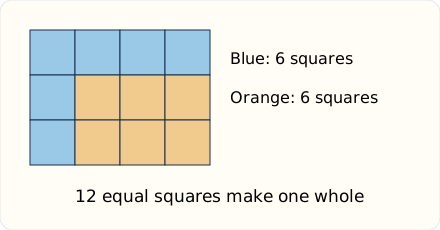
 The blue region has four squares across the top and two more down the left side. It contains six squares. The orange rectangle contains two rows of three, also six squares.
Back to the on-screen lesson ·
Equal shares of a shape, and why the pieces must be the same size.
Paper packet. Every task here also exists on screen, where it is checked automatically; answers written on paper are not assessed by Nydus. When you are back at a device, enter your answers there.
In this lesson you cut shapes into two, three or four equal parts and name them: halves, thirds, fourths. The word equal is doing all the work — four pieces that are not the same size are not fourths, however many there are — and getting that right now is what stops a great deal of trouble with fractions next year.
You have covered rectangles with equal squares and counted rows. Now use those pieces to check fair shares. Begin by pointing to the entire shape that is one whole. A share describes part of that chosen whole. We will split circles and rectangles into equal parts, name halves, thirds and fourths, and explain why the size of the shares matters as much as their number.
| Term | What it means |
|---|---|
| whole | The complete shape or amount chosen as one unit. |
| half | One of two equal shares that together make the whole. |
| third | One of three equal shares that together make the whole. |
| fourth or quarter | One of four equal shares that together make the whole. |
| equal area | Covering the same amount of flat space, even if the shapes differ. |
A rectangle split into four pieces has four pieces, but they are fourths only if all four shares cover equal amounts of the rectangle. Each must be one of four equal parts of the same whole. Three narrow strips and one wide strip do not become fourths just because there are four of them. Count the pieces, check their sizes, and check that together they fill the whole without gaps or overlap.
Another way: table
| Equal shares in one whole | Name of one share | Name of the whole in shares |
|---|---|---|
| 2 | one half | two halves |
| 3 | one third | three thirds |
| 4 | one fourth | four fourths |
To make halves, partition the whole into two equal shares. A rectangle can be split down the middle from top to bottom, making two equal side-by-side rectangles. It can also be split across the middle from left to right, making a top and bottom share. The cuts look different, but each gives two equal amounts of the same rectangle. Name each share one half. Together, the two halves make the whole.
For a paper rectangle, folding so opposite edges meet can help you locate a halfway cut. Open the fold and compare the two regions. A fold is useful evidence when the parts fit exactly over each other. Do not call a crease a halfway line merely because it looks near the middle. Check where the edges land. On a grid, counting equal small squares gives another way to check the areas.
A circle can be divided into halves by a straight cut through its center. The two semicircles cover equal areas. A cut that misses the center makes one piece larger than the other, so those two pieces are not halves. You do not need to calculate a circle's area to notice that a very small cap and a large remaining region are unequal.
Keep the whole visible while naming a share. If a shaded piece is one half of a small rectangle, it need not be one half of a larger rectangle drawn around it. The words one half describe a relationship to the chosen whole. Point to that whole or outline it clearly before discussing the shaded part.
Thirds require three equal shares. In a rectangle, three strips of equal width running the full height will have equal areas. Mark the width in three equal intervals, then draw the two dividing lines. There are three regions even though only two interior lines were drawn. Count the spaces made by the cuts, not the cuts themselves. Each region is one third, and all three regions together are three thirds, or one whole.
Fourths require four equal shares. You can split a rectangle into four equal strips. You can also split it in half and then split each half into two equal parts. A cross through the middle can make four equal smaller rectangles. All four shares must be equal to one another. Cutting one half into two pieces while leaving the other half unchanged makes three pieces, but they are not thirds: one piece is still half the whole and the other two are smaller.
The words fourth and quarter name the same size share. One quarter of a shape is one of four equal parts. In this lesson, quarter refers to a share, not to a coin. Context tells which meaning is being used. You can say two fourths, three fourths and four fourths by counting how many equal quarter-pieces you include.
A circle also can be shared into thirds or fourths. The slices must cover equal areas. Equal slices drawn from the center have equal turns at the center. A cross through the center makes four equal quarter-circles. Simply drawing three or four lines somewhere in the circle does not guarantee equal shares. Check the actual regions the lines create.
Once a whole has been partitioned into equal parts, keep the part size fixed while counting selected pieces. In a bar cut into thirds, shading two parts gives two thirds. The word thirds tells the size of each counted piece; the word two tells how many pieces are shaded. The unshaded part is one third of the same whole. Two thirds and one third together fill the bar.
For a bar divided into fourths, shading three parts makes three fourths, leaving one fourth unshaded. Shading all four parts makes four fourths, which is one whole. The whole does not become four separate wholes because four parts are colored. They are four pieces of the one original whole. Keep an outline around the complete bar to make that unit clear.
You may see these shares written with two numbers, such as 3/4. The bottom number says the whole was divided into four equal parts. The top number counts three of those parts. Read the notation as three fourths. You can understand the words and model before memorizing the names numerator and denominator, which will be studied more closely in the fractions course.
Some practice also uses sixths and eighths as an extension. Their names follow the same rule: six equal parts make sixths, and eight equal parts make eighths. One sixth is one of six equal shares of the whole; five sixths includes five of those shares. The main work here remains halves, thirds and fourths. For any new name, check the equal partition and the chosen whole rather than guessing from the number of colored regions alone.
Pieces that fit exactly over one another have equal areas, but that is not the only way to make equal shares. Equal areas can have different outlines. Look at the rectangle tiled with twelve equal small squares.
Six plus six is twelve, so the two regions cover equal amounts and together fill the whole rectangle. Each is one half. One region has an L-shaped outline and the other is rectangular; their shapes are different. Counting equal square units establishes the equality that their outlines do not immediately show. It would be wrong to reject these halves only because the pieces do not match in shape.
This check depends on the small squares being equal. Six large squares and six small squares need not cover the same area. The count is evidence only when every counted unit has the same size. In our diagram, all twelve grid squares use the same side length, so six units measure the same amount wherever they lie.
You can explore this with paper tiles. Choose a whole rectangle of twelve equal squares. Mark six squares for one share and leave six for the other. Check that all squares belong to exactly one share. Different choices can make different outlines while preserving half the area. If a task also requires each share to be one connected piece, check that extra condition separately. Equal area alone does not tell whether the selected squares touch one another.
For the same whole, one half is larger than one third, and one third is larger than one fourth. Sharing a fixed amount among more equal pieces makes each piece smaller. Imagine one paper bar shared fairly between two people, then an identical bar shared fairly between four. The four-person sharing gives each person a smaller piece because the original bars have equal size.
This statement needs the same-whole condition. Half of a very small cake can be smaller than a fourth of a much larger cake. The share names alone do not tell the actual amount when the wholes differ. Compare identical wholes first, or use a common measurement of the pieces. Do not assume every drawing on a page represents the same whole size unless the diagram or words establish it.
Two fourths of one whole cover the same amount as one half of that whole. You can see this by dividing each half into two equal parts. Each half then contains two fourths, and there are four fourths altogether. The number of selected pieces changed because the pieces became smaller, not because the shaded amount increased. This connection will help you recognize equivalent fractions later.
When checking a claim about equal shares, give evidence in order. Identify the whole, show how it is partitioned, establish that the parts are equal in area, and count the selected parts. If a claim fails, say which check failed. There might be four pieces of unequal size, or equal pieces that do not cover the whole, or a different whole being used halfway through. Naming the problem makes the repair clear. A fraction name should summarize a fair partition, not hide an untested assumption about the picture.
Two groups need equal space on one rectangular poster. One group would like a long strip across the top and a strip down the left side; the other would like a rectangular space in the lower right. The class overlays a grid of twelve equal squares. The first plan uses six squares in an L shape and leaves six squares in a rectangle. Each group receives half the poster because the areas are equal and together cover the whole. The teacher can check the unit-square count rather than reject the plan because the outlines differ. If one small square is moved from one group to the other, the areas become seven and five, so the sharing is no longer equal.
A craft group has one rectangular sheet to share among four learners. They first make four equal strips, so each learner receives one fourth. Two learners combine their strips for a joint design and now have two fourths of the original sheet. Their amount is one half of that same whole. The class keeps the original sheet outline in its drawing to avoid calling each new strip a whole sheet. If the next group uses a larger sheet, one fourth of that sheet may be a different physical size. Fairness within each group comes from equal shares of its own sheet; comparing between groups needs a check of the original sheet sizes as well.
A share name requires equal areas, a stated whole and a complete partition. Counting pieces without checking their sizes can give a false name. Equal shares can have different shapes, as a common square grid can prove. A larger number of equal pieces means smaller individual pieces only when the whole stays the same.
Identify the whole.
One complete rectangular sheet.
The share must refer to a stated unit.
Check the partition.
A middle fold makes two regions.
The regions together fill the sheet.
Check the two areas.
The regions fit exactly over each other.
Matching regions have equal areas.
Name one of the equal regions.
Each of the two equal regions is one half of the sheet.
A half is one of two equal shares.
Rebuild the whole.
Two halves make one whole sheet.
Both shares account for the full original region.
Locate the whole.
One bar is the whole.
The outside boundary defines one unit.
Read the partition.
The bar has four equal parts.
Each part is one fourth.
Read the requested share.
Shade three fourths.
Three counts how many fourth-size pieces are selected.
Select the parts.
Shade three of the four equal regions.
The parts can be counted without changing their size.
Account for the rest.
One fourth remains unshaded.
All four parts must be included in shaded or unshaded regions.
Check the whole.
Three fourths and one fourth make four fourths.
Four fourths fill the whole bar.
Identify the whole.
A rectangle contains 12 equal squares.
Every small square has the same area.
Count the first region.
An L-shaped region contains 6 squares.
Count each selected square once.
Count the other region.
The remaining rectangle contains 6 squares.
Its two rows of three give six.
Compare the areas.
6 equal squares cover the same area as 6 equal squares.
A common unit allows a fair comparison.
Check the complete cover.
6 + 6 = 12.
No part of the whole is missing or counted twice.
Name the shares.
Each region is one half.
There are two equal-area shares.
Explain the unfamiliar outlines.
The L shape and rectangle differ in shape but not area.
Equal shares need not have identical outlines.
Locate the whole.
A bar has three equal strips.
All strips together form one whole.
Name one strip.
Each is one third.
There are three equal shares.
Count the selected strips.
Name what remains.
Shade five sixths of the bar.
Shade the parts:
A rectangle has 6 equal small squares. It is shared into two equal-area regions. How many small squares belong to each half?
Name the whole and the sharing rule.
The whole has 6 equal squares and needs two equal shares.
Both the unit and equality condition are stated.
Find equal counts.
Each region needs share squares.
Equal squares measure area with a common unit.
Check the complete cover.
The two equal counts must total 6.
The halves together must fill the whole.
Shade one sixth of the circle.
Shade the parts:
Shade two fourths of the bar.
Shade the parts:
Shade one third of the circle.
Shade the parts:
Shade one fourth of the bar.
Shade the parts:
Match each unit-fraction fact to what it tells you about the cake pieces.
| means 3 equal pieces | means 8 equal pieces | makes each piece bigger | |
|---|---|---|---|
| one third | |||
| one eighth | |||
| The same cake is cut into fewer equal pieces |
Audio transcript: None
Lesson test: one question per skill, one attempt each, no hints. Your answers are checked when you submit.
A whole craft sheet was shared into 4 equal parts (fourths). One part has been used. On this fresh model of the original whole, shade the amount still available.
Shade the parts:
You can cut a shape into equal shares and name them. Without looking: if a shape is cut into four pieces that are not the same size, are they fourths?
16. Finish a thirds check, step 3
Two shaded strips make two thirds.
The number selected is two.
16. Finish a thirds check, step 4
One third is unshaded.
Two thirds and one third fill the whole.