Read three-digit numbers by place, count on in fives, tens and hundreds, and write expanded form.
Paper packet. Every task here also exists on screen, where it is checked automatically; answers written on paper are not assessed by Nydus. When you are back at a device, enter your answers there.
1. What you will learn
In this lesson you read three-digit numbers by their places, count on in fives, tens and hundreds, and write a number out as the parts it is made of. By the end you can say what any digit of a three-digit number is worth.
2. Group ten units into a new unit
You already use tens and ones to describe two-digit numbers. Ten ones make one ten. The same grouping idea continues: ten tens make one hundred, and ten hundreds make one thousand. Each exchange changes the way the amount is grouped, not the amount itself. We will connect bundles, place charts, written numerals and number names through one thousand.
3. Words for base-ten units
Term
What it means
one
A single unit in the chosen collection.
ten
A group of ten ones, treated as a new unit.
hundred
A group of ten tens, equal to one hundred ones.
thousand
A group of ten hundreds.
regroup
Exchange equal amounts between units without changing the total.
4. A hundred contains ten tens
The hundred grid has ten equal rows, each containing ten unit squares. Counting the rows by tens gives ten, twenty, thirty, forty, fifty, sixty, seventy, eighty, ninety, one hundred. The complete grid is one hundred-unit, but it still contains ten tens and one hundred ones. A place-value model lets you choose a useful grouping while keeping the underlying amount visible.
Another way: table
Hundreds
Tens
Ones
Number
2
4
3
243
3
0
6
306
7
5
0
750
5. Read a collection in units
Suppose a collection contains two hundred-packets, four ten-bundles and three loose counters. The two packets contribute two hundred counters, the four bundles contribute forty, and the loose counters contribute three. Write 200 + 40 + 3 = 243. The digit two records the count of hundreds, four records the count of tens, and three records the count of ones. Each digit counts a different-size unit.
A common error is to add two, four and three and report nine. Nine counts the packages and loose pieces sitting on the table, not the counters inside them. If the task asks how many counters there are, you must include what every package contains. Labels are part of the mathematics. Two hundreds and two ones have the same group count but very different values.
A proportional model helps you see the difference. A ten-strip should contain ten copies of the one-square, and a hundred grid should contain ten of those strips. When you draw a quick sketch, you may use a large square for a hundred, a line for a ten and a dot for a one, provided those meanings are stated. A quick symbol is a shorthand for the grouping, not proof that any large square automatically represents one hundred.
To check a collection, count one unit type at a time. Count the hundreds, then the tens, then the ones. Record each count in its labeled column. If a column contains ten or more units, regroup before writing a single digit in that place. This keeps the numeral connected to the quantities it represents.
6. Read and write number names
The numeral 243 is read two hundred forty-three. The words two hundred name the first part, and forty-three names four tens and three ones. The numeral 306 is read three hundred six. There are no separate tens to name, but the written numeral still needs a zero in the tens column. Saying the number and writing its expanded form are two ways to check that each value is represented.
For 750, say seven hundred fifty. The zero ones do not add a spoken ones amount. For 900, say nine hundred. The tens and ones columns are both empty of separate units, so both digits are zero. Practice translating in both directions: from words to a place chart, and from a place chart to a numeral. Do not simply copy the order of digits from an unlabeled list; identify their units.
Whole hundreds form a useful sequence: one hundred, two hundred, three hundred, up to nine hundred. Their numerals are 100, 200, 300 and so on. One thousand follows nine hundred when you add another hundred. The numeral 1000 has four places: one thousand, zero hundreds, zero tens and zero ones. It is not written as a three-digit number with a ten squeezed into the hundreds column.
Number names can sound different in everyday speech, but the place values remain fixed. Some speakers include and in a whole-number name, such as three hundred and six. The amount is still 306. In our written explanations, expanded form gives an unambiguous check: 300 + 6. Listen for the hundred and tens words, and use their values to build the numeral.
7. Explain the job of zero
Zero tells you that a place has no separate units in the standard grouping. In 508, there are five hundreds, zero tens and eight ones. The zero keeps the eight in the ones place and the five in the hundreds place. Writing 58 would make five tens and eight ones, which is only fifty-eight. The symbol zero contributes no amount in the tens place, but its position carries information.
Compare 508 and 580. Both use a five, an eight and a zero, but the eight has moved. In 508 it means eight ones; in 580 it means eight tens. The expanded forms 500 + 8 and 500 + 80 show the difference. When a zero changes places, other digits may change their values. Read the complete numeral instead of ignoring its zeros.
A zero tens digit does not mean the entire amount contains no groups of ten. Five hundreds can be exchanged for fifty tens. Thus 508 can be described as fifty tens and eight ones, even though its standard tens digit is zero. Distinguish the question what is the tens digit from how many full tens can be made. The first asks about the written standard grouping; the second allows regrouping.
Use empty columns explicitly when building a numeral from parts. If the parts are six hundreds and four ones, place six in hundreds, zero in tens and four in ones to make 604. If they are six hundreds and four tens, write 640. A chart can prevent the two descriptions from collapsing into the same mistaken numeral.
8. Trade units while preserving the total
Ten ones can be exchanged for one ten. If a collection has three hundreds, two tens and fourteen ones, separate ten of the ones and bundle them. You now have three hundreds, three tens and four ones, so the number is 334. The equation 300 + 20 + 14 = 300 + 30 + 4 shows equal amounts before and after the exchange.
Ten tens can be exchanged for one hundred. Four hundreds, twelve tens and five ones become five hundreds, two tens and five ones. The numeral is 525. Writing 4125 would not describe the collection; it would place a four in the thousands position and make a much larger amount. A column count above nine needs an exchange, not extra digits squeezed into one place.
You can also trade in the opposite direction. One hundred can be opened into ten tens. In 406, opening one of the four hundreds gives three hundreds, ten tens and six ones. The total remains 406. This regrouping will help with subtraction when a place does not contain enough separate units to remove. The hundred did not disappear; its value moved into ten tens.
Track both sides of every exchange. When ten tens become one hundred, remove those ten tens from the tens count and add one to the hundreds count. Doing only the second step increases the total incorrectly. When a hundred becomes ten tens, reduce the hundreds count by one. A written before-and-after chart lets a partner check that the exchange conserved the amount.
9. Use place value to predict changes
Adding one ten increases a collection by ten ones, while adding one hundred increases it by one hundred ones. From 326, ten more is 336 and one hundred more is 426. In these cases the smaller places stay the same. Explain the change using units instead of memorizing that one particular digit always changes. At a boundary, more than one written digit may need to change.
For example, ten more than 396 is 406. Nine tens plus one ten make ten tens, which regroup as one hundred. The hundreds digit increases, the tens digit becomes zero, and the six ones remain. Saying add one to the tens digit without considering regrouping would not give a valid numeral. The unit relationship explains the carry across the boundary.
Similarly, one hundred more than 900 is 1000. Ten hundreds make one thousand. One less than 1000 is 999, because opening the thousand into hundreds, tens and ones lets you remove a single one. You do not need to draw a thousand separate dots to reason about this; the nested groups of ten organize the count.
Place value also supports comparison. A number with six hundreds is larger than any three-digit number with five hundreds, because even five hundreds, nine tens and nine ones total only 599. If hundreds match, compare tens; if tens also match, compare ones. We will practice that method next. For now, use a size check whenever you read or build a numeral: does its hundreds part agree with the collection? Then expand the numeral to verify the remaining values.
10. Check a stockroom count
A school stockroom has five boxes of one hundred paper clips, three bundles of ten and seven loose clips. The inventory is 537 paper clips, not fifteen clips. Fifteen counts containers and loose pieces, while the inventory needs the contents. A helper records 500 + 30 + 7 beside the numeral so another person can check it. If a hundred-box is opened and its clips tied into ten-bundles, the stock count remains 537. There would be four hundred-boxes, thirteen ten-bundles and seven loose clips. Regrouping those thirteen tens restores the original standard description. The record changes packaging information only when that is what the question asks.
11. Count supplies near one thousand
A class collects sheets for an art project in packets of one hundred. Nine packets contain nine hundred sheets. Receiving one more packet gives ten hundred-packets, which together contain one thousand sheets. The written total changes from 900 to 1000, so the new numeral needs a thousands place. If one sheet is used, 999 remain. The class can check this by recognizing that 999 needs one more one to complete ten ones, which completes ten tens, which completes ten hundreds. This chain of equal exchanges explains the boundary without counting every sheet individually. Label the record sheets so the count is not confused with the number of packets.
12. Digits count units of different sizes
A digit's value depends on its position. Zero is needed to keep an empty place, even though it contributes zero to the expanded sum. A place containing twelve tens must be regrouped before standard notation is written. Exchanges change both affected unit counts; adding the new unit without removing its equal value from the old place changes the total.
13. Read a collection with an empty place
Identify the given units.
3 hundreds, 0 tens and 6 ones.
Each count belongs to a named place.
Value the hundreds group.
3 hundreds = 300.
A hundred contains ten tens.
Record the empty tens place.
Use 0 in the middle column.
The six ones must not move into the tens place.
Build and name the numeral.
306, read three hundred six.
The digits record the standard place counts.
Check by expanded form.
300 + 0 + 6 = 306.
The sum reproduces the original collection.
14. Regroup more than nine tens
Read the collection.
4 hundreds, 12 tens and 5 ones.
Twelve cannot fit as one tens digit.
Separate a group of ten tens.
12 tens = 10 tens + 2 tens.
Ten tens are the exchange group.
Make a new hundred.
10 tens = 1 hundred.
The traded units have equal value.
Update both counts.
5 hundreds and 2 tens remain with 5 ones.
The hundreds gain one while the tens lose ten.
Write the standard numeral.
525, read five hundred twenty-five.
Each place now has a single digit.
Check the original amount.
400 + 120 + 5 = 500 + 20 + 5.
Both descriptions total 525.
15. Cross a hundred by adding ten
Read the starting number.
396 = 3 hundreds, 9 tens and 6 ones.
The tens place is near an exchange boundary.
Add the stated unit.
Add 1 ten.
The change is ten, not one.
Combine the tens.
9 tens + 1 ten = 10 tens.
The existing and new units have the same size.
Exchange ten tens.
10 tens become 1 hundred and 0 separate tens.
The amount stays equal during regrouping.
Combine the hundreds.
3 hundreds + 1 hundred = 4 hundreds.
The regrouped hundred joins the original three.
Keep the ones unchanged.
The result is 406.
No ones were added or removed.
Check by subtracting the change.
406 - 10 = 396.
Undoing the change recovers the start.
16. Read the thousand boundary
Read the starting amount.
9 hundreds = 900.
There are no separate tens or ones.
Add another hundred.
9 hundreds + 1 hundred = 10 hundreds.
The units being combined match.
Your turn: work this step out. Its working is at the end of the packet.
Name the larger unit.
Your turn: work this step out. Its working is at the end of the packet.
Write and check the numeral.
17. Guided practice
A number is made of 1 hundreds, 8 tens and 0 ones. What is the number?
Answer:
18. Guided practice
Match each digit in 319 to its place value.
3 hundreds = 300
1 tens = 10
9 ones = 9
3 (first digit)
1 (middle digit)
9 (last digit)
19. Guided practice
A collection contains 3 hundreds, 12 tens and 7 ones. Find its standard numeral.
Exchange ten of the tens.
12 tens become 1 hundred and 2 tens.
Ten tens equal a hundred.
Update the place counts.
4 hundreds, 2 tens and 7 ones make number.
Standard notation uses one digit per place.
Check the original values.
The numeral should equal 300 + 120 + 7.
An exchange must preserve the total.
20. Guided practice
A number is made of 1 hundreds, 0 tens and 6 ones. What is the number?
Answer:
21. Practice
A number is made of 8 hundreds, 2 tens and 5 ones. What is the number?
Answer:
22. Practice
A number is made of 1 hundreds, 6 tens and 7 ones. What is the number?
Answer:
23. Somewhere new
A school records 943 paper clips. Pack them into as many hundreds as possible, then tens, then loose ones. Record the standard place counts.
943 is a hundreds, b tens and c ones
24. Lesson test
Lesson test: one question per skill, one attempt each, no hints. Your answers are checked when you submit.
25. Test question
A school has 5 hundred-packets, 4 ten-bundles and 8 loose clips. One hundred-packet is opened into ten ten-bundles. Record the new hundred-packet count, new ten-bundle count and total clips.
Hundred-packets
Ten-bundles
Total clips
After opening one packet
26. What you can do now
You can say what each digit of a three-digit number is worth, count on in fives, tens and hundreds, and write a number in expanded form and back again.
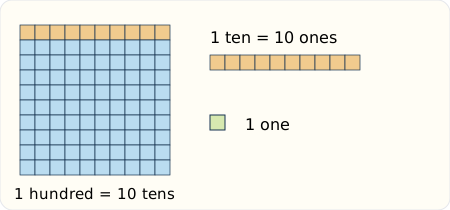 Counting the rows by tens gives ten, twenty, thirty, forty, fifty, sixty, seventy, eighty, ninety, one hundred. The complete grid is one hundred-unit, but it still contains ten tens and one hundred ones. A place-value model lets you choose a useful grouping while keeping the underlying amount visible.