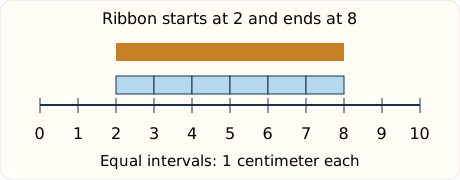
 There are six one-centimeter spaces. The label eight tells where the ribbon ends on this scale. It does not include the information that the ribbon began at two.
Back to the on-screen lesson ·
Lengths as jumps on a line, and differences as the gap between two points.
Paper packet. Every task here also exists on screen, where it is checked automatically; answers written on paper are not assessed by Nydus. When you are back at a device, enter your answers there.
In this lesson you show lengths on a number line, and find the difference between two lengths as the gap between two points. It links measuring to the number line you already use for counting, and it is the picture that makes 'how much longer' a subtraction rather than a guess.
A length tells how much distance is covered from one endpoint to another. You have used rulers and counted forward and backward. A number line brings these ideas together: a point names a position, while an interval names the distance between two positions. Keep those jobs separate as you use jumps to show sums, differences and missing lengths.
| Term | What it means |
|---|---|
| position | A location named by a number on the line. |
| unit interval | The distance representing one unit, repeated equally along the line. |
| endpoint | A position where a segment or movement begins or ends. |
| distance | The amount of space between two positions. |
| scale | The relationship between spacing on the line and the numbers it represents. |
A ribbon starts at the two-centimeter mark and ends at the eight-centimeter mark. Its length is six centimeters, not eight. Count the intervals from two to three, three to four, four to five, five to six, six to seven and seven to eight.
Another way: equation
Starting position + distance = ending position. Here, 2 + 6 = 8, so 8 - 2 = 6.
First locate the labeled positions. On a line marked zero, one, two, three and so on at equal distances, every neighboring space represents one unit. On another line, neighboring marks may be zero, five, ten and fifteen. Those equally drawn spaces each represent five units. The physical size of a space on a page does not decide its value; the labels and scale do.
Use two nearby labeled points to check the scale. If labels ten and twenty have two equal intervals between them, each interval represents five. Ten units have been shared between two spaces. If they have ten intervals between them, each represents one. Do not assume that every visible mark increases the number by one. Say the size of one interval before moving a marker.
Equal numbers need equal spacing. A line showing zero, ten, twenty and thirty should place those labels equally far apart. If the space from ten to twenty is much shorter than the space from twenty to thirty, the picture cannot be used as an evenly scaled number line. Repair the spacing or use the written numbers directly. A neat-looking arrow does not make an incorrect scale trustworthy.
Also read the unit. A line marked centimeters describes lengths in centimeters; a line without a physical unit may simply describe numbers. We can practice addition on either, but a length story needs a length unit in the answer. If one ribbon is measured in inches and another in centimeters, their bare numbers cannot be compared as though they came from the same scale.
To show 24 + 13, start at twenty-four, then move thirteen units to the right. The landing is thirty-seven. Twenty-four names the starting position, thirteen names the distance moved, and thirty-seven names the final position. These are three different roles. Mark the starting point before counting so that you do not accidentally begin at zero or count the start as your first unit of movement.
You can break the thirteen-unit movement into a ten-unit jump and a three-unit jump. Twenty-four plus ten is thirty-four; three more reaches thirty-seven. Both smaller jumps go right because both add a positive length. Label the arcs ten and three so a partner can check that their combined length is thirteen. The size of an arc should match the distance between its endpoints on an evenly scaled diagram.
On a line with five-unit intervals, a jump of fifteen needs three intervals. Count five, ten, fifteen as you cross them. Counting fifteen marks would move much too far. If you stop at the start and call it five, you move one interval too little. Touch the spaces or trace the movement between marks while keeping track of the distance added.
A ribbon story can use the same model. A short ribbon is twenty-four centimeters and a second piece is thirteen centimeters. Placing them end to end without overlap gives thirty-seven centimeters altogether. Beginning at twenty-four on the line keeps the first length already counted, then the jump adds the second. The model assumes the pieces meet exactly; overlap would change the combined outside length.
To show 42 - 17 by removal, start at forty-two and move seventeen units to the left. Move ten to thirty-two, then seven to twenty-five. The final position names the amount remaining. The leftward movement decreases the number, but the seventeen-unit distance traveled is still a positive length. A direction tells which way to move; a length tells how far.
Subtraction can also find the gap between two amounts. Suppose ribbons are twenty-five and forty-two centimeters long. Draw both from the same zero point. The longer one reaches seventeen centimeters beyond the shorter. Count forward from twenty-five to forty-two: five to thirty, ten to forty, and two to forty-two. The jumps total seventeen. Counting on and taking away answer the same comparison because 25 + 17 = 42 and 42 - 25 = 17.
Decide what the question asks before choosing which number to report. For a move from forty-two left seventeen, the answer is the landing twenty-five. For the distance between twenty-five and forty-two, the answer is seventeen. Both situations use the same three numbers but a different unknown. Label the missing part of the equation or picture rather than applying a rule without reading.
Distance between two positions does not change when you describe them in the opposite order. The distance from twenty-five to forty-two is the same as the distance from forty-two back to twenty-five. At this stage, subtract the smaller position from the larger to find that distance. You are finding how far apart the points are, not giving a signed direction.
A damaged ruler may have its zero end missing. You can still find a length using two readable marks. If an object's endpoints line up with four centimeters and eleven centimeters, the length is seven centimeters. Subtract four from eleven or count the seven unit spaces between them. Reporting eleven would include four centimeters before the object began.
A ruler is a number line with a physical unit, so the same reasoning applies to a drawing. Always inspect both endpoints. If the object begins at zero, the ending label and the length happen to be equal. That useful shortcut does not work at every starting position. The general relationship is start plus length equals end. It works whether the start is zero, four or another labeled position.
Imagine sliding a five-centimeter strip along a ruler without stretching it. From zero it ends at five. From three it ends at eight. From six it ends at eleven. The positions change, but every subtraction of start from end gives five. This is a useful check: moving an object should not change its length. If a method reports a different length after the slide, it is probably confusing position with distance.
Do not count both endpoint marks as units. From four to eleven, there are eight whole-number marks including both ends, but only seven spaces. A fence offers a similar picture: two posts hold one panel between them. The distance comes from the spaces, not the number of boundary posts. Trace each space once to check an answer that seems one unit too large.
Sometimes you know the landing and the length moved but not the start. A marker lands at sixty-three after moving eighteen units right. Undo that movement by going eighteen units left from sixty-three. Ten left reaches fifty-three and eight more left reaches forty-five. The start was forty-five. Check by moving eighteen right again: forty-five plus eighteen is sixty-three.
When the change is unknown, compare the endpoints. A marker starts at thirty-six and lands at fifty-four after moving right. Count four to forty, ten to fifty and four to fifty-four. The total change is eighteen. You can also subtract thirty-six from fifty-four. The start and end are positions; the missing number describes the movement between them. Write the unit if these positions represent a real length.
A two-step route needs both direction and distance for each move. Start at thirty, move twenty right, and then fifteen left. The first landing is fifty and the final landing is thirty-five. The total distance traveled is thirty-five units, because both movements covered ground. The final position is also thirty-five here, but that equality is a coincidence. Starting at forty would give final position forty-five while the total traveled distance stayed thirty-five. Read whether the task asks for a landing, a net change or the distance traveled.
Check any solution in two ways. Follow the labeled jumps to see whether they reach the proposed endpoint, then use an equation to verify the amounts. If the picture and equation disagree, check the scale, the starting mark and the count of intervals. These specific checks are more useful than guessing another nearby number. Explain which quantity your answer names so a partner can tell that the calculation answers the actual question.
A classroom ruler has a chipped beginning, so a learner lines a paper strip up with the readable three-centimeter mark. The other end lies at twenty-six centimeters. The strip is twenty-three centimeters long because 26 - 3 = 23. Another learner checks by counting seven centimeters from three to ten, ten more to twenty, and six more to twenty-six. Those jumps total twenty-three. Writing down both endpoint readings makes the measurement understandable to someone who did not watch. If the strip is moved to start at five, it should end at twenty-eight. The length remains twenty-three centimeters because the paper has been moved, not stretched.
A class has one ribbon measuring forty-eight centimeters and another measuring sixty-five centimeters. Lay their starting ends together or draw both from zero on a centimeter line. The longer ribbon extends seventeen centimeters beyond the shorter. Count two centimeters from forty-eight to fifty, ten more to sixty, and five more to sixty-five. The sum is seventeen. If the class cuts seventeen centimeters from the longer ribbon, the remaining length matches the shorter one. Check with 65 - 17 = 48. The comparison depends on using the same unit and lining up the beginnings. Starting one ribbon farther to the right would make the endpoints alone a misleading picture of their lengths.
An endpoint label is a position, not automatically a length. Count intervals rather than boundary marks, and read how many units each interval represents. Moving left changes the endpoint in the opposite direction from moving right. A diagram with unequal spacing for equal numerical changes cannot be read as an evenly scaled number line.
Read the scale.
Each interval is 5 units.
The labels increase by five at neighboring marks.
Mark the start.
Begin at 20.
The starting position is given separately from the jump.
Count the movement.
15 units require 3 intervals.
5 + 5 + 5 = 15.
Locate the landing.
20, then 25, 30, 35.
Three rightward intervals add fifteen.
Check the equation.
20 + 15 = 35.
Start plus change equals end.
Locate both endpoints.
A strip runs from 7 cm to 19 cm.
The start is not zero.
Name the unknown.
Find the distance between the endpoints.
The ending label alone is not the strip length.
Count to a useful landmark.
7 to 10 is 3 cm.
Ten makes the remaining gap easier to count.
Complete the gap.
10 to 19 is 9 cm.
Both jumps cover the strip without overlap.
Combine the distances.
3 + 9 = 12 cm.
The two intervals together span the whole strip.
Check by subtraction.
19 - 7 = 12 cm.
Removing the unused beginning gives the same length.
Read the route.
Move 20 right, then 15 left, ending at 65.
The starting position is missing.
Undo the last move first.
65 + 15 = 80.
Adding back reverses the leftward move.
Undo the first move.
80 - 20 = 60.
Subtracting twenty reverses the rightward move.
Name the proposed start.
Start at 60.
Both movements have now been undone.
Check the first forward move.
60 + 20 = 80.
The check follows the original order.
Check the second forward move.
80 - 15 = 65.
The check returns the stated final position.
Distinguish the quantities.
Start 60; end 65; net increase 5.
The route's total traveled distance is 35, a different quantity.
Read the endpoints.
Start at 38 cm and end at 61 cm.
The unknown is a distance.
Break the gap at tens.
38 to 40 is 2; 40 to 60 is 20.
Convenient landmarks simplify the count.
Finish and combine.
Check the relationship.
Start at 25 and jump 25 to the right. Move the marker to where you land.
0 |——————————| 100
Mark the position with a cross, then write the value:
A strip starts at 8 cm and ends at 24 cm on a ruler. Find its length.
Read both endpoints.
Start 8 cm; end 24 cm.
The strip does not begin at zero.
Remove the unused beginning.
24 - 8 = length cm.
Only the interval between endpoints belongs to the strip.
Check by adding forward.
The start plus the length should reach the ending mark.
An inverse calculation checks the distance.
Start at 25 and jump 20 to the left. Move the marker to where you land.
0 |——————————| 100
Mark the position with a cross, then write the value:
Start at 20 and jump 10 to the right. Move the marker to where you land.
0 |——————————| 100
Mark the position with a cross, then write the value:
Start at 35 and jump 15 to the left. Move the marker to where you land.
0 |——————————| 100
Mark the position with a cross, then write the value:
Start at 30 and jump 20 to the right. Move the marker to where you land.
0 |——————————| 100
Mark the position with a cross, then write the value:
A classroom ribbon runs from 30 cm to 65 cm on a marked measuring tape. How long is the ribbon, in centimeters?
distance
A learner estimates a paper strip at 19 cm, then measures its endpoints at 5 cm and 22 cm on a centimeter ruler. Select every statement supported by the measurement and a sound method.
This task has no paper form; do it on a device.
Lesson test: one question per skill, one attempt each, no hints. Your answers are checked when you submit.
A strip runs from 2 cm to 18 cm on a ruler. It is moved without stretching so its start is now 18 cm. Record its length and its new ending mark.
| Length (cm) | New ending mark (cm) | |
|---|---|---|
| Moved strip |
You can show a length on a number line and find a difference. Without looking: how would you show that one ribbon is 8 cm longer than another?
16. Find a missing jump, step 3
60 to 61 is 1; 2 + 20 + 1 = 23 cm.
The three jumps cover the complete interval.
16. Find a missing jump, step 4
38 + 23 = 61.
The start and distance recover the end.