Measure with rulers and choose units, estimate lengths from benchmarks, and jump along a number line.
Paper packet. Every task here also exists on screen, where it is checked automatically; answers written on paper are not assessed by Nydus. When you are back at a device, enter your answers there.
1. What you will learn
In this lesson you measure with a ruler and choose a sensible unit, estimate lengths by comparing them with lengths you know, and use a number line to add, subtract and find the distance between two numbers.
2. Repeat one equal unit
Measuring length means finding how many copies of a unit fit between chosen endpoints. You have laid objects end to end and counted spaces on a number line. A standard measuring tool fixes the unit size so different people can compare results. We will choose tools, measure the same object in different units, and use addition or subtraction to connect lengths.
3. Units and tools
Term
What it means
centimeter
A metric length unit; 100 centimeters equal 1 meter.
meter
A metric length unit useful for longer classroom distances.
inch
A customary length unit; 12 inches equal 1 foot.
foot
A customary length unit containing twelve inches.
ruler
A straight tool with marked length intervals.
measuring tape
A flexible tool with marked length intervals.
4. Use the intervals between marks
The ruler diagram shows a ribbon from the two-centimeter mark to the eight-centimeter mark. Six equal centimeter intervals lie between the endpoints, so the length is six centimeters. If the ribbon began at zero, the ending label alone would give its length. Because it begins at two, subtract the starting label: 8 - 2 = 6. The scale supplies equal units, while the endpoints decide which units belong to the object.
Another way: steps
Name the distance. Choose the tool and unit. Align the starting endpoint carefully. Read both endpoints if the start is not zero. Record the length with its unit and check it against an estimate.
5. Choose a tool for the distance
A ruler is useful for short straight lengths, such as a pencil or the width of a notebook. A meter stick reaches one meter along a straight edge; a yardstick reaches one yard, which is three feet. A measuring tape can measure a longer straight distance or follow a curved edge. Choose a tool that can reach the distance accurately without unnecessary repeated placements.
Name the endpoints before using the tool. The width of a table, its length along the longer edge and the distance around it are different measurements. Two learners can use a tool correctly and still report different results if they measured different distances. Point to the starting and ending locations and describe the path the measurement follows.
A flexible tape is not automatically better for every task. If you want the straight distance across a surface, keep it straight and reasonably taut rather than letting it bend or sag. If you want the distance around an edge, follow that edge. The path is part of the measurement. A curved path between two points can be longer than the straight path.
Read which scale the tool uses. Some rulers show inches along one edge and centimeters along the other. Do not begin reading one scale and finish on the other. Identify the unit label and the equal intervals belonging to that scale. A number without a unit leaves the measurement incomplete, especially when both kinds of scale are printed on the same tool.
6. Measure carefully from zero or another mark
Place the starting endpoint at the zero mark whenever possible. The physical end of a ruler may extend slightly before zero, so lining up with the wooden or plastic edge can introduce an error. Keep the ruler beside the object in the same direction and read the scale directly at the far endpoint. Avoid looking from a sharp angle that makes the endpoint appear beside a different mark.
If the object starts at zero and ends at seventeen on a centimeter scale, its length is seventeen centimeters. Count the intervals if you want to check. There are seventeen one-centimeter spaces, even though labels zero through seventeen include eighteen positions. Marks show boundaries; spaces measure the length between boundaries.
If zero is damaged or awkward to use, start at another clear mark and record both endpoints. A strip from four centimeters to nineteen centimeters is fifteen centimeters long. Subtract four from nineteen. Sliding that strip so it starts at six should move its end to twenty-one, keeping the length fifteen. This check distinguishes the strip's size from its position on the ruler.
When a tool is shorter than the object, place it repeatedly without gaps or overlaps. Mark the ending point of one placement and begin the next exactly there. Add the full placements and the last partial length. Forgetting a placement makes the result too short; starting before the previous endpoint can count the same region twice. A nearby estimate helps you notice such large errors.
7. Measure one object in two units
The same object can have different numerical measurements when different-sized units are used. A strip one foot long is twelve inches long. It takes twelve small inch units to cover the same distance as one larger foot unit. The strip has not grown when the written number changes from one to twelve. The unit changed.
Similarly, one meter is one hundred centimeters. A two-meter ribbon is two hundred centimeters long. Two groups of one hundred centimeters give the same total distance. Smaller units need a larger count to span the same object; larger units need a smaller count. Always include the condition same object or same distance when explaining this relationship. Two different objects may have different lengths as well as different units.
Measure a classroom item once in inches and once in centimeters with an appropriate tool. Record each reading with its own unit. Centimeters are smaller than inches, so the centimeter count will be larger for the same endpoints. We do not need a decimal conversion between these systems to observe that relationship. Use the tool's actual scales rather than inventing a whole-number rule between inches and centimeters.
Our practice also includes millimeters and kilometers as extensions. Ten millimeters make one centimeter; one thousand meters make one kilometer. Millimeters can describe very small thicknesses, while kilometers are useful for long routes. The main classroom work uses inches, feet, centimeters and meters. The broader units follow the same idea: choose an agreed size, count how many copies cover the distance, and keep that unit attached to the number.
8. Choose useful precision and a benchmark
A unit should suit both the object and the question. A whole-meter reading is too coarse to distinguish two short pencils that differ by a few centimeters. Centimeters give useful detail without an unwieldy count. A classroom width is often conveniently described in meters, though centimeters can be used when finer detail is needed. There is not only one legal unit for each object; some units are more practical for a particular purpose.
A measured benchmark helps you estimate before measuring. A ten-centimeter strip or one-foot ruler gives a known reference. Imagine equal copies along the target distance and record an approximate result. A body part can help only after its own size is measured; different people's hands and steps are different lengths. Do not treat a thumb or a stride as a universal standard unit.
Compare the estimate with the measured result using the same unit. If a shelf was estimated at eighty centimeters and measured at eighty-six centimeters, the estimate was six centimeters short. If you estimated one meter and measured ninety-four centimeters, rename one meter as one hundred centimeters before finding the six-centimeter difference. The two estimates may differ in notation but can still be compared fairly after the units are matched.
Report only the precision the task supports. If you are measuring to the nearest whole centimeter, use the nearest centimeter mark. If a diagram states exact whole-unit endpoints, use those given positions. A blurry drawing without a reliable scale does not support an exact measurement. Explain what the record is based on rather than presenting an unsupported number as precise.
9. Connect measurements to sums and differences
When two lengths are placed end to end without overlap, their total length is the sum. A twenty-three-centimeter strip joined to a seventeen-centimeter strip gives forty centimeters. A number line can start at twenty-three and jump seventeen to the right. The endpoint forty represents the combined length when the original strip begins at zero. Label the unit on the line.
To compare lengths, find the extra part of the longer one. A pencil measuring nineteen centimeters is seven centimeters longer than a twelve-centimeter crayon. Align their starting ends or calculate 19 - 12 = 7. The difference is not necessarily smaller than both lengths: a thirty-centimeter strip and a four-centimeter strip differ by twenty-six centimeters, which exceeds the shorter strip. Check the actual quantities instead of relying on that false shortcut.
For a target length, a missing part is another difference. A craft border needs sixty centimeters, and a forty-two-centimeter piece is ready. Eighteen more centimeters are needed because 42 + 18 = 60. A sketch can show the available piece and the unfilled gap. Be careful whether the question asks for the complete border or only the extra piece.
A comparison with different units needs a common unit first. A two-meter ribbon is two hundred centimeters, so it is longer than a ninety-centimeter ribbon by one hundred ten centimeters. Comparing two with ninety as bare numbers would reverse the conclusion. The converted measurements describe the original objects without changing them.
Check a measurement calculation by rebuilding the situation. Add a difference to the shorter length to recover the longer. Add the missing piece to the available piece to recover the target. For an end-to-end sum, separate the total back into its original lengths. These checks connect the arithmetic to the physical quantities and help reveal a wrong unit, omitted segment or misunderstood endpoint.
10. Prepare a craft border
A class needs a sixty-centimeter border. One available strip runs from the four-centimeter mark to the thirty-one-centimeter mark on a ruler, so it is twenty-seven centimeters long. A second strip is eighteen centimeters long. Together they provide forty-five centimeters without overlap, leaving fifteen centimeters still needed. The class records each endpoint reading, each strip length and the final missing amount separately. Adding 27 + 18 + 15 = 60 checks the plan. If the first strip were incorrectly called thirty-one centimeters long, the planned border would end up four centimeters short. The starting mark explains exactly where that mistaken count came from.
11. Compare two ways to measure a room
Two learners measure the same straight classroom width using the same endpoints. One records four meters, while the other records four hundred centimeters. The measurements agree because each meter contains one hundred centimeters. The larger written count does not mean that the second learner found a larger room. A third learner uses a flexible tape but lets it bend around a chair, producing a longer path. Before averaging or comparing that number, the class should correct the path to the same straight distance. The investigation shows why tools, endpoints, units and the path all need to be specified. Agreement means the measurements describe the same quantity, not merely that two bare numbers look alike.
12. Units and endpoints both matter
A ruler's physical edge may not be its zero mark. An ending reading gives length directly only when the object starts at zero. Counting boundary marks adds one too many units. A larger numerical measurement does not prove a longer object when units differ. A useful unit is chosen for the needed detail, not because other units are mathematically forbidden.
13. Read a ruler from zero
Identify the scale.
The ruler is labeled in centimeters.
The unit tells what each interval measures.
Check the starting endpoint.
The strip begins at the zero mark.
There is no unused numbered interval before the strip.
Read the ending endpoint.
The strip ends at 8 cm.
The ending mark is clearly stated.
Find the covered distance.
8 - 0 = 8 cm.
Length is the interval between endpoints.
State and check the result.
The strip is 8 centimeters long.
Eight unit intervals cover the strip.
14. Rename a length in smaller units
Read the given length.
A ribbon is 3 meters long.
The question asks for centimeters.
Use the unit relationship.
1 meter = 100 centimeters.
The conversion preserves physical length.
Account for the first meter.
100 centimeters.
Each meter contributes the same hundred centimeters.
Account for the other meters.
100 + 100 + 100 = 300.
Three meter units must all be included.
Attach the requested unit.
The ribbon is 300 centimeters long.
A bare number would not describe a measurement.
Check the direction of change.
The centimeter count is larger than the meter count.
More smaller units cover the same distance.
15. Compare lengths read away from zero
Read the first pair of endpoints.
Strip A runs from 3 cm to 21 cm.
The starting position must be removed from the ending reading.
Find the first length.
21 - 3 = 18 cm.
This counts only the intervals covered by A.
Read the second pair of endpoints.
Strip B runs from 5 cm to 17 cm.
B has a different starting position.
Find the second length.
17 - 5 = 12 cm.
Its endpoint label alone is not its length.
Check that units agree.
Both lengths are in centimeters.
A direct numerical comparison is now valid.
Find the extra length.
18 - 12 = 6 cm.
A is six centimeters longer than B.
Verify the comparison.
12 + 6 = 18 cm.
The shorter length plus the gap recovers the longer.
16. Measure and check a target gap
Read the target and available piece.
A border needs 50 cm and has 34 cm ready.
Both quantities use the same unit.
Write the missing-part equation.
34 + blank = 50.
The unknown is the additional length.
Your turn: work this step out. Its working is at the end of the packet.
Find the missing distance.
Your turn: work this step out. Its working is at the end of the packet.
Check the finished border.
17. Guided practice
A crayon is 10 centimeters long and a pencil is 19 centimeters long. How many centimeters longer is the pencil?
Answer:
18. Guided practice
A classroom strip begins at 2 cm and ends at 18 cm. Find its length.
Record both endpoint readings.
Start 2 cm; end 18 cm.
The starting mark is not zero.
Count the covered interval.
18 - 2 = length cm.
The unused beginning does not belong to the strip.
Check the ending mark.
Start plus length must recover 18 cm.
The inverse relationship checks the measured distance.
19. Guided practice
A meter is 100 centimeters. How long is 3 meters? Give the length in centimeters.
Answer: unit: m / cm
20. Practice
A crayon is 13 centimeters long and a pencil is 28 centimeters long. How many centimeters longer is the pencil?
Answer:
21. Practice
A meter is 100 centimeters. How long is 7 meters? Give the length in centimeters.
Answer: unit: m / cm
22. Somewhere new
Choose the most practical metric unit among the supplied options for each usual measurement. Other units can also describe lengths, but these choices match the scale of the objects.
kilometers
meters
millimeters
the distance to the next city
a football field
an ant
Audio transcript: None
23. Somewhere new
A board measures exactly 3 feet long. A builder records that same length in inches. One foot equals twelve inches. What length should the builder record? Give your answer in inches.
Answer: unit: ft / in
24. Lesson test
Lesson test: one question per skill, one attempt each, no hints. Your answers are checked when you submit.
25. Test question
A border joins a 3-meter strip and a 30-centimeter strip end to end without overlap. Give the total length in centimeters, including its unit.
Answer: unit: m / cm
26. What you can do now
You can choose a unit and measure with it, estimate a length from a benchmark you remember, and jump forwards and backwards along a number line.
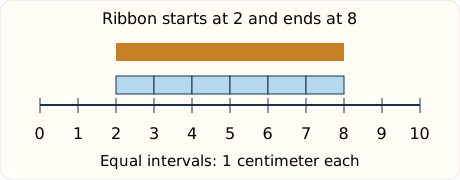 Six equal centimeter intervals lie between the endpoints, so the length is six centimeters. If the ribbon began at zero, the ending label alone would give its length. Because it begins at two, subtract the starting label: 8 - 2 = 6. The scale supplies equal units, while the endpoints decide which units belong to the object.