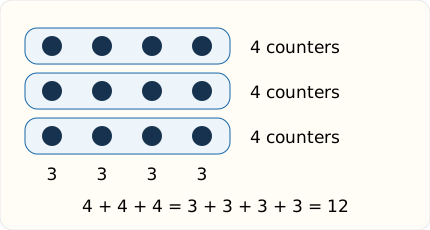
 Write 4 + 4 + 4 = 12 to show the rows. The same array has four columns of three, so 3 + 3 + 3 + 3 = 12 also counts it. These are two ways of grouping one collection, not two collections to combine.
Back to the on-screen lesson ·
Find the total of an array by adding equal rows, and find the row size from the total.
Paper packet. Every task here also exists on screen, where it is checked automatically; answers written on paper are not assessed by Nydus. When you are back at a device, enter your answers there.
In this lesson you learn to read an array: things arranged in equal rows. You find the total by adding one row's worth once for each row, and you work backwards from a total to the size of one row.
You can count a collection one object at a time or add equal groups. A rectangular array arranges objects in equal rows and columns so the groups are easy to see. Unlike a square-tile cover, the objects may have spaces between them. We count the objects, not the spaces. Begin by checking that each row has the same number and that the columns line up.
| Term | What it means |
|---|---|
| array | Objects arranged in equal rows and aligned columns. |
| row count | How many horizontal groups appear in the array. |
| row size | How many objects are in each horizontal group. |
| column | A vertical group of aligned objects. |
| repeated addition | Adding the same group size once for each equal group. |
Three rows of four counters contain twelve counters. The three tells how many groups to count, and the four tells how many counters each group contributes.
Another way: table
| Description | Number of groups | Objects per group | Total |
|---|---|---|---|
| Count rows | 3 | 4 | 12 |
| Count columns | 4 | 3 | 12 |
Look across the first row and count its objects. Then check every other row. If all rows have four counters and their positions line up in columns, you have a rectangular array. If the last row has only two counters, the arrangement is incomplete. You can still count its objects, but you must not pretend every row contributes four. The equal-group shortcut depends on the actual structure.
Objects do not have to touch. An array of buttons or chairs often has gaps for space. Those gaps are not extra objects. Count the button centers or the chairs themselves, keeping one count per object. In a tile-covering task the gaps matter because the surface must be filled; in an object array the spaces can be intentional. Say whether you are counting objects or covering a region before deciding what the diagram means.
An array also needs clear alignment. If counters are scattered into a loose pile, you can rearrange them into rows to make the count easier. Moving an object changes its position but not the number of objects. Keep track of each one so none is added or lost. Arrange one row at a time, checking that all complete rows use the same size.
An object that is hidden or missing cannot be counted as present just because an empty position suggests where it should go. If a task asks for the planned complete array, calculate all its positions. If it asks for objects currently there, count only those present. The difference between a plan and the actual collection becomes useful when finding how many more objects are needed.
For four rows of three buttons, write 3 + 3 + 3 + 3. Each addend belongs to one row. The total is twelve. Before calculating, check that the number of addends matches the number of rows. Then check that every addend equals the row size. These two checks connect the equation to the picture and catch a common mistake: writing 4 + 3 instead.
Four plus three gives seven, but it does not count four groups of three. The four is a count of rows, while the three is a count of buttons per row. Their roles are different. You can demonstrate the mismatch by pointing to the first two rows, which already contain six buttons, and then noticing that two more full rows remain. Seven cannot account for the complete collection.
Use a running total if the repeated sum feels long. For five rows of four, count four, eight, twelve, sixteen, twenty. Point to a new row with each spoken total. A row-count table can record one row gives four, two give eight, and so on. The jump between running totals must equal the row size. If one jump adds five instead of four, return to that row and repair the count.
You will later write a shorter multiplication equation for equal groups. Here the repeated sum is valuable because it shows the grouping directly. A total without a matching sum can hide confusion between the group count and group size. Say both quantities with their labels: five rows, four counters in each, twenty counters altogether.
In an array with two rows of five, look down instead of across. There are five columns, and each column contains two objects. Counting the rows gives 5 + 5 = 10. Counting the columns gives 2 + 2 + 2 + 2 + 2 = 10. Both include the same ten objects exactly once. Choose the direction whose repeated count is easier, and use the other direction to check.
Turning the array on the page switches how the rows and columns appear. No counter is added or removed, so the total stays fixed. A two-row, five-column array becomes five rows of two after a quarter turn. Its description changes with its orientation, but its size does not. If a task specifically asks for two rows, however, draw the requested orientation rather than only reporting a correct total.
Do not add the row total to the column total. In the two-by-five example, ten from rows and ten from columns are duplicate counts of the same objects. Their sum of twenty would count each object twice. A checking method should confirm a result independently, not contribute another group to the collection.
This connection works because the rows and columns are complete. An irregular arrangement with five buttons on top and four below cannot be described as five columns of two without accounting for the missing button. You might calculate the full ten-position array and subtract one, but explain why that subtraction is needed. The complete rectangle is a useful model; it must still match the actual situation.
Sometimes the total and row count are known, but the number in each row is missing. Suppose fifteen counters must form three equal rows. Deal one counter to each row repeatedly, keeping the rows equal. After five rounds, each row has five and all fifteen counters have been used. The check is 5 + 5 + 5 = 15. This shares the whole evenly among the stated groups.
You can also test a row size. Try four in each of three rows: 4 + 4 + 4 = 12. There are three counters still unused. Give one to each row, making five per row. If a trial uses too many counters, reduce the size equally in every row. A successful answer must satisfy both the total and the equal-row condition.
Distinguish finding row size from finding row count. With fifteen counters and five per row, you make three rows. With fifteen counters and three rows, you place five in each row. The numbers are connected, but the answers name different things. Read the unit of the requested answer: rows or counters per row. Labeling the unknown prevents swapping the two.
A total may not fit the chosen row size exactly. Fourteen counters in rows of four make three complete rows and two leftover counters. If the task demands a full rectangle using all fourteen, that arrangement does not satisfy it. You would need another row size or additional counters. Do not silently hide the leftover objects. Reporting them honestly is part of representing the original collection.
To represent a story, identify the number of equal groups and the number in each. A classroom places three paint pots on each of four tables. You can draw four rows of three dots, using one row per table. Label the rows as tables and the dots as paint pots. The repeated sum is 3 + 3 + 3 + 3 = 12. The drawing represents the grouped counts; the real tables need not literally stand in rows.
Now consider four paint pots on each of three tables. The total is still twelve, but a row-per-table drawing should have three rows of four. A total alone cannot show whether the story's groups have been represented correctly. Check the labels, row count and row size as well as the arithmetic. Both drawings are valid arrays, but each matches a different grouping description.
An unfamiliar arrangement may need a small repair. A display plans four rows of five cards but currently has three full rows and a last row with two cards. The full plan needs twenty cards; seventeen are present; three more complete the last row. Draw the missing positions as empty outlines and count them separately. This distinguishes what exists from what the plan requires.
Explain your finished representation with a picture, an equation and a sentence. The picture shows the groups, the repeated sum records one group contribution at a time, and the sentence names the total with its unit. Check that all three agree. If the picture has four rows, the row-based sum should have four addends. If each row has five dots, each addend should be five. A learner who can connect these details can rebuild a total even when the arrangement is new.
A classroom garden project needs four trays with five seedlings in each. A learner sketches four rows of five dots and labels each row Tray. The equation 5 + 5 + 5 + 5 = 20 gives the number of seedlings to prepare. A partner checks by counting five columns of four, also twenty. If only eighteen seedlings are ready, two positions remain empty; the class needs two more rather than another full tray of five. The array supports the supply count and the check of the filled trays. The dots stand for seedlings, so the spaces between them do not count as additional plants.
Twelve chairs can be arranged in three rows of four or in two rows of six. Both plans have twelve seats, but they use the room differently. A teacher may need fewer rows to leave a walkway, or shorter rows to fit a narrow space. The class records both the row count and the number of chairs in each row before comparing the plans. Repeated sums verify that neither plan changes the seating capacity. If a drawing labels every row as a team, then the two plans also represent different team sizes. The total alone cannot answer how many teams there are or how many learners belong to each team.
Adding the row count to the row size does not count all objects. A correct total can still accompany a drawing whose groups do not match the story. Do not add row and column totals together because they count the same collection. Keep missing positions and leftover objects visible when the arrangement is incomplete.
Read the arrangement.
There are 3 equal rows of 4 counters.
The row count and size have different roles.
Write one addend per row.
4 + 4 + 4.
Each row contributes four counters.
Find the row total.
4 + 4 + 4 = 12.
Every counter appears in one row.
Read the columns.
There are 4 columns of 3 counters.
The same objects can be grouped vertically.
Check the total again.
3 + 3 + 3 + 3 = 12.
Both complete counts agree.
Read the given quantities.
20 counters must form 4 equal rows.
The row size is missing.
Try four per row.
4 + 4 + 4 + 4 = 16.
A trial can be checked against the total.
Count the unused counters.
20 - 16 = 4.
All twenty must be included.
Share the remainder equally.
Give 1 more counter to each of 4 rows.
Equal increases preserve equal rows.
State the row size.
Each row now has 5 counters.
Four in each row grew by one.
Verify the construction.
5 + 5 + 5 + 5 = 20.
The equal rows use the complete collection.
Read the story.
4 tables need 3 paint pots each.
One group represents one table.
Inspect the proposed drawing.
A learner drew 3 rows of 4.
The total may be right while the grouping is different.
Identify the required row count.
Use 4 rows when one row means one table.
The story contains four tables.
Set the size of each row.
Draw 3 dots in every row.
Each table needs three pots.
Write the matching equation.
3 + 3 + 3 + 3 = 12.
Four equal contributions represent the four tables.
Check with the original collection.
Both arrays have 12 dots.
Rearranging did not change the total.
Explain the repair.
The new drawing matches the table groups as well as the total.
A complete representation must preserve the story's roles.
Name the equal groups.
3 trays hold 5 seedlings each.
One row will represent one tray.
Build the row plan.
Draw 3 rows with 5 dots in each.
The labels link the array to the story.
Write the repeated sum.
Check another grouping.
Counters are laid out in 4 rows with 5 counters in every row. How many counters are there altogether?
Answer:
Arrange 6 counters in three equal rows. Find the size of one row.
Identify the unknown.
Three equal groups must use 6 counters.
The missing value is counters per row.
Find an equal group size.
Each row needs size counters.
Three copies of the row size must reach the total.
Check the repeated sum.
Add the proposed row size three times.
The check must use all counters with none left over.
12 counters are laid out in 3 equal rows. How many counters are in each row?
Answer:
Counters are laid out in 5 rows with 5 counters in every row. How many counters are there altogether?
Answer:
15 counters are laid out in 5 equal rows. How many counters are in each row?
Answer:
A classroom plans three counter displays. Match each array plan to the number of counters needed.
| 15 | 6 | 18 | |
|---|---|---|---|
| 5 rows of 3 | |||
| 3 rows of 2 | |||
| 3 rows of 6 |
Audio transcript: None
A new planting plan uses 4 trays with 2 seedlings per tray. On paper draw an array with one row per tray and write its repeated-addition equation. Enter the total seedlings. The number is checked here; show the drawing and equation to your teacher for their separate check.
Answer:
Lesson test: one question per skill, one attempt each, no hints. Your answers are checked when you submit.
Arrange 9 name cards in three equal rows for a display. Complete a construction record: give the number in each row and the total of the repeated sum. Each row entry is also one addend in that sum.
| Row 1 / addend 1 | Row 2 / addend 2 | Row 3 / addend 3 | Total | |
|---|---|---|---|---|
| Array and equation record |
You can find the total of an array by adding equal rows, and you can say how many are in each row when you know the total and the number of rows.
16. Represent three trays, step 3
5 + 5 + 5 = 15.
Each tray contributes five seedlings.
16. Represent three trays, step 4
Five columns of three also total 15.
The same seedlings are counted once in either direction.