Name shapes by counting their sides, cut rectangles into equal squares, and shade thirds and fourths.
Paper packet. Every task here also exists on screen, where it is checked automatically; answers written on paper are not assessed by Nydus. When you are back at a device, enter your answers there.
1. What you will learn
In this lesson you name flat shapes and a cube by counting sides and faces, cut a rectangle into rows and columns of equal squares and count them, and shade thirds and fourths of a whole. By the end you can say why a third is smaller than a half.
2. Use features you can check
You have drawn flat shapes, counted equal squares and named equal shares. Now describe a shape by its attributes: straight sides, corners, square corners and flat faces. A name should follow from features you can inspect, even when the drawing is tilted, stretched or unfamiliar. At the end you will use geometry with money, measurement and data in an independent classroom planning task.
3. Words for flat and solid shapes
Term
What it means
side
A straight boundary segment of a polygon.
vertex or corner
A point where boundary edges meet.
polygon
A closed flat shape made of straight sides that do not cross.
quadrilateral
A polygon with four sides.
face
A flat surface of a solid shape.
edge
A segment where two faces of a solid meet.
4. A shape's attributes survive a turn
The narrow triangle, tilted square, irregular pentagon and irregular hexagon belong to their shape families because of their attributes. Trace one boundary from a chosen corner and count each straight side once until you return. A triangle has three sides, a quadrilateral four, a pentagon five and a hexagon six. Turning a drawing does not add or remove a side, so it does not change that family name.
Another way: table
Flat shape family
Straight sides
Corners
Triangle
3
3
Quadrilateral
4
4
Pentagon
5
5
Hexagon
6
6
5. Count a closed boundary carefully
Before naming a polygon, check that its boundary is closed and all its sides are straight. An open line of three segments is not a triangle because the ends do not meet to enclose a region. A shape with a curved boundary is not a polygon under this definition. The side-count names in this lesson apply to closed flat shapes made from straight segments.
Choose one corner as the start and mark it lightly. Trace along the next side, then the next, counting each segment once. Stop when you arrive back at the starting corner. Do not count the first side twice. For the simple polygons here, the number of corners matches the number of sides because each side leads to the next corner around the boundary.
A dot printed halfway along a straight side does not automatically create another corner. A corner is where the boundary changes direction as two sides meet. Likewise, a decorative line inside a shape is not part of its outside boundary. Decide whether the task asks about the whole outline or one of the smaller regions before counting.
Size, color and orientation are not side counts. A large blue triangle and a small yellow triangle both have three sides. A very narrow triangle still has three straight sides and three corners if its vertices are not all on one straight line. Use the attributes instead of rejecting a shape because it does not look like the most familiar example.
6. Use broad and more specific names
A quadrilateral is any simple polygon with four sides. Rectangles and squares are quadrilaterals because they meet that rule. A rectangle also has four square corners. Its opposite sides have equal lengths. A square has four square corners and all four sides equal, so it meets the rectangle rule as well as the quadrilateral rule. One shape can belong to more than one family.
A square turned so it rests on a corner is still a square. Its sides and corner angles did not change during the turn. Calling it a diamond may describe its appearance informally, but that word does not replace an attribute check. Inspect its equal sides and square corners to give a precise mathematical name.
Four sides alone do not prove that a shape is a rectangle. A slanted quadrilateral can have corners that are not square corners. You may compare a corner with the corner of a sheet of paper to check whether it is square. Do not assume a computer drawing is exact if its appearance is unclear; use the stated attributes when a task supplies them.
Pentagons and hexagons need not have equal sides. A pentagon has five straight sides and five corners even if one side is much longer than another. A hexagon has six. Shapes with equal sides and equal angles are special regular examples, but regularity is not required for the broad family name. Count and describe the actual shape rather than memorizing one outline for each word.
7. Distinguish faces, edges and corners of a cube
A cube is a solid, not a flat polygon. It has six square faces: a top, a bottom, a front, a back and two side faces. A drawing usually shows only some of these surfaces. A hidden back face is still part of the cube. Turn a real box or a model to inspect every face, marking counted faces if necessary so none is counted twice.
A face is a flat region, an edge is where two faces meet, and a corner is where edges meet. These are different kinds of attributes. A cube has eight corners. You can find four around the top face and four around the bottom face. It has twelve edges: four around the top, four around the bottom and four joining corresponding top and bottom corners. This edge count is an extension of the main face work.
Do not say a cube has six sides without explaining whether you mean its six faces. For a flat polygon, side means a boundary segment. For a solid, face is the clearer word for a flat surface. Precise language prevents confusing the six faces with the twelve edges or eight corners. Name what you are counting before giving the number.
A cube-shaped object can carry drawings on its faces without gaining new faces. A line drawn across one face divides the picture on that surface but does not create another outer flat surface of the solid. Likewise, a paper label placed on a corner does not create a new corner. Separate the object's geometric structure from marks added for decoration or counting.
8. Connect a rectangle's outline to its interior
A rectangle's four outside sides do not tell how many equal squares fill its interior. A rectangle partitioned into three rows of four equal squares contains twelve small squares. The outside still has four sides, while the interior count is 4 + 4 + 4 = 12. The questions how many sides and how many covering squares refer to different attributes.
For a valid square partition, the small pieces must be equal squares that cover the whole without gaps or overlaps. Equal-width strips are not always squares. To check a drawn grid, compare the width and height of each little region. A three-by-four arrangement of equal squares is a rectangle, while a three-by-three arrangement is also a square.
Equal shares describe area rather than the number of boundary segments. Split a rectangle into two equal-area regions to make halves, three equal-area regions to make thirds, or four to make fourths. Counting four pieces is not enough if their areas differ. Four fourths make the original whole, and two halves make the original whole. Keep that original outline visible while naming the shares.
The shares can have different shapes. In a twelve-square rectangle, a region containing six equal squares and its six-square complement are equal halves even if their outlines differ. The common small-square unit proves equal area. When comparing one half and one third, use the same whole: dividing a fixed area into more equal parts makes each part smaller. Different-sized wholes require another comparison of actual amounts.
9. Draw from attributes and explain your decisions
A drawing task should begin with the requested features. To draw a triangle, choose three noncollinear points and connect them with straight segments to close the boundary. Check that there are three sides and three corners and that no side crosses another. The sides need not be equal unless the instruction says so. A different valid triangle may look unlike your neighbor's drawing.
To draw a quadrilateral that is not a rectangle, make four straight sides but include at least one corner that is not square. Check the shape against both parts of the instruction: it must be a quadrilateral, and it must fail the rectangle condition. A four-sided drawing with four square corners would not satisfy the second part even though its side count is correct.
If asked to partition a rectangle into thirds, choose a method that establishes equal areas. Three equal-width strips spanning the same height work. A grid of twelve equal squares could also give three shares of four squares each. Explain how the construction establishes equality. Saying it looks fair is less convincing than showing matching strips or equal unit-square counts.
A complete geometric explanation names the whole or object, the attribute being counted, the evidence for the count and the resulting classification. For a cube, say which surfaces or corners were included, including hidden ones. For a flat outline, trace the closed boundary. For equal shares, give an area check. These methods let another person verify the claim instead of relying on a remembered name alone.
10. Independent course project: choose a supply plan
Work independently before requesting feedback. A class must prepare twelve name cards and a border exactly sixty centimeters long. The budget is $2, or two hundred cents. Plan A offers two packets of six cards at forty-five cents per packet and a sixty-centimeter border strip for sixty-five cents. Plan B offers three packets of four cards at thirty-two cents per packet and two thirty-centimeter border strips at twenty-five cents per strip. All listed prices are complete for this invented task.
For each plan, show that the card count reaches twelve, calculate the total cost in cents, and find the change from two hundred cents. Compare the costs and choose a plan with a reason. Verify that the border pieces reach sixty centimeters without overlap. Draw a rectangular twelve-position card layout and write its repeated-addition equation. Show how one whole sample card can be divided into thirds or fourths with an explicit equal-area check.
Use these eight supplied practice measurements for a labeled display: 8, 8, 9, 10, 10, 10, 11 and 12 centimeters. Make a line plot with equal one-centimeter intervals and one mark per strip. State the total measured count, the most frequent length and the longest length. Label these as supplied classroom data; do not claim you collected real measurements. Add an opening time of 3:35 p.m. to your plan using both a written time and a clock sketch. Explain how the minute hand and hour hand positions agree with the written time.
Adult-facing rubric: assess four dimensions separately as secure, developing or needs revision. Accuracy requires correct card counts, plan costs, change and measurement frequencies. Reasoning requires visible unit exchanges or equivalent arithmetic checks, a supported plan comparison and evidence of equal shares. Representation requires labeled money units, a correctly scaled display, a coherent array equation and a readable clock. Transfer and revision require an independent first attempt, an explanation of why the chosen plan meets every constraint, and a recorded correction after feedback. Record what evidence is missing rather than assuming understanding. This open project needs human review; passing automatic items does not certify its explanation, drawing quality or independent performance.
11. Label a classroom shape collection
A class collects a narrow triangular sign, a square card turned onto a corner, an irregular five-sided cutout and a cube-shaped box. Learners label the flat objects by tracing their straight boundaries rather than relying on orientation. The narrow sign is a triangle, the turned card is still a square and a rectangle, and the five-sided cutout is a pentagon. For the box, the label says six square faces rather than six straight sides. A partner checks the hidden bottom and back surfaces before accepting the face count. The labels record the attributes that support each name, allowing another group to verify the classification.
12. Design equal poster space
A rectangular poster is covered by twelve equal small squares. Three project groups need equal areas. Giving each group four of those squares creates thirds, provided the three regions cover the whole without overlap. The regions may have different outlines; the common square unit establishes equal area. If the poster must also have one connected region for each group, learners check that extra requirement separately. They record the complete total as 4 + 4 + 4 = 12 and label the original outside boundary as one whole poster. This explanation distinguishes the number of sides around a region from the amount of area each group receives.
13. Count the requested kind of feature
A cube's faces, edges and corners are different quantities. A turned square remains a square and a rectangle. A polygon's internal grid lines are not additional outside sides. Equal-share names depend on equal area and a stated whole, not merely the number of pieces or a familiar-looking outline.
14. Classify an unfamiliar flat outline
Check that the boundary is closed.
The outline returns to its starting point.
A polygon encloses a region.
Check the boundary pieces.
Every boundary segment is straight.
Curved edges do not fit this polygon definition.
Count each side once.
The outline has five sides.
Marking a start prevents double counting.
Check the corner count.
There are five corners around the same boundary.
Each side leads to the next vertex.
Give the family name.
The shape is a pentagon.
Five sides establish the broad family even if the sides differ in length.
15. Explain why a square is also a rectangle
Read the square's attributes.
Four equal sides and four square corners.
These are defining features, not its color or pose.
Recall the rectangle condition.
A rectangle has four straight sides and four square corners.
Compare the family rule with the actual attributes.
Check the side count.
The square has four straight sides.
The first rectangle condition is satisfied.
Check the corners.
All four are square corners.
The second rectangle condition is satisfied.
State both valid names.
The square is a rectangle and a quadrilateral.
More specific names can belong within broader families.
Check a turn of the picture.
Rotating the square leaves both names valid.
Turning does not change side lengths or corner angles.
16. Check equal shares in a tiled rectangle
Identify the original whole.
A rectangle has three rows of four equal squares.
The outside boundary defines one whole.
Count the unit squares.
4 + 4 + 4 = 12.
Every row contributes the same amount of area.
Read the proposed partition.
Three regions each contain four small squares.
The shares use the same area unit.
Check equal area.
Each region covers four equal squares.
Different outlines can still have equal area.
Check the complete cover.
4 + 4 + 4 = 12 with no gaps or overlaps.
All of the original whole is included once.
Name one region.
Each is one third of the rectangle.
There are three equal shares of the same whole.
Check the recombined whole.
Three thirds make the whole rectangle.
The share name and the total partition agree.
17. Check the hidden faces
Identify the solid.
The object is a cube.
Its flat surfaces are square faces.
Count top and bottom.
There are two opposite faces.
The bottom remains part of the cube even if hidden.
Your turn: work this step out. Its working is at the end of the packet.
Include the surrounding faces.
Your turn: work this step out. Its working is at the end of the packet.
Report and verify the count.
18. Guided practice
How many sides does a hexagon have?
Answer:
19. Guided practice
Match each number of sides to the shape that has that many.
quadrilateral
pentagon
triangle
4 sides
5 sides
3 sides
Audio transcript: None
20. Guided practice
A cube's top and bottom have been counted. Complete the face count.
Count the opposite horizontal faces.
The top and bottom contribute two faces.
Hidden surfaces still belong to the solid.
Include the surrounding faces.
Four more faces give faces altogether.
The cube has a front, a back and two side faces.
Check the kind of attribute.
Report faces rather than corners or edges.
Different attributes have different counts.
Audio transcript: None
21. Guided practice
How many sides does a pentagon have?
Answer:
22. Practice
How many faces does a cube have?
Answer:
23. Practice
How many corners does a cube have?
Answer:
24. Somewhere new
A classroom sorts shape cards into a quadrilateral tray and an other-shapes tray. Match each card description to the correct tray.
is a quadrilateral with 4 sides
is not a quadrilateral
a square
a pentagon
a triangle
25. Lesson test
Lesson test: one question per skill, one attempt each, no hints. Your answers are checked when you submit.
26. Test question

Record the number of straight sides and corners. Turning or stretching the outline would not replace an actual boundary count.
Straight sides
Corners
Outline attributes
27. What you can do now
You can name a shape from the number of its sides, count the equal squares in a rectangle, and shade thirds and fourths and say which piece is bigger.
Working for the steps left to you
17. Check the hidden faces, step 3
Four more faces go around the sides.
Each joins the top and bottom along an edge.
17. Check the hidden faces, step 4
2 + 4 = 6 faces.
A drawing showing only three faces does not show the entire solid.
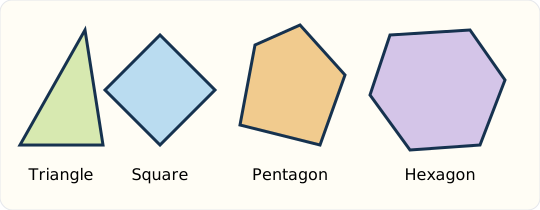 Trace one boundary from a chosen corner and count each straight side once until you return. A triangle has three sides, a quadrilateral four, a pentagon five and a hexagon six. Turning a drawing does not add or remove a side, so it does not change that family name.