Counting in fives, tens and hundreds, and hearing the pattern.
Paper packet. Every task here also exists on screen, where it is checked automatically; answers written on paper are not assessed by Nydus. When you are back at a device, enter your answers there.
1. What you will learn
In this lesson you count in fives, tens and hundreds, and listen to the pattern in what you say. Skip counting is how multiplication starts feeling possible — counting in fives is the five times table before anybody calls it that — and it is also how a child gets fast at reading a scaled graph or telling the time.
2. Count a group as one step
Counting by ones adds one object each time. Skip counting adds the same larger amount each time. You might count hands by fives, bundles of ten pencils by tens, or packages of one hundred sheets by hundreds. The count still needs a starting amount and a clear unit. Say what one step adds before beginning. We will count forward and backward within one thousand and explain what happens when a count crosses a new ten or hundred.
3. Words for a count
Term
What it means
starting value
The amount before any jumps are made.
step size
The amount added or removed in each jump.
sequence
An ordered list following a stated rule.
consecutive terms
Neighboring entries in the sequence.
count backward
Repeatedly subtract the same step size.
4. Keep the step equal
Start at 270 and add ten four times. The landings are 280, 290, 300 and 310. There are five labeled positions but only four jumps. The first label records where you begin; it is not a jump you have already made. Each arc shows a change of ten even when the written hundreds digit changes.
Skip counting is repeated addition when you move forward. Counting on by five from twenty gives twenty-five, thirty, thirty-five, forty. The difference between every neighboring pair is five. If one jump adds ten by mistake, the list no longer follows the rule. A familiar-looking final digit is not enough to prove that a sequence is correct. Check the difference between adjacent entries. When counting backward, the same step is removed each time. The numbers decrease, but the size of each change stays equal.
Another way: table
Jumps completed
Value
0
270
1
280
2
290
3
300
4
310
The zero-jump row is an important part of the record.
5. Count by fives with groups you can see
Lay out three groups of five counters. Count the first group as five, the second as ten altogether, and the third as fifteen altogether. Each spoken number is a running total, not the number inside the newest group. Every group still has five counters. You can check the last total by counting all fifteen counters one at a time, but grouping makes a larger collection easier to track.
Starting at zero and counting by fives gives numbers ending in five and zero in turn. After twenty-five comes thirty because adding five to twenty-five completes the next ten. The ones do not continue as ten ones in ordinary written form; those ten ones are regrouped as one ten. The amount has increased by five, even though two written digits may change. Count through fifty-five, sixty, sixty-five and notice the same idea.
A count need not begin at zero. Starting with twelve counters and adding groups of five gives seventeen, twenty-two, twenty-seven and thirty-two. Those numbers do not end in zero or five, but every step is still five. The rule concerns the difference between neighbors, not a particular last-digit pattern. You can use the ending pattern as a check only when you also know the starting value. If someone calls twelve, seventeen, twenty-two an incorrect count by fives, show the five new counters at each step.
6. Adding ten preserves the ones
When you add one ten to 47, four tens become five tens and the seven ones stay seven. The next number is 57. Another ten gives 67. Continuing gives 77, 87, 97, then 107. At that boundary, ten tens become one hundred, but the seven ones still remain. The rule has not changed simply because the number now has three digits.
You can record the step using expanded form: 97 is 90 + 7, and 97 + 10 is 100 + 7. This explains why 107 follows 97. Saying 100 would lose the seven ones; saying 101 would change them into one. Pay special attention when the middle place becomes zero. Zero shows that there are no separate tens in that grouping, while the hundred and the seven ones remain.
Counting backward by ten reverses these changes. From 107, remove one ten to reach 97. One hundred can be renamed as ten tens, then one ten is removed, leaving nine tens and seven ones. From 97 go to 87, then 77. Read the count forward again to check it. Every backward step should be undone by adding ten. This connection is more reliable than trying to subtract one from whichever printed digit seems easiest.
7. Adding a hundred preserves the smaller parts
A hundred is ten tens. If you have 236 and add one hundred, the two hundreds become three hundreds. The three tens and six ones do not change. The result is 336. Repeating gives 436, 536 and 636. You can describe the count as moving through the hundreds while keeping a remainder of thirty-six.
Numbers ending in two zeros arise when the count starts at zero or another whole hundred. Zero, one hundred, two hundred and three hundred are useful landmarks, but they are not the only possible count by hundreds. Beginning at eighty gives one hundred eighty, two hundred eighty and three hundred eighty. Write the place-value parts if the spoken names are confusing. Eighty is zero hundreds and eight tens, so adding a hundred creates one hundred and eight tens.
Keep the lesson's range in mind. A forward count from 700 by hundreds can reach 800, 900 and 1000. One thousand is the endpoint of our current work, not proof that numbers stop there. For a task that says remain within one thousand, do not supply later terms outside that range. A backward count from 600 by hundreds reaches 500, 400 and 300. In each direction the change is one hundred, while the direction decides whether the number grows or shrinks.
8. Separate jumps from listed numbers
A list with five entries has four changes between neighbors. This matters when a question asks for a certain number of steps. Start at thirty and take three steps of five. After the first step you are at thirty-five, after the second at forty, and after the third at forty-five. Thirty is the start, not the first step. If you count thirty, thirty-five, forty as your three steps, you stop one step too early.
A table with a zero row can keep the count straight. Label the left column Jumps completed and begin with zero. The right column holds the starting value. Then add one row for each jump. If the task says four jumps, the last row must have four in the first column. You can count the arrows in a sketch for the same check. Count movements, not the number of places where you could put your finger.
You can also combine the equal changes. Four jumps of ten add forty altogether. Starting at 270 therefore gives 270 + 40 = 310. This is a repeated-addition idea that will help with multiplication later. For now, write 10 + 10 + 10 + 10 = 40 and connect each ten to one jump. The number of jumps and the size of each jump have different jobs; confusing them gives an incorrect endpoint.
9. Repair a sequence and check the endpoint
Suppose a list says 140, 150, 160, 180, 190 and claims to count by tens. The jump from 160 to 180 is twenty, so something has gone wrong. If the entries are meant to be consecutive terms, the fourth should be 170 and the fifth should be 180. If the writer merely left out a displayed term, the missing 170 must be inserted. Read the instruction to decide whether you are replacing a wrong term or filling a blank.
For a missing middle term, check both sides. In 235, blank, 245 while counting by fives, 240 is five more than 235 and five less than 245. A proposed 241 fits neither gap. Checking only that a value lies somewhere between its neighbors is not enough; the steps must be exactly equal. This is the same equal-spacing idea you use on a number line.
After finding an endpoint, check the total change. The end minus the start should equal the sum of all forward jumps. The start minus the end should equal the sum of all backward jumps. You can also reverse the count to see whether it returns to the stated start. If a result is off by exactly one step size, inspect whether the start was counted as a jump. These checks tell you where to look instead of making you restart without a plan.
10. Adding packets to a display
A class in an invented Kansas school has 35 stickers ready for a display. Four new packets contain ten stickers each. Instead of opening every packet and counting by ones, record the totals after each packet: 45, 55, 65 and 75. The starting 35 is already in the collection. Four packets add forty, so 35 + 40 = 75 checks the endpoint. If someone reports 65 after saying 35, 45, 55, 65, they have named four numbers but counted only three deliveries. A table with a zero-delivery row makes the mistake visible. The packet method works because every supplied packet is stated to contain ten; unequal packet sizes would need a different calculation.
11. Checking a page-number pattern
A reading group chooses page markers beginning at page 125 and then every five pages for four more markers. The later pages are 130, 135, 140 and 145. There are five markers altogether because the original marker at 125 remains, but there are only four five-page gaps. The distance from the first page number to the last is twenty pages. This illustrates why a count of marked positions is different from a count of intervals. To check the arrangement, subtract each neighboring pair of page numbers and confirm that the difference is five. If the group instead wanted four markers including the start, it would stop at 140. The wording decides which count is needed.
12. The rule is the change
Counting by tens does not mean writing the next multiple of ten after any starting number. From forty-seven, the next term is fifty-seven, not fifty. Adding a hundred does not always produce a number ending in two zeros. Preserve the tens and ones already present. Another mistake is to count the starting value as the first jump. Label it zero jumps before beginning. Finally, a list can rise without being a skip count with the stated step. Check every neighboring difference. Increasing values alone do not prove that the jumps are equal.
13. Count three groups of five
Name the starting amount.
0 counters.
No group has been counted yet.
Include the first group.
0 + 5 = 5.
Each group contributes five counters.
Include the second group.
5 + 5 = 10.
The step size stays the same.
Include the third group.
10 + 5 = 15.
Three groups have now been included.
Check the count of steps.
5 + 5 + 5 = 15.
There are three additions, not three listed positions including zero.
14. Cross a hundred by tens
Write the starting parts.
87 = 80 + 7.
The seven ones will remain unchanged.
Add the first ten.
87 + 10 = 97.
Eight tens become nine tens.
Add the second ten.
97 + 10 = 107.
Ten tens regroup as one hundred.
Add the third ten.
107 + 10 = 117.
The separate tens count becomes one.
Add the fourth ten.
117 + 10 = 127.
The ones still remain seven.
Check the complete change.
127 - 87 = 40; 10 + 10 + 10 + 10 = 40.
Four equal jumps account for the difference.
15. Repair a backward count
Read the claimed rule.
Start at 640 and count backward by 100 three times.
Both the direction and step size matter.
Calculate the first landing.
640 - 100 = 540.
One hundred is removed.
Calculate the second landing.
540 - 100 = 440.
Forty remains unchanged.
Calculate the third landing.
440 - 100 = 340.
Three jumps have now occurred.
Inspect the proposed answer.
440 is only two jumps after 640.
Counting the start as a jump ends too soon.
Check the total decrease.
640 - 340 = 300.
Three hundreds were removed.
Reverse the three jumps.
340, 440, 540, 640.
Adding hundreds returns to the start.
16. Your turn: four steps of five from forty-five
Record zero completed steps.
Start at 45.
The start is not a jump.
Make the first two jumps.
45 + 5 = 50; 50 + 5 = 55.
The step size stays five.
Your turn: work this step out. Its working is at the end of the packet.
Make the last two jumps.
Your turn: work this step out. Its working is at the end of the packet.
Check the complete change.
17. Guided practice
Count on by 10 and fill in the two missing numbers.
60, 70, x, y
18. Guided practice
These four numbers come from counting on by 100. Put them in order, smallest first.
Number the steps in order (write the number in the box):
200
300
400
500
19. Guided practice
Start at 29 and count on by ten three times.
Label the starting position.
No jumps have yet been made.
The start does not count as a step.
Add the same amount three times.
The third landing is end.
Three ten-unit changes total thirty.
Check by reversing the movement.
Subtract three tens from the endpoint to recover the start.
Every forward jump can be undone.
20. Guided practice
Count on by 10 and fill in the two missing numbers.
60, 70, x, y
21. Practice
Count on by 5 and fill in the two missing numbers.
10, 15, x, y
22. Practice
Count on by 100 and fill in the two missing numbers.
600, 700, x, y
23. Practice
Count on by 10 and fill in the two missing numbers.
20, 30, x, y
24. Somewhere new
A classroom has 60 paper squares and receives four packets with 10 squares in each. Count on by 10 four times. How many squares are there afterward?
Answer:
25. Lesson test
Lesson test: one question per skill, one attempt each, no hints. Your answers are checked when you submit.
26. Test question
Start at 20 and make 4 jumps of five to the right. Place the marker on the final landing.
0 |——————————| 80
Mark the position with a cross, then write the value:
27. What you can do now
You can skip count in fives, tens and hundreds. Without looking: count on in tens from 47, and say what stays the same each time.
Working for the steps left to you
16. Your turn: four steps of five from forty-five, step 3
55 + 5 = 60; 60 + 5 = 65.
Four jumps have been completed.
16. Your turn: four steps of five from forty-five, step 4
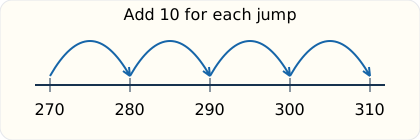 Start at 270 and add ten four times. The landings are 280, 290, 300 and 310. There are five labeled positions but only four jumps. The first label records where you begin; it is not a jump you have already made. Each arc shows a change of ten even when the written hundreds digit changes.