Rows and columns of equal squares, and counting them.
Paper packet. Every task here also exists on screen, where it is checked automatically; answers written on paper are not assessed by Nydus. When you are back at a device, enter your answers there.
1. What you will learn
In this lesson you split a rectangle into rows and columns of equal squares and count them. It looks like a shape lesson and it is really the beginning of multiplication and of area: the squares come in equal rows, so counting them is counting equal groups. Grade 3 will call the same picture an array.
2. Cover a region with equal pieces
A rectangle has four straight sides and four square corners. Opposite sides have equal lengths. A square is a special rectangle with all four sides equal. You can cover a larger rectangle with small equal squares. Today we will arrange those squares in rows and columns, count every square once, and explain why the count covers the entire region.
3. Words for a square grid
Term
What it means
partition
Split a whole region into parts without gaps or overlaps.
row
A line of squares running across the page.
column
A line of squares running up and down the page.
equal squares
Square pieces that all have the same side length and size.
grid
A pattern of crossing lines that makes rows and columns.
4. Every row is an equal group
The rectangle has three rows of four equal squares. Count across one row: four squares. Every other row has the same four-square structure, so count four, eight, twelve as you include the rows. The equation 4 + 4 + 4 = 12 records one addend for each row. It explains where the total comes from rather than merely giving a number.
Another way: table
Rows counted
Squares counted
1
4
2
8
3
12
5. Check the pieces before counting
A useful square partition covers the rectangle completely. Every small piece must be a square, the squares must be equal, and their edges must meet without gaps or overlaps. If you use loose paper tiles, push neighboring edges together carefully. Empty spaces are parts of the rectangle that have not been covered. Overlapping pieces cover some regions twice. Neither arrangement supports a count of how many equal squares exactly fill the rectangle.
Equal area pieces are not automatically equal squares. A narrow rectangle and a square might cover the same amount of space, but the narrow rectangle is not a square. In this lesson, check that each small tile has four equal sides and four square corners. Later you can compare other equal-area shapes. Here, using one repeated square makes the rows and columns clear.
The outside rectangle need not itself be a square. Three rows of four small squares make a rectangle wider than it is tall. Three rows of three make a square, which is also a rectangle. Both can be partitioned and counted. The word rectangle does not exclude a square; it describes the square corners and opposite sides shared by both.
Keep the size of the small squares fixed during a count. If half the region uses large tiles and half uses small tiles, the number of pieces no longer tells how many copies of one chosen square cover it. Label or show the common tile size so your partner knows what each counted piece represents.
6. Read rows and columns in the picture
A row runs across the page and a column runs up and down. In a grid with three rows and four columns, each row contains four squares and each column contains three. Point to one complete row before counting the number of rows. This separates two questions: how many groups are there, and how many squares are in each group?
The boundary lines are not extra rows. Two interior horizontal cuts divide a rectangle into three rows: one above the first cut, one between the cuts and one below the second. Three interior vertical cuts make four columns. Count the spaces between boundaries, not just the lines you drew. This is the same idea as counting unit intervals on a ruler instead of counting its marks.
To draw a grid, mark equal distances along opposite sides. Connect matching marks with straight lines. Use the same unit spacing in both directions if the parts must be squares. Dividing a long rectangle into three equal rows and three equal columns does not always make squares; it can make smaller rectangles. Equal counts in the two directions are not enough. The width and height of each little part must match.
If the picture is rotated, the total stays the same. What you previously called a row may now look like a column. Keep your description tied to the picture as it is shown. You can say three rows with four in each or four columns with three in each for the original orientation. Both describe the same collection when the groups are counted carefully.
7. Count complete rows without double counting
For four rows of five squares, each row contributes five. Record 5 + 5 + 5 + 5 = 20. There are four addends because there are four rows. Each addend is five because that is the row size. The sum 4 + 5 = 9 counts the two descriptive numbers together; it does not count the twenty squares in the picture. Trace each row as you say its contribution.
You can keep a running total: five after the first row, ten after the second, fifteen after the third and twenty after the fourth. A running total helps when the picture has more squares than you want to count one at a time. It also reveals a skipped row. If your total jumps straight from ten to twenty while only one five-square row was added, the record needs repair.
Counting columns offers a second check. Four rows of five are also five columns of four. Count four, eight, twelve, sixteen, twenty. The two methods agree because they include every square once, just grouped differently. Do not add the row total and the column total together. Those are two counts of the same collection, not two separate collections. Adding them would count every square twice.
For a very small grid, count one by one as a check and compare with the repeated-addition equation. When both methods agree, explain why the grouped method is reliable: every row is full and has the same number of equal squares. If a row is missing a tile, you need to account for that gap rather than pretend that all rows are complete.
8. Find missing squares and unfinished rows
A rectangle planned as three rows of five needs fifteen equal squares. If twelve squares have been placed, three more are needed. You can see this as two complete rows of five and a last row with two already in place. Three missing spaces complete that last row. The equation 12 + 3 = 15 connects the placed pieces, the missing pieces and the intended full rectangle.
An unfinished arrangement is not yet the full rectangular cover. Suppose there are fourteen tiles to arrange in rows of four. Three full rows use twelve tiles and two tiles remain. Those two can begin another row, but they do not make a fourth full row. Record three complete rows and two leftover tiles. To finish the fourth row, two additional tiles are needed. The leftover count and the number still needed are different ideas, even when they happen to have the same value here.
Try another case to see the difference. Seventeen tiles in rows of five make three complete rows with two left over. The next row needs three more tiles, because two plus three makes five. Saying two more are needed would leave that row short. Always compare the partial row with a full row of the stated size.
A missing-row problem can be solved by testing equal groups. If a rectangle contains twelve squares in three equal rows, try four squares per row: 4 + 4 + 4 = 12. That uses all the squares evenly. Three per row would use only nine; five per row would need fifteen. The trial must satisfy both the total and the number of rows. You do not need a memorized division fact to explain the grouping.
9. Use the whole grid as evidence
Two rectangles can have the same number of equal squares while looking different. Two rows of six and three rows of four both contain twelve squares. When the small squares have the same size, both cover the same amount of space. Their outside shapes differ, so one may fit a particular shelf or picture frame better. A total alone does not tell you the arrangement. Record the row count and the number in each row when the shape matters.
The distance around the outside is a different question from the number of squares inside. For a two-by-three grid, six equal squares cover the region. Counting the exposed outer sides gives ten unit edges around it. Do not use the border count as the inside square count. For this lesson, point inside each square when finding how many squares cover the rectangle. The border can help identify the region, but it is not what we are adding.
If a drawing hides an interior line, use the stated equal-square structure carefully. Continue a known row or column only when the diagram or task establishes that the grid is regular. A blank outline with no dimensions does not tell you how many squares will fit. You need the chosen square size and enough information about the rectangle. Saying every rectangle has twelve squares would confuse one example with a general rule.
Explain a completed count with three linked statements. First name the groups: there are four rows. Then name the group size: five squares in each. Finally give the repeated sum and total: five plus five plus five plus five is twenty. Add a check that every row is full and every square is counted once. Your explanation should let someone reproduce your reasoning without relying on the answer alone.
10. Plan a square-tile picture
A class makes a rectangular picture with equal paper squares. The design needs four rows with five squares in each row. Learners write 5 + 5 + 5 + 5 = 20 before collecting the pieces. They place the squares edge to edge and check that no space is uncovered. One learner counts five columns of four to verify the total independently. If only eighteen squares are available, two more are needed; the class can point to the two empty positions in the final row. The count supports a supply decision and a check of the finished picture. It also explains why bringing nine squares after adding four and five would not be enough.
11. Compare shelf mats
Two proposed shelf mats use the same small square tiles. One design has two rows of six, and the other has three rows of four. Both need twelve tiles, as shown by 6 + 6 = 12 and 4 + 4 + 4 = 12. The designs do not have the same outside shape, so the class also checks which arrangement fits the shelf space. They keep the tile size fixed while comparing; using smaller squares in one design would make twelve pieces cover a different amount of space. Recording both the layout and the total helps a partner rebuild each proposal. The repeated sum tells the material count, while the row and column description tells the arrangement.
12. Count the regions
Adding the number of rows to the number of columns does not count the small squares. Counting interior lines also gives the wrong quantity. Two dividing lines make three rows. A partial row is not a full row, and a rectangle split into smaller rectangles is not necessarily a partition into squares. Inspect the pieces and the complete cover before applying a repeated sum.
13. Count a complete square partition
Check the cover.
The rectangle has 2 full rows of 5 equal squares.
There are no gaps or overlaps.
Name the row size.
Each row contains 5 squares.
Equal rows support repeated addition.
Count the first row.
5 squares.
One whole row has been included.
Include the second row.
5 + 5 = 10 squares.
The second row contributes five more.
Check by columns.
2 + 2 + 2 + 2 + 2 = 10.
Both methods count every square once.
14. Find the size of one row
Read both facts.
18 equal squares fill 3 equal rows.
The total and number of rows are given.
Identify the missing amount.
Find the number of squares in one row.
The answer is not the total or the row count.
Test a possible row size.
5 + 5 + 5 = 15.
Five per row leaves three squares unused.
Distribute the remaining squares.
Add one more to each of the 3 rows.
This preserves equal row sizes.
Name the completed row size.
Each row has 6 squares.
Every row grew from five to six.
Check the full rectangle.
6 + 6 + 6 = 18.
All eighteen squares are used exactly once.
15. Complete an unfinished rectangle
Read the plan.
Build 4 rows of 5 equal squares.
Every row must have five squares.
Find the full count.
5 + 5 + 5 + 5 = 20.
Four complete rows need twenty squares.
Read the available count.
There are 17 tiles.
This is less than the planned total.
Fill complete rows.
3 rows use 15 tiles.
Five is repeated three times.
Place the remainder.
17 - 15 = 2 tiles begin row 4.
These are not enough for a full row.
Find what is missing.
5 - 2 = 3 tiles.
The partial row needs three more to reach five.
Check against the total.
17 + 3 = 20.
The repair completes all four rows.
16. Finish a row-size explanation
Read the arrangement.
A rectangle has 20 squares in 4 equal rows.
The row size is unknown.
Try an equal grouping.
Put 5 squares in each row.
Every row must receive the same amount.
Your turn: work this step out. Its working is at the end of the packet.
Check the sum.
Your turn: work this step out. Its working is at the end of the packet.
State the answer.
17. Guided practice
A rectangle is cut into 2 rows and 4 columns of equal squares. How many squares are there?
Answer:
18. Guided practice
A picture needs 3 rows of 4 equal square tiles. There are already 10 tiles. How many more are needed?
Find the planned total.
4 + 4 + 4 = 12.
Each of the three rows has the same size.
Compare with the available tiles.
12 - 10 = missing.
Missing tiles complete the planned count.
Check the repaired cover.
Available tiles plus missing tiles must fill all three rows.
Every square position needs exactly one tile.
19. Guided practice
A rectangle is cut into 12 equal squares, arranged in 3 equal rows. How many squares are in each row?
Answer:
20. Practice
A rectangle is cut into 5 rows and 4 columns of equal squares. How many squares are there?
Answer:
21. Practice
A rectangle is cut into 10 equal squares, arranged in 5 equal rows. How many squares are in each row?
Answer:
22. Practice
A rectangle is cut into 5 rows and 4 columns of equal squares. How many squares are there?
Answer:
23. Somewhere new
A class lays these paper squares in rows of 3 for a display. How many full rows are there, and how many squares are left over?
■■■■■■■■■■■■■■■■
Groups of 3: Left over:
24. Somewhere new
Read this new classroom-display record. In the afternoon, the clock's short hand is between 7 and 8, and its long hand points to 8. A picture graph uses one square for one vote: crayons has 4 squares and pencils has 6. One whole poster contains twelve equal small squares. Group A's L-shaped region has six squares and Group B's rectangular region has six; together they cover the poster once. Select every conclusion supported by this record.
This task has no paper form; do it on a device.
25. Lesson test
Lesson test: one question per skill, one attempt each, no hints. Your answers are checked when you submit.
26. Test question
A class plans a rectangle with 5 rows of 4 equal square tiles. It has placed 4 complete rows and 2 tiles in the last row. Enter the planned total and the number still needed.
Planned total
Tiles still needed
Tile plan
27. What you can do now
You can split a rectangle into equal squares and count them. Without looking: if a rectangle has 3 rows of 4 squares, how many squares is that, and how did you count them?
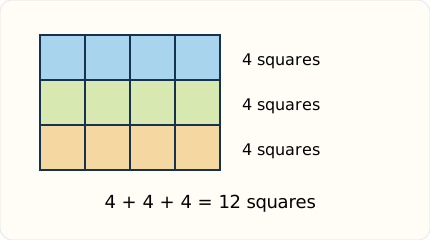 Count across one row: four squares. Every other row has the same four-square structure, so count four, eight, twelve as you include the rows. The equation 4 + 4 + 4 = 12 records one addend for each row. It explains where the total comes from rather than merely giving a number.