Reading a clock to the nearest five minutes, and what a.m. and p.m. mean.
Paper packet. Every task here also exists on screen, where it is checked automatically; answers written on paper are not assessed by Nydus. When you are back at a device, enter your answers there.
1. What you will learn
In this lesson you read a clock to the nearest five minutes. Counting round the face in fives is exactly the skip counting from earlier this year, which is why it comes now — the numbers on a clock face are not minutes, they are groups of five, and seeing that turns a confusing dial into something you already know how to read.
2. Before you begin
Count by fives from zero to sixty. Each count adds the same amount: five minutes. You already know that a clock can show an hour or half an hour. Today you will read the spaces between those times. Have a paper clock or a clock with movable hands nearby if you have one. You may point to a picture instead. Say which hand is longer before reading either number. A clock with only printed digits is a digital clock; a clock with moving hands is an analog clock. Both can name the same time.
3. Clock words
Term
What it means
hour
A time unit equal to sixty minutes.
minute
One of sixty equal time units in an hour.
hour hand
The shorter hand, which moves slowly between hour numbers.
minute hand
The longer hand, which goes once around in an hour.
a.m.
The half of the day from midnight until noon.
p.m.
The half of the day from noon until midnight.
4. One face carries two scales
Look at the picture. The short hand has passed four but has not reached five. The long hand points to four. These hands do different jobs even though they use the same face. The short hand says which hour we are in. The long hand counts minutes since that hour began. To read it, start at twelve with zero minutes, then move in the direction the hands travel: toward one, two, three and onward. Four groups of five minutes make twenty minutes. This clock shows four twenty.
The printed four does not mean four minutes when the long hand points there. There are twelve large spaces around the face, but sixty minutes in an hour. Each large space therefore covers five minutes. You can prove the total by counting five twelve times. Keep the two readings separate until the end: hour four, minutes twenty, time four twenty. The picture cannot tell you whether the time is before or after noon. You need information about the day for that.
Another way: steps
First name the hour that has begun. Next count the minutes from twelve. Write the hour, a colon, and two minute digits. Finally add a.m. or p.m. if the situation tells you which half of the day it is.
5. Count spaces from the starting point
Put your finger on twelve and say zero. Move to one and say five. Move to two and say ten. You have crossed two large spaces, so ten minutes have passed. Continue: three means fifteen, four means twenty, five means twenty-five and six means thirty. The lower half continues the same pattern: seven means thirty-five, eight forty, nine forty-five, ten fifty and eleven fifty-five. Returning to twelve finishes sixty minutes and begins the next hour. At that new hour we write zero minutes, shown as 00 after the colon.
Notice the difference between a starting mark and a counted space. Twelve is where the minute count begins; it is not the first five-minute group. If you say five while your finger is still on twelve, every later reading will be five minutes too large. Try reading the long hand at three. The spaces from twelve to one, one to two, and two to three are three five-minute groups. Fifteen minutes is also a quarter of the sixty-minute journey.
You do not need to count from the start forever. Once six means thirty is familiar, you can continue from there. For a long hand at eight, say thirty at six, thirty-five at seven, and forty at eight. This is counting on, just as you count on when adding. It gives the same reading as eight groups of five. Practice both ways so that one can check the other.
6. The hour hand keeps moving
Watch what happens between four o'clock and five o'clock. At four o'clock the short hand points at four and the long hand points at twelve. As minutes pass, both hands move. At four thirty the short hand is halfway from four to five. At four fifty-five it is very close to five, but five o'clock has not happened yet. The long hand must finish its trip to twelve first. Until then the hour is four.
A clock is different from rounding a number to the nearest label. We do not choose whichever hour number is closest. We choose the hour that has already begun. At seven forty-five, the short hand is closer to eight than to seven, yet the time still starts with seven. Cover the long hand for a moment and ask which two hour numbers surround the short hand. Then uncover the long hand to see how far through that hour the clock has moved.
Near twelve, use the same idea. A short hand between twelve and one still names the twelve o'clock hour. A short hand between eleven and twelve names the eleven o'clock hour. The printed numbers repeat around the clock; a face does not have a thirteen. Moving from twelve fifty-five to one o'clock changes the displayed hour to one. The day continues even though the hour labels start again. On a real clock, use the hand length rather than its color, because clocks can use different colors.
7. Write a time another reader can understand
An analog face and a digital display can show the same time in different ways. The face shows positions. The digital display writes the hour first, then a colon, then the minutes. The colon separates the two units. For nine twenty-five, write 9:25. The 9 counts hours on the daily clock, while 25 counts minutes since that hour began. You do not add those numbers together.
Use two minute digits even when the minute count is small. Five minutes past two is 2:05, not 2:50. The zero holds the tens place in the minute count. At two o'clock, write 2:00. A digital display might put a zero before the hour too, but 02:05 and 2:05 name the same time on a twelve-hour clock. Our written answers use the ordinary hour number and two minute digits.
Read the notation back aloud after writing it. If you meant six forty but wrote 6:04, your spoken reading and written reading will disagree. Four minutes and forty minutes place the long hand in very different positions. We are working with times exactly on five-minute marks in this lesson. A hand between those marks needs a more precise reading; do not pretend it is exactly on a mark when it is not. The pictures and descriptions used here give enough information for an exact five-minute reading.
8. Use the day to decide a.m. or p.m.
The hour labels go around twice during a full day. Three twenty-five can happen before sunrise and again in the afternoon. The hands have the same positions both times. This is why a schedule often includes a.m. or p.m. A.m. begins at midnight and continues until noon. P.m. begins at noon and continues until the next midnight. Noon is 12:00 p.m.; midnight is 12:00 a.m. These two boundary times deserve care because their hour number is the same.
A story must give useful evidence about the day. Breakfast before school usually happens in the morning, but a person's routine alone is not proof of a time. If a story says a club meets at four twenty in the afternoon, the words in the afternoon directly establish p.m. If it says a train leaves at one ten after midnight, that time is a.m. even though it is dark. Darkness does not always mean p.m.; early morning can be dark too.
When the story gives only a picture of a clock, report the time and say that the half of the day is unknown. Do not invent a.m. or p.m. just to make the answer look complete. If the time is for an actual meeting, ask for the missing information. A correct clock reading can still be an incomplete appointment. The date and place can matter too, but this lesson asks you to identify the hour, minutes, and stated half of the day.
9. Check both hands together
A reading should agree with both hand positions. Suppose someone reads a face as eight forty-five. Its long hand should point to nine, because nine groups of five make forty-five. Its short hand should lie between eight and nine and should be closer to nine. If the short hand is between three and four instead, the hour was misread even though the minutes may be right. Checking only one hand cannot settle the whole time.
You can reverse the process to test your answer. Start with your written time and describe where each hand should be. For ten fifteen, the long hand should be at three and the short hand a little beyond ten. Compare that description with the original face. This reverse check is useful when the short hand is nearly at the next hour or when the minute digits could have been reversed.
There are also simple size checks. The minute part of a twelve-hour clock reading is from zero through fifty-nine; in this lesson it is a multiple of five. A written minute count of seventy cannot describe minutes since the most recent hour began. The displayed hour is from one through twelve. These checks catch impossible readings, but they cannot prove that a possible reading is the right one. A time such as 5:20 is possible, yet it is wrong for a face showing 5:40. Finish by looking at the actual evidence.
10. An afternoon library visit
A class in Oregon has an invented library schedule. The visit begins at 2:35 p.m. The classroom clock has its long hand on seven and its short hand between two and three. To decide whether the visit is beginning, first read the short hand: two o'clock has begun. Then count the minute groups: five, ten, fifteen, twenty, twenty-five, thirty, thirty-five. The face agrees with 2:35. The schedule says afternoon, so p.m. agrees too. A child who reads 3:35 has moved the hour ahead too soon. Another child writes 2:07 by copying the face number for the minute count. Reconstructing both hands shows each mistake. In real life a schedule can change; here we are checking that the supplied clock and written time match, not promising that a library is open.
11. A message that needs one more detail
A relative writes, 'Call me at 7:15.' You can put the long hand at three and the short hand just beyond seven, but you cannot decide which half of the day the relative means. A morning call and an evening call would use the same hand positions. You ask for the missing detail and learn that the call is after dinner that evening. Now write 7:15 p.m. on your reminder. Check that fifteen minutes is three groups of five and that the short hand has not reached eight. If the message had said morning, a.m. would be appropriate instead. This example shows why a mathematically correct reading still needs a clear situation. A useful time message gives the information the other person needs, rather than making them guess from a familiar daily routine.
12. Mistakes that a check can catch
A minute hand pointing to five means twenty-five minutes, not five minutes. Count the spaces from twelve to find out why. A short hand nearly at seven still names six if seven has not been reached. Do not treat a clock like a rounding exercise. Another mistake is writing 3:50 when you mean five minutes past three. Read the two minute digits aloud: fifty is different from zero five. Finally, do not decide a.m. or p.m. from hand position. A pictured face can show the time within a twelve-hour cycle without showing which cycle of the day it is. Describe what the evidence tells you and leave missing information open.
13. Read the teaching clock
Find the shorter hand.
It lies between 4 and 5.
Its length identifies the hour hand.
Name the hour begun.
The hour is 4.
The hand has passed four, not five.
Count the minute groups.
5 + 5 + 5 + 5 = 20 minutes.
The long hand is at four.
Write both time units.
4:20
The colon separates the hour and minute readings.
Check the day's information.
a.m. or p.m. is not given.
An ordinary clock face shows neither half of the day.
14. Read a hand near the next hour
Locate the hour hand.
It lies between 8 and 9, near 9.
The short hand moves throughout the hour.
Keep the current hour.
The hour is still 8.
Nine o'clock has not begun.
Locate the minute hand.
It points at 9.
The long hand names five-minute groups.
Count from a known point.
30 + 5 + 5 + 5 = 45 minutes.
Six is thirty, and three more groups reach nine.
Write the clock reading.
8:45
Do not round the hour up.
Reverse the hand check.
45 minutes is three quarters of an hour.
The short hand should be three quarters of the way toward nine.
15. Repair a morning schedule
Read the supplied situation.
The event is before noon; the short hand is between 10 and 11.
The story gives day information as well as hand positions.
Choose the begun hour.
The hour is 10.
The short hand has not reached eleven.
Use the long-hand position.
The long hand is at 11: 50 + 5 = 55 minutes.
Eleven large spaces have passed since twelve.
Reject the proposed reading.
11:55 uses the next hour too soon.
The hour hand cannot yet name eleven.
Write the corrected schedule.
10:55 a.m.
Before noon supplies the a.m. label.
Check the next five minutes.
Five minutes later the hands would show 11:00 a.m.
Finishing the minute-hand circuit begins the next hour.
Check the appointment detail.
10:55 a.m. is not 10:55 p.m.
The second reading would place the event after noon.
16. Your turn: the short hand is between six and seven, the long hand is at eight, and it is evening
Identify the begun hour.
The hour is 6.
The short hand has passed six.
Continue from half an hour.
30 + 5 + 5 = 40 minutes.
Eight is two five-minute groups beyond six.
Your turn: work this step out. Its working is at the end of the packet.
Write the time and half-day.
Your turn: work this step out. Its working is at the end of the packet.
Check both hand positions.
17. Guided practice
A classroom clock's hour hand is between 7 and the next hour, and the minute hand points at the 6. Write the time.
a:b
18. Guided practice
Match each pictured clock to its time.
5:50
6:10
10:55
clock
clock
clock
Audio transcript: None
19. Guided practice
The short hand has passed 7, and the long hand points at 8. Complete the minute calculation.
Keep the hour already begun.
The hour is 7.
Do not round to the next hour.
Count the long hand's groups.
The minute count is minutes.
Each large space holds five minutes.
Check both readings together.
Write the hour before the colon and two minute digits after it.
The two hands report different units.
20. Guided practice
A classroom clock's hour hand is between 3 and the next hour, and the minute hand points at the 7. Write the time.
a:b
21. Practice
A classroom clock's hour hand is between 10 and the next hour, and the minute hand points at the 2. Write the time.
a:b
22. Practice
A classroom clock's hour hand is between 2 and the next hour, and the minute hand points at the 11. Write the time.
a:b
23. Practice
A classroom clock's hour hand is between 1 and the next hour, and the minute hand points at the 2. Write the time.
a:b
24. Somewhere new
Match the day-part facts for the middle of the afternoon, at playtime.
falls after noon
is written p.m.
is the matching time-of-day context
the middle of the afternoon, at playtime
after noon
3:25 p.m.
25. Lesson test
Lesson test: one question per skill, one attempt each, no hints. Your answers are checked when you submit.
26. Test question
Read both hands of this clock.  Enter the hour and minutes in separate cells. The half of the day is not supplied.
Hour
Minutes past
Clock reading
27. What you can do now
You can read a clock to the nearest five minutes. Without looking: what does the 4 on a clock face mean when the long hand points at it, and why?
Working for the steps left to you
16. Your turn: the short hand is between six and seven, the long hand is at eight, and it is evening, step 3
6:40 p.m.
Evening is after noon and before midnight.
16. Your turn: the short hand is between six and seven, the long hand is at eight, and it is evening, step 4
The short hand should be beyond halfway toward seven.
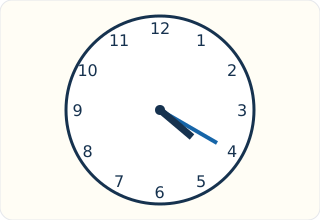 The short hand has passed four but has not reached five. The long hand points to four. These hands do different jobs even though they use the same face. The short hand says which hour we are in. The long hand counts minutes since that hour began. To read it, start at twelve with zero minutes, then move in the direction the hands travel: toward one, two, three and onward. Four groups of five minutes make twenty minutes. This clock shows four twenty.