Back to the on-screen lesson ·
Fractions that look different and name the same amount, and how to find them.
Paper packet. Every task here also exists on screen, where it is checked automatically; answers written on paper are not assessed by Nydus. When you are back at a device, enter your answers there.
In this lesson you find fractions that are written differently and mean the same amount: 2/4 and 1/2, 3/6 and 1/2. The idea underneath is that you can cut every piece of a whole into the same number of smaller pieces without changing how much you have — which is why the top and bottom numbers both grow together.
You can name a fraction by identifying one whole, partitioning it into equal parts and counting how many parts are selected. You also know that one third means one of three equal parts of that whole. Before learning a new fraction name, point to the whole you are measuring. A shaded piece without a stated whole is not enough information. In this lesson the whole stays unchanged while the pieces used to describe it change. The selected amount also stays unchanged. Only its name, and the size of each counting piece, will change.
| Term | What it means |
|---|---|
| Equivalent fractions | Different fraction names for the same number or amount of the same whole. |
| Numerator | The number of equal parts selected or counted. |
| Denominator | The number of equal parts making one whole. |
| Partition | Divide a whole into parts; fraction parts must have equal size. |
| Regroup | Combine smaller equal pieces into larger equal pieces. |
| Unit interval | The length from 0 to 1 on a number line. |
Fold a paper strip into two equal parts and shade one. Half the strip is shaded. Now fold each half into two smaller equal parts, keeping the shading where it was. The strip has four equal parts, and two are shaded. One half and two fourths describe exactly the same shaded length: 1/2 = 2/4. The shaded part did not stretch, and the unshaded part did not disappear.
A fraction counts pieces of a particular size. When the pieces become smaller, more pieces can be needed to describe the same amount. That is why a larger numerator does not always mean a larger fraction. Two fourths use more pieces than one half, but each fourth is smaller than a half. To decide whether fractions are equivalent, compare the amount or number they represent, not just one of the written numbers.
The equal sign records this unchanged value. You are giving a number another name, just as four tens and forty ones can name the same whole-number amount.
Another way: steps
Identify one whole. Keep its size and the selected amount fixed. Repartition every original piece equally. Count the new selected parts and all the new parts.
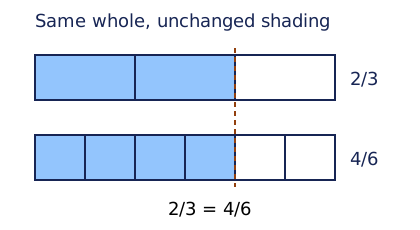
Look first at the left and right ends of the two bars. They line up, so each bar represents a whole of the same length. The upper bar contains three equal parts, and two are shaded. The lower bar contains six equal parts, and four are shaded. A dashed guide passes through the right end of both shaded regions. That shared endpoint is the visual evidence that 2/3 and 4/6 are equivalent.
Each third in the upper bar corresponds to two sixths below it. The selected two thirds therefore correspond to four sixths. The unselected third also splits into two sixths. It matters that the whole bar was repartitioned, not just the selected region. The denominator counts every equal part in the whole.
Cover the fraction labels and describe the picture before using symbols. Both bars have the same total length and the same shaded length; the second simply has twice as many equal pieces. Then restore the labels. The equation summarizes what the picture establishes. If the bars did not share a whole length, matching shaded endpoints alone would not establish the same fraction of each bar. Check the entire representation.
Suppose every original piece is cut into two equal pieces. The number of parts in the whole doubles, so the denominator doubles. The number of selected parts also doubles, so the numerator doubles. Starting with 3/4, this gives 6/8. Three selected fourths become six selected eighths, and four fourths become eight eighths in the whole.
The operation on the two written numbers must describe the same cutting. Multiplying the numerator by two but leaving the denominator unchanged gives 6/4, which counts six fourths rather than three fourths. Multiplying only the denominator gives 3/8, which counts three smaller pieces rather than six. Neither preserves the original selected amount.
Nor does adding the same number usually describe an equal repartition. From 1/2, adding one to both numbers gives 2/3. Two thirds lies beyond one half on a common number line. The reliable change here is to multiply both numbers by the same positive whole-number factor, because each original piece is being replaced by that many smaller pieces. You should still be able to connect the arithmetic to a whole and its selected parts rather than treating it as an unexplained rule for changing digits.
Consider 1/3 = ?/6. Ask how the whole's parts changed. Three parts became six parts, so every third was split into two. One selected third must become two selected sixths. The missing numerator is two. Write the complete equality, 1/3 = 2/6, and check it against an aligned strip.
Sometimes the missing number is the denominator. In 2/3 = 4/?, the selected parts doubled from two to four. To keep their total size unchanged, every original third must split into two. The whole therefore has six parts, giving 2/3 = 4/6. Do not add two to the denominator merely because the numerator increased by two. That description ignores how each individual part changed.
A useful record has two arrows, one beside the numerator and one beside the denominator, both marked with the same multiplication factor. The arrows explain the coordinated change. If your two arrows use different factors, stop and redraw the pieces. A missing-number problem is asking you to preserve a relationship, not simply to make a larger fraction-looking pair of numbers. Check the new denominator by counting all parts, including those not shaded.
Equivalent names work in both directions. Four sixths can be regrouped into two thirds. Pair the six equal pieces of the whole to make three equal groups. Four selected sixths form two of those groups. The whole now has three parts, and two are selected. Both written numbers were divided by two, matching the pairs of pieces.
Regrouping needs complete equal groups. For 2/6, pair the two selected sixths into one group. The entire whole has three such groups, giving 1/3. For 3/6, group three sixths together instead: the whole has two equal groups, and one is selected, giving 1/2. The appropriate group size depends on both the selected count and the whole count.
A later procedure asks for a fraction in simplest form: a name whose numerator and denominator have no shared whole-number factor greater than one. Some retained practice extends this regrouping procedure to larger denominators. The central Grade 3 idea is simpler: explain easy equivalences with parts and positions. Do not assume that the shortest-looking name is the only correct fraction. One half, two fourths and four eighths are all correct names for the same number.
A number line gives another test of equivalence. Mark zero and one and keep that unit interval fixed. Divide it into two equal lengths. The end of the first length is one half. Now divide the same interval into four equal lengths. Two fourth-length jumps from zero reach the same point as one half-length jump. That is why 1/2 and 2/4 name the same number.
Count intervals, not tick marks. Four intervals between zero and one require five boundary marks when both endpoints are included. Zero is where counting jumps begins; it is not the end of the first jump. Mistaking the initial mark for one counted part moves every fraction to the wrong position.
The point at one can also have different fraction names. Two halves, three thirds, four fourths and six sixths each fill one whole unit interval. Their numerators equal their denominators because every part of the whole is counted. You can place all those labels at the same point without moving the point. Adding more labels does not create more numbers. The position records value; the labels record different ways of measuring that value.
Start every check by identifying the whole. A half of a short ribbon and two fourths of a much longer ribbon need not have the same physical length, even though the fraction numbers 1/2 and 2/4 are equivalent. For a physical comparison, either use equal whole ribbons or measure the resulting lengths in a common unit. Otherwise a picture can make a true numerical equality appear false.
Next check equal partitioning. Four pieces with different areas are not automatically fourths. Counting two shaded pieces out of four is not enough unless each piece represents an equal part of the whole. Inspect the sizes before writing the fraction. This is especially useful when a drawing is not a regular strip or grid.
Finally compare the selected amount. On aligned bars, the selected regions should end together. On aligned number lines, the labels should sit at the same position measured from zero. In the arithmetic, both numbers should be changed by the same factor. These checks support one another. If a numerical rule and a drawing disagree, inspect the whole, the partition and the counted parts before deciding which needs repair.
A walking route is divided into three equal sections. A group has completed two sections, so it has walked two thirds of the route. The organizer adds a marker halfway through every section. The route now has six equal sections, and the same stopping place comes after four of them. The group has not walked any farther while the markers were added. Its progress can be named either 2/3 or 4/6 of this route. The denominator describes the chosen partition, not a change in the route's full length.
For a snack, two identical flatbreads are cut differently. One is cut into halves and the other into fourths. One child receives a half from the first bread; another receives two fourths from the second. Because the breads began with equal size and every cut made equal parts, the children receive equal amounts. The number of pieces is different, but the total amount of bread is the same.
If the breads were not identical in size, the fraction labels alone would not settle who received more food. A half of a large bread could exceed two fourths of a small one. This is why a fair comparison needs the common-whole condition as well as correct fraction arithmetic. State that condition when explaining the sharing plan, and use a drawing or measurement to support it.
A learner says four sixths must exceed two thirds because four is greater than two. The missing information is piece size: a sixth is half the size of a third of the same whole. Four small pieces can exactly match two larger ones. Another learner changes 2/3 into 2/6 by cutting every third in half but forgetting to count the extra selected pieces. Check both the selected count and the total count after every repartition. Equivalent fractions keep the amount fixed, not necessarily either of the two written numbers.
Identify the whole and selected part.
1 of 2 equal parts
The selected amount is one half.
Split every original piece in two.
2 × 2 = 4 parts
The denominator counts all new parts.
Count the new selected pieces.
1 × 2 = 2 selected parts
The original shading is unchanged.
Write the new fraction name.
1/2 = 2/4
Both names describe the same selected length.
Check by pairing fourths.
2 fourths make 1 half
Regrouping reverses the split.
Read the equivalent-fraction statement.
3/4 = ?/8
The whole and amount must stay fixed.
Compare the whole's part counts.
8 ÷ 4 = 2
Each fourth became two eighths.
Apply the same split to the selected parts.
3 × 2 = 6
All three selected fourths are split.
Write the completed fraction.
3/4 = 6/8
Six eighths cover the original selected region.
Check the unselected part too.
4 - 3 = 1 fourth; 8 - 6 = 2 eighths
The unselected region is also unchanged.
Compare aligned endpoints.
3/4 and 6/8 occupy one point
Equal positions represent equal numbers.
Start with the selected fraction.
4/6
Four of six equal parts are selected.
Choose pairs of smaller pieces.
2 sixths per group
Both selected and total counts can be grouped in pairs.
Count groups in the whole.
6 ÷ 2 = 3
The new denominator counts equal larger parts.
Count selected groups.
4 ÷ 2 = 2
The selected amount forms two complete groups.
Write the equivalent name.
4/6 = 2/3
Regrouping changes labels without changing amount.
Reverse the regrouping.
2 × 2 = 4; 3 × 2 = 6
Splitting both counts restores the original name.
Check the number-line position.
4 sixth-length jumps = 2 third-length jumps
Both begin at zero and end together.
Read the proposed equal names.
1/2 = 4/?
The selected amount stays one half.
Find the change to the numerator.
4 ÷ 1 = 4
Every selected part becomes four smaller parts.
Apply that change to the denominator.
Write and check the equality.
Write 2/10 in its simplest form as {{n}}/{{m}}.
n/m
A whole has 3 equal parts and 2 are selected. Split every part into two equal pieces.
Count the parts in the repartitioned whole.
3 × 2 = whole
Every original part produces two smaller parts.
Count the selected smaller parts.
2 × 2 = selected
The selected original parts are split in the same way.
Check the unchanged amount.
Pair the new pieces to recover the original fraction.
Repartitioning does not add or remove shading.
Complete the pair of equal fractions: 1/3 = 5/?. Type the missing number below the line.
1/3 = 5/denominator
Write 3/9 in its simplest form as {{n}}/{{m}}.
n/m
Complete the pair of equal fractions: 3/4 = 12/?. Type the missing number below the line.
3/4 = 12/denominator
Write 6/10 in its simplest form as {{n}}/{{m}}.
n/m
A bar is cut into 5 equal parts and 4 of them are shaded. The same bar is then cut into 20 equal parts instead. How many of the smaller parts are shaded?
Answer:
A one-meter ribbon has 3 of its four equal sections colored. Each section is then halved. Complete the new fraction label for the colored length.
Colored length: top/bottom of the ribbon
Lesson test: one question per skill, one attempt each, no hints. Your answers are checked when you submit.
A one-meter ribbon has 2 of its four equal sections colored. Each section is then halved. Complete the new fraction label for the colored length.
Colored length: top/bottom of the ribbon
You can tell whether two fractions are equal and find one that matches. Without looking: what is 2/6 in its simplest form, and what did you do to both numbers?
16. Find the missing denominator, step 3
2 × 4 = 8
Every part of the whole must be split alike.
16. Find the missing denominator, step 4
1/2 = 4/8
Four eighths cover half of the unchanged whole.