Define the reference whole, count repeated unit fractions and inspect equal-part representations, including amounts beyond one whole.
Paper packet. Every task here also exists on screen, where it is checked automatically; answers written on paper are not assessed by Nydus. When you are back at a device, enter your answers there.
1. What you will learn
In this lesson you learn what a fraction really is: some of the equal parts of a defined whole. You will name the unit fraction, count copies of it and explain which conditions make a model valid. The count can extend beyond one whole without changing the size of the unit fraction.
2. What you already know
You can share a whole into equal parts and count repeated units. A fraction is a number built from those units. It can name less than a whole, exactly one whole or more than one whole. Keep the reference whole and the size of each counted piece explicit when reading a representation.
3. Words in this lesson
Term
What it means
Reference whole
The unit amount against which a fraction is measured.
Unit fraction
One of the equal parts that together make one whole.
Numerator
The number of unit-fraction parts counted.
Denominator
The number of equal parts that make one reference whole.
Iterate
Repeat a unit without changing its size.
Partition
Divide the whole into parts; the counted fraction parts must be equal in the relevant measure.
4. Equal parts
Imagine a chocolate bar snapped into 4 pieces of exactly the same size. Each piece is one quarter of the bar, written 1/4. The word equal matters: if one piece is bigger than the others, the pieces are not quarters, even if there are four of them. A fraction has two numbers. The number below the line says how many equal parts the whole was cut into. The number above the line says how many of those parts we are talking about. So in 3/4 the whole was cut into 4 equal parts and we have 3 of them. A unit fraction has a 1 on top: 1/6 is one of six equal parts.
Another way: picture
A bar divided into six equal boxes. Shade one box: that is 1/6. Shade three boxes: 3/6. The number of boxes in the whole bar is the bottom number.
Another way: story
A pizza cut into 8 equal slices. You eat 3 slices: 3/8 of the pizza. The 5 slices left are 5/8, and together they make 8/8, the whole pizza.
5. Choose the whole before naming a part
A fraction describes a number relative to a reference whole. One paper strip can be that whole. If it is divided into three equal lengths, each length is one third of the strip. Place a second identical strip beside it. The original pieces remain thirds of one strip. The new collection does not silently change what the word 'whole' means.
You could deliberately choose both strips together as a different whole. Then one original piece would be one sixth of the two-strip collection. That is a valid different description, but it must be announced. Write 'one strip is one whole' or outline the chosen unit in a model before selecting a denominator. A fraction label without its reference can be ambiguous in a physical situation.
When two learners give different names to the same piece, first compare their chosen wholes. They may be measuring against different units rather than disagreeing about the piece itself. A precise explanation names both the part and its whole.
6. Use one part as a repeated measuring unit
A unit fraction has numerator one. One fourth is a unit that can be repeated: two fourths is two copies, three fourths is three copies, and four fourths completes one whole. This makes fractions numbers that can be counted, not merely names for colored pictures. The denominator names the unit size and the numerator counts its copies.
Lay four equal quarter-strip pieces end to end. They must reach exactly the length of the original strip, with no gap or overlap. That reconstruction tests whether the proposed piece really is a fourth. A piece slightly too long would extend past the whole after four copies. A piece too short would leave a gap. The denominator claims a relationship that the reconstruction can check.
The same reasoning applies to thirds, sixths and eighths. Three copies of a third rebuild one whole, six copies of a sixth rebuild one, and eight copies of an eighth rebuild one. More equal parts mean a smaller unit fraction when the whole stays fixed.
7. Read the selected and unselected counts together
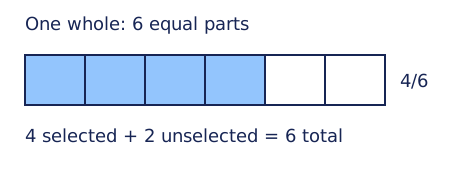
In , the reference whole is one complete bar. It has six equal parts, of which four are selected. Each part is a sixth. The selected amount is four sixths, while the two unselected parts make two sixths. Both fractions use the same denominator because they use the same whole and partition.
Check the full account: four selected pieces plus two unselected pieces makes six pieces. The denominator includes both kinds. Writing four over two would compare the selected count with the unselected count; it would not name the selected fraction of this bar. Point to all the pieces when explaining the denominator, then point only to selected pieces for the numerator.
Selection does not need to be consecutive. Four scattered sixths still have the same combined length as four neighboring sixths when all pieces are equal. The number of separate colored patches is not necessarily the number of unit fractions selected.
8. Inspect equal size rather than equal-looking labels
Suppose a rectangle is divided into a left half and two right-hand fourths. It has three visible regions, but those regions are not thirds. The left region is twice the area of either right-hand region. Counting regions without checking their sizes would assign a false unit fraction to each.
To repair the model, split the left half into two fourths too. The whole now consists of four equal areas. One small selected region can be named one fourth, and the original large region can be named two fourths. Notice that the large region's area did not change. The new partition supplies a common unit for counting it.
Equal area does not always mean identical shape. Different regions can contain the same number of equal grid squares. A grid or a valid fold can establish equal area even when outlines differ. Without measurements or a clear construction, do not claim equality merely because two regions look close.
9. Keep length and area interpretations clear
A paper strip can model a fraction of length or a fraction of area. Equal-width vertical partitions of a rectangular strip have equal lengths along the strip and equal areas when their heights also match. That convenient model connects the two interpretations, but they remain different measurements. A fraction of an edge is not automatically the same fraction of every enclosed surface.
For length, use a number line. The interval from zero to one is one whole unit. Divide it into four equal intervals, then travel three of them from zero to locate three fourths. The point is a number's location, while the traveled intervals show its distance from zero. Count intervals rather than the starting mark.
A bar model and a number line should agree when their unit lengths match. The end of a three-fourths selected bar lies at the three-fourths point on the line. This agreement is evidence about the same number represented in two different ways.
10. Continue counting past one whole
There is no rule that a fraction's numerator must be smaller than its denominator. Five thirds means five copies of one third. Three copies fill the first whole, and two more continue into a second identical whole. The value is greater than one and less than two. A drawing needs enough space to show the complete count.
The denominator remains three because three equal pieces still make one chosen whole. Writing 5/6 after drawing two bars would redefine the whole as both bars together. That would change the number being represented. Keep the unit fixed as you count across a boundary between whole strips.
Check using benchmarks. Three thirds is one; six thirds is two. Five thirds must lie between them. A model shading only two thirds shows the extra part but omits the complete first whole. Account for both: one whole and two thirds more. The numerator counts every selected unit fraction, including those within complete wholes.
11. Distinguish fraction size from physical amount
One half of a long strip can be longer than one half of a short strip. The fraction numbers are equal, but the reference lengths differ. Suppose one strip is eight length units and another is four. Half of the first is four units; half of the second is two. Equal fraction names do not by themselves prove equal physical amounts.
To compare numerical fractions using drawings, first make the drawn wholes equal in size. Otherwise, a larger picture can make a smaller fraction look physically longer. To compare actual ribbons from different wholes, measure their selected lengths in a common length unit. The question determines which comparison is appropriate.
State the limit of a picture. A label saying 'one half' tells you a relative share. It does not tell you an exact number of inches or centimeters without the whole's measurement. Asking for that missing measurement is part of careful fraction reasoning, not a failure to calculate.
12. Connect equivalent names to the same unit amount
Two sixths can cover the same amount as one third. To see why, split every third of a strip into two equal pieces. The whole now has six equal parts, and the one selected third now contains two selected sixths. The selected amount stayed fixed while its counting unit changed.
You can reverse the process by pairing all the sixths. Six pieces make three pairs, and two selected pieces make one selected pair. Each pair is one third of the unchanged whole. Do not pair only selected pieces and ignore the rest of the partition: numerator and denominator must describe the same unit size.
Core examples use halves, thirds, fourths, sixths and eighths. Some retained practice uses other equal-part counts as an extension of the same unit-fraction meaning. The central evidence here is whether you can interpret and build a valid partition, not whether you can perform an unexplained numerical simplification procedure.
13. Label equal sections of a display ribbon
A display ribbon is chosen as one whole and divided into six equal lengths. Four sections receive printed messages and two remain plain. Each section is one sixth of the ribbon, so the printed share is 4/6 and the plain share is 2/6. The two counts account for all six equal sections. The denominator includes the plain sections as well as the printed ones.
The class wants seven printed sixth-length sections for a new display. One ribbon supplies six such sections, so it needs one additional section from a second identical ribbon. The selected amount is seven sixths of one ribbon. It is not seven twelfths unless the reference whole is deliberately changed to the two-ribbon collection.
These fractions describe lengths, not the amount of ink used or the time needed to print messages. Messages with different lettering can require different work even on equal-length sections. Also, if the ribbons are not identical in length, a sixth of one may not replace a sixth of the other. Measure or compare the whole ribbons before using their sections interchangeably. The supported claim is about equal-length sections under an explicit common-whole condition. A physical check of cutting accuracy requires someone to inspect the actual pieces, beyond this written calculation.
14. The mistake to avoid
Four pieces do not make quarters unless the four pieces are the same size. Four unequal regions cannot all be called quarters merely because there are four regions. The other common slip is writing the fraction upside down: the number of pieces in the whole always goes below the line.
15. Name three selected eighths
Choose the reference.
One complete rectangular sheet = 1 whole
The fraction needs a stated whole.
Partition the sheet into eight equal areas.
Each piece = 1/8
Equal size allows every piece to use the same counting unit.
Select three pieces.
1/8 + 1/8 + 1/8
The numerator counts copies of the unit fraction.
Write the selected share.
3/8 of the sheet
Three parts are selected out of eight in one whole.
Check the account.
3 selected + 5 plain = 8 equal parts
Both selected and unselected pieces belong in the denominator.
16. Repair an unequal partition
Read the partition: one small region is selected.
Left half; two right fourths
The description gives enough size information to test the model.
Compare the region sizes.
Left region = twice either small region
Three regions alone do not establish thirds.
Repair the partition.
Split the left half into two equal fourths
This changes neither the whole nor the selection.
Count the repaired whole.
2 left parts + 2 right parts = 4 equal areas
The new counting unit is one fourth of the rectangle.
Name the selection.
One selected fourth = 1/4
The selected small region occupies one of those four equal areas.
Check by rebuilding the whole.
Four copies of the selected region's area = 1 whole
Reconstruction verifies the unit fraction rather than trusting the number of old regions.
17. Build seven fourths without changing the whole
Choose a reference and provide enough material.
One strip = 1 whole; two identical strips available
More than one whole needs enough material, but the unit stays one strip.
Divide each strip into four equal lengths.
Each piece = 1/4 of one strip
Each piece uses the same reference length.
Interpret the numerator.
7/4 = seven copies of 1/4
The numerator counts pieces, not complete strips.
Select the first complete strip.
4/4 = 1
Four fourths rebuild one complete whole.
Find the extra pieces needed.
7 − 4 = 3 fourths
The requested count continues beyond the first whole.
Account for all pieces across both strips.
7 selected + 1 plain = 8 pieces
This checks the physical selection while keeping four parts per whole.
Check the benchmarks.
4/4 < 7/4 < 8/4, so 1 < 7/4 < 2
Seven fourths is more than one whole but less than two; 7/8 would instead use both strips as the whole.
18. Your turn: nine sixths
Identify the reference.
One bar = 1 whole; six equal parts per bar
The denominator is determined by the partition of one bar.
Interpret nine sixths.
9 copies of 1/6
The numerator counts the repeated unit fraction.
Your turn: work this step out. Its working is at the end of the packet.
Select pieces across both bars.
Your turn: work this step out. Its working is at the end of the packet.
Check the benchmarks.
19. Guided practice
A loaf of bread is cut into 6 pieces of the same size. Ben takes 5 of them. Write the fraction Ben took using the original 6-part partition: {{n}}/{{d}}.
n/d
20. Guided practice
A strip is partitioned into 5 equal parts. 1 parts are left plain; the rest are shaded. Complete the counts.
Name one equal part.
1/5 of the strip
The denominator counts equal parts in the reference whole.
Count selected unit fractions.
5 − 1 = selected
Shaded and plain parts together form the whole.
Verify the complete partition.
selected + 1 = 5
Every equal part must be included once.
21. Guided practice
The bar is cut into 9 equal parts. Shade 7/9 of it.
Shade the parts:
22. Practice
A melon is cut into 5 pieces of the same size. Ana takes 3 of them. Write the fraction Ana took using the original 5-part partition: {{n}}/{{d}}.
n/d
23. Practice
The bar is cut into 9 equal parts. Shade 5/9 of it.
Shade the parts:
24. Somewhere new
A ribbon is cut into equal pieces, and each piece is 1/12 of it. How many pieces are there altogether?
Answer:
25. Lesson test
Lesson test: one question per skill, one attempt each, no hints. Your answers are checked when you submit.
26. Test question
Each bar represents one whole and has 7 equal parts. Shade 9/7 using the two bars. Keep one bar as the reference whole.
Shade the parts:
27. What you can do now
A fraction names some of the equal parts of a whole. The denominator counts equal parts in one whole; the numerator counts selected parts. Explain why five thirds uses more than one whole, and why the denominator remains three.
Working for the steps left to you
18. Your turn: nine sixths, step 3
6 + 3 = 9 sixths
One complete whole accounts for six of the requested pieces.
18. Your turn: nine sixths, step 4
6/6 < 9/6 < 12/6
The model lies between one and two wholes; this catches omission of the complete first bar.
 , the reference whole is one complete bar. It has six equal parts, of which four are selected. Each part is a sixth. The selected amount is four sixths, while the two unselected parts make two sixths. Both fractions use the same denominator because they use the same whole and partition.