The same amount written two ways, and why tenths are the bridge.
Paper packet. Every task here also exists on screen, where it is checked automatically; answers written on paper are not assessed by Nydus. When you are back at a device, enter your answers there.
1. What you will learn
In this lesson you meet the same amount written two ways: three tenths as 3/10, and as 0.3. Tenths are where fractions and decimals meet, because our whole way of writing numbers is built on tens — so the first place after the point is exactly the tenths place. Seeing them as two spellings of one number now saves a great deal of confusion later.
2. Extend the fraction idea
You know that a denominator names the number of equal parts in one whole. You also know that ten ones make one ten. This extension lesson connects those ideas by splitting one whole into ten equal parts. Decimal notation is a later-grade connection retained in this course; it does not replace the Grade 3 work with halves, thirds, fourths, sixths and eighths. Use those familiar fractions to check the new notation. A half should still be halfway between zero and one, however its name is written.
3. Read the place and the unit
Term
What it means
Tenth
One of ten equal parts of one whole.
Decimal notation
A way to write numbers using places based on powers of ten.
Decimal point
The mark that separates whole-number places from fractional places in this notation.
Tenths place
The first place to the right of the decimal point.
Hundredth
One of one hundred equal parts of one whole.
Equivalent names
Different expressions for the same number.
4. One number, two names
Three tenths can be written 3/10 or 0.3. Both names count three pieces, each one tenth of a whole. The fraction shows the unit size with its denominator. The decimal shows the unit size with the position of the digit three. The first place to the right of the point is reserved for tenths. The zero before the point says that there are no complete wholes. Changing notation does not move the number on a number line or change the amount in a model.
Another way: steps
Name the whole. Count its tenths. Put that count in the tenths place, and check the value against zero, one half and one.
5. Continue the place-value pattern
In a whole-number place-value chart, moving one place to the left makes a unit ten times as large. Ten ones can be regrouped as one ten. Move in the other direction by partitioning: one ten can be separated into ten ones. Continue the same idea past the ones place. One whole separates into ten tenths, so a tenth is smaller than a whole. The decimal point keeps the ones and tenths places apart.
Compare 3, 0.3 and 30. Each contains the digit three, but that digit counts different units. Three means three ones. Zero point three means three tenths. Thirty means three tens. A digit by itself does not establish its value; its place matters. Saying the unit aloud is a better check than merely checking whether the right digit appears somewhere.
The zero in 0.3 is a useful placeholder. It makes the lack of whole units visible and makes the point easier to notice. Write it even though you may sometimes see .3 elsewhere. Do not place the point after three and write 3.0. That says three wholes and no tenths, a different amount from three tenths.
6. Read the line in intervals
The diagram shows one whole unit from zero to one. Ten equal intervals fit in that distance. The third interval endpoint after zero is labelled both 3/10 and 0.3. These labels share one point because they are equivalent names. The fifth endpoint is 5/10 or 0.5, halfway through the unit.
Count jumps, not marks. There are eleven marks from zero through one when both ends are included, but only ten intervals. The starting mark represents zero jumps. After one jump you have traveled one tenth; after ten jumps you have traveled ten tenths, which is one complete unit. Treating the starting mark as the first tenth would shift every label incorrectly.
Use this line to compare decimals with one fractional digit. Seven tenths lies farther from zero than four tenths because both counts use the same step size. Thus 0.7 is greater than 0.4. The comparison is about equal units, not about a rule that all longer-looking decimal names are larger. That shortcut fails when the places do not match.
7. Translate in both directions
To translate 8/10, first read it as eight tenths. Put eight in the tenths place and zero in the ones place: 0.8. To translate 0.6 back into a fraction, read the six as six tenths and write 6/10. The denominator comes from the place, not from the digit. It is ten for both numbers.
Check each translation with a rough location. Eight tenths is less than one but more than one half. An answer of 8.0 fails that check immediately. An answer of 0.08 also fails: it counts hundredths, a smaller unit introduced below. The decimal digits must describe the same size of part as the original fraction.
Not every denominator can be turned into a decimal by placing its numerator after a point. One half is not 0.1 merely because its numerator is one. You must first find how many tenths, or another decimal unit, make that fraction. The value determines the decimal, not the appearance of the two numbers around a fraction bar.
8. Connect halves and fifths to tenths
Partition a strip into ten equal pieces. Half the strip contains five of those pieces because ten shared into two equal groups gives five in each. Therefore 1/2 = 5/10 = 0.5. This is the same equivalence idea you already used with halves and fourths; the decimal is one additional name.
For fifths, split every fifth into two equal smaller pieces. The whole now has ten pieces. One fifth becomes two tenths, so 1/5 = 2/10 = 0.2. Two fifths becomes four tenths, and four fifths becomes eight tenths. Both the selected count and total part count must reflect the same split.
Notice the difference between this reasoning and writing 0.15 for one fifth. The digits one and five do not get joined together to form a decimal. We replace fifths with equivalent tenths and then use the place-value system. Reverse the split to check: pairing the two selected tenths rebuilds one selected fifth of the unchanged whole.
9. A bounded extension to hundredths
The existing practice also includes one fourth and three fourths. Whole tenths cannot exactly name one fourth: two tenths is too little and three tenths is too much. Split each tenth into ten equal pieces. The whole now contains one hundred pieces, called hundredths. The second place after the point counts this smaller unit.
One hundred equal squares can be arranged in four equal groups of twenty-five. One fourth is twenty-five hundredths, written 25/100 or 0.25. Three such groups contain seventy-five hundredths, so 3/4 = 75/100 = 0.75. This lesson uses those familiar equivalences without requiring a general decimal division procedure.
Keep the two places distinct. In 0.25, the two counts two tenths and the five counts five hundredths. Two tenths is twenty hundredths, so together they make twenty-five hundredths. In 0.05, there are no tenths and only five hundredths. That is much less than 0.5, which contains five tenths or fifty hundredths. The zero inside the decimal cannot be ignored.
10. Recover a simpler fraction name
A decimal may have several correct fraction names. For 0.4, the immediate place-value name is 4/10. If a question asks for simplest form, regroup those ten tenths into five pairs. Each pair is one fifth. The four selected tenths form two pairs, giving 2/5. Dividing both counts by two records the regrouping: 4 ÷ 2 = 2 and 10 ÷ 2 = 5. The selected length remains unchanged.
For 0.75, begin with seventy-five hundredths, or 75/100. The hundred-part whole can be arranged in four groups of twenty-five. The selected seventy-five parts make three such groups. This gives 3/4. Check by multiplying both new counts by twenty-five to recover 75/100. Do not reduce only the numerator: 3/100 would be three hundredths, a much smaller amount. In independent practice, read whether the question requests a tenths name or simplest form. Those instructions can require different written answers even when both represent exactly the same number.
11. Equivalent trailing zeros and whole units
A half can be written 0.5 or 0.50. Five tenths and fifty hundredths are equal because each tenth contains ten hundredths. The zero at the end adds no hundredths to the existing five tenths. It does not push the five into a different place.
This explains a common price notation. In a currency with one hundred small units per whole unit, half a whole unit is fifty small units. A price may show 0.50 even though the same number is 0.5. Do not assume every decimal question concerns money; the same notation can describe lengths or liquid amounts.
Ten tenths make one, so 10/10 = 1.0. It is not 0.10: that decimal is ten hundredths, equal to one tenth. Once your tenths count reaches ten, regroup ten of them as one whole. Twelve tenths would be one whole and two tenths, or 1.2. This regrouping continues the same base-ten pattern used in whole-number arithmetic.
12. Read two labels on one measuring strip
A classroom measuring strip is exactly one metre long. It is marked into ten equal intervals. A paper ribbon reaches the seventh interval endpoint after zero. Its length is seven tenths of a metre, written 7/10 metre or 0.7 metre. The fraction label and decimal label refer to one physical endpoint. They are not two measurements to add together.
Another ribbon reaches the halfway mark. Five of the ten equal intervals reach that point, so the second ribbon measures 5/10 metre or 0.5 metre. The first ribbon is two tenth-metre intervals longer. You can see that difference on the strip without learning a new decimal subtraction algorithm. Count equal spaces between the two endpoints.
Now imagine the zero mark is hidden under tape and a ribbon begins at the first tenth rather than at zero. Its right endpoint alone is no longer its length. A ribbon from 0.1 to 0.7 spans six tenth-metre intervals, so it is 0.6 metre long. Always check where measurement starts. Translating a label accurately cannot repair a mistaken choice of starting point. The numbers here are exact constructed measurements; a real ribbon falling between marks would need a finer scale or an explicitly approximate reading.
13. Read value, not digit strings
A denominator is not pasted after a numerator to make a decimal. Convert to tenths or hundredths by preserving the fraction's value. A zero at the end of 0.50 preserves five tenths; a zero inserted before the five in 0.05 changes its place. Use the number line and the benchmark one half to check whether your result is reasonable.
14. Write six tenths as a decimal
Read the fraction unit.
6/10: six tenths
The denominator identifies tenths.
Count complete wholes.
0
Six tenths is less than ten tenths.
Place the fractional digit.
6 in the tenths place
The first place after the point counts tenths.
Write the decimal.
0.6
It records zero wholes and six tenths.
Check the position.
0.5 < 0.6 < 1
Six tenths lies beyond half but before a whole.
15. Write two fifths as a decimal
Name the original amount.
2/5
Two fifth-pieces are selected.
Split each fifth in two.
5 × 2 = 10
The new pieces are tenths.
Count selected tenths.
2 × 2 = 4
Both selected fifths receive the split.
Write the equivalent fraction.
2/5 = 4/10
The selected amount is unchanged.
Use decimal notation.
4/10 = 0.4
Four is placed in the tenths column.
Check the amount.
0.4 < 0.5
Two fifths is less than half the whole.
16. Explain a three-quarter label
Choose a hundred-part whole.
100 equal squares
Hundredths can represent fourths exactly.
Find one fourth's count.
100 ÷ 4 = 25
The whole is shared into four equal areas.
Count three fourths.
3 × 25 = 75
Three equal groups are selected.
Write the hundredths fraction.
3/4 = 75/100
Both names describe the selected area.
Separate place values.
75 hundredths = 7 tenths + 5 hundredths
Ten hundredths regroup as one tenth.
Write the decimal.
0.75
Seven tenths and five hundredths occupy their respective places.
Check against benchmarks.
0.5 < 0.75 < 1
Three quarters is more than half but less than the whole.
17. Read 0.8 as a fraction
Identify the occupied place.
Tenths
Eight is immediately after the point.
Name the amount.
Eight tenths
The digit counts that unit.
Your turn: work this step out. Its working is at the end of the packet.
Write the fraction.
Your turn: work this step out. Its working is at the end of the packet.
Check its position.
18. Guided practice
Write 1/4 as a decimal.
Answer:
19. Guided practice
Translate 2/5 into tenths and then decimal notation.
Repartition each fifth.
5 × 2 = 10
The new unit is one tenth.
Count selected tenths.
2 × 2 = tenths
The same split applies to every selected piece.
Place that count after the point.
Decimal = decimal
The tenths place records the count of tenths.
20. Guided practice
Write 0.7 as a fraction in its simplest form.
0.7 = n/d
21. Practice
Write 1/5 as a decimal.
Answer:
22. Practice
Write 0.75 as a fraction in its simplest form.
0.75 = n/d
23. Practice
Write 7/10 as a decimal.
Answer:
24. Somewhere new
A shop sign says a toy costs 6/10 of a pound. Which price tag matches the sign?
£0.6
£6.00
£0.06
25. Lesson test
Lesson test: one question per skill, one attempt each, no hints. Your answers are checked when you submit.
26. Test question
Write 0.3 as a fraction in its simplest form.
0.3 = n/d
27. What you can do now
You can write a number of tenths as a fraction and as a decimal. Without looking: what is 7/10 written with a decimal point, and what is 0.4 written as a fraction?
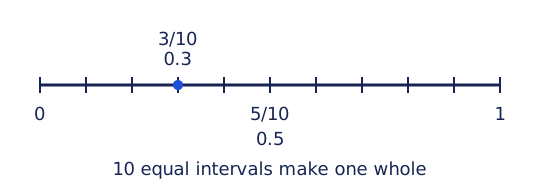 shows one whole unit from zero to one. Ten equal intervals fit in that distance. The third interval endpoint after zero is labelled both 3/10 and 0.3. These labels share one point because they are equivalent names. The fifth endpoint is 5/10 or 0.5, halfway through the unit.