What the top number counts and what the bottom number names.
Paper packet. Every task here also exists on screen, where it is checked automatically; answers written on paper are not assessed by Nydus. When you are back at a device, enter your answers there.
1. What you will learn
In this lesson you get precise about the two numbers in a fraction and the different jobs they do. The bottom number names the size of the piece — how many equal pieces the whole was cut into. The top number counts how many of those pieces you have. Keeping them straight is what makes everything else about fractions possible.
2. Read a fraction as a count
You have named equal parts of a whole and seen that different fraction names can represent the same amount. Here you will slow down and examine the job of each written number. You do not need a new calculation rule. You need two clear questions: what size of part is being counted, and how many of those parts are selected? Answer those questions with a drawing, a sentence and a fraction. Moving between those forms will help you explain your work without depending on a memorized position.
3. Use the names with their meanings
Term
What it means
Numerator
The count of the unit-fraction parts selected or measured.
Denominator
The number of equal parts making one reference whole.
Selected
The parts that the question asks us to count, often shown by shading.
Unselected
Parts of the whole outside the selected amount.
Partition
A division into parts; fraction counting requires equal-sized parts.
Reference whole
The complete unit used to decide the size of a fraction part.
4. Two different jobs
In 4/6, the denominator is six. It says that six equal parts make one whole, so each part is a sixth. The numerator is four. It says to count four of those sixths. Read the complete number as four sixths. Four does not describe the size of a piece, and six does not say how many pieces are shaded. The numbers work together, just as a count and its unit do in 'four metres.' Reversing the numbers changes the count and the unit, so it usually changes the number represented.
Another way: steps
First name the reference whole. Count all its equal parts for the denominator. Count the selected parts for the numerator. Read the resulting number in unit-fraction words.
5. Read the whole before reading the shading
Look at . The outside rectangle marks one whole. Six equal smaller rectangles fill it completely, without overlaps or gaps. Four are shaded and two are unshaded. The denominator is six because all six pieces belong to the whole. The numerator is four because shading selects four pieces. The result is 4/6, not 4/2. Four over two would compare the shaded count with the unshaded count; it would not name the shaded fraction of this whole.
Cover the label and check the drawing yourself. Point to every piece once as you count the denominator. Then point only to shaded pieces as you count the numerator. The second count is included in the first count. It is not a separate collection to add to the denominator. Four selected plus two unselected gives six total; it does not give ten parts. This is a useful check whenever shading is scattered rather than placed in one block.
Imagine moving the shading to alternate pieces while keeping exactly four pieces shaded. The fraction remains 4/6. Their locations have changed, but the selected amount has not. A fraction of area does not require all selected pieces to touch. Count equal areas, not the number of separate patches of colour.
6. Equal parts are a condition, not decoration
A rectangle cut into three unequal regions is not automatically a model of thirds. The number of visible regions alone does not establish a fraction. Suppose one region covers half the rectangle, and the other two each cover a fourth. Shading one of the small regions selects a fourth, not a third. To see why, split the large half into two fourths. Now the whole consists of four equal areas, one selected. The repaired partition explains the denominator.
Parts can have equal area without having the same shape. A square divided along a diagonal has two triangles of equal area. A suitable grid can also show equal areas with different outlines. At this stage, use a clear fold, a grid or given measurements to establish equality. Do not claim that two irregular regions have equal area just because they look close. If the information does not establish equal parts, say what is missing.
This gives you a careful order for reading a model. Identify the whole, establish equal part size, count all parts, then count selected parts. Starting with the shading can tempt you to write a fraction before checking whether the denominator has a meaning. A correct numerator cannot repair an invalid partition.
7. Move from a description to notation
Consider the sentence 'A strip has eight equal parts and three are marked.' The complete strip is one whole. Eight tells you how many equal parts make that whole, so write eight below the fraction bar. Three counts marked parts, so write three above it. Read 3/8 as three eighths. Check the meaning by sketching eight equal boxes in one strip and marking exactly three.
Now read a description that reverses the order of the information: 'Five parts are coloured in a whole that has six equal parts.' Five is still the numerator, and six is still the denominator. The first number mentioned is not always the denominator. Listen to the job of the number rather than its position in a sentence. The same care is needed when a question uses the formal words directly: denominator six and numerator five means 5/6.
Writing the word 'numerator' from memory is useful language practice, but it is not the same as understanding a fraction. You should be able to point to the selected amount and explain what the numerator counts. Similarly, knowing that the denominator is written below the line is a starting reminder. Its mathematical job is to name the unit-fraction size relative to one whole.
8. Move from notation to a model
To model 2/3, first draw one whole. Partition it into three equal parts because the denominator is three. Select two of those parts because the numerator is two. Finally check that one third is left unselected. These actions can be described without using the words top and bottom: choose the whole, make thirds, count two thirds. That description works whether the fraction is written with a horizontal bar or a slash.
Do not draw two wholes and split each into three parts merely because you see a two in the numerator. The numerator counts thirds here, not whole strips. Two thirds occupies less than one whole. If you select every third in two whole strips, you have selected six thirds instead. Both pictures involve thirds, but they represent different counts of that unit.
A number line uses the same two jobs. For 2/3, divide the distance from zero to one into three equal intervals. Move two such intervals from zero. The denominator controls the interval size, and the numerator counts intervals traveled. Counting the starting mark as an interval gives the wrong position. The starting mark is zero distance traveled.
9. Change one count and predict what happens
Keep the denominator fixed at eight. Three eighths and five eighths count pieces of the same size from the same whole. Five eighths selects two more pieces than three eighths, so its value is larger. Here looking at the numerators is enough because the units already match. Always state that condition when explaining the comparison.
Now keep the numerator fixed at one and compare one half with one fourth of the same strip. Dividing the strip into four equal pieces makes each piece smaller than dividing it into two equal pieces. One fourth is smaller than one half, although four is a larger whole number than two. The denominator is not a count of selected objects. It changes the size of each object being counted.
If both numbers change, neither one alone settles the comparison. For example, 1/2 and 2/4 have different numerators and different denominators but equal values. Splitting the selected half into two fourths doubles the count while halving the piece size. This lesson's vocabulary makes that explanation precise: the numerator counts more of the smaller units named by the denominator.
10. Read zero, one and amounts beyond one
With one whole divided into four equal parts, no selected parts gives 0/4. All four selected gives 4/4, which is one. The denominator remains four throughout. Selection changes the numerator, not the original partition. A zero numerator is possible; a zero denominator does not give a valid unit-fraction size.
You can count more parts by using another identical whole. Six fourths uses four parts from the first whole and two from the second. The fraction 6/4 still has denominator four because each whole contains four equal parts. Changing the denominator to eight would choose both strips together as a different reference whole. Do not change that agreement silently.
When checking any fraction statement, finish with a sentence containing both jobs. 'Six counts the selected parts, and four tells how many such parts make one whole.' Then compare the value with one: six fourths is greater than four fourths, so it is greater than one. This check connects vocabulary to quantity instead of treating the names as two isolated labels to memorize.
11. Describe a panel accurately
A class decorates a rectangular display panel made from six equal-area tiles. Four tiles are blue and two are plain. The entire panel is the reference whole. The blue fraction is 4/6: the numerator counts four blue tiles, and the denominator counts all six equal tiles in the panel. The plain fraction is 2/6. Both descriptions use the same denominator because the partition and whole have not changed.
A partner writes 4/2 for the blue fraction. Ask what the two counts mean. Four is the blue count, but two is only the plain count. It leaves the selected tiles out of the whole. Rebuild the total: four blue plus two plain equals six tiles. The correct denominator must include both kinds. This correction comes from the model, not from a spelling reminder about numerator and denominator.
Suppose another panel has eight tiles but their sizes differ. Knowing that three tiles are blue does not establish that three eighths of its area is blue. A tile-count fraction would describe a collection of tiles, while an area fraction must account for their sizes. To answer the area question, measure the tiles or repartition the panel into equal-area units. The meaning of the requested fraction decides which information you need. Always check whether the question asks about objects, area or length before interpreting a numerator and denominator.
12. Numbers must describe the same unit
Do not put the unshaded count in the denominator. Do not call unequal regions unit fractions merely because there are several of them. The denominator counts equal parts in one reference whole; the numerator counts the parts selected. A larger denominator makes smaller unit fractions when the whole is fixed. Neither written number alone describes the fraction's value.
13. Read five marked eighths
Choose the whole.
One complete strip
The fraction refers to this strip.
Verify the partition.
8 equal parts
Equal size permits counting eighths.
Read the selected count.
5 marked parts
This is the numerator's job.
Write the number.
5/8
Five eighths are selected.
Check the unused count.
8 − 5 = 3
Three unmarked parts complete the same whole.
14. Repair a shaded-to-unshaded error
Read the given counts.
3 selected, 1 unselected
These counts describe one complete panel.
Find all equal parts.
3 + 1 = 4
The whole includes both kinds.
Set the denominator.
4
Four equal parts make the whole.
Set the numerator.
3
Three parts are selected.
Repair the proposed 3/1.
Selected fraction = 3/4
The unselected count is not the denominator.
Check against one.
3/4 < 1
Some of the whole remains unselected.
15. Keep the unit when counting beyond one
Define one whole.
One strip
Two identical strips are available.
Read the partition per strip.
3 equal parts
Each piece is a third of one strip.
Count the first selection.
3 thirds
The entire first strip is selected.
Count the second selection.
2 thirds
Two parts of the second strip are selected.
Combine the selected count.
3 + 2 = 5
All selected pieces have the same unit size.
Write the fraction.
5/3
The numerator counts five thirds, not five sixths.
Check its size.
1 < 5/3 < 2
One whole is complete and the second is incomplete.
16. Build a fraction from its roles
Read the whole's partition.
6 equal parts
This establishes the part size.
Find the selected count.
6 − 1 = 5
One part is unselected.
Your turn: work this step out. Its working is at the end of the packet.
Assign the two roles.
Your turn: work this step out. Its working is at the end of the packet.
Write and read the fraction.
17. Guided practice
A whole is partitioned into 7 equal parts; 6 are marked. Give the numerator and denominator of the marked fraction.
Numerator: top; denominator: bottom.
18. Guided practice
One panel has 5 equal-area tiles; 2 are unpainted. Complete the fraction that is painted.
Find the painted count.
5 − 2 = painted
Painted and unpainted tiles together make the whole.
Assign the numerator.
painted selected tiles
The numerator counts the selected parts.
Keep the denominator.
5 equal tiles per panel
Painting does not change the partition.
19. Guided practice
In the fraction 6/9, which number is the denominator?
9
6
15
20. Practice
A whole is partitioned into 7 equal parts; 1 are marked. Give the numerator and denominator of the marked fraction.
Numerator: top; denominator: bottom.
21. Practice
In the fraction 2/9, which number is the denominator?
9
2
11
22. Practice
A whole is partitioned into 6 equal parts; 5 are marked. Give the numerator and denominator of the marked fraction.
Numerator: top; denominator: bottom.
23. Somewhere new
A display panel has 10 equal-area tiles. 3 tiles are blue. Write the blue fraction using the original tile partition, as {{a}}/{{b}}.
a/b
24. Lesson test
Lesson test: one question per skill, one attempt each, no hints. Your answers are checked when you submit.
25. Test question
A mosaic consists of 6 equal-area tiles. 2 tiles are plain and the rest are patterned. Write the patterned fraction using the original tile partition.
n/d
26. What you can do now
You can say what each number in a fraction does. Without looking: in 5/8, which number tells you the size of a piece, and which tells you how many you have?
Working for the steps left to you
16. Build a fraction from its roles, step 3
Numerator 5; denominator 6
Selected count and total parts have different jobs.
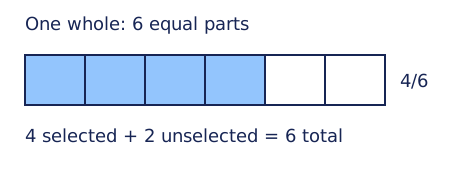 . The outside rectangle marks one whole. Six equal smaller rectangles fill it completely, without overlaps or gaps. Four are shaded and two are unshaded. The denominator is six because all six pieces belong to the whole. The numerator is four because shading selects four pieces. The result is 4/6, not 4/2. Four over two would compare the shaded count with the unshaded count; it would not name the shaded fraction of this whole.