Back to the on-screen lesson ·
Regrouping in any place, including subtracting across a row of zeros.
Paper packet. Every task here also exists on screen, where it is checked automatically; answers written on paper are not assessed by Nydus. When you are back at a device, enter your answers there.
In this lesson you add and subtract numbers of several digits, carrying and borrowing wherever they are needed. The case worth slowing down for is subtracting across a row of zeros — 3000 minus 476 — where the borrowing has to travel several places before it finds something to take from. It is the one that goes wrong most, and understanding it is understanding place value.
You can add and subtract within one thousand and name the value of each digit. Larger numbers use the same exchanges. Ten ones equal one ten; ten tens equal one hundred; ten hundreds equal one thousand. Before computing, read each number aloud and point to its ones place. A zero holds an empty place so that the other digits keep their intended values. It does not make that place disappear from the calculation.
| Term | What it means |
|---|---|
| Addend | A quantity being added. |
| Sum | The result of addition. |
| Difference | The result of subtraction, also a distance between two counts. |
| Regroup | Exchange equal values between neighboring places. |
| Inverse operations | Operations that can undo each other, such as addition and subtraction. |
| Column | A vertical arrangement of quantities with the same place value. |
The standard addition and subtraction algorithms are organized records of place-value reasoning. We align ones with ones, tens with tens and so on because those are equal-sized units. Adding five thousands to three hundreds does not make eight of one unit. It makes five thousands and three hundreds, or 5,300. Columns keep these different units visible while we work.
In addition, a column may contain ten or more units. Exchange a group of ten for one unit in the column to its left. In subtraction, a column may not contain enough units to remove the requested amount. Exchange one unit from the left for ten units in the current column. Either exchange preserves the starting value. Marking the changed counts carefully matters more than memorizing the words carry and borrow. Nothing is created, lost or owed later: the same quantity is being written another way.
Another way: steps
Align equal places, calculate from the ones, record each equal-value exchange, then check with an inverse operation and an estimate.
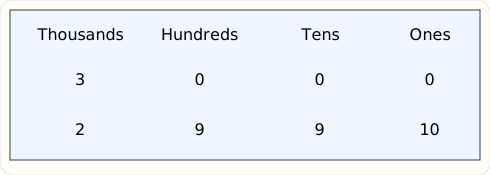
Imagine place-value cards labeled one, ten, hundred and thousand. Start with three thousand-cards and no other cards. To remove six ones you cannot simply take six cards away: there are no one-cards yet. Exchange a thousand-card for ten hundred-cards, then one hundred-card for ten ten-cards, then one ten-card for ten one-cards. You now have two thousands, nine hundreds, nine tens and ten ones.
Read the bottom row as counts of place-value units, not as the written numeral 29910. Its value is 2,000 + 900 + 90 + 10 = 3,000. This is a temporary working representation, so a column may contain ten units. The final written numeral will return to one digit per place. The chart explains why intermediate zeros become nines while the final zero becomes ten when you regroup all the way to the ones.
Consider 26,785 + 14,638. The ones give thirteen, so keep three ones and exchange ten ones for one ten. The tens now contain eight plus three plus the exchanged one: twelve tens. Keep two tens and exchange ten tens for one hundred. The hundreds contain seven plus six plus one: fourteen hundreds. Keep four and exchange ten for one thousand.
The thousands contain six plus four plus one: eleven thousands. Keep one thousand and exchange ten for one ten thousand. The ten-thousands column now contains two plus one plus one: four ten thousands. The sum is 41,423. Each small written carry has a different value depending on its column. A one above the hundreds column means one hundred, not one individual object. Reading its unit prevents the common mistake of treating every carried one as the same amount.
To add 8,406 and 735, place the five under the six because both are ones. Place the three under the zero because both are tens, and the seven under the four because both are hundreds. There is no thousands digit in 735, so that column contributes zero thousands. Aligning the left edges would incorrectly turn 735 into a number of thousands.
You may write 0735 temporarily in a place-value chart to display the empty thousands place. That leading zero does not change the value. In contrast, removing the zero inside 8,406 would change the value to 846. Once the columns are aligned, add as usual to obtain 9,141. Check by estimating about 8,400 + 700 = 9,100. The estimate supports the size of the result, although it does not verify every digit.
In 5,241 - 1,368, the ones column asks for one minus eight. Do not reverse it and write seven. That would change the subtraction question in this column while leaving the other columns unchanged. Exchange one ten from the four tens, leaving three tens and eleven ones. Eleven minus eight is three.
The tens now contain three, not the original four. To remove six tens, exchange one hundred from the two hundreds. That leaves one hundred and thirteen tens. After subtracting six tens, seven remain. Exchange one thousand to make eleven hundreds, then remove three hundreds to leave eight. Finally four thousands minus one thousand is three thousands. The difference is 3,873. Check that 3,873 + 1,368 returns to 5,241; this confirms that each exchange preserved the intended subtraction.
For 30,004 - 8,759, look left from the ones when four is too small to remove nine. The tens, hundreds and thousands contain zeros, so the first available unit is a ten thousand. Exchange one ten thousand, leaving two ten thousands and ten thousands. Exchange one of those thousands into hundreds, one hundred into tens, and one ten into ones.
The working counts are now two ten thousands, nine thousands, nine hundreds, nine tens and fourteen ones. Their total is still 30,004. Subtract in each place to obtain 21,245. The original four ones were already present, so they join the ten exchanged ones to make fourteen. Writing ten ones would accidentally discard four. At every stage, say what remains in the place you exchange from. This record is especially useful when a chain crosses several zeros.
Subtraction is useful even when no objects are physically removed. Suppose one collection contains 18,420 cards and another contains 15,965 cards. Match one card from the smaller collection with one from the larger. The unmatched part is how many more cards the larger collection has. Its size is 18,420 - 15,965 = 2,455.
A drawing with two bars of different lengths can show that the larger total is the smaller total plus a gap. Therefore 15,965 + 2,455 = 18,420 is also a model of the comparison. Do not select an operation from the word more alone. 'A collection has 2,455 more than 15,965' asks for the larger total and uses addition. 'How many more does 18,420 have than 15,965?' asks for the gap and uses subtraction. Identify the unknown part of the relationship before calculating.
An inverse check tests an exact relationship. For a subtraction, add the difference to the amount subtracted; you should recover the starting amount. For an addition, subtract one addend from the total; you should recover the other. Repeating the same algorithm may repeat the same error, so using the inverse gives a useful change of perspective.
Sometimes a mental adjustment is another clear route. For 7,000 - 2,998, subtract 3,000 to get 4,000, then restore the extra two you subtracted, giving 4,002. This does not replace understanding the standard algorithm. It supplies an independent check and can be efficient for numbers close to convenient landmarks. Explain the adjustment direction: subtracting too much makes the result too small, so restoring two increases it. An unexplained plus two can hide an accidental rule.
For 48,762 + 23,489, rounding each addend to the nearest thousand gives about 49,000 + 23,000 = 72,000. An exact result near seven thousand or seven hundred thousand would be implausible. The true sum, 72,251, has the expected size. A nearby incorrect sum such as 72,241 would also pass that broad estimate, so estimation alone cannot prove correctness.
Keep approximate and exact statements separate. The exact equality is 48,762 + 23,489 = 72,251. The rounded total is about 72,000. If a question asks for the number of tickets remaining, report the exact difference, not an estimate, unless the question explicitly requests an approximation. Include the counting unit. A correct digit string without its meaning may leave unclear whether you found the total, the amount used or the amount still needed.
If a sum is exactly one hundred too small, inspect the exchange into the hundreds column. If it is one thousand too large, inspect a thousands digit or an exchange counted twice. These are clues, not proof of a particular mistake. Compare the written work with the value represented at each step before changing a digit.
For a subtraction across zeros, reconstruct the expanded value of the regrouped top row. It must equal the original minuend. A row representing 2,000 + 900 + 100 + 10 would total 3,010, so it cannot be a correct regrouping of 3,000. The chart has exposed an extra ten before any subtraction occurs. This kind of check explains an error instead of merely replacing an answer. Practicing it makes the algorithm a record you can reason about and repair.
A library records 24,608 books in one building and 19,875 in another. The question asks how many more books are in the first building, not how many books the two buildings own altogether. Represent the larger inventory as the smaller inventory plus a missing gap. Subtraction gives 4,733 books. Addition checks the result: 19,875 + 4,733 = 24,608. These are fictional counts for practicing a comparison, not a claim about a real library. If the buildings later combine their inventories, that new question uses addition and gives 44,483 books. The same two known numbers support different operations because the unknown relationship changes. Write a sentence identifying your result so the comparison gap is not mistaken for the combined inventory.
A workshop begins with 30,004 labels and uses 8,759 during a project. Assuming no labels are added, lost or discarded in another way, the expected remainder is 21,245 labels. The zero-chain subtraction finds an exact expected count. An inventory team counts 21,235, ten fewer than expected. That discrepancy does not prove the arithmetic is wrong or that someone misused labels. Recheck both the calculation and the records, including whether a small batch was omitted from the use log. An estimate near twenty-one thousand is too broad to resolve a discrepancy of ten. Exact reconciliation needs precise counts and stated assumptions. Arithmetic describes the relationship in the record; checking the physical collection supplies separate evidence about whether the record describes what happened.
Never reverse the order of digits within one subtraction column. Update the place that supplies an exchanged unit. A zero in the original number may become nine in a working representation, but only because a unit entered and one smaller unit was exchanged onward.
Align equal place values.
26,785 + 14,638
The ones digits belong in the same column.
Combine ones and tens.
5 + 8 = 13; 8 + 3 + 1 = 12
Each group of ten moves to the next place.
Combine the hundreds next.
7 + 6 + 1 = 14 hundreds
The exchanged ten tens contribute one hundred.
Finish the larger places.
6 + 4 + 1 = 11; 2 + 1 + 1 = 4
Remember both exchanges.
Read and check the sum.
41,423; about 27,000 + 15,000 = 42,000
The result has a reasonable size.
Locate the first available unit.
3,000 - 476: use one thousand
The smaller places initially contain zeros.
Exchange through the smaller places.
2 thousands, 9 hundreds, 9 tens, 10 ones
Their total is still 3,000.
Subtract ones and tens.
10 - 6 = 4; 9 - 7 = 2
Use the updated counts.
Subtract the remaining places.
9 - 4 = 5 hundreds; 2 thousands remain
The difference is 2,524.
Verify by the inverse operation.
2,524 + 476 = 3,000
The removed amount and remainder reconstruct the start.
Identify the recorded relationship.
18,420 total = 7,685 first shipment + missing shipment
The unknown is a part of a known total.
Choose the inverse operation.
18,420 - 7,685
Subtracting the known part leaves the other part.
Regroup the ones and tens.
10 - 5 = 5; 11 - 8 = 3
Exchange one ten, then one hundred.
Continue into the hundreds.
13 - 6 = 7 hundreds
The remaining three hundreds need one thousand exchanged.
Finish the thousands and state the result.
7 - 7 = 0 thousands; 1 ten thousand: 10,735 items
Keep the zero thousands place.
Check the complete relationship.
10,735 + 7,685 = 18,420
Both shipments account for the recorded total.
Name the needed exchange.
Exchange one ten thousand
Zeros separate the ones from the first available unit.
Record the equivalent top row.
3 ten thousands, 9 thousands, 9 hundreds, 9 tens, 13 ones
All entries together still total 40,003.
Subtract the smaller places.
13 - 7 = 6; 9 - 4 = 5; 9 - 8 = 1
Use the regrouped counts.
Subtract the larger places.
Verify the missing part.
Add 89391 + 51942.
Sum: s
Complete the check for 7000 - 476.
Exchange through the empty places.
Keep the original value while changing units.
Subtraction needs enough units in every column.
State the computed difference.
The difference is d.
Subtract 476 from the original quantity.
Verify using the inverse operation.
Add 476 back to recover the starting number.
A difference and the removed part make the whole.
Calculate 50000 - 8800.
Difference: d
Add 55373 + 87849.
Sum: s
Calculate 60000 - 1086.
Difference: d
Add 77991 + 55575.
Sum: s
Two fictional collections contain 60567 and 13285 cards. How many more cards are in the first collection?
Answer:
Lesson test: one question per skill, one attempt each, no hints. Your answers are checked when you submit.
Calculate 80000 - 5839.
Difference: d
You can add and subtract multi-digit numbers with regrouping. Without looking: work out 3000 minus 476, and say what happens to each zero.
20. Find 40,003 - 6,847, step 4
9 - 6 = 3; 3 - 0 = 3
The difference is 33,156.
20. Find 40,003 - 6,847, step 5
33,156 + 6,847 = 40,003
The inverse check restores the original total.