Back to the on-screen lesson ·
Combine and decompose like fractional units, regroup mixed quantities and interpret fraction measurement data.
Paper packet. Every task here also exists on screen, where it is checked automatically; answers written on paper are not assessed by Nydus. When you are back at a device, enter your answers there.
Explain addition and subtraction of like-denominator fractions as combining or removing equal units. Decompose fractions in several ways, regroup sums beyond one and use repeated measurements to calculate a total length.
You can name unit fractions, recognize equivalent fractions and regroup fractional pieces into wholes. Addition and subtraction with like denominators use the same idea as adding or removing objects of one kind: count the pieces while preserving their size. Before operating, check that the fractions refer to the same whole or fixed measurement unit. Two eighths of a meter and three eighths of a meter use matching pieces.
| Term | What it means |
|---|---|
| Like denominators | Denominators that name the same fractional unit. |
| Unit fraction | One equal part, such as one eighth. |
| Decompose | Write a quantity as a sum of parts without changing its value. |
| Difference | The amount left after subtraction or the gap between two quantities. |
| Line plot | A display placing one mark above a number-line value for each observation. |
| Frequency | The number of observations at a particular value. |
Two eighths plus three eighths is five eighths because two eighth-sized pieces and three more make five of those pieces. Write 2/8 + 3/8 = 5/8. The denominator remains eight: none of the pieces has been cut smaller or joined into a new reference whole. Adding the denominators would incorrectly rename the pieces as sixteenths.
Subtraction reverses the combining action. Seven eighths minus three eighths leaves four eighths. An inverse check adds the removed amount back: 4/8 + 3/8 = 7/8. The arithmetic of the numerators records counts of a shared unit fraction. A model and unit language explain the rule, helping you decide when it applies and when unlike pieces need to be renamed first.
Another way: steps
Identify the shared whole and unit fraction, combine or remove the counted pieces, preserve the denominator, then check the result and regroup if useful.
Imagine two eighth-meter strips placed end to end, followed by three more eighth-meter strips. There are five strips altogether, each still one eighth of a meter long. The combined length is five eighths of a meter. You can draw one fixed meter divided into eight equal intervals and highlight five of them to show the result.
The two addends need not be adjacent parts cut from one physical strip; they need equal unit sizes. The common meter defines their size. If one 'eighth' came from a two-meter roll and another from a one-meter roll, they would not be matching length units until converted. The visible denominator alone is insufficient when the underlying wholes differ. State the measurement unit or shared whole before applying the numerator rule.
A learner adds one fourth and one fourth and reports two eighths. But one fourth plus another fourth covers one half of the original whole. Two eighths covers only one fourth. The proposed denominator doubled the number of pieces per whole, making each piece half as large without accounting for the original amount.
The correct result is two fourths, which can then be renamed one half by grouping. Addition and simplification are different actions. Addition combines the counts of fixed-size pieces; simplification changes the name while preserving the resulting quantity. A reliable explanation says 'two fourth-sized pieces' before writing 2/4. That phrase keeps the numerator's count and denominator's unit connected.
Five sixths can be written as one sixth plus four sixths, two sixths plus three sixths, or five copies of one sixth. Each expression describes a different grouping of the same five unit pieces. Record 5/6 = 1/6 + 4/6 = 2/6 + 3/6. The equal signs are valid because every expression has the same value.
A decomposition can help solve a problem or explain a diagram. If a shaded region contains two blue sixths and three green sixths, the sum 2/6 + 3/6 matches its color grouping. Another grouping may be mathematically correct without matching that particular description. Distinguish the total quantity from the chosen partition of the selected pieces. The ability to construct more than one decomposition shows that a fraction is a number with flexible part-whole relationships.
For 7/8 - 3/8, start with seven eighth-sized pieces and remove three. Four remain, giving 4/8, which equals one half. The result is nonnegative because the starting count is at least the removed count in these tasks. Count the remaining pieces or use a number line moving three eighth-intervals left from seven eighths.
Check by adding four eighths and three eighths to recover seven eighths. This exact relationship can expose a mistaken subtraction or denominator change. The difference also represents how much longer a seven-eighth-meter strip is than a three-eighth-meter strip. No cutting is required for that comparison interpretation: the unmatched length after aligning their starting points is four eighths of a meter.
Adding five sixths and four sixths gives nine sixths. Six sixths make one whole, with three sixths remaining, so the total is one and three sixths, or one and one half. The product of the numerator addition is allowed to exceed the denominator; fractions can represent numbers greater than one.
Do not stop at one and discard the extra pieces. The three remaining sixths are part of the sum. Conversely, do not enlarge the denominator to force the numerator below it. Nine twelfths would be a different amount. Use a number line extending beyond one or two equal whole strips to represent all nine sixths. Each whole interval must have the same size so the fractional unit remains consistent.
For 1 3/4 + 2 2/4, combine the three whole units and the five quarter-units, then regroup four quarters as another whole. The total is 4 1/4. Alternatively, convert the addends to seven fourths and ten fourths, add to get seventeen fourths, and regroup. Both routes count the same pieces.
For 3 1/4 - 1 3/4, exchange one of the starting wholes for four quarters. The working form becomes 2 5/4. Removing one whole and three quarters leaves 1 2/4, or 1 1/2. This exchange preserves the original quantity just as regrouping a hundred into tens does in whole-number subtraction. The temporary fractional part can exceed one during the calculation even though the final mixed form is conventionally regrouped.
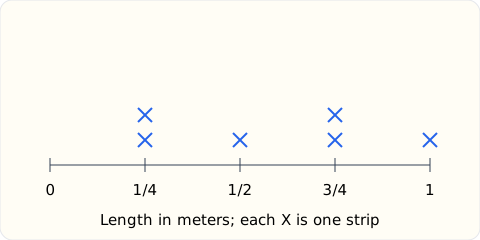
Each X represents one measured strip. The number-line position gives that strip's length in meters, while the height of a stack gives how many strips have that length. Two strips measure one fourth, one measures one half, two measure three fourths, and one measures one meter. Count all six marks to find the number of observations.
Do not read a stack of two X marks as a length of two meters. It means two observations at the value below the stack. The horizontal spacing must match the measurement scale: the labels increase by one fourth each time. A value with no marks is still a possible scale value, but no strip in this data set was recorded there. The axis and mark key are necessary for interpreting the picture.
For the six strips in the plot, rewrite every length in fourths: one fourth, one fourth, two fourths, three fourths, three fourths and four fourths. Add the counts 1 + 1 + 2 + 3 + 3 + 4 = 14. The total is fourteen fourths of a meter, or three and one half meters. Repeated marks must each contribute their measurement to the sum.
Adding only the distinct labels would omit one quarter-meter strip and one three-quarter-meter strip. Counting six X marks would give the number of strips rather than their combined length. Keep frequency and measured value separate, then combine them purposefully. Two strips at three fourths contribute six fourths altogether. The same plot supports several questions, so identify whether the requested answer is a count, an individual length, a range or a total length.
The longest strip in the displayed data measures one meter and the shortest one fourth of a meter. Rename one meter as four fourths and subtract one fourth to find a gap of three fourths of a meter. The number of times either value occurs does not change this longest-minus-shortest difference.
In contrast, frequency matters for total length and for how many strips meet a condition. There are three strips at least three fourths of a meter long: two at three fourths and one at one. State whether 'at least' includes the boundary value; here it does. Reading the question's condition carefully avoids excluding the two exactly three-quarter-meter strips. The plot describes only these six measurements, so it does not establish how long every strip in an unseen collection must be.
A design requires a combined length of two meters, and the available pieces total one and three fourths meters. Rename the target as eight fourths and the available amount as seven fourths. One more fourth of a meter is needed. The equation 7/4 + 1/4 = 8/4 verifies the missing amount.
This calculation concerns total length under the assumption that pieces can be joined without loss. If the design requires a single continuous two-meter piece, a collection of shorter pieces might fail even when their sum reaches the target. The arithmetic establishes a part-whole relationship; the construction rules determine whether that relationship is sufficient for the practical goal. Include both the measured unit and the relevant condition when interpreting your answer.
A craft design uses a two-eighth-meter piece and a five-eighth-meter piece end to end. Under the assumption that joining them consumes no length, their combined length is seven eighths of a meter. If the target is one meter, one eighth more is needed. State the reference unit explicitly so the eighths are known to be equal-sized. If a joint overlaps the pieces, the usable combined length would be smaller than the simple sum and the overlap would need to be included in the model. The calculation explains the ideal part-whole relationship. It does not silently establish how the pieces are connected or guarantee that a real assembly reaches the same measured endpoint.
The displayed line plot records six strips measured to quarter-meter positions. Their total length is three and one half meters, and the difference between longest and shortest is three fourths of a meter. These statements answer different questions: the first uses every observation and its frequency, while the second uses only the two extreme values. A summary should identify both the measurement unit and the number of strips. It should not claim that the six observations describe every strip in a larger workshop unless there is separate evidence about how they were selected. The arithmetic is exact for the displayed values; the scope of the conclusion is the displayed data set.
Add or subtract numerator counts only when the pieces use a shared whole and denominator. Regroup totals beyond one rather than changing the piece size. In a line plot, stack height is frequency, not length; repeated marks must each contribute to a total.
Identify the shared unit.
Eighths of the same whole
The two denominators refer to equal-sized pieces.
Read the two piece counts.
2 and 3
The numerators count selected pieces.
Combine the counts.
2 + 3 = 5
Addition joins the two quantities.
Preserve the piece size.
2/8 + 3/8 = 5/8
No subdivision changed the denominator.
Check with subtraction.
5/8 - 3/8 = 2/8
Removing one addend recovers the other.
Record the matching parts.
5/6 and 4/6
Both use sixths of the same whole.
Add their unit-fraction counts.
5 + 4 = 9
Nine sixths are present altogether.
Identify one complete whole.
6/6 = 1
Six sixths can be grouped as one whole.
Count the remaining pieces.
9 - 6 = 3 sixths
The extra pieces must not be discarded.
State equivalent final forms.
9/6 = 1 3/6 = 1 1/2
Every form preserves the full sum.
Read the scale and mark key.
Meters; one X per strip
Position gives length and stack size gives frequency.
List all six measured lengths.
1/4, 1/4, 1/2, 3/4, 3/4, 1
Repeated observations must be retained.
Rename each in fourths.
1/4, 1/4, 2/4, 3/4, 3/4, 4/4
All pieces now use the same fractional unit.
Add every observation's contribution.
1 + 1 + 2 + 3 + 3 + 4 = 14
The numerator counts total fourth-meters.
Regroup the combined length.
14/4 = 3 2/4 = 3 1/2 meters
Four fourths make each complete meter.
Check a different grouping.
Two quarters plus one half = 1; two three-quarters plus one = 2 1/2
The two group totals again give 3 1/2 meters.
Write the required total.
2 meters = 8/4 meters
The target must use the same unit as the available pieces.
Rename the available amount.
1 3/4 meters = 7/4 meters
One whole contributes four fourths.
Find the missing count.
8 - 7 = 1
Subtraction finds the gap between target and supply.
Attach the fractional unit.
Check the part-whole equation.
Add 3/12 + 5/12. Keep the stated denominator.
Numerator n; denominator d
Find 2/8 + 2/8, keeping eighths.
Identify the common piece size.
Both fractions count eighths of the same whole.
Equal units can be combined directly.
Add the selected counts.
The numerator of the sum is n.
The total counts every selected eighth once.
Retain the denominator.
The resulting pieces are still eighths.
Addition did not repartition the whole.
Subtract 4/12 - 3/12. Keep the stated denominator.
Numerator n; denominator d
Add 3/8 + 1/8. Keep the stated denominator.
Numerator n; denominator d
Subtract 12/10 - 4/10. Keep the stated denominator.
Numerator n; denominator d
A strip record lists 4 pieces of length 1/4 meter and 4 pieces of length 3/4 meter. How many quarter-meter units are in their combined length?
Answer:
Lesson test: one question per skill, one attempt each, no hints. Your answers are checked when you submit.
Add 6/10 + 9/10. Keep the stated denominator.
Numerator n; denominator d
Explain why 2/8 + 3/8 is 5/8 rather than 5/16. Then say why two line-plot marks at 3/4 meter contribute 6/4 meter to a total.
21. Find a missing quarter-meter amount, step 4
1/4 meter needed
The denominator remains four.
21. Find a missing quarter-meter amount, step 5
7/4 + 1/4 = 8/4
Available and missing amounts reach the target exactly.