Back to the on-screen lesson ·
Using the formulas, and running them backwards to find a missing side.
Paper packet. Every task here also exists on screen, where it is checked automatically; answers written on paper are not assessed by Nydus. When you are back at a device, enter your answers there.
In this lesson you use the formulas for the area and the perimeter of a rectangle — and, more usefully, run them backwards. Given the area and one side, you can find the other; given the perimeter and one side, likewise. Working a formula in reverse is a habit that carries all the way into algebra, and a rectangle is the friendliest place to learn it.
You can count square units in a rectangle and add lengths around a closed shape. You also know that opposite sides of a rectangle have equal lengths. Before using a formula, decide which quantity is requested: the surface inside the shape or the distance along its boundary. A square tile measures an area, while an edge segment measures a length. They cannot be exchanged just because both answers happen to be numbers.
| Term | What it means |
|---|---|
| Area | The amount of surface covered, measured in square units. |
| Perimeter | The distance around the entire boundary, measured in length units. |
| Length and width | The two adjacent side measurements of a rectangle. |
| Formula | A general relationship recorded with symbols. |
| Square centimeter | The area of a square with side length one centimeter. |
| Unknown factor | A missing number in a multiplication relationship. |
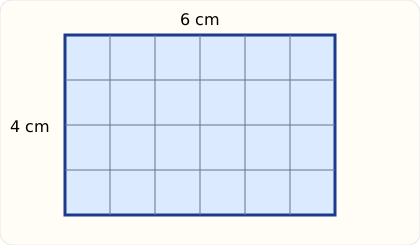
A rectangle with length six centimeters and width four centimeters can be covered by four rows of six one-centimeter squares. Its area is 6 × 4 = 24 square centimeters. In general, a rectangle's area A equals length l times width w: A = l × w. The multiplication counts equal rows of square units.
The boundary has two length sides and two width sides. Adding them gives l + w + l + w, or 2 × (l + w). For the same rectangle, the perimeter is 6 + 4 + 6 + 4 = 20 centimeters. The area and perimeter describe different features of one shape. The formulas are useful because the rectangle's repeated structure lets you calculate without counting every tile or measuring all four sides separately.
Another way: steps
Identify area or perimeter, label the rectangle and units, use the corresponding relationship, then check the result against the shape.
The grid has six columns and four rows. Every small square has side length one centimeter, so each covers one square centimeter. Counting all cells gives twenty-four square centimeters. The heavy outer line is the boundary. Following it once covers six centimeters across, four down, six back and four up, for twenty centimeters.
Interior grid lines help count area but do not belong to the perimeter. Adding all visible line segments would count boundaries between neighboring tiles, not just the outside edge. Conversely, counting only the squares touching the boundary would not find the entire area. Point to the measured feature before calculating. The picture lets you verify both formulas through different counting actions, even though the same side measurements appear in each.
If a rectangle is eight meters long and five meters wide, each one-meter row contains eight square meters and five rows cover forty square meters. Write A = 8 × 5 = 40 square meters. The two side lengths must be expressed in compatible units before the product can be interpreted in a standard square unit.
For example, two meters by fifty centimeters is not one hundred square meters. Rename two meters as two hundred centimeters, giving 200 × 50 = 10,000 square centimeters. Alternatively, later work with half a meter as the width gives one square meter. In this lesson, use whole-number side lengths in one stated unit unless a conversion is explicitly supplied. Checking the unit prevents an arithmetic product from being attached to the wrong kind of measurement.
A rectangle measuring twelve meters by seven meters has perimeter twelve plus seven plus twelve plus seven, or thirty-eight meters. Adding only twelve and seven gives nineteen meters, the distance along two adjacent sides. Doubling that sum accounts for the two matching opposite sides. Thus P = 2 × (12 + 7) = 38.
You may also double each dimension separately: 2 × 12 + 2 × 7 = 24 + 14 = 38. The two expressions count the same four sides with different grouping. Use a drawing to explain why the factor two appears. If a real enclosure uses a wall as one boundary and needs fence on only three sides, the required fencing is not the full perimeter. Name which sides need material before applying a perimeter formula to a purchasing decision.
Suppose a rectangular surface has area forty-eight square meters and width six meters. Let l be the unknown length. The area relationship is 6 × l = 48. Since six groups of eight make forty-eight, the length is eight meters. Division finds the missing factor: 48 divided by 6 = 8.
The result is a length, not an area, because you have found how many one-meter units run along the missing side. Check by multiplying both dimensions to reconstruct the given area. A sketch with six rows can make the reasoning concrete: forty-eight unit squares arranged equally among six rows put eight squares in each row. The formula is being used backward, but its meaning as equal rows of square units remains unchanged.
A rectangle has perimeter thirty-four centimeters and length eleven centimeters. Two length sides account for twenty-two centimeters, leaving twelve centimeters for the two equal widths. Divide twelve by two to obtain six centimeters per width. Check all four sides: 11 + 6 + 11 + 6 = 34.
Another route halves the perimeter first. Half of thirty-four is seventeen, which equals one length plus one width. Subtract the known eleven to get six. Both routes are valid because opposite rectangle sides match. Subtracting eleven only once from the full perimeter leaves three sides, not one width. A labeled sketch helps you see what each intermediate number measures. Do not report the combined two-width length as though it were a single width.
A rectangle six units by four units has area twenty-four square units and perimeter twenty units. A rectangle eight units by three units also has area twenty-four square units, but its perimeter is twenty-two units. The same number of unit squares can be arranged into different rectangular shapes with different boundary lengths.
Imagine rearranging twenty-four loose square tiles from four rows of six into three rows of eight. No tile is added or removed, so the covered area stays twenty-four. The arrangement becomes longer and narrower, changing how many edges lie on the outside. Therefore knowing only the area does not uniquely determine the perimeter. You need additional information about the dimensions or shape. This is an important limit on what a formula can infer from incomplete data.
A rectangle six units by four units has perimeter twenty units and area twenty-four square units. A square five units by five units also has perimeter twenty units, but its area is twenty-five square units. The same total boundary length can surround different amounts of surface.
You can investigate with a loop representing twenty edge units. Arrange it around different rectangles with whole-number side lengths. For each, record length, width, perimeter and area in a table. Keep the perimeter fixed and observe how the product changes. This is evidence from the cases you construct, not permission to claim a general maximum for every possible shape without further reasoning. The immediate conclusion is that a perimeter measurement alone does not determine a unique rectangular area.
The letters A, P, l and w represent quantities. In A = l × w, the letter A is an area and the other two letters are lengths. A problem may use different letters, but the geometric relationship stays the same. Write what an unknown symbol means before solving. If x is a missing width, the answer should be expressed in length units.
Do not choose multiplication merely because the problem contains two numbers. A perimeter problem also gives two numbers but may need addition and doubling. Conversely, a missing-side area problem uses division even though the area formula contains multiplication. Identify what is known and what is unknown within the relationship. That habit makes formulas flexible tools instead of isolated instructions that work only when the answer is on the left side.
A twelve-centimeter by eight-centimeter rectangle has area ninety-six square centimeters. It takes ninety-six tiles only if each tile covers one square centimeter and the tiling has no gaps or overlaps. If each tile covers four square centimeters, the area alone suggests twenty-four tiles, but the shape and arrangement of those tiles still matter for an exact fit.
Likewise, a perimeter of forty centimeters gives forty centimeters of ideal edge coverage. A real border may require overlaps, corner pieces or an opening. The elementary calculation measures the geometric boundary; material planning must state whether extra allowances or exclusions apply. Keep these conditions explicit in word problems. A correct area formula does not silently establish a tile size, and a correct perimeter formula does not silently remove a gate.
A learner labels a six-by-four rectangle's area as twenty centimeters. Twenty is the perimeter, found by adding all sides. Ask the learner to point to what the question measures. If it asks for a cover, count rows of square units and calculate twenty-four square centimeters. If it asks for a border, twenty centimeters is appropriate.
Another learner finds a missing side by dividing forty-eight square meters by six meters and writes eight square meters. The number eight is correct, but the unknown side is a length. Label the sketch with eight meters and multiply six meters by eight meters to recover forty-eight square meters. Unit language is part of mathematical reasoning: it identifies the kind of quantity computed and helps distinguish an arithmetic slip from a misunderstanding of the model.
A rectangular display is twelve centimeters long and eight centimeters wide. A paper cover must match the entire surface, so its area is ninety-six square centimeters. A border following the full outside edge has ideal length forty centimeters. These numbers answer different material questions even though they use the same dimensions. If the cover is assembled from one-square-centimeter tiles with no gaps or overlaps, ninety-six tiles are needed. If the border joins with a two-centimeter overlap, the material length must include that allowance beyond the geometric perimeter. State which quantity your answer measures. The area formula does not calculate edge trim, and the perimeter formula does not calculate how much paper covers the middle.
A class has twenty-four identical unit-square tiles. One proposed rectangle has four rows of six; another has three rows of eight. Both use every tile and have area twenty-four square units. The first has perimeter twenty units, while the second has perimeter twenty-two units. If the class has exactly twenty units of border material and no joins require extra length, the first arrangement can be bordered completely and the second cannot. This decision needs both an area check for the tile supply and a perimeter check for the border. The example does not claim that area alone determines the better layout. A different purpose, such as fitting a narrow table, could favor a different shape with the same tile count.
Use square units for area and length units for perimeter or a missing side. Opposite rectangle sides are equal, so perimeter includes each adjacent dimension twice. Equal area does not force equal perimeter, and equal perimeter does not force equal area.
Read both adjacent side lengths.
6 cm and 4 cm
The figure is a rectangle.
Identify the required quantity.
Area in square centimeters
The task asks for surface coverage.
Count one row of unit squares.
6 squares per row
Each square is one centimeter by one centimeter.
Count all equal rows.
6 × 4 = 24
Four rows cover the whole rectangle.
State and check the result.
24 square centimeters
The grid contains exactly twenty-four cells.
Identify the known measurements.
Area 48 square meters; width 6 meters
The length is unknown.
Write the rectangle relationship.
6 × l = 48
Area is the product of adjacent side lengths.
Find the missing factor.
48 divided by 6 = 8
Division reverses the equal-row multiplication.
Label the missing side.
l = 8 meters
The unknown is a length.
Reconstruct the area.
6 × 8 = 48 square meters
The dimensions match the given surface measure.
Record the boundary information.
Perimeter 34 cm; length 11 cm
Both opposite length sides measure eleven.
Account for the two known sides.
2 × 11 = 22 cm
Perimeter includes both of them.
Find the combined width sides.
34 - 22 = 12 cm
The remaining boundary consists of two equal widths.
Find one width.
12 divided by 2 = 6 cm
Both widths have the same length.
Calculate the enclosed area.
11 × 6 = 66 square centimeters
Now both adjacent dimensions are known.
Check both relationships.
11 + 6 + 11 + 6 = 34; 11 × 6 = 66
Boundary and surface measurements stay distinct.
Name the known quantities.
Perimeter 46 meters; length 15 meters
The width is the unknown length.
Find half of the boundary.
46 divided by 2 = 23 meters
One length and one width make half the perimeter.
Subtract the known length.
23 - 15 = 8 meters
The remaining half-boundary portion is the width.
Check the perimeter.
Calculate area if requested.
A rectangle measures 14 cm by 6 cm. What is its area in square centimeters?
Answer:
A rectangle has area 42 square centimeters and width six centimeters. Find the length.
Write the unknown-factor equation.
6 × length = 42.
Six equal rows make the rectangular area.
Divide by the known width.
The length is l centimeters.
Division reverses the area multiplication.
Check the product of dimensions.
Multiply the found length by six to recover the area.
The result must satisfy the original measurement.
A rectangle has adjacent sides 18 cm and 6 cm. What is its perimeter in centimeters?
Answer:
A rectangle has area 90 square meters and width 5 meters. Find its length in meters.
Answer:
A 5 cm by 3 cm rectangle needs both unit-square tiles to cover it and trim around all four sides. Each tile is exactly 1 square centimeter; there are no gaps or overlaps. Calculate both material quantities.
Tiles a; trim length p cm
A rectangle measures 4 cm by 12 cm. What is its area in square centimeters?
Answer:
A rectangular model pen has 28 cm of border around all four sides and length 10 cm. No border is wasted or overlapped. What is its width in centimeters?
Answer:
Lesson test: one question per skill, one attempt each, no hints. Your answers are checked when you submit.
A rectangle has area 198 square meters and width 11 meters. Find its length in meters.
Answer:
You can find an area, a perimeter, or a missing side from either. Without looking: a rectangle has area 48 and one side 6 — what is the other side?
21. Find a rectangle's missing width, step 4
2 × (15 + 8) = 46 meters
All four sides are accounted for.
21. Find a rectangle's missing width, step 5
15 × 8 = 120 square meters
The product describes the enclosed surface, not the boundary.