Back to the on-screen lesson ·
Sorting shapes by their angles and by their parallel sides.
Paper packet. Every task here also exists on screen, where it is checked automatically; answers written on paper are not assessed by Nydus. When you are back at a device, enter your answers there.
In this lesson you sort triangles by their biggest angle and quadrilaterals by their parallel sides and right angles. The useful habit is that a shape can belong to more than one group at once — a square is a rectangle and a rhombus and a parallelogram — so classifying is about which properties hold, not about picking one name.
You know that triangles have three straight sides and quadrilaterals have four. You can recognize right, acute and obtuse angles and distinguish parallel from intersecting lines. Classification organizes figures by properties that remain true when a shape is moved or turned. Begin by counting sides, then inspect angle sizes, parallel side pairs and equal lengths. A familiar-looking outline is a clue, but a definition supplies the reason for a name.
| Term | What it means |
|---|---|
| Quadrilateral | A polygon with four straight sides. |
| Parallel sides | Sides lying on lines in the same plane that never meet. |
| Perpendicular sides | Sides whose lines meet at a right angle. |
| Rectangle | A quadrilateral with four right angles. |
| Rhombus | A quadrilateral with four equal side lengths. |
| Parallelogram | A quadrilateral with two pairs of parallel opposite sides. |
| Square | A quadrilateral with four equal sides and four right angles. |
A square has four right angles, so it is a rectangle. It also has four equal sides, so it is a rhombus. Its opposite sides form two parallel pairs, so it is a parallelogram. These names describe overlapping sets of properties rather than competing labels that force exactly one answer. Saying a shape is a square does not make its other true classifications disappear.
Triangles can be classified by their angles. A right triangle has one right angle, an obtuse triangle has one obtuse angle, and an acute triangle has all three angles acute. Seeing one acute angle does not establish an acute triangle, because right and obtuse triangles also contain acute angles. Inspect enough information to satisfy the full definition. The largest angle is useful when all three measures are known.
Another way: steps
Count sides, identify stated or measured properties, compare them with complete definitions, and report every classification justified by the evidence.
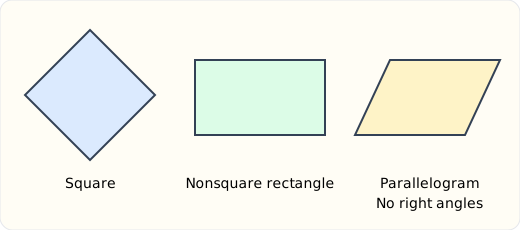
The square on the left has been rotated. Its top point does not make it a new category called a diamond: it still has four equal sides and four right angles. The middle figure is a rectangle with unequal adjacent side lengths, so it is not a square. The right figure has two pairs of parallel sides but no right angles, so it is a parallelogram that is not a rectangle.
All three are parallelograms because they each have two pairs of parallel opposite sides. Only the first two are rectangles. The first is also a rhombus. These conclusions use the exact properties named for the constructions. In an unmarked rough sketch, apparent equality or a near-right corner may need measurement or additional given information. Do not turn a visual impression into an exact property without evidence.
A triangle with angles forty, sixty and eighty degrees is acute because every angle is less than ninety. Its largest angle is eighty, so checking that largest value is enough once the three measures are known. A triangle with angles thirty, sixty and ninety is right because one angle is exactly ninety. A triangle with angles twenty-five, thirty-five and one hundred twenty is obtuse because one angle exceeds ninety.
A triangle cannot have two angles of ninety degrees or more: those two would already use at least one hundred eighty degrees, leaving no positive third angle in a plane triangle. The three angles total one hundred eighty degrees. This relationship explains why a largest-angle test works, but classification does not always require calculating an angle sum. A marked right angle in a known triangle is sufficient to identify it as a right triangle.
Suppose a triangle has a forty-degree angle and its other angles are unknown. It might have angles forty, sixty and eighty, making it acute. It might have forty, fifty and ninety, making it right. It might have forty, thirty and one hundred ten, making it obtuse. The same known acute angle fits all three categories.
This is an example of insufficient evidence. You can truthfully say that one angle is acute, but you cannot yet classify the whole triangle by angles. Ask for the remaining measurements or a condition such as a right-angle mark. A complete definition tells you how much evidence is needed: all three acute angles for an acute triangle, but only one confirmed right or obtuse angle to establish those categories in a triangle.
When two triangle angles measure thirty-eight and fifty-two degrees, their sum is ninety degrees. Since the three angles of a plane triangle total one hundred eighty, the missing angle is ninety. The triangle is therefore right. Write 38 + 52 + x = 180, then x = 90. This calculation connects measured data to a classification instead of asking you to guess from the drawing.
The total of one hundred eighty is a property of triangles, not of every polygon. Do not subtract two known angles from one hundred eighty for an arbitrary quadrilateral. Likewise, if three proposed triangle measures total more or less than one hundred eighty, they cannot all be exact measures of one plane triangle. A data check can reveal an inconsistent description before you assign a category.
Parallel lines remain the same distance apart and never intersect in their plane. Perpendicular lines intersect at ninety degrees. In a rectangle, opposite side lines are parallel, while adjacent side lines are perpendicular. The same pair of lines is not both parallel and perpendicular, but one shape can contain different pairs with these different relationships.
When a question asks for pairs of parallel sides, count pairs rather than individual sides. A rectangle has four sides arranged as two parallel opposite pairs. Four right angles occur at its four vertices. A slanted parallelogram still has two parallel pairs but can have no right angles. Seeing parallel sides therefore does not by itself justify calling the shape a rectangle. The angle condition is additional evidence.
A rectangle is defined by four right angles; it need not have all four sides equal. A rhombus is defined by four equal sides; it need not have right angles. A square satisfies both conditions, so it lies in both categories. To prove a quadrilateral is a square, establish both the equal-side condition and the right-angle condition.
Imagine a four-sided hinged frame made from four equal sticks. It can form a square, but pushing opposite corners can make a slanted rhombus while preserving the stick lengths. The equal sides remain, while the angles change. This model shows why equal side lengths alone do not force a square. Conversely, a long narrow rectangle has four right angles but unequal adjacent side lengths, showing why right angles alone do not force a square.
Different mathematical texts use different conventions for the word trapezoid. In this course, a trapezoid has exactly one pair of parallel opposite sides. Under that convention a parallelogram is not a trapezoid because it has two such pairs. Some other texts use at least one pair, which includes parallelograms. Read the definition used in a task rather than treating the name as more precise than its stated rule.
The underlying side relationships do not change when the naming convention changes. A figure with exactly one parallel pair still has exactly one pair under either convention. Reporting the property along with the name makes the conclusion clear. Avoid defining a general parallelogram as a shape with no right angles: rectangles and squares are also parallelograms. If you mean the slanted example with no right angles, state that extra condition explicitly.
Rotating a figure preserves its side lengths and angle measures. A square resting on one vertex is still a square, and a right triangle remains right when its right-angle corner is not at the lower left. Use properties rather than familiar page orientation. Tracing and turning a paper cutout can help demonstrate this invariance.
Stretching is different from rotating. Stretching a square horizontally can create a nonsquare rectangle, preserving right angles but changing equality of side lengths. Pushing a hinged square sideways can preserve equal sides while changing the angles. These transformations show which properties support each classification. Ask what action was performed before claiming that a name must remain the same. Moving or turning a rigid shape differs from changing its dimensions or angles.
For each shape, record the number of sides, number of parallel opposite pairs, number of right angles and whether all sides are equal. A square's record is four sides, two parallel pairs, four right angles and all sides equal. A nonsquare rectangle shares the first three entries but not the last. A nonrectangular parallelogram has four sides and two parallel pairs, with no right angles.
This record supports classification without relying on a memorized picture. It also shows why one observation may not distinguish categories. Four sides only establishes quadrilateral. Two parallel pairs establishes parallelogram. Four right angles adds rectangle, and equal side lengths then adds square. Build the conclusion from the supplied evidence and stop where that evidence stops. Do not infer unmeasured equal lengths merely because a sketch looks balanced.
Suppose measured data for a quadrilateral state that all four sides are five centimeters long, but provide no angle measurements. You can classify it as a rhombus. You cannot yet decide whether it is a square: four equal sides permit both square and nonsquare rhombi. A right-angle measurement would supply the missing distinction in this setting.
For a triangle with two known angles of forty-five degrees each, use the triangle sum to find ninety degrees for the third. Now a right-triangle classification is justified even if the sketch is tilted. These two cases illustrate different kinds of evidence. In one, the missing angle information prevents a narrower conclusion. In the other, a known geometric relationship lets you infer the missing angle. State which evidence you used and why it is sufficient.
A floor design requires square tiles so neighboring edges meet at right-angle corners. A supplier's fictional data sheet lists four equal side lengths for a tile but says nothing about its angles. Those lengths establish a rhombus, not necessarily a square. Ask for the right-angle property or inspect the angle measurements before claiming the tile meets the design. If the tile is confirmed to have four right angles as well, it is a square and therefore also a rectangle and a parallelogram. The extra names are not contradictions. They describe properties the tile satisfies. A review should identify both the evidence supporting the intended category and the specific missing evidence when a narrower claim cannot yet be made.
A model brace is drawn as a triangle with two measured angles of thirty-eight and fifty-two degrees. Their sum is ninety, so the third angle is ninety under the plane-triangle angle relationship. This supports classifying the brace as a right triangle even if the drawing is rotated. Label the inferred right angle and distinguish it from the two directly supplied measurements. A reviewer can check that all three sum to one hundred eighty and that the right corner occurs where the design needs it. The classification alone does not establish the brace's strength or its side lengths. It establishes an angular property useful for the drawing's geometry, and any additional physical requirements need their own evidence.
A square is also a rectangle, rhombus and parallelogram. A general parallelogram is not required to lack right angles. One acute triangle angle is insufficient to call the triangle acute. Use the stated trapezoid convention and report the actual parallel-side property.
Read the complete angle data.
40 degrees, 60 degrees, 80 degrees
All three interior measures are supplied.
Check that they form a triangle total.
40 + 60 + 80 = 180
The data are consistent with a plane triangle.
Find the largest angle.
80 degrees
Every other angle is no greater.
Compare it with a right angle.
80 < 90
All three angles are acute.
State the triangle category.
Acute triangle
The full definition requires every angle to be acute.
Record the two known measures.
38 degrees and 52 degrees
The third measure is unknown.
Use the triangle's total.
38 + 52 + x = 180
The interior angles make one hundred eighty degrees.
Combine the known parts.
38 + 52 = 90
This is the portion already accounted for.
Find the remaining angle.
x = 180 - 90 = 90 degrees
The missing corner is exactly right.
Classify with the decisive evidence.
Right triangle because one angle is 90 degrees
The conclusion does not depend on the sketch's orientation.
Identify the polygon size.
Four straight sides
The figure is a quadrilateral.
Inspect the opposite-side relationships.
Two pairs of parallel sides
It satisfies the parallelogram definition.
Inspect the corner measures.
Four right angles
It also satisfies the rectangle definition.
Inspect the side lengths.
All four sides are equal
It also satisfies the rhombus definition.
Combine the side and angle conditions.
Equal sides and four right angles: square
Both conditions justify the narrower category.
Check orientation is irrelevant.
Turning the square preserves these properties
All the stated classifications remain true.
Record the side evidence.
Four sides, each 5 cm
The figure is a quadrilateral with equal sides.
Apply the definition supported by that evidence.
Rhombus
All four side lengths agree.
Identify the extra square condition.
Four right angles
Equal side lengths alone do not provide this.
State the unresolved classification.
Name useful additional evidence.
A triangle has two angles of 52 and 29 degrees. Its three angles total 180 degrees. Find the third measure in degrees.
Answer:
A triangle has angles 35 degrees, 25 degrees and an unknown measure. Use its 180-degree total to classify it by angles.
Combine the known angles.
35 + 25 = 60 degrees.
These are two of the triangle's three angles.
Find the remaining angle.
The third angle measures a degrees.
Subtract the known total from 180.
Classify using the inferred measure.
The triangle is obtuse.
The inferred angle exceeds a right angle.
Audio transcript: None
A triangle has angles 80, 60 and 40 degrees. Construct the angle-count record that justifies its classification: how many angles are acute, right and obtuse? Each angle belongs in exactly one count.
Acute angles ac; right angles ri; obtuse angles ob
A triangle has two angles of 37 and 24 degrees. Its three angles total 180 degrees. Find the third measure in degrees.
Answer:
A triangle has angles 80, 60 and 40 degrees. Construct the angle-count record that justifies its classification: how many angles are acute, right and obtuse? Each angle belongs in exactly one count.
Acute angles ac; right angles ri; obtuse angles ob
A triangle has two angles of 27 and 45 degrees. Its three angles total 180 degrees. Find the third measure in degrees.
Answer:
A tile drawing specifies a square of side 4 cm, turned so a vertex points upward. Construct its property record: number of parallel opposite-side pairs, number of right angles, and number of sides equal to 4 cm.
Parallel pairs p; right angles r; equal-length sides e
 A new roof-panel diagram labels triangle PQR with angle Q = 35 degrees, angle R = 55 degrees and angle P = x. The measured side record is PQ = 12 cm, PR = 8.4 cm and QR = 14.6 cm, rounded to the nearest tenth. A separate four-sided panel has two marked parallel opposite-side pairs and all four sides measured as 6 cm, but no angle measurements. Select every supported analysis passage, including the limit.
This task has no paper form; do it on a device.
Audio transcript: None
Lesson test: one question per skill, one attempt each, no hints. Your answers are checked when you submit.
A triangle has two angles of 59 and 48 degrees. Its three angles total 180 degrees. Find the third measure in degrees.
Answer:
You can classify a triangle and a quadrilateral by their properties. Without looking: what kind of triangle has an angle over 90 degrees, and name three groups a square belongs to.
21. Review equal-side data without angle data, step 4
It may be a square, but the data do not establish that
A nonsquare rhombus also fits the measurements.
21. Review equal-side data without angle data, step 5
A verified right-angle condition
Angle information can distinguish the narrower category.