Back to the on-screen lesson ·
A common bottom number, or a comparison against one half.
Paper packet. Every task here also exists on screen, where it is checked automatically; answers written on paper are not assessed by Nydus. When you are back at a device, enter your answers there.
In this lesson you compare two fractions even when they share nothing — not the top number, not the bottom. There are two ways through: give them a common bottom number so the pieces are the same size, or compare each one against a half and see whether they land on opposite sides. The second is quicker when it works, and knowing when it works is part of the skill.
You know that a fraction counts equal parts of a whole and that equivalent fractions name the same amount. You can compare fractions with a common denominator by comparing their numerators. Before comparing unfamiliar fractions, ask whether they refer to the same whole or the same measurement unit. Half of a large sheet can be physically larger than three quarters of a small sheet. The fraction numbers alone do not describe different-sized original sheets.
| Term | What it means |
|---|---|
| Numerator | The count of equal fractional parts. |
| Denominator | The number of equal parts making one whole. |
| Common denominator | A shared part size used to rename fractions. |
| Benchmark | A familiar value, such as one half or one, used for comparison. |
| Equivalent fractions | Different fraction names for the same value. |
| Inequality | A statement that one quantity is less than or greater than another. |
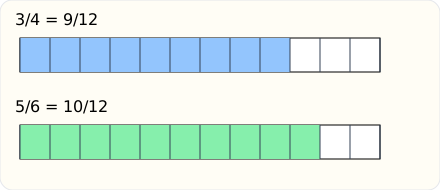
To compare fractions, use a representation in which their sizes can be judged fairly. One approach renames both fractions using the same-sized pieces. For example, three quarters equals nine twelfths and five sixths equals ten twelfths. Ten equal pieces exceed nine of those same pieces, so 5/6 is greater than 3/4. We changed the names, not the quantities.
Another approach compares each fraction with a shared benchmark. Three eighths is less than one half because half of eight pieces is four pieces. Five eighths is greater than one half. Therefore three eighths is less than five eighths. A benchmark can also compare fractions with different denominators if it separates them. If both lie on the same side of the benchmark, that information alone may not determine which is greater.
Another way: steps
Check the whole or unit, choose equal parts or a separating benchmark, compare, and explain why the comparison preserves the original quantities.
The two strips have the same length, so they represent the same whole. Every quarter in the upper strip has been split into three equal parts, making twelve parts per whole. Every sixth in the lower strip has been split into two equal parts, also making twelve. The shaded lengths have not changed during this repartitioning.
Count nine shaded twelfths in the upper strip and ten in the lower one. The lower strip extends one twelfth farther. The diagram supports both the ordering and an explanation of the common denominator: the parts are now the same size. If the strips had different whole lengths, simply comparing the number of shaded cells would not establish a fair fractional comparison. The shared whole is an essential part of the model, not a decoration.
For quarters and sixths, twelve is a useful common denominator because both four and six divide twelve exactly. You can find it by listing a few multiples: four, eight, twelve; six, twelve. A larger common denominator such as twenty-four also works, but it creates more pieces to count. The smallest common denominator is convenient, not a requirement for a valid comparison.
Once you choose twelve, ask how many new pieces replace each old piece. Each quarter becomes three twelfths, so three quarters becomes nine twelfths. Each sixth becomes two twelfths, so five sixths becomes ten twelfths. Multiply the numerator and denominator by the same positive whole number. Changing only the denominator would change the value because it would shrink the pieces without increasing how many you count.
A number line represents fractions as distances from zero measured with one fixed unit interval. To locate three quarters, split the distance from zero to one into four equal intervals and count three intervals. To locate five sixths, use six equal intervals of that same distance and count five. The point for five sixths lies farther right.
A common twelfths partition lets you mark both points on one set of equally spaced ticks. Three quarters is the ninth tick after zero and five sixths is the tenth. Count intervals, not all visible tick marks including zero. Twelve intervals require thirteen boundary marks from zero through one. The line connects comparison to magnitude: a larger nonnegative fraction lies farther from zero in the positive direction. The fraction's written digits are names for those positions, not independent whole-number scores.
Compare three fourths and three eighths. Both count three pieces, but the pieces differ in size. Dividing the same whole into eight equal pieces makes each piece smaller than dividing it into four. Three fourth-sized pieces therefore exceed three eighth-sized pieces. A larger denominator does not automatically mean a larger fraction.
This reasoning applies when the numerator is the same and positive and the whole is fixed. It does not justify comparing three eighths with five sixths merely by looking at the denominators, because the counts of pieces also differ. State which feature is held constant before using a shortcut. You can verify the equal-numerator example by renaming three fourths as six eighths; six eighths is greater than three eighths. The two explanations agree because they describe the same quantities.
Compare three eighths with two thirds. Four eighths is one half, so three eighths is below one half. One half of a whole is also smaller than two thirds: splitting each third into two equal parts gives four sixths, while one half is three sixths. Thus three eighths is below one half and two thirds is above it. The benchmark lies between them, proving the comparison.
You do not need the exact difference to determine which is greater. A chain such as 3/8 < 1/2 < 2/3 communicates the reasoning clearly. However, merely saying both fractions are 'near half' is not enough. Identify the side of the benchmark for each. If one fraction equals the benchmark, equality also helps: one half is greater than three eighths and less than two thirds.
Three fourths and five sixths are both greater than one half. That fact places both in the upper half of the unit interval, but it does not decide their order within that region. Likewise, knowing two runners both finished before noon would not tell which finished first. More precise evidence is needed.
You can now use common twelfths, as in the figure, or compare how far each fraction is below one. Three fourths is missing one fourth; five sixths is missing one sixth. A sixth of the same whole is smaller than a fourth, so five sixths is closer to one and therefore larger. This complementary reasoning works here because each fraction is exactly one unit fraction below the same whole. Explain that relationship instead of applying a rule about 'smaller missing denominators' without meaning.
Comparing fractions includes the possibility that they are equal. Two thirds and four sixths have different numerators and denominators, but partitioning each third into two equal pieces shows that both occupy the same length. Their points overlap on a number line, and 2/3 = 4/6 is the correct comparison.
A method that always selects the fraction with the larger numerator would incorrectly declare four sixths larger. A method that always selects the fraction with the smaller denominator would incorrectly declare two thirds larger. Neither looks at the relationship between numerator and denominator. Rename the quantities or use a model. When a question asks for the larger fraction and equality is possible, report that there is no strictly larger one. Do not invent a difference from the appearance of the written forms.
Suppose one ribbon is three quarters of a meter and another is five sixths of a meter. Both use the same unit, so their fractional numbers determine their length order. The second ribbon is longer. If instead each fraction refers to a different original roll with unknown length, the comparison cannot determine the actual cut lengths. A fraction must be connected to its whole before it describes a physical quantity.
For example, one half of a two-meter roll is one meter, while three quarters of a one-meter roll is three quarters of a meter. Although one half is less than three quarters as a number, the first physical cut is longer because its reference whole is twice as long. Label the unit or whole in your explanation. This boundary prevents a correct number comparison from becoming an unsupported real-world conclusion.
Try comparing two thirds and three fourths without selecting from answer choices. Draw equal unit strips or rename both in twelfths. Two thirds becomes eight twelfths and three fourths becomes nine twelfths. Now write 2/3 < 3/4 and say that eight equal parts are fewer than nine of the same parts. The construction supplies the evidence for the sign.
The open side of the greater-than or less-than sign faces the larger quantity. If you reverse the order in the written statement, reverse the sign: 3/4 > 2/3 describes the same fact. Check the sentence by reading it aloud. The sign records your conclusion; it should not be guessed first and defended afterward. A complete comparison includes the quantities, the relation and the reason the chosen representation compares equal units.
A model needs a continuous ribbon at least three quarters of a meter long. One available piece is two thirds of a meter, and another is five sixths of a meter. Rename the needed length as nine twelfths of a meter. The pieces are eight twelfths and ten twelfths respectively. The first is too short, while the second reaches beyond the required length. This comparison assumes the stated lengths are accurate and no extra material is needed for fastening. If fastening consumes additional length, the minimum requirement must include that amount before you decide. The fraction comparison answers the stated length question; it does not establish that a ribbon is strong enough or suitable in color. Keep the conclusion tied to the measured property.
Two students shade designs on equally sized rectangular sheets. One shades five eighths of a sheet, while the other shades three fourths. Three fourths is six eighths, so the second student shades a greater area by one eighth of a sheet. Equal sheet sizes are essential evidence. If the second sheet were much smaller, the fractional comparison would describe proportions without necessarily describing larger physical area. Ask which claim is intended: a larger fraction of the sheet or a larger actual area. A clear report can say that three fourths is the larger fraction and, because the sheets are equally sized, it is also the larger shaded area in this particular situation. Both the number relationship and its physical condition belong in the explanation.
Never compare unlike numerators as though they count equal-sized parts. A larger denominator makes each unit fraction smaller for a fixed whole. A benchmark decides order only when its position provides enough information. State equality when equivalent fractions occupy the same point.
Identify the common whole.
3/4 and 5/6 of one equal-length strip
Both quantities use the same reference.
Choose a common part size.
12 equal parts per whole
Twelve is a multiple of four and six.
Rename the first quantity.
3/4 = 9/12
Each fourth becomes three twelfths.
Rename and compare the second.
5/6 = 10/12; 10 > 9
The new parts have equal size.
State the original comparison.
3/4 < 5/6
Renaming preserved both values.
Choose a familiar benchmark.
Compare 3/8 and 2/3 with 1/2
One half may lie between them.
Place the first fraction.
3/8 < 4/8 = 1/2
Three eighths is one eighth below half.
Rename the second for a half comparison.
2/3 = 4/6; 1/2 = 3/6
Sixths make their relationship visible.
Place the second fraction.
2/3 > 1/2
Four sixths exceeds three sixths.
Connect the two inequalities.
3/8 < 1/2 < 2/3
The benchmark separates the quantities.
Read the two reference lengths.
Half of a 2-meter roll; three quarters of a 1-meter roll
The original wholes differ.
Find the first physical length.
1/2 of 2 meters = 1 meter
Two equal halves divide the two-meter roll.
Find the second physical length.
3/4 of 1 meter = 3/4 meter
The second unit is a single meter.
Express both in one unit.
1 meter = 4/4 meter
Now the counted fourths have the same size.
Compare the physical lengths.
4/4 meter > 3/4 meter
The first cut is longer.
Explain the apparent reversal.
1/2 < 3/4 as numbers, but the reference rolls differ
A fractional number alone does not specify an unknown physical whole.
Check the unit is shared.
Both are lengths measured in meters
The same unit makes comparison meaningful.
Choose equal parts.
Use twelfths
Twelve is a multiple of three and four.
Rename both fractions.
2/3 = 8/12; 3/4 = 9/12
Numerator and denominator change by the same factor.
Compare the counts.
State the conclusion.
Which fraction is greater: 2/5 or 3/4?
Compare 2/3 and 3/4 using twelfths.
Rename the first fraction.
2/3 = 8/12.
Each third splits into four twelfths.
Rename the second fraction.
3/4 = n/12.
Each fourth splits into three twelfths.
Compare equal-sized parts.
Eight twelfths is less than nine twelfths.
The common whole and part size make the comparison fair.
Audio transcript: None
Rename 3/4 and 5/6 with denominator 12.
First numerator a; second numerator b
A unit strip is split into 12 equal pieces. One shading covers 5 pieces; another covers 7. Complete the distances below and above half, counted in these pieces.
Half contains h pieces; first is b piece below; second is a piece above
Which fraction is greater: 3/4 or 5/6?
Rename 3/8 and 1/2 with denominator 8.
First numerator a; second numerator b
In two equal-value-per-question quizzes, a student answers 2 of 3 questions correctly on the first and 3 of 4 on the second. Express both success fractions in 12ths. By how many of these equal parts is the second success fraction greater?
Answer:
Lesson test: one question per skill, one attempt each, no hints. Your answers are checked when you submit.
Rename 2/3 and 3/4 with denominator 12.
First numerator a; second numerator b
You can compare any two fractions and say how you did it. Without looking: which is greater, 3/8 or 5/9, and which method did you use?
20. Compare two thirds and three fourths, step 4
8 < 9
Every counted part is one twelfth of a meter.
20. Compare two thirds and three fourths, step 5
2/3 meter < 3/4 meter
Equivalent names preserve the original lengths.