Back to the on-screen lesson ·
Giving them the same number of places, so a longer decimal is not mistaken for a bigger one.
Paper packet. Every task here also exists on screen, where it is checked automatically; answers written on paper are not assessed by Nydus. When you are back at a device, enter your answers there.
In this lesson you compare and order decimals. The trap is that 0.45 looks longer than 0.5 and is smaller. Decimal places name fractional units, so counting the digits after the point does not decide size. Writing both with the same number of places makes the comparison obvious and stops the habit from carrying over.
You can read tenths and hundredths as equal parts of one whole. One tenth equals ten hundredths because each tenth can be split into ten equal smaller pieces. Decimal notation records these units by position: the first place after the decimal point is tenths, and the second is hundredths. Before comparing decimal numbers, read them as quantities rather than as strings of digits. Forty-five hundredths and five tenths use different-sized counted parts.
| Term | What it means |
|---|---|
| Tenth | One of ten equal parts of a whole. |
| Hundredth | One of one hundred equal parts of a whole. |
| Decimal point | The mark separating whole-number places from fractional places. |
| Trailing zero | A zero written after the last nonzero decimal digit without changing its place. |
| Order | Arrange quantities by their values, such as least to greatest. |
| Distance | The amount separating two positions on a consistently scaled number line. |
The decimal 0.45 means forty-five hundredths. The decimal 0.5 means five tenths, which is fifty hundredths. Since forty-five hundredths is less than fifty hundredths, 0.45 < 0.5. The longer written decimal is smaller in this example. Digit count after the decimal point does not decide magnitude. Place value does.
You can write 0.5 as 0.50 to make the shared hundredth unit visible. The zero says there are no additional hundredths beyond the five tenths. It does not move the five to a new place. Compare whole-number parts first, then tenths, then hundredths, stopping at the first unequal place. If every place agrees after equivalent zeros are included, the decimal numbers are equal.
Another way: steps
Check the common unit, align decimal places, rename tenths as hundredths when useful, and compare the first place that differs.
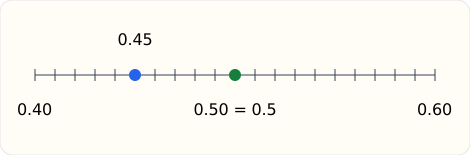
The displayed interval begins at forty hundredths, not at zero. Each small step is one hundredth, so the point at forty-five hundredths is five steps to the right of forty hundredths. Fifty hundredths is five more steps to the right. The picture therefore shows both which number is greater and the five-hundredth distance between them.
A close-up line can make small differences visible, but its labels and scale matter. Do not assume the left endpoint is zero just because it is at the left edge of the drawing. Count equal intervals between labeled landmarks. Five tenths and fifty hundredths occupy the same point because they are equivalent quantities. Writing an extra trailing zero changes the name shown beside that point, not the point's position.
Imagine a square divided into ten equal rows with ten equal cells in every row. The whole square contains one hundred cells. Shading five complete rows covers fifty cells, so five tenths of the square equals fifty hundredths. Shading four rows and five more cells covers forty-five hundredths, which is smaller.
This model explains why comparing forty-five with five as whole numbers is inappropriate. The forty-five counts individual hundredth-cells, while the five counts tenth-rows. Rename both in cells or both in another common unit before comparing. The reference squares must have the same size. If one square is enlarged, the model can still represent its own fraction, but comparing its shaded physical area with a smaller square's shaded area requires accounting for the different wholes.
The numbers 0.6 and 0.60 are equal because six tenths equals sixty hundredths. The zero after the six adds zero hundredths and leaves the six in the tenths place. Likewise, 2.3 = 2.30. Writing the extra place can help align columns for a comparison without changing the number.
In contrast, 0.06 is six hundredths, not six tenths. The zero before the six places that digit one position farther right, making its contribution one tenth as large. Do not say that zeros never matter. Their position determines their role. A zero in 3.04 records no tenths and keeps the four in the hundredths place. Removing that zero would produce 3.4, a different value. Read the place names to distinguish an equivalent trailing zero from an essential placeholder.
Compare 2.09 and 1.95. The first has two complete wholes; the second has one complete whole and less than another whole. Therefore 2.09 is greater. The ninety-five hundredths in the second number cannot overcome a whole-number part that is one smaller, because ninety-five hundredths is still below one.
If the whole-number parts agree, then inspect the fractional places. For 2.09 and 2.30, both have two wholes, but the second has three tenths while the first has none. Thus 2.30 is greater. Aligning the decimal points creates matching whole, tenth and hundredth columns. Aligning the last written digits instead could compare a whole-number place with a fractional place and would destroy the meaning of the comparison.
Compare 0.64 and 0.68. Both have zero wholes and six tenths. The hundredths differ: four hundredths is less than eight hundredths, so 0.64 < 0.68. Now compare 0.69 and 0.70. Six tenths is less than seven tenths, so the second is greater even though nine is greater than zero in the hundredths place.
The first unequal place from the left decides because every smaller place together remains less than one unit of that earlier place. Within hundredths, the most that can follow six tenths is nine hundredths, producing 0.69, still below seven tenths. This reasoning explains the digit-by-digit method. It is not a rule about finding any large digit anywhere in a numeral. The digit's place and all earlier agreements are part of the justification.
To order 0.7, 0.47, 0.74 and 0.07 from least to greatest, rename them as seventy, forty-seven, seventy-four and seven hundredths. The hundredth counts order as 7 < 47 < 70 < 74. Therefore 0.07 < 0.47 < 0.7 < 0.74. Each numeral stays attached to its value during the sorting.
Check neighboring pairs rather than assuming the list is correct because the smallest and largest entries are correct. Seven hundredths precedes forty-seven hundredths; forty-seven precedes seventy; seventy precedes seventy-four. If two entries are equivalent, such as 0.7 and 0.70, show equality or place them together. An ordering task does not create a numerical difference between two equivalent forms. The question's notation may distinguish their written forms, but their magnitude is the same.
Which is closer to half a meter: 0.46 meter or 0.57 meter? Half a meter is 0.50 meter. The first length is four hundredths below half, while the second is seven hundredths above half. Four hundredths is the smaller distance, so 0.46 meter is closer. The smaller decimal happens to be closer here, but smaller does not always mean closer.
If the choices were 0.42 and 0.51, the distances would be eight hundredths and one hundredth, making 0.51 closer. First identify the benchmark and then compare distances on either side. Comparing the lengths directly answers which is larger, a different question. Writing both values in hundredths makes distance counting concrete: count the steps needed to reach fifty hundredths from each location.
A strip of length 0.75 meter is longer than a strip of length 0.6 meter because seventy-five centimeters exceeds sixty centimeters. Both decimal quantities use meters, and each hundredth of a meter is one centimeter. This conversion supplies a second explanation of the comparison.
A comparison of 0.75 meter and 0.6 centimeter cannot be made just by comparing the written decimal numbers as if the units matched. First convert to a common unit. Also distinguish a stated measurement from an exact physical guarantee. In these practice problems, use the supplied values as given. In a real measurement, the instrument and measurement process can limit precision. A larger written number of decimal places alone does not prove that a measurement is more accurate.
Three fourths of a meter can be renamed seventy-five hundredths of a meter, or 0.75 meter. Compare it with 0.8 meter by writing eight tenths as eighty hundredths. The second length is greater by five hundredths of a meter. This uses equivalent representations of the same unit, not a rule that decimal notation is automatically larger than fraction notation.
One half is fifty hundredths, one fourth is twenty-five hundredths, and three fourths is seventy-five hundredths. These useful equivalences can be shown with equal strips or a hundred-square. Do not invent a terminating hundredths representation for every fraction. One third, for example, does not equal an exact whole number of hundredths. The comparisons here choose fractions that can be renamed exactly in tenths or hundredths so the evidence remains exact.
A learner says that 0.48 is larger than 0.6 because forty-eight is larger than six. Ask what each count measures. Forty-eight counts hundredths, while six counts tenths. Rename six tenths as sixty hundredths and compare forty-eight with sixty. The corrected statement is 0.48 < 0.6.
A second learner says that 0.08 equals 0.8 because the zero can be removed. Read the two values aloud as eight hundredths and eight tenths, then represent them with eight cells and eight rows of a hundred-square. The quantities differ by a factor of ten. These explanations locate the misconception in the unit rather than merely replacing an inequality sign. When you compare independently, include a place-value or equal-unit statement that another learner could use to check your conclusion.
A model requires a strip at least 0.6 meter long. The available strips measure 0.58 meter and 0.62 meter. Rewrite the requirement as sixty hundredths of a meter. Fifty-eight hundredths is too short, while sixty-two hundredths exceeds the requirement by two hundredths. The longer written form does not decide the comparison because both available values have two decimal places while the requirement has one. Equal-unit reasoning decides it. This conclusion assumes the given lengths can be used without an extra fastening allowance. If the strip must overlap a joint, add that overlap to the requirement before comparing. The comparison establishes whether the stated length is sufficient; it does not establish whether the material has any other needed property.
One drawing specifies a border three fourths of a meter long, while a second specifies 0.8 meter. A common meter unit allows an exact comparison. Three fourths equals seventy-five hundredths, and eight tenths equals eighty hundredths. The second border is five hundredths of a meter longer, which is five centimeters. A report can include both the inequality and this distance to make the result useful. If the original fractions referred to different-sized drawing sheets rather than meters, the number comparison would not by itself establish physical length. Naming the common unit is therefore part of the evidence. A useful explanation states what was converted, why the conversion preserves value, and what measured difference follows.
Trailing zeros after a decimal can preserve value, but zeros that hold an internal place may be essential. Compare the whole part before tenths and hundredths. To decide closeness, compare distances from the benchmark rather than simply choosing the smaller value.
Read both values as fractional units.
0.45 is 45/100; 0.5 is 5/10
The counts initially use different units.
Rename the tenths.
5/10 = 50/100
Each tenth contains ten hundredths.
Compare equal-sized parts.
45 < 50
Both counts now refer to hundredths.
State the decimal comparison.
0.45 < 0.5
The longer written decimal is smaller here.
Check the number-line positions.
0.45 lies five hundredths left of 0.50
Distance confirms the order.
List the original values.
0.7, 0.47, 0.74, 0.07
Keep every value in the set.
Rename all in hundredths.
70/100, 47/100, 74/100, 7/100
The denominator is now shared.
Order the counts.
7 < 47 < 70 < 74
Equal-sized parts can be compared by count.
Return to the original notation.
0.07 < 0.47 < 0.7 < 0.74
Renaming has preserved each value.
Check adjacent pairs.
7 < 47; 47 < 70; 70 < 74
Every neighboring comparison is correct.
Identify the common measurement unit.
3/4 meter and 0.8 meter
Both refer to the same meter.
Choose exact hundredth units.
100 is 25 times 4
Each fourth can be partitioned into twenty-five hundredths.
Rename the fraction.
3/4 = 75/100 = 0.75
Three groups of twenty-five hundredths preserve the length.
Rename the decimal.
0.8 = 80/100
Eight tenths equal eighty hundredths.
Compare the two counts.
75 < 80, so 3/4 meter < 0.8 meter
The decimal length is longer.
Find the exact gap.
80 - 75 = 5 hundredths of a meter
The conclusion concerns length in a common unit.
Name the two lengths and benchmark.
0.46 meter, 0.57 meter; benchmark 0.50 meter
Closeness means distance from the same point.
Express all in hundredths.
46, 57 and 50 hundredths
The distances will use matching units.
Find the lower value's distance.
50 - 46 = 4 hundredths
The first length is below half.
Find the upper value's distance.
Compare distances and conclude.
Which is greater: 0.08 or 0.8?
Compare 0.45 with 0.5 using hundredths.
Read the first decimal.
0.45 is forty-five hundredths.
The second decimal place counts hundredths.
Rename the tenths as hundredths.
0.5 equals h hundredths.
Every tenth contains ten hundredths.
Compare the equal-unit counts.
Forty-five is less than fifty.
The first decimal is smaller despite having more decimal digits.
Audio transcript: None
Rename 3 tenths as hundredths, then compare that count with 25 hundredths by finding the excess.
Hundredths h; excess hundredths e
Order 51/100, 1/2 and 1/100 from least to greatest. Give their hundredths counts in that order.
Least a hundredths; middle b hundredths; greatest c hundredths
Which is greater: 0.39 or 0.4?
Rename 5 tenths as hundredths, then compare that count with 43 hundredths by finding the excess.
Hundredths h; excess hundredths e
Two strips measure 47/100 meter and 16/25 meter. Which is closer to half a meter? Enter the distance of the closer strip from half, in centimeters; one hundredth of a meter is one centimeter.
Answer:
A replacement strap must be as long as the longer of two samples. Sample A is 3/4 meter long. Sample B is 81/100 meter long. How many centimeters longer is the longer sample? Convert both measurements to the same length unit before comparing.
Answer:
Lesson test: one question per skill, one attempt each, no hints. Your answers are checked when you submit.
Order 17/25, 3/5 and 2/25 from least to greatest. Give their hundredths counts in that order.
Least a hundredths; middle b hundredths; greatest c hundredths
You can compare and order decimals. Without looking: which is greater, 0.45 or 0.5 — and why does the answer feel wrong at first?
21. Which is nearer to half a meter?, step 4
57 - 50 = 7 hundredths
The second length is above half.
21. Which is nearer to half a meter?, step 5
4 < 7, so 0.46 meter is closer
Magnitude order alone would answer a different question.