Back to the on-screen lesson ·
Dividing when it does not come out exactly, and what the remainder means.
Paper packet. Every task here also exists on screen, where it is checked automatically; answers written on paper are not assessed by Nydus. When you are back at a device, enter your answers there.
In this lesson you divide numbers that do not come out exactly, and say what is left over. The remainder is not a nuisance to be dropped: in a real problem it decides the answer, and whether you round up, round down or use the remainder itself depends entirely on what was being asked. Buses for a school trip and sweets shared between friends round in opposite directions.
You know multiplication facts and can subtract quantities while preserving their units. Division uses those facts to find equal groups or equal shares. Begin with a small check: eighteen counters arranged in groups of six make three groups because three times six is eighteen. If one counter is added, three complete groups still fit, but now one counter remains. The extra counter changes the division record even though it does not create another complete group.
| Term | What it means |
|---|---|
| Dividend | The quantity being divided. |
| Divisor | The number of equal shares or the size of each group. |
| Whole-number quotient | The number of complete groups, or whole units in each equal share. |
| Remainder | The amount left after all possible complete groups are formed. |
| Partial quotient | A part of the total quotient found by removing a useful multiple of the divisor. |
| Capacity | The greatest amount a container can hold under the stated conditions. |
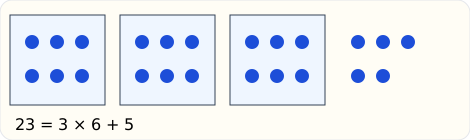
For whole-number division by a positive divisor, the dividend equals divisor times whole-number quotient plus remainder. The remainder must be zero or greater and smaller than the divisor. For example, 23 = 6 × 3 + 5 records twenty-three counters as three complete groups of six and five extra counters. The five is part of the original quantity and must be accounted for.
The equation alone is not the whole check. The statement 23 = 6 × 2 + 11 is also an equality, but eleven is not a finished remainder when groups have size six. Another complete group can still be formed. Requiring the remainder to be smaller than the divisor tells us that grouping is complete. After calculating, read the question again: it may ask for complete groups, a total number of containers, the leftover amount, or an equal share that can include a fraction.
Another way: steps
Find complete groups, subtract their total, check the remainder range, reconstruct the dividend, then interpret the requested quantity.
Each outlined pack in the picture contains six counters. The five loose counters are fewer than a full pack. If only full packs may be sold, three full packs are available and five counters remain unsold. If every counter must be stored in a pack that can hold six, a fourth pack is needed. That last pack has five counters and one empty space. The same division supports both statements because they answer different questions.
The picture also helps separate the units. Three is a count of full packs; five is a count of counters. Adding three and five to claim eight packs would mix different units. When you record an answer, write what each number counts. The notation '3 remainder 5' is useful in arithmetic, but a practical answer needs the meaning supplied by the situation.
Suppose twenty-three counters are shared equally among six children, with counters kept whole. Each child receives three, using eighteen counters, and five counters remain. Here the divisor six counts children, while the quotient three counts counters per child. If instead each bag must contain six counters, the divisor measures counters per bag and the quotient counts bags. Both use 23 divided by 6.
An equal-sharing model can be built by dealing one counter to each child in turn. Stop when there are too few counters for another complete round. Giving a leftover counter to only some children would break the condition that everyone receives the same number. You could change the condition, but you must say so. Division describes the rules actually stated; it does not decide whether unequal sharing is acceptable.
Removing one group at a time is clear for small numbers but slow for larger totals. For 1,487 divided by 6, remove two hundred groups at once: 6 × 200 = 1,200, leaving 287. Then remove forty groups, or 240, leaving 47. Remove seven groups, or 42, leaving 5. Add the partial quotients: 200 + 40 + 7 = 247.
The result is 247 remainder 5. Each subtraction removes an exact multiple of six, so every removed object belongs to a complete group. You may choose different useful multiples. Removing one hundred groups twice reaches the same stage as removing two hundred at once. The choices affect efficiency, not the final quotient. Keep a record of both the number of groups removed and their total quantity; confusing 200 groups with 200 objects changes the calculation.
For 1,487 divided by 6, the first quotient contribution 200 means two hundreds in each of six equal shares. Six shares of two hundreds use twelve hundreds, or 1,200. The remaining 287 can then supply four tens to each share, using 240. The last 47 supplies seven ones to each share, using 42, with five ones left.
A compact written division algorithm records this same sequence with digits and exchanges. Its instruction to bring down a digit means combine the remainder in one place with the next smaller units. It is not permission to attach an unrelated digit without tracking value. If a hundred remains, exchange it for ten tens before combining it with existing tens. Naming those units makes the compact procedure explainable and helps you recover when a quotient digit is placed in the wrong column.
Consider 1,224 divided by 6. Two hundreds in each share use 1,200 and leave 24. There are no whole tens for every share, because giving one ten to each of six shares would require sixty. The quotient therefore has zero tens. Twenty-four ones give four ones per share, producing 204.
Writing 24 would lose the hundreds contribution and give a much smaller answer. Multiplying checks the place: 204 × 6 = 1,224, while 24 × 6 = 144. A zero in the quotient records that a particular place contributes no units, even though a smaller place may contribute some. In a partial-quotient method, writing 200 + 4 naturally preserves the missing tens place when the terms are combined. Use that expanded form if the compact notation becomes confusing.
A craft worker has eighty-three beads and uses nine beads per identical bracelet. Nine complete bracelets use eighty-one beads and leave two. If the question asks how many beads remain, the answer is two beads. Giving nine would report the number of bracelets instead. Giving ten would report enough containers of capacity nine, a different question again.
Underline or restate the requested quantity before deciding what to report. A remainder is not automatically discarded, automatically added to the quotient or automatically converted to a decimal. Its treatment depends on the unit and the permitted actions. Beads that must stay whole cannot be split merely to eliminate a remainder. A measured length of ribbon may be cut into equal fractional shares, so a fraction can be appropriate there. State the physical assumption instead of applying a slogan about always rounding up.
To store 83 beads in boxes holding at most nine each, nine boxes have capacity 81 and are insufficient. Ten boxes have capacity 90 and can hold every bead. This is why a nonzero remainder leads to one additional container when all items must fit and a partially filled container is allowed. The quotient does not become ten mathematically; the practical answer becomes ten containers.
If there are exactly 81 beads, nine boxes suffice. Do not add a container when the remainder is zero. Also check any extra condition. If only full boxes may be shipped and loose beads must remain at the workshop, the shipment contains nine boxes and two beads stay behind. Capacity, complete grouping and shipping rules are different constraints. The question should tell you which applies, and your explanation should connect the decision to that condition.
For 2,357 divided by 7, the whole-number quotient is 336 and the remainder is 5. Multiply 336 by 7 to obtain 2,352, then add 5 to recover 2,357. The remainder is nonnegative and smaller than seven, so the division is complete. These two checks establish the arithmetic result. They do not by themselves tell whether the final answer should be 336 full kits, five spare pieces or 337 containers.
An estimate supplies another useful check. Because 7 × 300 = 2,100 and 7 × 400 = 2,800, the quotient should lie between 300 and 400. An answer of 36 is too small even before you multiply exactly. Use the estimate to catch place-value errors, the multiplication equation to verify the exact result, and the problem conditions to choose the final response.
A learner writes 95 divided by 4 as 22 remainder 7. The equation 4 × 22 + 7 = 95 is correct, so the work has accounted for every item. However, the seven leftovers contain another complete group of four. Form that group to get 23 complete groups and three leftovers. Now the remainder is smaller than the divisor.
Another learner writes 24 remainder minus one because 4 × 24 is 96. This has formed a group that the available items cannot fill. Remove one complete group from the quotient, restoring four items to the remainder, to obtain 23 remainder 3. These repairs explain why both remainder conditions matter. A final check should test the equation and the allowed range, rather than accepting any pair of numbers that reconstructs the dividend.
A maker has 157 centimeters of ribbon and needs pieces exactly six centimeters long. Assume cutting uses no length and pieces cannot be joined from scraps. Twenty-six complete pieces use 156 centimeters, leaving one centimeter. The maker can supply twenty-six pieces, not twenty-seven, because the leftover length is too short for another complete piece. If the question asks for the unused ribbon, report one centimeter. If actual cutting removes material, this simplified calculation is no longer enough to guarantee twenty-six pieces. The model states its assumptions so that a practical user can see what must be checked. The division equation accounts for length, while the requirement that every finished piece have the full requested length determines the usable output.
A class must move 157 sealed samples in trays that hold at most six samples each. Samples must remain whole, every sample must travel and a partially filled tray is allowed. Twenty-six trays would hold only 156 samples, so twenty-seven trays are required. The last tray contains one sample and has five empty spaces. Notice that the arithmetic is the same as in the ribbon example, but the final answer differs because here an incomplete group is a permitted container. A packing explanation should mention both the capacity check and why one fewer tray fails. Merely writing 'round up' does not identify the condition that makes an extra tray necessary. If there were 156 samples exactly, twenty-six trays would already satisfy every stated rule.
The remainder must be smaller than a positive divisor. Always check dividend = divisor × quotient + remainder. Then identify whether the question asks for complete groups, leftovers, equal shares or enough capacity. Add one container only when a nonzero remainder must be accommodated.
Identify the group size.
47 objects, 6 per group
The divisor measures the size of each group.
Find a nearby multiple.
6 × 7 = 42
Seven complete groups fit.
Subtract the grouped objects.
47 - 42 = 5
These objects have not yet been placed.
Check that grouping is complete.
0 ≤ 5 < 6
Five cannot make another group of six.
Reconstruct the total.
47 = 6 × 7 + 5
All original objects are accounted for.
Remove a large useful multiple.
1,487 - 6 × 200 = 287
Two hundred groups use twelve hundred items.
Remove forty more groups.
287 - 6 × 40 = 47
This accounts for another 240 items.
Remove seven more groups.
47 - 6 × 7 = 5
The remainder is now smaller than six.
Combine the group counts.
200 + 40 + 7 = 247
Partial quotients count the same kind of group.
Check the full equation.
6 × 247 + 5 = 1,487
The result is 247 remainder 5.
Read the packing restriction.
235 fragile tiles; at most 8 tiles per tray
Every tile must travel and partial trays are allowed.
Find the complete groups.
8 × 29 = 232
Twenty-nine full trays fit within the tile count.
Find the unpacked amount.
235 - 232 = 3 tiles
The nonzero remainder still needs protection.
Allocate the remaining tiles.
29 + 1 = 30 trays
One partial tray can hold all three.
Verify sufficient capacity.
30 × 8 = 240 ≥ 235
The proposed trays hold all tiles.
Verify that one fewer fails.
29 × 8 = 232 < 235
Thirty is the minimum number under the stated rule.
Remove three hundred groups.
2,357 - 2,100 = 257
Seven times three hundred is 2,100.
Remove thirty more groups.
257 - 210 = 47
Seven times thirty is 210.
Remove six more groups.
47 - 42 = 5
The remainder is less than seven.
Combine the partial quotients.
Check all original items.
Divide 4370 by 6. Give the whole-number quotient and remainder.
Quotient q; remainder r
Finish a partial-quotient solution for 269 divided by six.
Locate a complete multiple of six.
Use 44 groups, containing 264 objects.
Multiplication accounts for the complete groups.
Subtract the grouped quantity.
The remainder is r.
The difference counts objects not in a full group.
Verify the remainder range.
Five is less than six.
No additional complete group can be formed.
Calculate 3908 divided by 4.
Quotient q; remainder r
Divide 4304 by 6. Give the whole-number quotient and remainder.
Quotient q; remainder r
Calculate 5384 divided by 8.
Quotient q; remainder r
Divide 1466 by 8. Give the whole-number quotient and remainder.
Quotient q; remainder r
A workshop must transport 381 fragile samples. Each tray holds at most 6 samples. Every sample must travel; partly filled trays are allowed. What is the minimum number of trays?
Answer:
Lesson test: one question per skill, one attempt each, no hints. Your answers are checked when you submit.
Divide 2888 by 7. Give the whole-number quotient and remainder.
Quotient q; remainder r
You can divide with a remainder and say what it means. Without looking: 47 divided by 6, and if 47 children need buses that hold 6, how many buses?
20. Divide 2,357 by seven, step 4
300 + 30 + 6 = 336
Each contribution counts groups of seven.
20. Divide 2,357 by seven, step 5
7 × 336 + 5 = 2,357
The result is 336 remainder 5.