Back to the on-screen lesson ·
Construct and simplify equivalent fraction names using equal partitions and grouping.
Paper packet. Every task here also exists on screen, where it is checked automatically; answers written on paper are not assessed by Nydus. When you are back at a device, enter your answers there.
Explain fraction equivalence with a fixed whole, construct missing numerators or denominators, simplify by common factors and use exact equivalent names to support a comparison.
You can represent a fraction with equal parts of a fixed whole and locate it on a number line. Two fraction names are equivalent when they represent the same quantity. The numerator counts selected parts and the denominator describes how many equal parts make the whole. If the partition changes, both counts may change even though the selected length or area remains fixed.
| Term | What it means |
|---|---|
| Equivalent fractions | Fractions that name the same value. |
| Partition | Divide a whole into equal parts. |
| Repartition | Divide existing parts into smaller equal parts without changing the whole. |
| Common factor | A positive whole number that divides two numbers exactly. |
| Simplest form | A fraction whose numerator and denominator have no common factor greater than one. |
| Reference whole | The fixed unit whose equal parts define the fraction. |
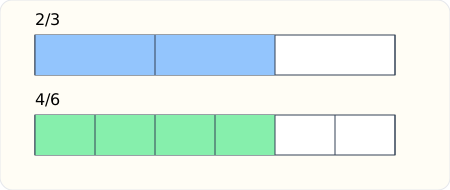
Two thirds means two pieces when the whole is divided into three equal parts. Split each third into two equal pieces. The whole now contains six equal pieces, and the selected amount contains four. Thus 2/3 = 4/6. The selected amount has not grown; its pieces have become smaller and more numerous.
Multiplying the numerator and denominator by the same positive whole number records this repartitioning. Reversing it groups equal small pieces into larger pieces, dividing both counts by a common factor. These are two directions of one value-preserving action. A valid equivalence must keep both the original whole and the selected quantity unchanged. Changing only one of the counts generally changes the fraction's value.
Another way: steps
Keep the same whole, identify the equal subdivision or grouping factor, change both counts consistently, and verify the resulting quantity with a model or reconstruction.
The two strips begin and end at the same positions, so they represent equal wholes. Their shaded portions also end at the same position. The top strip counts two shaded thirds, while the lower counts four shaded sixths. Each original third corresponds to two new sixths, so both the total part count and the shaded part count double.
The picture supplies the reason for the rule. If only the numerator doubled, four thirds would be twice the original amount and would extend beyond one whole. If only the denominator doubled, two sixths would be half the original amount. Doubling both creates more pieces of half the size, preserving the length. Explain these two changes together rather than treating the numerator and denominator as unrelated numbers to manipulate.
To rename three fourths in twelfths, ask how many twelfths make one fourth. Since four times three is twelve, each fourth is split into three equal pieces. Three selected fourths therefore contain nine twelfths. Write 3/4 = 9/12. The denominator change determines the numerator change.
A missing-numerator equation such as 3/4 = n/12 can be solved by this piece-count reasoning. The unknown n is not found by adding eight merely because twelve is eight more than four. Addition does not describe the equal subdivision. The factor three applies to both counts. Check with a strip model or reverse grouping: nine twelfths can be collected into three groups of three twelfths, each group equal to one fourth.
Suppose two fifths is renamed as six of some equal part. The selected part count has tripled from two to six. To preserve the amount, every fifth must have been split into three equal pieces, so the whole contains fifteen of the new pieces. Therefore 2/5 = 6/15.
The denominator is fifteen because the whole's five original pieces each contribute three new pieces, not because fifteen is a convenient large number. If the new numerator is not a whole-number multiple of the original numerator, a simple subdivision by a whole-number factor may not be the intended route. The practice here uses exact factors so the pieces can be counted directly. Always check the full equality rather than filling one blank from a pattern in only one row of numbers.
Six eighths can be grouped into pairs of eighths. Each pair is one fourth because eight small pieces make four pairs in the whole. The six selected pieces make three pairs, so 6/8 = 3/4. Both numerator and denominator are divided by two.
Grouping must be possible for both counts. Dividing only the numerator by two would give three eighths, which is a smaller selected amount. Dividing only the denominator by two would give six fourths, which is larger. The common factor identifies a grouping size shared by the selected count and the whole count. A drawing can make the grouped boundaries visible while leaving the shaded region unchanged. This is the same equivalence process as subdivision, performed in reverse.
To simplify eight twelfths, notice that both eight and twelve can be divided by four. The result is two thirds. The numerator two and denominator three have no common positive factor greater than one, so the fraction is in simplest form. You could also divide by two twice: 8/12 = 4/6 = 2/3.
Using the greatest common factor is efficient, but a sequence of valid common-factor groupings also works. The important condition is that every step divides both counts by the same nonzero factor. Simplest form does not mean the smallest value; all forms in the chain have equal value. It means the written counts no longer share a factor that would allow another whole-number grouping. Explain the distinction between simplifying a name and reducing an amount.
Compare two thirds and three fourths. Rename two thirds as eight twelfths and three fourths as nine twelfths. Eight of the same-sized pieces is less than nine, so 2/3 < 3/4. The comparison depends on two exact equivalences followed by a comparison of equal units.
The chosen denominator need not be the smallest possible common denominator, although a smaller one may make counting easier. Twenty-fourths would give sixteen and eighteen, reaching the same conclusion. The ordering does not depend on which valid common partition you choose because equivalence preserves the original values. If two methods give different orderings, inspect whether a numerator was changed by the wrong factor or the original wholes were unequal.
A number line uses one fixed unit interval from zero to one. Mark two thirds by splitting that interval into three equal parts and counting two. If each third is split in half, the same point is reached by counting four sixths. Splitting each third into four gives eight twelfths at that same location.
Equivalent fractions do not form a row of different points in increasing order just because their numerators increase. Two thirds, four sixths and eight twelfths overlap at one point. The denominator changes the step size while the numerator changes the step count. Their combined effect determines distance from zero. This representation is useful for checking that a procedure really preserves magnitude rather than merely producing a familiar-looking pair of numbers.
Equivalence also applies to improper fractions. Six fourths equals three halves because grouping pairs of fourths creates halves. Both quantities equal one and one half. Multiplying both counts by two gives twelve eighths, another name for the same amount beyond one whole.
The reference whole must remain consistent across multiple units. On a number line, every whole interval has the same length, and every fourth has one quarter of that length. The numerator may count more parts than fit inside one interval. Do not change the denominator merely because the total passes one. Grouping pieces into complete wholes and simplifying the fractional name are useful but distinct ways to describe the same magnitude.
One half and two fourths are equal numbers. If both describe portions of the same-sized sheet, their physical areas are equal as well. If one refers to half of a large sheet and the other to two fourths of a small sheet, the proportions are equivalent but the physical portions may differ.
A clear comparison names the reference whole or uses a fixed measurement unit such as a meter. Three fourths of a meter and six eighths of a meter are equal lengths because their unit is shared. Three fourths of one unknown roll and six eighths of another unknown roll do not establish equal cut lengths. The mathematical equivalence does not supply missing information about different original wholes. State exactly which equality your evidence supports.
A learner writes 2/3 = 3/4 because one was added to both numerator and denominator. Test the claim with twelfths: two thirds is eight twelfths, while three fourths is nine twelfths. The quantities differ. Adding the same number to both counts does not generally preserve the fraction because it does not describe equal subdivision or grouping of every part.
Another learner writes 3/5 = 6/10 and explains that the numerator increased by three and the denominator by five. Those differences happen to describe the changes, but the stronger explanation is that both counts doubled. Doubling corresponds to splitting each original fifth into two equal pieces. A valid explanation should identify the shared factor and what it does to the unit pieces, so it can be applied reliably to a new fraction rather than memorized as a one-case coincidence.
Sometimes one amount arrives in two parts. Suppose a jar contains 2/12 liter and receives another 3/12 liter. Each part uses the same twelfth-liter unit, so the combined amount is 5/12 liter: add the counts two and three while keeping the denominator twelve. A second jar contains 2/3 liter. Rename its thirds as twelfths to get 8/12 liter. Now the comparison uses equal-sized parts of the same liter, and the second jar contains three twelfths more. The number three counts twelfths; it does not mean three whole liters. First combine matching units, then rename unlike units, compare, and subtract the smaller count from the larger. A drawing of one liter partitioned into twelve equal spaces can check every step without changing the reference whole.
One design labels a strip three fourths of a meter long; another labels it six eighths of a meter. These can describe the same length because each fourth-meter piece can be divided into two eighth-meter pieces. Three selected fourths become six selected eighths, and four pieces per meter become eight. The labels are equivalent even though both written counts differ. This allows a maker using eighth-meter marks to follow a plan written in fourths. The conversion does not add material or change the physical strip. Check that both labels refer to meters, since equal fraction proportions of different unknown rolls would not establish equal lengths.
Two equally sized rectangular panels are divided differently. One design shades two thirds of its panel, while another shades three fourths. Repartition both into twelfths without changing the panel size. The first design covers eight twelfths and the second nine, so the second covers one twelfth more of a panel. The equivalence steps make the comparison fair by creating a common part size. If a report claims the difference is one original piece, ask which original partition it means: a third and a fourth are different units. Reporting one twelfth supplies a precise shared unit. This conclusion depends on equal panel sizes and says nothing about paint thickness or other material properties.
The counts may grow or shrink while the value stays equal. Multiply or divide numerator and denominator by the same positive factor. Adding the same number to both is not a general equivalence rule. Keep the reference whole fixed and distinguish simplifying a name from reducing a quantity.
Identify the original partition.
2 selected parts out of 3 equal parts
The reference whole is fixed.
Choose the subdivision factor.
Split every third into 2
The new unit is a sixth.
Count all new parts.
3 × 2 = 6
The denominator records the whole's partition.
Count the selected new parts.
2 × 2 = 4
The numerator records the same selected region.
State and check the equivalence.
2/3 = 4/6
Both shaded lengths end at the same point.
Record the selected and total counts.
8 of 12 equal pieces
Both counts can be grouped in fours.
Group the selected pieces.
8 divided by 4 = 2 groups
The selected region remains unchanged.
Group the whole's pieces.
12 divided by 4 = 3 groups
Each new group is one third of the whole.
Write the new fraction.
8/12 = 2/3
Both counts changed by the same factor.
Check simplest form and reverse.
2 and 3 share no factor above 1; 2 × 4 = 8 and 3 × 4 = 12
The new name is simplest and reconstructs the original.
Identify the two fractions.
2/3 and 3/4
Their original pieces have different sizes.
Choose a common whole partition.
12 equal parts
Both thirds and fourths can be subdivided into twelfths.
Rename the first fraction.
2/3 = 8/12
Each third becomes four twelfths.
Rename the second fraction.
3/4 = 9/12
Each fourth becomes three twelfths.
Compare the equal-part counts.
8 < 9
The common unit permits a count comparison.
State the original ordering.
2/3 < 3/4
Both renamings preserved the original values.
Read the target denominator.
12
The whole will contain twelve equal pieces.
Find the subdivision factor.
12 divided by 4 = 3
Each fourth splits into three new pieces.
Apply it to the selected count.
3 × 3 = 9
All three original selected parts are subdivided.
Write the equivalent fraction.
Check by reverse grouping.
Rename 7/10 using denominator 30.
Numerator n; denominator d
Complete 3/4 = n/12.
Find how the denominator changed.
4 was multiplied by 3.
The new partition subdivides every original fourth equally.
Apply the same factor to the numerator.
The missing numerator is n.
The selected parts receive the same subdivision.
Verify the original value is retained.
Divide both new counts by 3 to recover 3/4.
Reversing the grouping checks the equivalence.
Write 14/20 in simplest form.
Numerator n; denominator d
Rename 1/4 using denominator 8.
Numerator n; denominator d
Write 10/15 in simplest form.
Numerator n; denominator d
A strip is 7/8 meter long. A measuring plan divides each meter into 32 equal intervals. How many of these intervals exactly match the strip's length?
Answer:
One jar contains 1/12 liter plus 1/12 liter. A second jar contains 3/3 liter. Find the positive difference in twelfths of a liter: how many twelfths more are in the fuller jar? Use one common unit to decide which jar is fuller.
Answer:
Lesson test: one question per skill, one attempt each, no hints. Your answers are checked when you submit.
Write 9/24 in simplest form.
Numerator n; denominator d
Explain why 3/4 equals 9/12 using pieces, not only a rule. Then simplify 8/12 and compare its value with 3/4.
22. Complete three fourths in twelfths, step 4
3/4 = 9/12
Both numerator and denominator used the same factor.
22. Complete three fourths in twelfths, step 5
9 divided by 3 = 3; 12 divided by 3 = 4
The original fraction is recovered.