Back to the on-screen lesson ·
The pairs a number is built from, and the numbers it builds.
Paper packet. Every task here also exists on screen, where it is checked automatically; answers written on paper are not assessed by Nydus. When you are back at a device, enter your answers there.
In this lesson you find every factor pair of a number and list its multiples. Factors are the numbers that multiply to make it; multiples are the numbers it makes. They are the same relationship read in two directions, and getting used to switching between them is what makes primes, common denominators and simplifying fractions feel like one idea rather than three.
You can count equal groups and use multiplication facts. Today you will read a multiplication fact in two directions. First ask which whole-number groups can make a fixed total. Then ask which totals can be made by repeating a fixed group. Use counters or small squares if a fact is unfamiliar. Arrange rather than guess: an empty space or an extra counter tells you whether your proposed grouping works. Keep the total visible while rearranging it so that you can explain what changed and what stayed the same.
| Term | What it means |
|---|---|
| Factor | A whole number that divides a given whole number exactly. |
| Factor pair | Two whole numbers whose product is the given number. |
| Product | The result of multiplying. |
| Multiple | A number obtained by multiplying a whole number by another whole number. |
| Array | Objects arranged in equal rows and columns. |
| Remainder | The amount left when equal whole-number groups do not use the entire total. |
Consider 3 × 4 = 12. Three and four are factors of twelve, and twelve is a multiple of both three and four. These are not three separate facts to memorize. They describe the same equal-group relationship. A factor tells you a possible number of groups or a possible size of each group. A multiple tells you a total that those groups can build. Read the sentence aloud in both directions: three is a factor of twelve; twelve is a multiple of three. Now try replacing three with four. The relationship still holds.
In this lesson we find positive factors of positive whole numbers. Every such number has one and itself as factors. For example, one group of twelve and twelve groups of one both use twelve objects exactly. We do not divide by zero. Zero is a multiple of a whole number because zero copies give zero, but when a task asks for the first positive multiples, start with one copy rather than zero copies. Reading that word prevents an otherwise correct list from starting in the wrong place.
Another way: steps
Fix a total to find factors. Fix a group size to find multiples. Check both questions by multiplication.
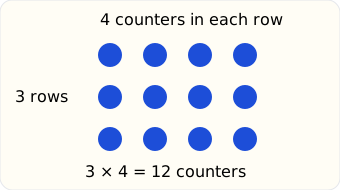
The picture shows three rows with four counters in every row. Count rows separately from counters per row. Three plus four would count neither the counters nor the groups correctly; it gives seven, while the array contains twelve. The multiplication equation describes the structure: three equal groups of four make twelve. Read down the columns instead. There are four columns with three counters each, so four groups of three also make twelve.
Turning an array changes its orientation, not its total. We usually record 3 × 4 and 4 × 3 as one factor pair when listing pairs without repetition. They can still describe different arrangements in a story: three shelves holding four jars each and four shelves holding three jars each use the same twelve jars. A complete answer keeps track of what the two factors mean, especially when the question asks for shelves rather than jars per shelf.
Suppose you want every factor pair of twenty. Begin with 1 × 20. Test two next: 2 × 10 = 20, so record that pair. Three does not work because 3 × 6 = 18 and 3 × 7 = 21. Four works because 4 × 5 = 20. Five would give the same pair reversed. The positive factor list is 1, 2, 4, 5, 10, 20. Write each number only once in the list.
Testing numbers in order is more reliable than remembering favorite times-table facts. If you jump from two to five, you might miss the pair four and five. Explain rejected trials too: a proposed factor fails when no whole-number partner reaches the target exactly. Six groups of three leave two out of twenty, and seven groups go past twenty. A remainder does not create another whole-number factor. It tells you the proposed equal grouping does not fit this total.
Factor partners move toward each other as you test larger possible factors. For twenty-four, the pairs are 1 × 24, 2 × 12, 3 × 8 and 4 × 6. Testing five fails. Testing six reaches the reverse of the pair already found. After the smaller trial has passed its partner, later pairs repeat earlier ones. You can also test every number up to the target if you need a slower check; completeness matters more than speed.
A square total has a pair with the same number twice. For thirty-six, 6 × 6 is a factor pair. Include six once in the factor list, not twice. The full pairs are 1 × 36, 2 × 18, 3 × 12, 4 × 9 and 6 × 6. A list containing only the pairs that use one-digit numbers would miss 1 × 36, 2 × 18 and 3 × 12. The size of a factor does not depend on which multiplication facts you can recall quickly.
To list positive multiples of six, take one copy, two copies, three copies and so on. The totals are 6, 12, 18, 24, 30 and 36. Each next total is six more than the previous one. That equal step is useful for checking a list. The sequence 6, 12, 19, 24 contains a mistake: the jump from twelve to nineteen is seven, and the next jump is five. Multiplication checks the same error because three copies of six equal eighteen.
There is no largest positive multiple of six. If someone gives you a proposed last one, add another six and you have a larger multiple. Factors behave differently: a positive factor of twenty cannot exceed twenty, since even one group of a larger size would be too large. This difference helps you decide which question a task asks. A finite list of ways to share twenty objects is a factor question; continuing possible totals for groups of six is a multiple question.
Is fifty a multiple of seven? Seven copies of seven make forty-nine; eight copies make fifty-six. Fifty lies between these consecutive multiples, so it is not a whole-number multiple of seven. Being close is not enough. The question is whether equal groups fit exactly. Fifty is a multiple of five because 5 × 10 = 50. The same total can fit one group size and fail another.
A number ending in zero is not automatically a multiple of every small number. Test the requested relationship rather than using the last digit as a universal rule. Last digits can help with two, five or ten, but they do not replace multiplication for seven. For a number within one hundred, you can build a short list until you reach or pass it. If your list passes the target without landing on it, show the two neighboring multiples as evidence.
Two totals can share a useful group size. Eighteen and thirty both have six as a factor: 18 = 6 × 3 and 30 = 6 × 5. If two classes need equal teams of the same size with no one left out, six could work. Three could work too. A question that asks for a possible size differs from one that asks for the greatest possible size. Check both totals before accepting a shared factor.
A common multiple answers a different question. Packages holding four counters and packages holding six counters can both make a total of twelve: three four-packs or two six-packs. Twenty-four is another common total. A common factor divides each starting number; a common multiple can be built from either starting group size. You will use this distinction again when fraction pieces need matching sizes. For now, demonstrate it using the equations rather than memorizing a name without its meaning.
For a missing-factor question, multiply your answer by the given factor. If the question is 8 × ? = 56 and you answer forty-eight, the check 8 × 48 cannot equal fifty-six. Subtracting eight found a difference, not a factor. The correct partner is seven because 8 × 7 = 56. Use the check before submitting, even when an answer feels familiar.
For a factor-pair list, check every product and then check completeness. A list can contain only correct pairs and still be incomplete. For twenty-eight, 2 × 14 and 4 × 7 are correct, but 1 × 28 is missing. For multiples, divide or multiply back and check equal jumps. Finally read the units: four boxes of seven books means four is the box count and seven is the books per box. A correct product does not make those meanings interchangeable in the final sentence.
Ari says six is a multiple of twenty-four because 6 × 4 = 24. Bea says twenty-four is a multiple of six. Both point to a true equation, but only Bea has named the multiple correctly. Twenty-four is the total produced by copies of six. Six is a factor of twenty-four. Repair Ari's sentence without changing the equation. Explaining the direction is more helpful than saying that one person forgot a rule.
Now consider a learner who lists 1, 2, 3, 4, 6 and 12 as factors of twelve. Another learner wants to add eight because it is a multiple of four. Eight does not divide twelve exactly, so that extra fact about four is irrelevant. Keep the target number fixed throughout a factor search. When you critique a solution, identify the particular relationship that fails and show a check. You do not need to reject the whole method if just one pair or one word needs correction.
A teacher has thirty-two counters and wants equal bags with none left on the table. Two counters per bag need sixteen bags; four counters per bag need eight; eight counters per bag need four. These are factor relationships, not different totals. Suppose only four bags are available. Then eight counters in each uses the collection exactly: 4 × 8 = 32. Six counters per bag would use twenty-four counters in four bags and leave eight unpacked. Describe both the bag limit and the counter total before choosing a size. If more bags become available, the mathematical possibilities change. A factor list provides choices, while the practical conditions decide which choice fits. Check the final arrangement by counting bags and counters separately, then multiplying.
A reading club receives six new books each week and starts with no books from this delivery. After one week it has six, after two it has twelve, and after five it has thirty. These totals are positive multiples of six. If a shelf has space for twenty-five books, four complete weekly deliveries fit because 4 × 6 = 24. The fifth would make thirty, which is too many for that shelf. One unused space does not mean the weekly group should change size. Explain the result as four complete deliveries with one space unused, not twenty-five divided into unequal weeks. If the club needs exactly thirty-six books for an event, six weekly deliveries supply that total. The same multiples list answers both capacity and target questions when you read each condition carefully.
Subtracting a known factor from a product does not find its partner. Use division or equal groups. A correct pair list may still omit a pair, and reversing a pair does not create a new one. Keep each total and its units attached to the relationship you are testing.
Identify the fixed total.
4 × ? = 28
The missing number counts equal groups or their size.
Write the inverse calculation.
28 ÷ 4
Division reverses multiplication by a known factor.
Use the matching multiplication fact.
4 × 7 = 28
Seven copies of four reach the total exactly.
Name the factor pair.
4 and 7
Both whole numbers belong to the product twenty-eight.
Check the proposed answer.
28 ÷ 7 = 4
The reverse grouping gives the original factor.
Begin with one group.
1 × 30 = 30
One and the total are always positive factors.
Test the next two candidates.
2 × 15 = 30; 3 × 10 = 30
Both trials divide the target exactly.
Reject four with neighboring products.
4 × 7 = 28; 4 × 8 = 32
No whole-number partner fits between seven and eight.
Test the next candidate.
5 × 6 = 30
This gives a new unordered pair.
Finish before repeating pairs.
1, 2, 3, 5, 6, 10, 15, 30
Testing six reverses the last pair; all earlier candidates were checked.
Record both fixed totals.
18 photographs; 30 photographs
Every row must have the same whole-number size in both displays.
List the first total's factors.
1, 2, 3, 6, 9, 18
Each divides eighteen with nothing left over.
List the second total's factors.
1, 2, 3, 5, 6, 10, 15, 30
Each divides thirty with nothing left over.
Select the largest shared factor.
Shared: 1, 2, 3, 6; largest: 6
The question asks for the most photographs per row.
Check each display's row count.
18 ÷ 6 = 3; 30 ÷ 6 = 5
Three rows and five rows each contain six photographs.
Interpret the size and count separately.
6 photographs per row; 3 rows in one display and 5 in the other
The common factor fixes row size, while the different totals require different numbers of rows.
Begin with the first two trials.
1 × 40; 2 × 20
Both products equal forty.
Test three and then four.
3 × 13 = 39; 4 × 10 = 40
Three fails and four succeeds.
Test the next possible smaller factor.
5 × 8 = 40
This is another exact grouping.
Check the remaining trials before reversal.
Write each factor once.
3 × ? = 21. Find the missing whole-number factor.
Answer:
Finish the missing-factor check for 3 × ? = 21.
Identify what stays fixed.
The product and one factor are given.
We need the partner, not the difference.
Use the inverse operation.
The missing factor is answer.
Divide the given product by the given factor.
Check the proposed partner.
Multiply the partner by the known factor.
The result must reproduce the target.
Complete every factor pair of 40, without repeating a reversed pair.
1 × 40; 2 × a; 4 × b; 5 × c
Which number is a multiple of 4?
3 × ? = 24. Find the missing whole-number factor.
Answer:
Complete every factor pair of 24, without repeating a reversed pair.
1 × 24; 2 × a; 3 × b; 4 × c
A class has 18 children and must form exactly 3 equal teams. How many children belong in each team so nobody is left out?
Answer:
Lesson test: one question per skill, one attempt each, no hints. Your answers are checked when you submit.
4 × ? = 44. Find the missing whole-number factor.
Answer:
You can list the factor pairs of a number and its first few multiples. Without looking: what are the factor pairs of 24, and what are the first four multiples of 6?
19. Finish a factor search for forty, step 4
6 × 6 = 36; 6 × 7 = 42; 7 × 5 = 35; 7 × 6 = 42
Six and seven miss forty, and eight reverses a known pair.
19. Finish a factor search for forty, step 5
1, 2, 4, 5, 8, 10, 20, 40
Both members of every successful pair belong in the list.