Back to the on-screen lesson ·
Read geometric definitions and evidence, then create and review an original measured floor design.
Paper packet. Every task here also exists on screen, where it is checked automatically; answers written on paper are not assessed by Nydus. When you are back at a device, enter your answers there.
Distinguish points, lines, rays and segments; justify parallel and perpendicular relationships; and connect measured properties with shape and symmetry claims. Create an independent floor design with calculations and a human review.
You can identify polygons, compare angle sizes and measure lengths. Geometry also uses ideal objects that a drawing can only represent: points, lines, rays and segments. Learn what each drawing symbol means before interpreting a plan. A dot marks a location, while arrowheads indicate continuation rather than a physical edge ending at the page boundary. Exact labels and marks can provide information that a rough picture alone cannot establish.
| Term | What it means |
|---|---|
| Point | An exact location, represented by a dot but having no length. |
| Line | A straight path continuing indefinitely in both directions. |
| Ray | A straight path with one endpoint, continuing indefinitely in one direction. |
| Segment | The straight part between two endpoints. |
| Parallel lines | Distinct lines in one plane that never intersect. |
| Perpendicular lines | Lines that meet at a right angle. |
| Vertex | A shared endpoint of angle rays or adjacent polygon sides. |
A line has no endpoints, a ray has one endpoint and a segment has two. A point is a location rather than a tiny segment. On paper we draw only finite portions, so dots and arrowheads communicate the intended object. A polygon side is a segment because it connects two vertices; its supporting line continues beyond them.
Two distinct lines in the same plane can be parallel or intersecting. Perpendicular lines are a special kind of intersecting lines, meeting at ninety degrees. Intersecting lines that are not perpendicular form some other angle. Do not present parallel, perpendicular and intersecting as three mutually exclusive categories: every perpendicular pair is also intersecting. The property that makes it more specific is the right-angle relationship.
Another way: steps
Read endpoints and continuation marks, identify the relevant lines or segments, use stated angle and side properties, and limit the conclusion to what the evidence establishes.
Mark two locations A and B. Joining them with a straight stroke and marking both endpoints represents segment AB. Add arrowheads at both outer ends to represent the line through A and B, continuing indefinitely. To represent ray AB, mark A as the endpoint and draw the path through B with continuation beyond B. The first named point identifies the ray's endpoint.
The drawn length of a ray does not make it a segment. Its arrowhead communicates indefinite continuation even though the ink stops. Likewise, a line drawn with two arrowheads does not have endpoints at those arrows. A physical ruler edge is finite, but it can model a portion of a straight line. Distinguish the ideal object from the finite tool or sketch used to represent it.
Two segments on a page may not touch even though the lines supporting them would intersect if extended. To decide whether their supporting lines are parallel, consider their directions beyond the drawn endpoints. Parallel lines in one plane remain the same distance apart and never meet. A gap between two short segments is not enough evidence for parallelism.
A ruler can help extend a sketch, but a rough extension is still a drawing. Exact parallel marks or a stated construction may provide stronger evidence in a mathematical task. If only an unmarked picture is supplied, describe what you can observe without asserting an exact unmeasured relationship. The tasks here either provide decisive marks, exact statements or sufficient angle data to support the requested classification.
When two lines cross at a right angle, they are perpendicular. The crossing produces four right-angle openings around the intersection. Each is ninety degrees, and together they cover a full turn of 360 degrees. A small square at one opening marks a right angle in a diagram.
Lines can intersect without being perpendicular. If one of the crossing openings measures sixty degrees, an adjacent opening along a straight turn measures one hundred twenty. Those are acute and obtuse openings rather than right angles. The pair is intersecting but not perpendicular. Use the measured or marked angle to justify the more specific name. A horizontal line crossed by a vertical one is a familiar example, but perpendicular pairs can be rotated to any orientation on the page.
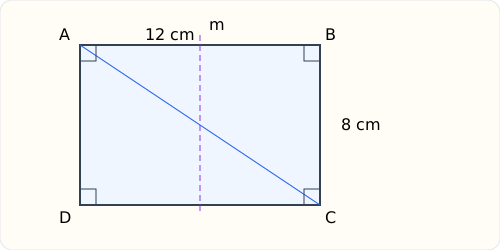
The plan identifies four vertices and four finite side segments. The rectangle has opposite parallel side pairs AB with DC and AD with BC. Adjacent side lines meet at the marked right angles. Its twelve-centimeter and eight-centimeter dimensions make it a nonsquare rectangle. The vertical dashed midline reflects the boundary onto itself.
The diagonal AC divides the rectangle into two right triangles because each includes a marked right corner of the rectangle. The diagonal is not a symmetry line of this nonsquare rectangle: reflecting across it does not match the two off-line corners. Equal triangle areas do not establish a reflection match. Read all these conclusions as properties of the specified geometric plan, rather than assuming they hold for every four-sided drawing that looks similar.
A quadrilateral with four right angles is a rectangle. If all four side lengths also agree, it is a square. The plan's adjacent lengths twelve and eight do not agree, so its rectangle is not a square. It still belongs to the parallelogram category because opposite sides form two parallel pairs. Several true names can apply at once.
For a triangle, a marked right angle is sufficient to establish a right triangle. If instead two measured angles are thirty-five and fifty-five degrees, their sum is ninety and the third angle is ninety by the triangle's 180-degree total. That also establishes a right triangle. In each case, state the decisive evidence. Do not claim all sides are equal or that a triangle has a symmetry line unless additional side or angle relationships support that conclusion.
The plain nonsquare rectangle has two symmetry lines through opposite-side midpoints. Adding a diagonal as a visible decoration can remove a boundary symmetry because the diagonal also has to map onto itself. If a task asks only about the boundary, ignore decorations that are explicitly excluded. If it asks about the complete drawing, include them.
The dashed midline in the illustrated plan marks a candidate fold of the boundary; it is not a claim that every ink mark on the diagram, including labels, is itself symmetric. This distinction keeps instructional annotations from confusing the geometric object. A review should name what is being tested. Equal distances across a proposed line support reflected point pairs, while a single unmatched point can disprove the line's symmetry claim.
To draw perpendicular segments, mark a vertex and draw a first ray. Center a protractor at the vertex, align zero with the first ray and mark ninety degrees. Draw the second ray through that mark. If the task requests finite segments, choose and mark their endpoints at the required lengths. The angular relationship does not depend on those chosen lengths.
To draw an acute angle of forty degrees, use the same alignment process but mark forty instead. Check that the resulting opening is less than a right angle. Extending either ray leaves its measure unchanged. A drawing task requires an actual construction and inspection; selecting a statement that says 'perpendicular' does not demonstrate that you can position the tool or draw the intended angle accurately.
Suppose a plan states that two walkway edges are parallel, a crossing edge meets them at ninety degrees, and a four-sided platform has unequal adjacent lengths with four right angles. The supported conclusions are parallel walkway edges, perpendicular crossings and a nonsquare rectangular platform. A claim that the platform must be a square conflicts with the unequal lengths.
A reviewer should identify the observation supporting each conclusion and the boundary of the inference. The plan may establish angular layout without providing material thickness, construction tolerance or safety information. Geometric classification does not certify those other properties. In a passage-selection task, mark the supplied statements that correctly link evidence to a conclusion and leave unsupported extensions unmarked. This is analysis of a provided record, distinct from constructing and explaining your own design.
Create an original measured floor plan on grid paper. Choose a rectangular outer boundary with whole-number side lengths between twelve and thirty centimeters on your drawing, and label the drawing units clearly. Your design is a model; if you introduce a real-floor scale, state it and distinguish drawing measurements from full-sized measurements. Calculate the model's perimeter and area, showing a multi-digit multiplication strategy rather than only a final number.
Add a border made from repeated equal fractional lengths, using halves, fourths or eighths of a centimeter. State how many pieces are needed and calculate their total length with a fraction-times-whole-number equation. Include a sum or difference of like fractional units to check a remaining length. Draw one required right angle split into two labeled positive parts, with one part of your choice between twenty and seventy degrees. Calculate the other part and verify their ninety-degree total.
Label a parallel pair, a perpendicular pair, a finite segment and the vertex of your split angle. Add a triangular feature and justify its angle category using measurements or a stated triangle-sum calculation. Mark a proposed symmetry line for one clearly identified feature, then either show that corresponding points match or provide a counterexample explaining why that proposed line fails. Do not assume the whole floor plan is symmetric merely because its outer rectangle is.
Record at least six fractional measurements from features in your design and construct a line plot with an explicit unit and one mark per observation. Use the plotted data to find a total or longest-minus-shortest difference, retaining repeated observations correctly. Convert one measured quantity into a smaller compatible unit. These records connect arithmetic, fractions, measurement and geometric constraints in one independently produced artifact.
Ask a reviewer to inspect your actual drawing, calculation record and explanation; automated quizzes do not assess this project. For each criterion, the reviewer records secure, needs revision or missing, and points to specific evidence. Arithmetic is secure when the multi-digit product, perimeter and inverse or estimate checks are correct with suitable units. Fraction reasoning is secure when the repeated lengths and like-unit operation preserve the reference whole and account for every piece.
Geometry is secure when the measured drawing satisfies its stated angle constraints, line relationships, classification and symmetry claim. Data communication is secure when the line plot represents every recorded measurement on an equal-interval scale and the summary calculation uses the observations correctly. Explanation and transfer are secure when assumptions and model limits are stated and the design is revised after one changed condition, such as a longer border or a different split-angle requirement. Revise every criterion marked needs revision or missing, and keep the reviewer's specific comments alongside your corrected work.
A small diagram represents two straight streets as parallel lines and a connecting street as perpendicular to both. Those marks describe the geometry of the idealized plan. They do not prove that actual roads continue forever, are perfectly straight or meet at exactly ninety degrees in the physical town. A finite road section is more naturally modeled by a segment when its endpoints matter. The line model is useful for studying directions and crossings. State which features of reality the drawing represents and which it leaves out. If another road crosses at sixty degrees, it is intersecting but not perpendicular, even if its drawn segment is short or its crossing lies near the edge of the page.
A proposed floor motif uses a twelve-by-eight rectangle divided by a diagonal. The boundary is a rectangle and a parallelogram, and each triangular half includes a right corner. The two triangles have equal area, but the diagonal is not a reflection line of the nonsquare boundary. A reviewer who accepts 'equal halves' as sufficient symmetry evidence would miss the unmatched corners. Ask for the exact fold or reflected-point test. At the same time, check the material arithmetic separately: ninety-six square units describes surface coverage and forty length units describes the full border. A correct shape name does not certify those quantities, and a correct calculation does not certify the drawing's angular accuracy. Each claim needs its own relevant evidence.
Perpendicular lines are also intersecting. Segments that do not touch can have supporting lines that intersect. A square is a rectangle, so specify nonsquare when claiming exactly two boundary symmetry lines. Drawing size and arm length do not determine an angle's degree measure.
Locate the marked endpoint.
A is a fixed starting point
A ray has exactly one endpoint.
Follow the straight path through another point.
The path passes through B
B identifies its direction.
Read the continuation mark.
An arrow extends beyond B
The path continues indefinitely in that direction.
Name the object in order.
Ray AB
The endpoint is named first.
Contrast a segment.
Segment AB would stop at B
A second endpoint would change the geometric object.
Identify the common intersection.
Two straight lines meet at O
They are an intersecting pair.
Read the given opening.
One angle is 60 degrees
This is not a right angle.
Find the adjacent straight-turn part.
180 - 60 = 120 degrees
Adjacent openings fill a half turn.
Apply the perpendicular definition.
The crossing is not perpendicular
Perpendicular lines require ninety-degree openings.
State the supported category.
Intersecting, nonperpendicular lines
The angle evidence justifies the distinction.
Read the decisive shape data.
Four right angles; adjacent sides 12 cm and 8 cm
The labels describe exact intended properties.
Classify the quadrilateral.
Rectangle and parallelogram, but not square
Unequal adjacent lengths rule out a square.
Calculate its surface and boundary.
Area 12 × 8 = 96 square cm; perimeter 2 × (12 + 8) = 40 cm
The same dimensions support different measured quantities.
Classify a diagonal triangle.
Triangle ABC is right at B
The rectangle supplies a marked right corner.
Test the boundary's proposed midline.
The vertical midpoint line is a symmetry line
Corresponding opposite corners and edges match.
Reject an unsupported diagonal-fold claim.
AC is not a symmetry line of this nonsquare rectangle
Equal-area triangles do not guarantee mirror alignment.
Identify the required outer relationship.
Perpendicular outer rays
The whole opening is ninety degrees.
Record one measured part.
37 degrees
The inner ray partitions the opening without overlap.
Calculate the other part.
90 - 37 = 53 degrees
The unknown completes the required quarter turn.
Check the numerical constraint.
Inspect the actual drawing.
Construct an endpoint record for a line, a ray and a segment. Do not count arrowheads as endpoints.
Line endpoints l; ray endpoints r; segment endpoints s
Audio transcript: None
Two adjacent openings at intersecting lines form a straight angle. One measures 38 degrees.
Name the complete outer turn.
A straight angle has 180 degrees.
The outer rays are opposite directions on one line.
Find the adjacent opening.
It measures b degrees.
Subtract the known part from the straight turn.
Check the pair's relationship.
The two measures must add to 180 degrees.
They cover the whole without overlap.
Which picture shows a perpendicular pair of lines?
Audio transcript: None
Two perpendicular lines meet at O. A new ray inside one of their right-angle openings splits that opening into 31 degrees and an unknown part. Construct the angle record: the missing part and the number of original right-angle openings left unsplit.
Missing part b degrees; unsplit right-angle openings r
Construct an endpoint record for a line, a ray and a segment. Do not count arrowheads as endpoints.
Line endpoints l; ray endpoints r; segment endpoints s
Audio transcript: None
Two straight support lines intersect in a new frame plan. One opening measures 36 degrees, and its adjacent opening completes a straight angle. Find that adjacent measure in degrees; use it to check whether the pair could be perpendicular.
Answer:
Audit this new plaza plan. AB and CD are stated parallel; a crossing segment meets AB at 90 degrees. A separate platform is a 15 cm by 9 cm rectangle with all four right angles marked. Its diagonal divides it into two triangles. Select exactly the record passages supported by these data, including the stated limit.
This task has no paper form; do it on a device.
Audio transcript: None
Lesson test: one question per skill, one attempt each, no hints. Your answers are checked when you submit.
Two straight support lines intersect in a new frame plan. One opening measures 78 degrees, and its adjacent opening completes a straight angle. Find that adjacent measure in degrees; use it to check whether the pair could be perpendicular.
Answer:
Explain why perpendicular lines are also intersecting. Then name the evidence needed to distinguish a nonsquare rectangle from a square and an equal-area diagonal cut from a symmetry line.
22. Recover a right-angle part from a design, step 4
37 + 53 = 90
The two measures cover the stated whole.
22. Recover a right-angle part from a design, step 5
Center the protractor and read from the correct baseline
The numerical plan and physical construction both need checking.