Back to the on-screen lesson ·
Folds that land a shape exactly on itself, and counting them.
Paper packet. Every task here also exists on screen, where it is checked automatically; answers written on paper are not assessed by Nydus. When you are back at a device, enter your answers there.
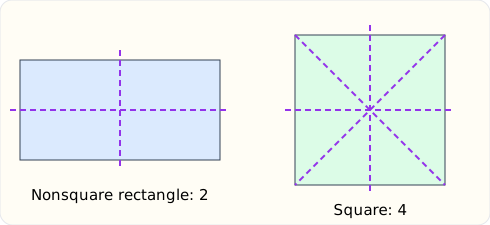
In this lesson you find the lines a shape can be folded along so that the two halves land on each other exactly. Counting them is a good test of whether you know a shape's properties: a nonsquare rectangle has two lines, while a square has four. Explain each successful fold and identify a failed matching point when a proposed line does not work.
You can identify rectangles, squares and triangles from their properties. You know that moving or turning a rigid shape preserves its lengths and angles. Line symmetry asks a different question: can a reflection across one line place the entire figure exactly onto itself? A paper fold provides a concrete test. Imagine folding one side over the line and checking whether every boundary edge, corner and included mark lands on a matching part.
| Term | What it means |
|---|---|
| Line of symmetry | A line across a figure that reflects the entire figure exactly onto itself. |
| Reflection | A mirror transformation across a line. |
| Corresponding points | Points that match under the reflection. |
| Midline | A line through the middle of a figure in a specified direction. |
| Diagonal | A segment joining nonadjacent vertices of a polygon. |
| Counterexample | One failed match that disproves a proposed symmetry line. |
A line of symmetry divides a figure so that folding along the line brings the two sides into exact agreement. Equal area alone is not enough. Two regions can contain the same amount of surface while having different boundary shapes or positions. The fold must pair corresponding points across the line, not merely divide a total count into halves.
A nonsquare rectangle has two lines of symmetry: the line through the midpoints of its longer sides and the line through the midpoints of its shorter sides. A square has these two plus both diagonals, for four altogether. This distinction matters because a square is a rectangle too. Saying 'every rectangle has exactly two' would exclude squares incorrectly. State nonsquare rectangle when the exact count is two.
Another way: steps
Propose a fold line, test matching points and boundaries, reject any failed match, and search systematically for all lines that work.
The left rectangle is wider than it is tall. Folding along its vertical midline maps the left edge onto the right edge and matches the top and bottom half-edges in pairs. Folding along its horizontal midline similarly matches the upper and lower parts. Each proposed line passes through the middle, but passing through the middle is only the beginning of the test.
The square on the right also matches along both diagonals. Across a diagonal, one side of the square folds onto an adjacent side of equal length. The nonsquare rectangle does not have that equality between adjacent sides. Its diagonal divides it into two triangles with equal area, but those triangles do not lie as mirror images across that diagonal. This example separates equal-area division from reflection symmetry.
Trace a nonsquare rectangle onto paper and cut it out carefully. Fold it so the two shorter edges coincide. The crease halfway between them is one symmetry line. Open the paper and fold so the two longer edges coincide to find the other. Check the whole boundary, including all corners, rather than accepting the fold because one pair of edges overlaps.
Then try folding along a diagonal from one corner to the opposite corner. The corners on the crease remain fixed, but the other two corners do not coincide. One boundary extends beyond the other. That failed match is enough to reject the diagonal as a symmetry line. A physical cutout may have small cutting errors, so distinguish the ideal geometric rectangle from imperfections in the paper. The intended exact shape determines the mathematical result.
Corresponding points in a reflection lie on opposite sides of the mirror line at equal perpendicular distances from it. For a vertical mirror line on square grid paper, count horizontal grid spaces from the line to the point, then place its partner the same number of spaces on the other side at the same height. A point three spaces left corresponds to one three spaces right.
Points lying on the mirror line stay in place. They do not need another point on the opposite side. This rule helps complete a partly drawn symmetric figure without guessing its outline. Reflect several vertices, connect the corresponding edges in order and then check the whole shape. Equal distances are measured straight across the line, not diagonally along an arbitrary route. The direction of the distance is part of the reflection rule.
Suppose a design has a vertical symmetry line. On its left, one vertex is two squares from the line and another is four squares from the line, with the second vertex three rows higher. Draw their partners two and four squares to the right at the same respective heights. Connect the new points according to the original edge connections.
Do not simply copy the left-hand piece to the right without reversing it. Sliding a shape preserves its orientation; reflecting reverses its left-right relationship with the mirror line. A sloping edge may therefore tilt in the opposite direction after reflection. Check each paired vertex's distance and row. If the completed outline has a point that cannot find a reflected partner, either the proposed line is not a symmetry line or the construction contains an error.
A square has two midlines joining the midpoints of opposite sides and two diagonals joining opposite vertices. Each maps the four corners and every edge onto the square. Together they give four distinct symmetry lines. Turning the square on the page turns these lines with it; a diagonal-looking fold in one orientation may look vertical in another.
Do not count each direction along the same line separately. A line extending upward and downward through the center is one line, not two. Also do not count a line that passes through the center at an arbitrary angle. Most such lines fail to send the corners to other corners. Testing the image of a single corner can reject a candidate quickly. A successful line must then match the entire boundary, not only that one corner.
An equilateral triangle has three equal sides and three equal angles. A line from each vertex to the midpoint of the opposite side reflects the triangle onto itself, so there are three symmetry lines. An isosceles triangle with exactly two equal sides has one line, through the shared vertex of those sides and the midpoint of the base.
A scalene triangle, with all sides different, has no line of symmetry. A proposed reflection would have to pair two sides of equal length while fixing a vertex or an edge relationship, but those equal sides are absent. The word triangle by itself does not determine a symmetry count. State the side conditions. Likewise, a right triangle can have one symmetry line if its two legs are equal, but a right triangle with unequal legs has none.
A slanted parallelogram can match itself after a half turn around its center even when it has no line of reflection symmetry. Rotating the paper by one hundred eighty degrees is not the same action as folding it over a line. The transformation being tested matters. A shape may have rotational symmetry without any line symmetry.
For a typical parallelogram that is neither a rectangle nor a rhombus, horizontal, vertical and diagonal fold tests fail. Opposite corners may swap under a half turn, but a reflection would need different paired relationships. This example explains why visual balance alone is not enough. When the question asks for lines of symmetry, test reflections explicitly. Do not count a successful rotation as evidence for an untested fold.
A plain square boundary has four symmetry lines. Add one small dot near a corner and the decorated figure may have fewer, because the dot also needs a reflected partner. If a question asks about the whole design, include its colors, markings and holes. If it asks only about the outer boundary, interior decoration may be irrelevant. Read the stated object of the symmetry test.
Letters provide another caution. A carefully drawn block capital letter may have a symmetry line in one font and not in another. A generic claim about every printed version of a letter is too broad. Use the exact drawing supplied and check its parts. The same principle applies to real leaves, faces and buildings: approximate resemblance is different from the exact matching used in these geometric tasks.
To reject a proposed symmetry line, you do not need to show every part failing. One point without a matching reflected point is enough. On a nonsquare rectangle's diagonal, the two off-line corners fail to pair, so the line cannot be a symmetry line. On a decorated square, a single unmatched dot can invalidate an otherwise successful boundary fold.
To establish symmetry, however, one matching pair is not enough. You must account for the whole figure. This difference between proving and disproving is useful: one counterexample defeats an 'every point matches' claim, while one successful example does not establish it. In a polygon, checking how the reflection maps all vertices and their connected edges can provide a systematic whole-boundary argument. Explain both the candidate line and the decisive evidence.
Draw a vertical mirror line on grid paper and create a polygon on one side. Reflect each vertex using equal perpendicular distances, then connect the partners in matching order. The completed boundary has the chosen line of symmetry by construction, provided every segment is reflected. Add any decorative marks in reflected pairs as well.
Now inspect whether the design has additional symmetry lines. Constructing one line does not prove it is the only one. A symmetric rectangle might accidentally create a horizontal line too, while a less regular mirrored outline may have only the intended vertical line. State the claim you can support: 'this line works' is weaker than 'exactly one line works.' A complete count requires a systematic search or a property-based argument excluding other possibilities.
A class wants a paper decoration with a vertical line of symmetry. Fold a sheet along a straight crease and draw half of a boundary on one side, making sure the intended shape meets the crease where the halves should join. Cutting both folded layers together and opening the paper can create matching halves. Inspect the actual result: rough cuts or an accidental hole may break exact agreement. If colored marks are later added, place them in reflected pairs or on the crease itself when they should remain fixed. The boundary's symmetry does not automatically guarantee symmetry of the decorated object. A useful review names whether the claim concerns the outline alone or every visible part of the finished design.
A floor drawing uses a square tile outline with one dot on its vertical midline above the center. The plain outline has four symmetry lines, but the complete motif has only the vertical line. A horizontal reflection would move the dot below the center, where no partner exists, and either diagonal would move it to an unmarked side position. This matters if neighboring motifs must mirror each other: matching the square edges is not enough to match the decoration. A reviewer can test the whole design by tracing the boundary and dot together. The example illustrates how a small added feature changes the evidence needed for a symmetry claim while leaving the underlying shape classification unchanged.
A fold must match corresponding points and the entire relevant figure, not merely equal areas. A square has four symmetry lines; a nonsquare rectangle has two. A half-turn match does not establish a line of symmetry. Include decorations when the claim concerns the complete design.
Identify the exact figure.
An 8 cm by 4 cm rectangle
Unequal adjacent sides rule out a square.
Test the vertical midline.
Left and right boundaries coincide under folding
Corresponding corners are equally far from the line.
Test the horizontal midline.
Top and bottom boundaries coincide
The paired edges have equal lengths.
Test a diagonal candidate.
The two off-line corners fail to coincide
Unequal adjacent side lengths prevent the needed match.
State the complete count.
2 lines of symmetry
Only the two midpoint lines preserve the whole boundary.
Identify the mirror line.
A vertical grid line
Distances are measured horizontally across it.
Locate the first original vertex.
2 squares left, row 1
Its reflected point must keep the same row.
Place its reflected partner.
2 squares right, row 1
Equal perpendicular distances pair the points.
Reflect the second vertex.
4 squares left on row 4 becomes 4 right on row 4
Apply the same rule independently.
Join and check the reflected edge.
Connect the two new vertices
The new segment mirrors the original connection.
Identify the object being tested.
The square boundary and one dot on its vertical midline above the center
The dot is part of the design.
Recall the boundary's candidates.
Two midlines and two diagonals
A decoration cannot add a symmetry the boundary lacks.
Test the vertical midline.
The dot lies on the line and stays fixed
The boundary also maps onto itself.
Test the horizontal midline.
The dot would need a partner below the center
No such dot is present.
Test both diagonals.
The dot would reflect to an unmarked side position
Neither diagonal preserves the complete design.
State the supported count.
Exactly 1 line of symmetry
All boundary candidates have been checked with the decoration included.
Identify the original location.
3 squares left of the line, on row 2
The line is the reflection axis.
Keep the same height.
The partner stays on row 2
Reflection across a vertical line preserves vertical position.
Match the perpendicular distance.
3 squares to the right
The distances on opposite sides must be equal.
Find the separation of the pair.
Check the reflection reverses itself.
How many lines of symmetry does a scalene triangle have? Consider the plain boundary without decoration.
Answer:
A point is 7 squares left of a vertical mirror line. Find the separation between it and its reflected partner.
Locate the reflected partner.
Place it 7 squares right at the same height.
Reflection preserves perpendicular distance from the line.
Combine the two equal distances.
The pair is s squares apart.
The line lies halfway between corresponding points.
Check the midpoint relationship.
Half the separation equals the original distance.
Both points must be equally far from the mirror line.
For a 12 cm by 6 cm rectangle, which proposed fold is NOT a line of symmetry?
How many lines of symmetry does a square have? Consider the plain boundary without decoration.
Answer:
For a 11 cm by 4 cm rectangle, which proposed fold is NOT a line of symmetry?
How many lines of symmetry does a scalene triangle have? Consider the plain boundary without decoration.
Answer:
A design uses a plain square and a nonsquare rectangle. Record each symmetry count. Then complete a reflected point for a vertical mirror line: a point 4 grid squares left must have its partner how many squares right?
Square lines s; nonsquare rectangle lines r; partner distance d squares
Lesson test: one question per skill, one attempt each, no hints. Your answers are checked when you submit.
How many lines of symmetry does a scalene triangle have? Consider the plain boundary without decoration.
Answer:
You can find and count the lines of symmetry of a shape. Without looking: how many does a nonsquare rectangle have, and why do its diagonals fail?
21. Reflect a point across a vertical line, step 4
3 + 3 = 6 squares
The mirror line lies halfway between them.
21. Reflect a point across a vertical line, step 5
Reflecting the partner returns to the original point
The paired locations satisfy the same rule in both directions.