Back to the on-screen lesson ·
Naming angles by size, and finding the one left over when two make a known turn.
Paper packet. Every task here also exists on screen, where it is checked automatically; answers written on paper are not assessed by Nydus. When you are back at a device, enter your answers there.
In this lesson you measure angles in degrees and name them: acute, right, obtuse, straight. Then you use the fact that angles on a straight line make 180 degrees, and a full turn 360, to find an angle you cannot measure — the one left over. An angle is a measure of turn, not of how long the arms are drawn, which is the thing to hold on to.
You can identify corners and recognize a square corner as a right angle. An angle consists of two rays with a shared endpoint, called the vertex. To compare openings, align their vertices and one ray, then look at how far the other ray turns. Extending a ray makes its drawn arm longer but does not change the angle. Measurement assigns a number to the turn, using a fixed angular unit.
| Term | What it means |
|---|---|
| Vertex | The common endpoint of the rays forming an angle. |
| Degree | An angular unit equal to one three-hundred-sixtieth of a full turn. |
| Protractor | A tool with a degree scale for measuring and drawing angles. |
| Acute angle | An angle greater than zero and less than ninety degrees. |
| Obtuse angle | An angle greater than ninety and less than one hundred eighty degrees. |
| Adjacent angles | Angles sharing a vertex and a side, with interiors that do not overlap. |
Imagine a circle centered at the vertex of an angle. A full turn around that center contains 360 equal one-degree turns. A half turn is 180 degrees, and a quarter turn is 90 degrees. The angle between two rays is measured by the number of those equal degree turns from one ray to the other along the indicated opening.
The radius of the imagined circle does not change the degree measure. A larger circle has a longer arc between the rays, but the arc is the same fraction of that circle's full circumference. That is why angle size is independent of arm length. A protractor places a degree scale around a center so you can compare the opening with these standard units. Correct alignment is essential: the center belongs on the vertex and zero belongs on the starting ray.
Another way: steps
Estimate the angle category, align center and baseline, read from the correct zero, and check that the measured value agrees with the visible turn.
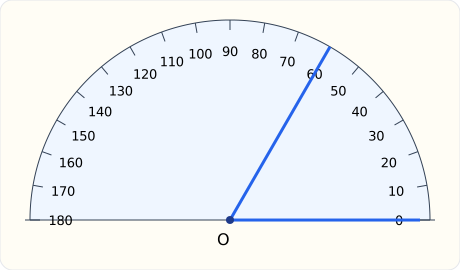
The blue horizontal ray begins at O and points right. The degree scale starts at zero on that right-hand baseline and increases upward and around to the left. The second blue ray crosses sixty on this scale, so the smaller opening measures sixty degrees. It is acute, matching its appearance as less than a quarter turn.
Many classroom protractors show two scales, one starting at each end of the baseline. On such a tool, the same tick can be labeled sixty on one scale and one hundred twenty on the other. Choose the scale whose zero lies on your starting ray. If you measured this acute opening as one hundred twenty degrees, the category check would expose the wrong-scale reading. The diagram uses a single scale to make the starting direction clear.
Place the protractor's center mark exactly over the angle's vertex. A small shift can make the ray intersect the wrong scale mark, especially for a short drawn arm. Rotate the tool until its zero baseline lies along one ray. Keep the center on the vertex while rotating. Then read where the other ray crosses the scale, following numbers from the chosen zero.
If a ray is too short to reach the scale, extend it with a ruler along the same straight direction. Extending preserves the angle because it does not rotate the ray. Do not move the protractor's center out toward the short arm to make it reach. The center controls which turn you are measuring. Record the degree symbol or the word degrees so the result cannot be mistaken for a length.
A right angle measures ninety degrees, the same as one quarter of a full turn. A straight angle measures one hundred eighty degrees, a half turn. An acute angle is strictly between zero and ninety; an obtuse angle is strictly between ninety and one hundred eighty. Exactly ninety belongs to the right-angle category rather than either neighboring category.
These benchmarks help estimate before measuring. An opening slightly smaller than a square corner might be eighty degrees, while one slightly larger might be one hundred degrees. Estimation narrows the plausible range, but it does not give an exact measurement by itself. A rough drawing of sixty degrees may look close to fifty-eight. Use the protractor for measurement, and use explicit labels or stated conditions when a diagram is not drawn to scale.
To draw a seventy-degree angle, first mark a vertex and draw one ray with a ruler. Place the protractor's center at the vertex and align zero with the ray. Locate seventy on the scale beginning at that zero and mark a small point beside it. Remove the tool and draw a second ray from the vertex through the marked point.
Check the result by placing the protractor back on the drawing. It should read seventy degrees and look acute. The marked point determines a direction, so the second ray can be longer or shorter without changing its opening. Label the vertex and the measured angle. When practicing on paper, draw the same degree measure in a different orientation; the opening should remain equal even though neither ray lies horizontally on the page.
Suppose a ray inside an angle divides it into adjacent parts measuring twenty-eight degrees and thirty-seven degrees. The parts share the interior ray and do not overlap. Together they cover the original opening, so the whole angle measures 28 + 37 = 65 degrees. This is an additive measurement relationship, just as two adjacent lengths can combine to make a longer segment.
The conditions matter. Two angles located in different places do not necessarily describe one visible opening, and overlapping angles cannot simply be added without double-counting their shared turn. Before adding, identify the starting ray, the shared ray and the ending ray in order. State that the parts together cover the intended whole. A diagram or clear description supplies that structural evidence; the numbers alone do not.
A right-angle opening is split into two adjacent angles. One measures thirty-four degrees. Let x be the other angle's measure. The relationship is 34 + x = 90 because both parts together fill one quarter turn. Subtraction gives x = 56 degrees. Check that thirty-four plus fifty-six equals ninety.
The missing angle is acute, which is sensible because it is a positive part smaller than the whole right angle. Do not subtract from one hundred eighty merely because the diagram contains straight ray segments. The relevant whole is the marked right-angle opening. Identify the total turn from the outer starting ray to the outer ending ray before choosing the number to subtract from.
Two opposite rays form a straight angle of one hundred eighty degrees. A third ray between them divides that half turn into adjacent parts. If one part measures fifty-five degrees, the other measures 180 - 55 = 125 degrees. The larger part is obtuse, and the two measures add to one hundred eighty.
A straight-angle relation requires the outer rays to be opposite directions along the same line. A drawing that merely looks almost straight is not sufficient evidence for an exact total unless the problem states or marks that relationship. Use given geometric conditions for exact calculations. If you physically measure a hand-drawn picture, acknowledge that small drawing and reading differences may occur; that is a measurement activity rather than an exact inference from labeled constraints.
A set of adjacent, non-overlapping angles around one point can cover a full turn. Their total measure is 360 degrees. If three known parts measure ninety, one hundred twenty and eighty degrees, they total 290 degrees. The remaining part is seventy degrees. Verify 90 + 120 + 80 + 70 = 360.
Track whether the parts cover the entire turn exactly once. If there is an unmarked gap, that gap is another unknown part. If a ray passes through a previously counted region, you may be counting overlapping turns. For the tasks here, diagrams and descriptions specify complete partitions. The subtraction method depends on that information. A full turn can be divided into many parts; it is the combined coverage, not the number of pieces, that determines the total.
Two doors of different widths can open through the same sixty-degree turn. The outer edge of the wider door travels a longer distance, but the angle between its closed and open positions is the same. On a drawing, making both rays twice as long does not double the angle. Moving one ray farther around the vertex does change it.
This distinction is useful when comparing diagrams printed at different sizes. Match vertices and directions or measure each opening with a protractor. Do not compare only the gap between the ray endpoints, because that gap also depends on arm length. A degree measure describes a fraction of a turn. A centimeter measure describes a length. Both may be relevant to an object, but one cannot substitute for the other.
A learner reads a small acute angle as one hundred thirty degrees on a dual-scale protractor. The visible opening is less than a right angle, so that reading is inconsistent with the category estimate. Check which scale has zero on the starting ray. The other scale gives fifty degrees. Re-align the center and baseline, then read again to confirm.
This repair uses the estimate as an error signal rather than assuming the estimate is exact. If the tool were misaligned, choosing fifty solely because it is acute would not finish the measurement. A complete explanation reports the alignment, correct starting zero and measured tick. For a labeled diagram, instead report the given measures and the additive relationship used. Distinguish what you measured from what you inferred so another person can reproduce the result.
A cardboard model has a hinged flap that should open through sixty degrees from its closed position. Mark the hinge point as the vertex and use the closed edge direction as the starting ray. Center the protractor at the hinge, align zero with that ray and mark sixty on the appropriate scale. Draw the target open direction through the mark. A longer flap would have an outer edge farther from the hinge but would still use the same angular opening. The paper diagram specifies a turn, not a guarantee that a physical hinge will stop there. Test the actual model separately if the stopping position matters. The measurement plan should identify the vertex, baseline and direction so another person can reproduce it.
A measured floor design requires a right-angle corner to be split by a decorative line. The first part is thirty-four degrees, leaving fifty-six degrees for the other part. Label the outer rays as perpendicular and write the equation 34 + 56 = 90 beside the drawing. A reviewer can check the numerical relationship and use a protractor to inspect the drawn angles. If the line is only sketched roughly, the labels express the intended design while the physical drawing may need adjustment. Do not claim a precise angle from appearance alone. This task connects angle addition to a construction constraint: both parts must be positive, must not overlap, and must together fill the specified quarter-turn corner.
Longer rays do not create a larger angle. Use the protractor scale whose zero matches the starting ray. Subtract from ninety, one hundred eighty or three hundred sixty only when the stated outer rays and partition justify that total.
Estimate the opening's category.
Less than a right angle
The result should be below ninety degrees.
Place the center on the vertex.
Protractor center at O
The scale must measure a turn about the correct point.
Choose the starting zero.
Zero on the right-pointing ray
The scale must begin at the ray used as the baseline.
Read the second ray's mark.
60 degrees
The blue ray crosses the sixty-degree tick.
Check the category.
0 < 60 < 90: acute
The reading agrees with the initial estimate.
Identify the outer rays.
Opposite rays on one line
They form a straight angle.
Name the total measure.
180 degrees
A straight angle is half a full turn.
Write the part-whole equation.
55 + x = 180
The two adjacent parts cover the whole opening.
Find the missing measure.
x = 180 - 55 = 125 degrees
Subtracting the known part leaves the other.
Check and classify.
55 + 125 = 180; 125 is obtuse
The arithmetic and the expected larger opening agree.
Name the required overall turn.
90 degrees
The design requires perpendicular outer rays.
Record the first part.
34 degrees
A ray inside the corner creates a known opening.
Construct the missing-part equation.
34 + x = 90
The non-overlapping parts fill the right angle.
Calculate the second part.
x = 56 degrees
The missing measure is the remainder of the quarter turn.
Sketch and measure the design.
Draw 34 degrees, then another 56 degrees in the same turning direction
The final ray should be perpendicular to the first.
Check both the sum and drawing.
34 + 56 = 90
The exact constraint and protractor check support the construction.
Identify the complete partition.
Four adjacent angles cover one full turn
Their interiors do not overlap.
Name the whole turn.
360 degrees
A complete rotation has this measure.
Add the three known parts.
90 + 120 + 80 = 290 degrees
These cover all but the unknown opening.
Subtract from the whole.
Verify the completed turn.
Two adjacent angles fill a straight angle exactly, without overlap. One measures 36 degrees. What is the other measure in degrees?
Answer:
An angle of 90 degrees is split into adjacent parts of 29 degrees and an unknown measure.
Identify the whole and known part.
Whole 90 degrees; known 29 degrees.
The parts cover the whole without overlap.
Subtract the known measure.
The unknown measure is b degrees.
Angle measure is additive for this partition.
Check the completed relationship.
Add the two parts to recover 90 degrees.
The answer must satisfy the given total.
An angle measures 90 degrees. What kind of angle is it?
Two adjacent angles fill a straight angle exactly, without overlap. One measures 73 degrees. What is the other measure in degrees?
Answer:
An angle measures 60 degrees. What kind of angle is it?
Two adjacent angles fill a straight angle exactly, without overlap. One measures 149 degrees. What is the other measure in degrees?
Answer:
A model's right-angle corner is split into adjacent parts. One part measures 53 degrees. Construct the missing measure and verify their total.
Missing part m degrees; total t degrees
Lesson test: one question per skill, one attempt each, no hints. Your answers are checked when you submit.
Two adjacent angles fill a straight angle exactly, without overlap. One measures 95 degrees. What is the other measure in degrees?
Answer:
You can name an angle by its size and find a missing one. Without looking: two angles make a straight line and one is 55 degrees — what is the other?
21. Complete a turn around a point, step 4
360 - 290 = 70 degrees
The difference is the remaining part.
21. Complete a turn around a point, step 5
90 + 120 + 80 + 70 = 360
All four parts account for the full rotation.