Back to the on-screen lesson ·
The same amount written two ways, and moving between them.
Paper packet. Every task here also exists on screen, where it is checked automatically; answers written on paper are not assessed by Nydus. When you are back at a device, enter your answers there.
In this lesson you move between a mixed number such as 2 3/4 and an improper fraction such as 11/4, in both directions. They are the same amount written differently, and each is easier for a different job: a mixed number tells you at a glance roughly how big it is, and an improper fraction is far easier to calculate with.
You can count equal fractional parts and recognize that four fourths, five fifths or eight eighths each make one whole. Fractions do not stop at one. Keep counting quarter-length intervals after reaching four quarters: five quarters, six quarters and so on. The unit piece remains one quarter of the same whole even when the total includes several wholes. A mixed number provides another way to record that same total.
| Term | What it means |
|---|---|
| Unit fraction | One equal part of a whole, such as one fourth. |
| Improper fraction | A fraction whose numerator is at least its denominator, so its value is at least one. |
| Mixed number | A whole-number part together with a proper fractional part. |
| Proper fraction | A positive fraction less than one, with numerator smaller than denominator. |
| Regroup | Collect fractional pieces into wholes or exchange a whole for fractional pieces. |
| Equivalent | Equal in value even when written differently. |
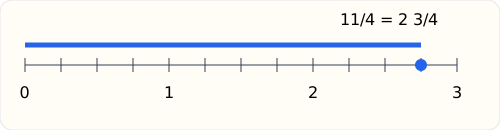
Eleven quarters can be counted as eleven pieces of size one fourth. They can also be collected into two complete groups of four quarters, with three quarters remaining. Therefore 11/4 = 2 3/4. Neither representation changes the amount. The improper fraction emphasizes the total count of equal pieces, while the mixed number makes the number of complete wholes easy to see.
The space in a mixed number means addition: 2 3/4 means 2 + 3/4. It does not mean two times three fourths, which would be six fourths. When changing between representations, keep the denominator because the unit piece has not changed. Multiplication and division help count groups, but the reason for the conversion is the relationship between one whole and its equal fractional pieces.
Another way: steps
Identify the unit fraction, count or group its pieces, preserve the denominator, and check that both names locate the same quantity.
The distance from zero to one is the reference whole. Every interval on the line is one quarter of that distance. The blue length covers eleven such intervals. Four reach one, four more reach two, and three more reach the marked point. The next quarter would reach three, so the point is between two and three and is closer to three.
Count intervals rather than including the starting zero as a piece. The line contains several whole units, all with the same length. If the interval from one to two were longer than the interval from zero to one, counting equal-looking fractional marks would become misleading. A consistent unit makes the names eleven quarters and two and three quarters refer to exactly the same point.
To write 3 2/5 as one fraction, first count the fifths in the three wholes. Each whole contains five fifths, so three wholes contain fifteen fifths. Add the two extra fifths to get seventeen fifths. The result is 17/5. The denominator remains five because every counted piece is still a fifth of the original whole.
The compact calculation is 3 × 5 + 2 = 17 for the numerator. This is not an arbitrary order of operations to memorize. The multiplication counts pieces in complete wholes, and the addition includes the partial whole. A common mistake is to add three and two and write five fifths. That treats three wholes as though they were three fifths, discarding most of the quantity. Labeling the units makes the mistake visible.
To write 17/5 as a mixed number, ask how many complete groups of five fifths fit into seventeen fifths. Three groups use fifteen fifths, leaving two fifths. Therefore 17/5 = 3 2/5. The division statement 17 = 5 × 3 + 2 records the same grouping.
The remainder must be smaller than five; otherwise another whole can be formed. Writing 2 7/5 still describes seventeen fifths, but it has not finished grouping into a conventional mixed number because seven fifths is more than one whole. Exchange five of those seven fifths for another whole, leaving 3 2/5. When the remainder is zero, report a whole number. For example, 20/5 = 4, with no extra fractional part needed.
A fraction with numerator eleven and denominator four must lie between two and three because eight fourths is two and twelve fourths is three. A conversion to 3 1/4 cannot be right because that is greater than three. This bound catches a mistaken quotient or an extra whole without requiring a second full calculation.
You can also convert back. Two wholes contain eight fourths; adding three fourths gives eleven fourths. Both the bound and the reverse conversion support 2 3/4. The reverse conversion is exact, while the bound only restricts the possible interval. An incorrect answer such as 2 1/4 would pass the interval check but fail the exact reconstruction. Use both kinds of evidence with an understanding of their limits.
Twelve eighths equals one and four eighths because eight eighths make one whole and four eighths remain. Four eighths also equals one half, so you may write the same amount as one and one half. The grouping step and the simplifying step answer different questions: how many complete wholes are present, and whether the fractional part has a simpler equivalent name.
If a task asks for eighths, keep 1 4/8. If it asks for a simplest mixed-number form, use 1 1/2. Both are equal quantities. Do not change twelve eighths into twelve fourths merely because the denominator can be divided by two. Equivalent simplification divides both numerator and denominator by the same factor. The unit piece becomes larger while fewer of those pieces are counted, preserving the total.
Consider 1 3/4 + 2 2/4. Add the whole parts to obtain three wholes. Add the quarter parts to obtain five quarters. Five quarters contains one additional whole and one quarter, so the total is 4 1/4. The temporary expression 3 + 5/4 is correct, but it can be regrouped into the conventional mixed-number form.
Another route converts both addends first: 1 3/4 = 7/4 and 2 2/4 = 10/4. Adding gives 17/4, which is 4 1/4. Both methods preserve the same quarter unit. The denominator is not added because the pieces remain quarters. A result of seventeen eighths would change the size of every piece and would not represent the combined amount.
For 3 1/4 - 1 3/4, the quarter part of the starting amount is too small to remove three quarters directly. Exchange one of the three wholes for four quarters. The starting amount becomes 2 5/4, an equivalent working representation. Now subtract one whole and three quarters to obtain one whole and two quarters, or 1 1/2.
You may instead convert to improper fractions: 13/4 - 7/4 = 6/4 = 1 2/4. The two routes agree. The working representation 2 5/4 is useful during subtraction even though its fractional part is greater than one. It is not the final conventional mixed-number form, but it is a valid equality. This is like regrouping a hundred as ten tens in whole-number subtraction: the amount stays the same while its units are reorganized.
A recipe uses 1 3/4 cups of water for one batch and 2 2/4 cups for a larger batch. Their sum is 4 1/4 cups because every fourth is a fourth of the same cup measure. The same arithmetic would not combine fourths of two different container sizes without first expressing both in a common measurement unit.
Likewise, a strip labeled 11/4 meters means eleven quarter-meters, not eleven quarters of whatever roll happens to be on the table. The meter is a fixed reference. A physical description such as 'eleven quarter-pieces' is incomplete unless the whole from which each piece was cut is known. Include units in your equations and final sentence. Conversion changes the number's representation, not the identity or size of its measurement unit.
Suppose three identical lengths each measure 1 1/4 meters. Converting the length to five quarter-meters makes repeated counting straightforward: five quarters plus five quarters plus five quarters gives fifteen quarters. Grouping those quarters gives 3 3/4 meters. The improper-fraction representation made all the pieces the same type before combining them.
A mixed number can be more useful for deciding whether a two-meter shelf is long enough for a single 7/4-meter strip. Seven quarters is 1 3/4 meters, visibly less than two meters. Neither representation is always better. Choose one that exposes the relationship you need, and be able to explain the other. Fluency means moving between equivalent names purposefully, not replacing every fraction automatically with whichever form you learned most recently.
Imagine thirteen half-meter pieces laid end to end without gaps. Pairing the pieces makes six full meters and leaves one half-meter piece. Write 13/2 meters = 6 1/2 meters. State that two half-meters make one meter, so six groups use twelve pieces. This explanation connects the numerator, denominator, quotient and remainder to physical quantities.
Now reverse the reasoning: six and one half meters contains twelve halves in its six whole meters plus one more half, for thirteen halves altogether. Both directions land at the same point on a consistently scaled number line. If someone reports six and one third meters, ask which unit the leftover piece has. The division remainder counts the original half-pieces; it does not choose a new denominator. Keeping the unit named is the best safeguard against that error.
A craft plan needs a strip eleven quarters of a meter long. A measuring tape marked in meters and quarters makes the mixed form convenient: two and three quarters of a meter. Count two complete meter intervals and then three quarter-meter intervals beyond the two-meter mark. The required length remains eleven quarter-meters. If the available strip measures three meters, it is twelve quarter-meters long, so one quarter-meter remains after the cut, assuming the cutting process uses no measurable length. The two representations support different parts of the reasoning: the mixed number helps locate the cut, and the improper fraction makes counting matching pieces straightforward. Neither authorizes changing the meter unit or ignoring extra length required for joining.
A cooking activity measures one and three quarters cups of liquid and then adds two and two quarters cups. Use the same measuring cup for both amounts. The whole cups contribute three, and the fractional cups contribute five quarters. Four of those quarters form another complete cup, leaving one quarter, so the total is four and one quarter cups. A container holding exactly four cups would be too small even though the original whole-number parts add to only three. This example shows why the fractional total must be regrouped before making a capacity decision. The calculation assumes the quantities combine without loss and refers only to measured volume; it does not establish whether changing a real recipe's proportions would produce the intended result.
A mixed number means a whole part plus a fractional part. Count all fractional pieces in the wholes before adding extras. When grouping pieces, the leftover count becomes the numerator of the proper fractional part; its denominator remains the original unit size.
Identify the unit piece.
3 2/5 uses fifths
Five equal fifths make one whole.
Count pieces in complete wholes.
3 × 5 = 15 fifths
Each of the three wholes contributes five.
Include the remaining pieces.
15 + 2 = 17 fifths
The mixed number includes two extra fifths.
Write a single fraction.
17/5
The counted pieces remain fifths.
Check by regrouping.
17 = 5 × 3 + 2
The original three wholes and two fifths are recovered.
Identify the pieces being counted.
11/4 means eleven quarters
The denominator fixes the unit piece.
Find complete groups of four.
4 × 2 = 8
Two wholes use eight quarters.
Find the ungrouped pieces.
11 - 8 = 3 quarters
Fewer than four pieces remain.
Write the mixed number.
2 3/4
The remainder is still measured in quarters.
Check magnitude and reconstruction.
2 < 11/4 < 3; 2 × 4 + 3 = 11
Both the location and exact count agree.
Check that both measurements use the same unit.
1 3/4 meters + 2 2/4 meters
Every fractional piece is a quarter-meter.
Combine the whole lengths.
1 + 2 = 3 meters
The whole-number parts use matching units.
Combine the quarter-length pieces.
3/4 + 2/4 = 5/4 meter
The denominator stays four.
Regroup the fractional total.
5/4 = 1 1/4
Four quarters form an additional meter.
Combine all complete meters.
3 + 1 1/4 = 4 1/4 meters
The exchanged whole joins the original three.
Verify by counting all quarters.
7/4 + 10/4 = 17/4 = 4 1/4
A second representation confirms the total.
Name the piece size.
Sixths
Six such pieces make a whole.
Find complete wholes.
6 × 3 = 18; 6 × 4 = 24
Twenty-three lies between these multiples.
Count the extra sixths.
23 - 18 = 5
The remainder is less than six.
Write the equivalent mixed number.
Reconstruct the improper fraction.
Write 5 2/4 as one fraction with denominator 4.
Numerator n; denominator d
Convert 4 3/4 to an improper fraction.
Count quarters in the whole part.
4 × 4 = 16 quarters.
Each whole contains four quarters.
Add the extra quarter pieces.
There are n quarters in total.
Three additional quarters belong to the mixed number.
Keep the same piece size.
The denominator remains four.
Counting more quarters does not resize them.
Write 34/6 as a mixed number, keeping denominator 6.
Wholes w; remaining numerator n
A length is 52/10 meters. How many complete one-meter lengths fit, before the shorter leftover piece?
Answer:
Write 5 6/10 as one fraction with denominator 10.
Numerator n; denominator d
Write 18/5 as a mixed number, keeping denominator 5.
Wholes w; remaining numerator n
Combine 4 3/6 meters and 4 4/6 meters. Give the total as a mixed number with denominator 6.
Wholes w; numerator n
Lesson test: one question per skill, one attempt each, no hints. Your answers are checked when you submit.
Write 6/4 as a mixed number, keeping denominator 4.
Wholes w; remaining numerator n
You can convert between a mixed number and an improper fraction. Without looking: write 3 2/5 as an improper fraction, and 17/5 as a mixed number.
21. Write twenty-three sixths as a mixed number, step 4
3 5/6
Three wholes and five sixths use all pieces.
21. Write twenty-three sixths as a mixed number, step 5
3 × 6 + 5 = 23
The denominator stays six.