Back to the on-screen lesson ·
Making several copies of a fraction, and why only the top number changes.
Paper packet. Every task here also exists on screen, where it is checked automatically; answers written on paper are not assessed by Nydus. When you are back at a device, enter your answers there.
In this lesson you multiply a fraction by a whole number, which is just making that many copies of it: three lots of 2/5 is 6/5. Only the top number changes, and the reason is worth saying — you are collecting more pieces, but the pieces themselves are still fifths. That is the same reason the bottom number stayed put when you added fractions.
You can add fractions with a shared denominator and regroup an improper fraction into a mixed number. Multiplication by a whole number compresses repeated addition. Before using a rule, say what one copy contains and how many identical copies are being made. For three copies of two fifths, the repeated amount is two fifths and the number of copies is three. These roles explain the result even though multiplication can be written in either order.
| Term | What it means |
|---|---|
| Copy | One occurrence of the same measured amount. |
| Product | The result of multiplication. |
| Unit fraction | One equal part of a whole, with numerator one. |
| Multiple | A quantity formed by a whole-number number of copies. |
| Denominator | The number of equal parts in one reference whole. |
| Improper fraction | A fraction with value at least one, whose numerator is at least its denominator. |
Two fifths is two copies of one fifth. Three copies of two fifths therefore contain three groups of two fifth-pieces, or six fifth-pieces altogether. We write 3 × 2/5 = 6/5. The denominator remains five because the pieces are still fifths of the same whole. Multiplying both numerator and denominator by three would give six fifteenths, which is merely another name for the original two fifths, not three copies of it.
A product can be greater than one even when each repeated amount is less than one. Six fifths contains five fifths, or one whole, plus one more fifth. Thus 6/5 = 1 1/5. A picture, repeated-addition expression, multiplication equation and mixed-number form can all describe this same total. Choose the representation that makes the requested decision clear.
Another way: steps
Name one copy and its unit, count the copies, multiply the number of fractional pieces, preserve their size, and check the total's magnitude.
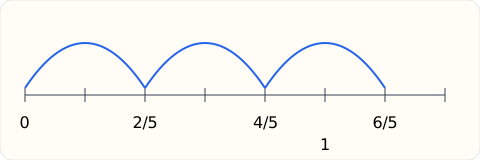
Every small interval on the number line is one fifth of a whole unit. Each blue arc spans two such intervals. Starting at zero, the first jump reaches two fifths, the second four fifths, and the third six fifths. The endpoint is beyond one because five fifths make one whole. Count the jumps to see the whole-number factor and count the small intervals in each jump to see the fractional factor.
The line keeps the unit interval consistent after one. A fifth between one and two has the same length as a fifth between zero and one. Stretching later intervals would no longer model repeated copies of the same amount. The arcs show the grouping, while the evenly spaced ticks show the total measure. Neither the number of arcs alone nor the last numerator alone explains the product without its unit.
Four copies of one eighth equal four eighths. Write 4 × 1/8 = 4/8. This can also be named one half because four eighth-sized pieces cover half of an equally partitioned whole. The multiplication counts copies; the simplification renames the total using larger pieces. They are separate steps with separate purposes.
If you can explain whole-number multiples of a unit fraction, you can explain multiples of any fraction. Three eighths is three unit-fraction pieces, so four copies of three eighths contain twelve such pieces. The product is twelve eighths, not four eighths and not twelve thirty-seconds. The whole-number factor tells how many groups to count; the numerator tells how many pieces belong to each group. Both are needed to find the complete piece count.
The sum 3/8 + 3/8 + 3/8 + 3/8 contains four equal addends. It can be written 4 × 3/8. Adding the numerators gives twelve while the denominator remains eight, so the product is 12/8. Regrouping gives 1 4/8, or 1 1/2.
Multiplication is appropriate because every copy is equal. If the amounts are three eighths, three eighths and one eighth, the sum is not three copies of three eighths. You could combine two equal copies first and then add the different amount: 2 × 3/8 + 1/8 = 7/8. Inspect the quantities before replacing a sum with a product. A repeated context does not guarantee repeated equal measures unless that equality is stated or established.
Imagine three equal meter strips, each with two fifths of a meter highlighted. Moving the highlighted pieces end to end gives six fifth-meter pieces. You have more pieces, but no piece was cut smaller. The new total is six fifths of a meter. If you changed the denominator to fifteen, each counted piece would become only one fifteenth of a meter, and six of them would cover just two fifths.
Equivalent-fraction renaming works differently. Splitting each original fifth into three smaller pieces turns two fifths into six fifteenths without changing the highlighted length. Multiplication by three copies the highlighted length three times. The same numerator six can appear in both processes, so the denominator and the action matter. Ask whether you are making more copies or subdividing existing pieces; the two operations must not be confused.
Five copies of three fourths equal fifteen fourths. Twelve fourths make three complete wholes, leaving three fourths. Therefore 5 × 3/4 = 15/4 = 3 3/4. Grouping into wholes helps compare the total with a capacity such as four meters or four cups.
Do not stop at a whole-number quotient and discard the fractional remainder. Fifteen divided by four has quotient three and remainder three, but those remaining three pieces are quarters of the original unit. They still belong to the total. A product of exactly sixteen fourths would be four with no fractional remainder. Check the regrouping by converting back: three wholes contain twelve fourths, and adding three more produces fifteen fourths. This exact reconstruction catches a missed whole or an altered denominator.
If each of five lengths is three fourths of a meter, each is less than one meter, so the combined length must be less than five meters. Each is also greater than one half meter, so the total must be greater than two and one half meters. The exact answer, three and three quarters meters, lies within those bounds.
An answer of fifteen meters is impossible under the stated conditions even though fifteen is the correct numerator of the unsimplified product. An answer of fifteen twentieths is also too small: making five positive copies must produce more than one copy. For a positive fraction and a whole-number factor greater than one, the product is larger than the original fraction. This statement concerns repeated copies; it is not a claim that every possible multiplication makes a number larger.
One copy of a fraction is the fraction itself: 1 × 3/4 = 3/4. Zero copies contain none of the quantity: 0 × 3/4 = 0. These cases fit the piece-count explanation because one times three is three and zero times three is zero. The denominator does not make an empty amount nonzero.
These boundaries also help interpret practical questions. If no batches are made, no ingredient is needed for the batches under this simplified model. If one batch is made, the original per-batch amount is sufficient. A setup allowance or unavoidable waste would be an additional condition, so it should be added explicitly rather than hidden in the multiplication. State what the repeated amount includes before using it to plan resources.
A maker needs four lengths of three eighths of a meter. The total length is twelve eighths, or one and one half meters. A roll containing eleven eighths of a meter is one eighth too short. A roll containing thirteen eighths is one eighth longer than the stated total. Comparing numerators is valid here because both required and available amounts use eighths of the same meter.
Enough total length does not always guarantee a practical cutting plan. This simple model assumes no length is lost at cuts and that pieces can be taken from one continuous roll. If the available length is split into several scraps, their total might be sufficient while none is long enough for a required piece. A numerical total establishes one condition, not every physical condition. Tie your conclusion to the assumptions actually provided.
A learner writes 4 × 3/8 = 12/32. Ask for a repeated-addition model. Four copies of three eighths visibly contain twelve eighths. Ask next what twelve thirty-seconds means: it equals three eighths, so the proposed product has the same value as one copy rather than four. This reveals that the learner used the equivalent-fraction rule where repeated copying was intended.
Repair the statement to 12/8 and check on a number line with four jumps of three eighths. The endpoint is beyond one, at one and one half. This explanation connects the error to its cause instead of only saying that the denominator should stay. The learner can now decide which rule belongs to which action: subdividing preserves a quantity, while repeating adds equal quantities together.
Choose six pieces each two thirds of a meter long. Before calculating, sketch six equal jumps or six labeled bars. Count twelve third-meter pieces altogether and group them into four complete meters. Record 6 × 2/3 = 12/3 = 4 meters. The equality of the copied lengths is the reason multiplication applies.
Now change only the piece count to five. The total becomes ten thirds, or three and one third meters, which is two thirds of a meter less than before. That difference equals exactly one removed piece. Comparing neighboring cases is a useful check because it tests the meaning of the factor. Your explanation should identify the fixed piece size, the number of copies and the total measured quantity, rather than merely listing a multiplication rule.
A display needs five ribbons, each three fourths of a meter long. Counting quarter-meters gives fifteen quarters, or three and three quarters meters, before allowing for cutting or fastening. A four-meter roll contains sixteen quarter-meters, so it exceeds that ideal total by one quarter-meter. State the assumption that all pieces come from the same continuous roll and cutting consumes no length. If each ribbon needs extra material for a knot, add that requirement to each repeated length before multiplying. Adding a single allowance at the end would be appropriate only if it were one allowance for the entire display. The relationship between a per-piece quantity and the number of pieces determines where an additional amount belongs in the plan.
One model mixture uses two thirds of a cup of water. Six identical mixtures need twelve thirds of a cup, or four cups altogether. Use the same cup measure for every mixture so that the thirds are comparable. If only five mixtures are prepared, the requirement becomes ten thirds, or three and one third cups. The decrease is two thirds of a cup, exactly one mixture's amount. This neighboring-case check helps confirm that the multiplier counts mixtures rather than changing the size of a third. The calculation describes measured water under the stated classroom model. It does not justify changing other ingredients independently or claim that every real mixture behaves the same when its quantities are increased.
Multiplying numerator and denominator by the same factor creates an equivalent name for one amount. Multiplying a fraction by a whole-number count creates that many copies, so only the count of pieces changes. Regroup improper products without discarding their fractional remainder.
Identify one repeated piece.
1/8 of a unit
The unit fraction fixes the piece size.
Count how many copies are present.
4 copies
The whole-number factor counts groups.
Combine the piece counts.
4 × 1 = 4 eighths
No piece changes size.
Write the fractional product.
4 × 1/8 = 4/8
The denominator remains eight.
Rename and check the amount.
4/8 = 1/2
Four of eight equal pieces cover half a whole.
Identify the repeated amount.
3 copies of 2/5
Each copy contains two fifth-sized pieces.
Write repeated addition.
2/5 + 2/5 + 2/5
The equal addends match the multiplication.
Count all fractional pieces.
3 × 2 = 6 fifths
There are three groups of two pieces.
Regroup the product.
6/5 = 1 1/5
Five fifths form one whole.
Check with equal jumps.
0 to 2/5 to 4/5 to 6/5
The endpoint agrees with the counted pieces.
Read the required lengths.
4 pieces, each 3/8 meter
All four pieces have equal length.
Construct the total requirement.
4 × 3/8 = 12/8 meter
The unit remains an eighth of a meter.
Read the available roll.
13/8 meter
Available and required lengths use the same unit.
Compare the equal-part counts.
13 > 12
The roll exceeds the total requirement.
Calculate the excess.
13/8 - 12/8 = 1/8 meter
One eighth remains after the idealized cuts.
State the conclusion with its condition.
Enough length if cutting loses no material
The arithmetic does not include an unstated allowance.
Identify one copy and its unit.
3/4 meter
Each copy contains three quarter-meters.
Count the copied pieces.
5 × 3 = 15
Five equal groups contribute fifteen quarters.
Write the improper-fraction product.
15/4 meters
The piece size remains one fourth of a meter.
Regroup into whole meters.
Check the magnitude.
Calculate 8 × 4/6, keeping denominator 6.
Numerator n; denominator d
Find 2 copies of 3/8.
Identify the pieces in one copy.
Each copy contains three eighths.
The denominator fixes the piece size.
Count all repeated pieces.
The numerator of the product is n.
Multiply the number of copies by three.
Keep the fractional unit unchanged.
The product has denominator eight.
Repeating does not subdivide the pieces.
A maker uses 4/5 meter for each of 3 equal pieces. How many meters are used altogether? You may enter a fraction.
Answer:
Calculate 6 × 3/5, keeping denominator 5.
Numerator n; denominator d
A maker uses 4/5 meter for each of 8 equal pieces. How many meters are used altogether? You may enter a fraction.
Answer:
Calculate 5 × 3/4, keeping denominator 4.
Numerator n; denominator d
A measuring dispenser releases 1/6 liter each time its lever is pressed. The lever is pressed 3 times without changing the setting. Which explanation correctly represents the total released?
A continuous roll is 9/8 meters long. Cut 3 pieces of 2/8 meter, with no cutting loss. Express the required and leftover lengths with denominator 8.
Required numerator r; leftover numerator l
Lesson test: one question per skill, one attempt each, no hints. Your answers are checked when you submit.
Calculate 6 × 4/6, keeping denominator 6.
Numerator n; denominator d
You can multiply a fraction by a whole number. Without looking: what is 4 times 3/8, and why does the 8 stay as it is?
21. Find five copies of three fourths, step 4
15/4 = 3 3/4
Twelve quarters make three meters.
21. Find five copies of three fourths, step 5
2 1/2 < 3 3/4 < 5
Each of five pieces is between half and one meter.