Back to the on-screen lesson ·
Multiply up to four digits by one digit and two digits by two digits, using models and inverse checks.
Paper packet. Every task here also exists on screen, where it is checked automatically; answers written on paper are not assessed by Nydus. When you are back at a device, enter your answers there.
Explain multi-digit multiplication with place-value partial products and an area model. Connect those models to a compact algorithm, and use division or another decomposition to check the exact product.
You know multiplication facts, addition with regrouping and the value of digits in larger numbers. Multiplying twenty by four uses the same fact as two times four, but the two counts tens. Two tens times four is eight tens, or eighty. Before multiplying larger numbers, name each place contribution so that familiar digit facts are attached to their correct units.
| Term | What it means |
|---|---|
| Factor | A number multiplied by another to form a product. |
| Partial product | A product of selected place-value parts that contributes to the full product. |
| Distributive property | Multiplying a sum can be done by multiplying each part and adding the products. |
| Area model | A rectangle divided into regions whose areas represent partial products. |
| Regroup | Exchange equal values between neighboring place units. |
| Estimate | An approximate result used to check the size of an exact calculation. |
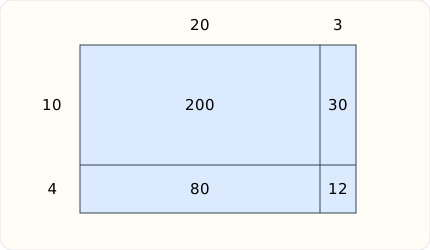
To multiply 23 by 14, write the factors as 20 + 3 and 10 + 4. Every part of the first factor must combine with every part of the second: 20 × 10, 3 × 10, 20 × 4 and 3 × 4. Their values are 200, 30, 80 and 12, giving a total of 322. The four regions of a partitioned rectangle make all these combinations visible.
For a four-digit number times one digit, split the larger factor into thousands, hundreds, tens and ones. Multiplying 2,314 by 3 gives 6,000 + 900 + 30 + 12 = 6,942. A compact algorithm records the same place-value work with exchanges. The goal is to understand why every contribution belongs in the product, then choose an organized method that keeps those contributions correct.
Another way: steps
Decompose the factors by place, calculate all partial products, add without losing units, and check with an estimate and an inverse relationship.
The rectangle's full width is twenty-three units and its full height is fourteen units. A vertical cut separates twenty from three; a horizontal cut separates ten from four. The four resulting rectangles have areas two hundred, thirty, eighty and twelve square units. Together they fill the original rectangle exactly once.
The top two regions total 230, representing twenty-three times ten. The bottom two total 92, representing twenty-three times four. Combining those two row areas also gives 322. Thus the diagram connects a four-part decomposition with a two-part decomposition. Both are correct because neither omits or repeats any region. The area model explains an arithmetic product even when the original story concerns equal groups rather than a physical surface.
For 30 × 7, think of three tens copied seven times. Three times seven is twenty-one, so the result is twenty-one tens, or 210. For 300 × 7, the same digit fact produces twenty-one hundreds, or 2,100. The difference comes from the unit attached to the three.
A rule about adding zeros may produce these answers, but it does not explain the place relationship and can be misapplied when factors have internal zeros or require regrouping. State the unit first. Twenty times thirty means two tens times three tens, giving six hundreds, or 600. An area model can show two groups of ten along one direction and three groups of ten along the other. The hundred-sized regions explain why the product has the value it does.
For 2,314 × 3, identify 2,000, 300, 10 and 4. Three copies contribute 6,000, 900, 30 and 12. Adding gives 6,942. Each partial product has a clear place-value meaning. The twelve ones regroup as one ten and two ones when the total is written in standard form.
The compact method begins with 4 × 3 = 12, writes two ones and records one ten to add to the next column. The tens then give 1 × 3 + 1 = 4 tens. Hundreds give nine hundreds, and thousands give six thousands. This record is shorter, but its carried one must be understood as one ten. Reading the units explains why it belongs in the tens column rather than being added as an extra one at the end.
Multiply 3,768 by 4. The ones give thirty-two, so keep two ones and exchange thirty for three tens. Six tens times four gives twenty-four tens; adding the three exchanged tens makes twenty-seven tens. Keep seven tens and exchange twenty tens for two hundreds. Seven hundreds times four plus those two hundreds gives thirty hundreds.
Thirty hundreds regroup as three thousands and zero hundreds. Finally three thousands times four plus the three exchanged thousands gives fifteen thousands. The product is 15,072. Check with partial products: 12,000 + 2,800 + 240 + 32 = 15,072. The zero hundreds digit is not optional. It records that all thirty hundreds were regrouped into thousands, leaving none in that place.
For 4,006 × 3, the thousands contribute twelve thousand and the ones contribute eighteen. There are zero hundreds and zero tens in the original factor. The total is 12,018. A place-value record must preserve the empty hundreds and tens positions between the thousands and ones.
Writing 1218 would incorrectly move contributions into smaller places. Expanded partial products make the zeros easy to interpret: 12,000 + 0 + 0 + 18. A compact algorithm can also work if every column is processed, including zero times three and any incoming exchanged units. An original zero does not always remain zero in the final product, because a smaller place may send an exchange into it. Track the actual contributions rather than copying zeros mechanically.
To calculate 23 × 14, first multiply twenty-three by four to get ninety-two. Then multiply twenty-three by ten to get 230. Add the partial products: 92 + 230 = 322. The second factor's one is in the tens place, so its contribution is ten copies of twenty-three, not one copy.
In a stacked algorithm, the tens partial product is aligned with the tens column. A written zero in the ones column can record that alignment. If the second row is written as twenty-three instead of 230, the calculation would represent twenty-three times five rather than times fourteen. Explain the row as ten copies before relying on a positional shortcut. The alignment follows from the value of the factor's digit.
For 34 × 26, the decompositions are 30 + 4 and 20 + 6. The required partial products are 600, 80, 180 and 24. Their sum is 884. Multiplying only thirty by twenty and four by six would omit the cross-regions of eighty and one hundred eighty, leaving only 624.
The diagram prevents that omission because every region has one width part and one height part. Label all four before calculating. You can also group them as 34 × 20 = 680 and 34 × 6 = 204, then add. The two methods should agree. If they do not, inspect which partial product is missing, repeated or assigned the wrong place value. A disagreement between representations is useful evidence for locating an error.
For 3,768 × 4, rounding the large factor to about four thousand gives an estimate of sixteen thousand. The exact answer 15,072 is reasonably close. An answer of 1,507 or 150,720 would be about ten times too small or too large and should trigger a place-value review.
An estimate cannot verify every digit. The incorrect answer 15,082 is also close to sixteen thousand. Use an exact partial-product reconstruction or division check for detailed verification. If the original factor is between 3,000 and 4,000, multiplying those bounds by four shows the product must lie between 12,000 and 16,000. A bound can reject implausible answers without pretending that all answers inside the interval are correct.
If 34 × 26 = 884, then dividing 884 into twenty-six equal groups should give thirty-four, or dividing it into thirty-four equal groups should give twenty-six. A full division by a two-digit divisor is beyond the main calculation target here, but the relationship still explains what a correct product means. For a four-digit-by-one-digit product, division by the one-digit factor is a practical check.
For example, 6,942 divided by 3 gives 2,314 with no remainder. This confirms the product of 2,314 and 3. You can also compare two multiplication decompositions without using a more difficult inverse algorithm. Choose a check you can carry out reliably. The purpose is to test the exact relationship from a second route, not to add an unexplained calculation merely because checking was requested.
If twenty-three boxes each contain fourteen tiles, the product 322 counts tiles. If a rectangle is twenty-three centimeters by fourteen centimeters, the same product is an area of 322 square centimeters. Equal-group and area models share the multiplication structure but attach different units to the result.
A story may also ask for a quantity after the product is found. If eighteen tiles are set aside from the 322, the usable amount is 304. Label the intermediate product as the starting total before subtracting. This prevents a correct multiplication from becoming an incomplete answer to a multistep question. Check the context's assumptions, such as every box containing the stated number and no tiles being lost before the reserve is taken.
A fictional workshop receives twenty-three boxes with fourteen tiles in each box. The total is 322 tiles, found as 230 tiles from ten in each box plus ninety-two from four in each box. If eighteen tiles are reserved for repairs, 304 remain for the initial design. The box structure explains the multiplication, and the reserve explains the later subtraction. A calculation of twenty-three plus fourteen would combine a box count with a per-box quantity and would not describe the delivery. The result assumes every box actually contains fourteen usable tiles. Checking a real shipment requires inspecting that condition; the arithmetic gives the total implied by the stated packing rule.
A rectangular floor drawing measures thirty-four centimeters by twenty-six centimeters on the plan. Split the width into thirty and four, and the height into twenty and six. The four region areas are six hundred, eighty, one hundred eighty and twenty-four square centimeters, totaling 884 square centimeters on the drawing. Every region must be included, including the two cross-regions. This is the drawing's area, not automatically the actual floor's area. A real scale would need to be applied to both dimensions before calculating the physical area. The example shows why a correct product needs a clear unit and reference: the same numbers may describe tiles, a paper model or a full-sized surface, but those interpretations are not interchangeable.
The one in fourteen means ten, so its product must be aligned as tens. Include every cross-region in a two-factor area model. Preserve internal zero places and label exchanged units. An estimate checks scale but cannot certify every digit.
Decompose the larger factor.
2,314 = 2,000 + 300 + 10 + 4
Every place contributes to the product.
Multiply the two larger parts.
3 × 2,000 = 6,000; 3 × 300 = 900
Known facts retain their thousand and hundred units.
Multiply the two smaller parts.
3 × 10 = 30; 3 × 4 = 12
The ones product requires regrouping.
Combine all partial products.
6,000 + 900 + 30 + 12 = 6,942
The sum includes every copied part.
Check the inverse relationship.
6,942 divided by 3 = 2,314
The product contains three equal original quantities.
Split both factors by place.
23 = 20 + 3; 14 = 10 + 4
The area model has four regions.
Find the top row products.
20 × 10 = 200; 3 × 10 = 30
This row accounts for ten copies of twenty-three.
Find the bottom row products.
20 × 4 = 80; 3 × 4 = 12
This row accounts for four copies.
Combine the complete regions.
200 + 30 + 80 + 12 = 322
No region is omitted or repeated.
Check with two partial products.
23 × 10 + 23 × 4 = 230 + 92 = 322
A different grouping gives the same total.
Multiply the ones.
8 × 4 = 32: 2 ones, 3 tens
The exchanged units move one place left.
Multiply the tens and include the exchange.
6 × 4 + 3 = 27 tens
Keep seven tens and exchange two hundreds.
Multiply the hundreds with the new exchange.
7 × 4 + 2 = 30 hundreds
Keep zero hundreds and exchange three thousands.
Finish the thousands.
3 × 4 + 3 = 15 thousands
The product extends into the ten-thousands place.
Read the complete product.
3,768 × 4 = 15,072
The zero hundreds place must remain.
Verify with expanded products.
12,000 + 2,800 + 240 + 32 = 15,072
The independent place contributions confirm every digit.
Decompose both factors.
(30 + 4) × (20 + 6)
Every part of one factor meets every part of the other.
Find the products using twenty.
600 and 80
These account for twenty copies of thirty-four.
Find the products using six.
180 and 24
These account for the remaining six copies.
Combine all four values.
Check a second grouping.
Calculate 3140 × 6. Use place-value partial products or an algorithm with explained exchanges.
Product p
Complete the partial-product calculation for 38 × 14.
Find ten copies of the factor.
38 × 10 = 380.
The tens digit in fourteen represents ten.
Find four more copies.
38 × 4 = p.
The ones digit contributes four copies.
Combine the two partial products.
Add the tens contribution and the ones contribution.
Together they account for all fourteen copies.
Calculate 78 × 56.
Product p
Calculate 6772 × 9. Use place-value partial products or an algorithm with explained exchanges.
Product p
Calculate 54 × 86.
Product p
A rectangular design measures 41 cm by 56 cm. Split each dimension into tens and ones. Give the four region areas, in the order tens×tens, ones×tens, tens×ones, ones×ones, then the whole area.
Regions a, b, c, d; total t square cm
A supply order contains 24 packets with 26 counters in each packet. All counters are shared equally among 4 classrooms. How many counters does each classroom receive? Work out the complete order and use a one-digit division to check your result.
Answer:
Lesson test: one question per skill, one attempt each, no hints. Your answers are checked when you submit.
Calculate 47 × 14.
Product p
Name all four partial products for 23 × 14. Then explain why multiplying by the one in fourteen contributes 230 rather than 23.
21. Calculate thirty-four times twenty-six, step 4
600 + 80 + 180 + 24 = 884
The regions fill the entire model.
21. Calculate thirty-four times twenty-six, step 5
680 + 204 = 884
The tens row and ones row give the same result.