Back to the on-screen lesson ·
Read, write and compare large whole numbers, explaining the tenfold relationship between places.
Paper packet. Every task here also exists on screen, where it is checked automatically; answers written on paper are not assessed by Nydus. When you are back at a device, enter your answers there.
Construct and read whole numbers through one million, explain each digit's contribution and the tenfold relationship between adjacent places, and justify comparisons using the highest differing place.
You can group ten ones as one ten and ten tens as one hundred. Larger whole-number places continue the same pattern. Ten hundreds make one thousand, ten thousands make one ten thousand, and ten ten-thousands make one hundred thousand. You do not need a new kind of arithmetic for each larger place. You need to keep track of which unit each digit counts and how neighboring units are related.
| Term | What it means |
|---|---|
| Digit | One of the ten symbols zero through nine used to write numbers. |
| Place value | The value a position gives to its digit. |
| Standard form | A number written with digits in their usual place-value positions. |
| Expanded form | A sum showing the contribution of each nonzero place. |
| Period | A group of three places used to organize reading large numbers. |
| Million | One thousand thousands, also ten hundred-thousands. |
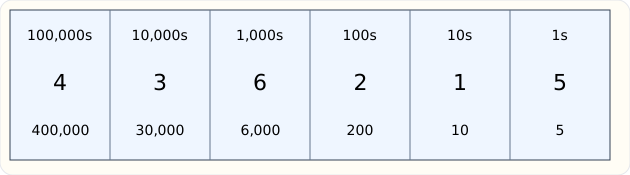
In 436,215, the four counts hundred-thousands and contributes 400,000. The three counts ten-thousands and contributes 30,000. The six counts thousands, the two hundreds, the one tens and the five ones. Therefore 436,215 = 400,000 + 30,000 + 6,000 + 200 + 10 + 5. The six digits and six contributions describe the same quantity.
Each place is ten times the place immediately to its right. The same nonzero digit one place farther left therefore contributes ten times as much. In 55, the left five means fifty and the right five means five, and fifty is ten times five. This relationship concerns the values of the places, not a claim that every digit on the left is numerically larger than every digit on the right.
Another way: steps
Name the places from the ones outward, multiply each digit by its place unit, preserve zero placeholders, and compare the highest differing place.
The chart has one position for each digit of 436,215. Start at the right if you need to identify the ones place, then move left through tens, hundreds, thousands, ten-thousands and hundred-thousands. Reading the contributions from left to right gives the expanded sum. Adding those contributions reconstructs the standard numeral.
The chart labels are unit values, not extra digits belonging to the number. The three in the ten-thousands column contributes three groups of ten thousand, or thirty thousand. It does not contribute three thousand. Point to the heading as you read a digit's value. This small habit prevents a one-place shift, an error that can change a contribution by a factor of ten while leaving the written digit itself unchanged.
Imagine counters packed in groups of ten. Ten small bundles make a hundred-counter bundle; ten hundred-bundles make a thousand. You can continue representing larger quantities with labeled cards instead of physically collecting every counter. A card labeled ten thousand represents ten thousand individual units, not a large object with an unknown count.
Ten cards labeled ten thousand can be exchanged for one card labeled one hundred thousand. The total value stays the same. Likewise, ten hundred-thousand cards can be exchanged for one million. These exchanges explain the base-ten structure concretely. When an amount reaches ten in one place, it can be regrouped as one in the next place. The written numeral normally uses a single digit per place, so its digits range from zero through nine.
The comma in 436,215 separates the thousands period from the ones period. Read the left group as four hundred thirty-six, then attach thousand. Read the right group as two hundred fifteen. Together the number is four hundred thirty-six thousand two hundred fifteen. The comma organizes reading; it does not add a place or a value.
For 408,006, the thousands group is four hundred eight and the final group is six. Read four hundred eight thousand six. The zeros preserve empty places even though you do not speak each zero in the number name. Writing only 4086 would mean four thousand eighty-six, a much smaller number. Spoken language and positional notation organize the same quantity differently, so use a chart when translating between them.
To write three hundred seven thousand forty-two, first identify the two periods: 307 thousands and 42 ones. The final period needs three positions, so write it as 042 after the comma. The standard form is 307,042. The zero in the hundreds place ensures that four means forty rather than four hundred.
Check the result with expanded form: 300,000 + 7,000 + 40 + 2. Then read the standard numeral back aloud. If the reconstructed words do not match the original, inspect the zero placeholders. A missing spoken place does not permit the written places to collapse. The zeros keep each later nonzero digit attached to its correct unit. This is especially important when several neighboring places are empty.
The expanded form of 582,107 is 500,000 + 80,000 + 2,000 + 100 + 7. The tens contribution is zero, so it may be omitted from the sum. In a place-value chart, however, the tens position remains visible and contains zero. Both records are correct because the sum is about contributions while the chart is about positions.
You can also use multiplication to show each contribution: 5 × 100,000 + 8 × 10,000 + 2 × 1,000 + 1 × 100 + 0 × 10 + 7 × 1. This makes the role of every digit explicit. To reconstruct standard form, collect all contributions into matching places and check whether any need regrouping. A sum such as 50,000 + 30,000 + 7 is 80,007 because two terms belong to the same place.
Compare the values of the two sevens in 77,000. The left seven contributes 70,000 and the next contributes 7,000. Since 70,000 = 10 × 7,000, the left contribution is ten times the right. The repeated digit lets you isolate the effect of the position.
Now compare the sevens in 70,700. The first contributes 70,000 and the second 700, with one place between them. Moving two places left multiplies by ten twice, so the contribution is one hundred times as large. Show the intermediate units: seven hundreds become seven thousands, then seven ten-thousands. Do not count the number of zeros in the entire numeral without identifying the specific digit contributions. The comparison is between place values, not between the full number and one of its digits.
Without leading zeros, any six-digit whole number is at least 100,000, while every five-digit whole number is at most 99,999. Therefore 102,340 is greater than 98,001 even though the latter begins with a larger digit. The highest occupied place matters before individual digit comparisons.
Leading zeros do not change a number's value: 098,001 still represents 98,001. Counting every printed character would therefore be a poor comparison method unless leading zeros have first been excluded. Identify the actual highest nonzero place. Commas also do not count as digits. This reasoning explains the familiar digit-length shortcut for standard whole-number numerals and states the conditions under which it works.
Compare 582,107 and 581,990. Their hundred-thousands digits agree at five and their ten-thousands digits agree at eight. The first difference is in the thousands place: two thousands exceeds one thousand. Therefore 582,107 is greater. The later hundreds, tens and ones cannot overcome that one-thousand difference, because together they form less than one thousand.
This is why the first unequal place decides. You do not add all digits and compare those sums, and you do not choose the numeral containing the largest single digit somewhere inside it. Compare corresponding place contributions in order. If every digit agrees, the numbers are equal. Read the final inequality in words to ensure the sign points toward the intended larger quantity.
The greatest six-digit whole number is 999,999. Adding one creates ten ones, which regroup as an extra ten. That ten causes another exchange into hundreds, and the chain continues through every place. The result is 1,000,000, one million. It is the first seven-digit positive whole number in standard form.
One million equals ten hundred-thousands, one hundred ten-thousands or one thousand thousands. These are equivalent groupings of the same count. Do not confuse one thousand thousands with one thousand hundreds, which is only one hundred thousand. Name both the number of groups and the group unit. A place-value chart extended one column to the left of hundred-thousands makes the new million position explicit.
Two fictional collections contain 408,006 and 408,060 items. Their hundreds place is zero in both, but the tens differ: zero tens versus six tens. The second collection has the greater count, and the difference is fifty-four items. A report claiming the first is larger because its last digit is six ignores the earlier tens difference.
The comparison establishes a count relationship, not the quality or usefulness of either collection. If the counts refer to different dates or count different kinds of items, state that context before drawing practical conclusions. In these tasks the quantities use a common counting unit. The mathematical method preserves that unit while comparing values; it does not supply missing information about what the numbers measure or how they were collected.
A storage record lists 307,042 small components. Read the quantity as three hundred seven thousand forty-two. The zero in the hundreds place and the zero in the ten-thousands place both matter, even though neither contributes a positive amount to the expanded sum. An accidental entry of 37,042 would omit a hundred-thousands contribution, while 307,420 would move the last digits into different places. Compare the record with the expanded form 300,000 + 7,000 + 40 + 2 to check the transcription. This verifies that the numeral matches the stated quantity; it does not independently count the physical components. A real inventory requires separate counting evidence as well as accurate recording.
Two fictional event records give 582,107 visits and 581,990 visits using the same counting rule. Compare hundred-thousands and ten-thousands first; both agree. The first record has two thousands where the second has one, so the first count is greater even though the second ends in larger-looking digits. The difference is 117 visits. If one report counted unique people and the other counted repeated entries, their meanings would differ and that limitation would need to be stated. The arithmetic comparison still orders the written numbers, but a fair claim about attendance requires compatible counting definitions. Place-value reasoning establishes numerical order while the description of the measure determines what that order can mean.
The same digit can represent different amounts in different places. Internal zeros preserve those places. Compare the highest occupied place first, then the first unequal corresponding digit. Adjacent place units differ by a factor of ten, not by an additive ten.
Identify the highest place.
436,215 has six digits; begin with hundred-thousands
The ones place is at the right.
Read the three larger contributions.
400,000 + 30,000 + 6,000
Each digit counts its column's unit.
Read the three smaller contributions.
200 + 10 + 5
The final period contains hundreds, tens and ones.
Combine the expanded terms.
400,000 + 30,000 + 6,000 + 200 + 10 + 5
The terms account for every digit.
Reconstruct the numeral.
436,215
The sum matches the original place-value record.
Separate the named periods.
Three hundred seven thousand; forty-two
The word thousand marks the period boundary.
Write the thousands group.
307
There are no ten-thousands beyond those in the named group.
Give the final period three positions.
042
Zero holds the missing hundreds place.
Combine the groups.
307,042
Each period keeps its intended place units.
Check by expanding and reading.
300,000 + 7,000 + 40 + 2
The reconstructed quantity matches the spoken name.
Record the comparison numerals.
77,000 and 70,700
Both use the same base-ten places.
Compare the highest shared place.
Both have 7 ten-thousands
These contributions agree.
Find the first differing place.
7 thousands versus 0 thousands
The first numeral is greater.
Identify the two sevens in the first numeral.
70,000 and 7,000
They occupy adjacent places.
Calculate their value relationship.
70,000 = 10 × 7,000
Moving one place left multiplies the unit by ten.
Contrast the second numeral's repeated sevens.
70,000 = 100 × 700
Two-place separation applies the tenfold relationship twice.
Align the corresponding places.
Both have six digits
The highest place is hundred-thousands.
Compare the first two places.
5 = 5 and 8 = 8
These contributions are equal.
Find the first unequal place.
2 thousands > 1 thousand
The thousands place decides.
State the comparison.
Explain the limit of the smaller places.
Expand 980627 into its six place contributions.
a + b + c + d + e + f
A number contains 5 hundred-thousands, three thousands and seven ones. Write it in standard form.
Record the nonzero contributions.
500000 + 3000 + 7
Each count uses its named place unit.
Combine them with empty places preserved.
The standard numeral is n.
Zeros hold the unnamed ten-thousands, hundreds and tens places.
Read the numeral back.
Check every named place against the original description.
The reconstruction must preserve the value and unit of every contribution.
What is the value of the digit in the ten-thousands place of 466334?
Answer:
In 99000, the two repeated nonzero digits occupy adjacent places. Give the larger contribution, smaller contribution, and multiplicative factor between them.
Larger l; smaller s; factor f
Expand 577363 into its six place contributions.
a + b + c + d + e + f
Three fictional counters show 103402, 94537 and 904082. Enter their readings from least to greatest.
Least a; middle b; greatest c
A counter records 8 thousands, 1 hundreds and 6 tens. Another counter records 8 ten-thousands, 1 thousands and 6 hundreds. Read both records as whole numbers. How much greater is the larger record?
Answer:
Lesson test: one question per skill, one attempt each, no hints. Your answers are checked when you submit.
Expand 822565 into its six place contributions.
a + b + c + d + e + f
Write three hundred seven thousand forty-two in digits. Explain the value of the 8 in 582,107 and why 582,107 is greater than 581,990.
21. Compare 582,107 and 581,990, step 4
582,107 > 581,990
Later places cannot outweigh the earlier difference.
21. Compare 582,107 and 581,990, step 5
Hundreds, tens and ones together are below 1,000
They cannot supply another full thousand.