Back to the on-screen lesson ·
Using the digit to the right to decide, at whichever place is asked for.
Paper packet. Every task here also exists on screen, where it is checked automatically; answers written on paper are not assessed by Nydus. When you are back at a device, enter your answers there.
In this lesson you round a number to whichever place you are asked for — the nearest ten, hundred, thousand or ten thousand. The rule is always the same: look at the single digit immediately to the right of that place, and nothing else. Rounding is what makes an estimate possible, and an estimate is how you find out that an exact answer is wrong.
You can read digits by their places and compare whole numbers. Rounding uses those skills to replace a number with a nearby landmark. Before applying a digit rule, name the two landmarks on either side. If the task asks for the nearest hundred, both landmarks must be multiples of one hundred. A nearby multiple of ten may be closer, but it does not answer that question. Keep the requested place visible beside the original number while you work.
| Term | What it means |
|---|---|
| Round | Replace a number with a nearest multiple of a specified unit. |
| Midpoint | The point halfway between two endpoints. |
| Estimate | An approximate value used for a stated purpose. |
| Nearest thousand | A multiple of one thousand closest to the given number. |
| Tie | Equal distances from the two candidate landmarks. |
| Exact | The original count or calculation, before approximation. |
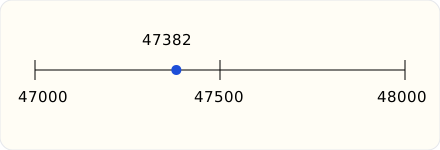
To round 47,382 to the nearest thousand, compare 47,000 and 48,000. The original count is 382 above the lower landmark and 618 below the upper landmark, so it is nearer 47,000. Rounding does not change the original count. It creates a new approximate way to report it. Write 'about 47,000' when the distinction matters. If a task asks how many items actually exist, the exact count remains 47,382.
Sometimes the number is equally distant from two landmarks. Exactly 47,500 is halfway between 47,000 and 48,000. In this course, a halfway whole-number value rounds to the higher landmark. That is a stated convention used to decide a tie. Below halfway, choose the lower landmark; above halfway, choose the higher one. Understanding these distances explains the familiar digit rule instead of treating it as a set of unexplained changes to written digits.
Another way: steps
Name the requested unit, find neighboring multiples, locate the midpoint, and choose the closer endpoint. Use the stated tie convention when needed.
The line shows one thousand units from the left endpoint to the right endpoint. Its halfway mark is five hundred units from either end. The point for 47,382 lies to the left of halfway. Its closeness to 47,000 is a distance fact, not a rule about choosing the smaller number every time. Move the point to 47,760 and it would lie nearer 48,000 instead.
A rounding line does not need a mark for every individual unit. The endpoints and midpoint can be enough to compare distances. However, the spacing must represent the quantities consistently. Drawing the midpoint near one endpoint would make the picture misleading. The numeric distance check is useful even when a sketch is not perfectly measured: subtract the lower endpoint from the number, then subtract the number from the upper endpoint. The smaller difference identifies the nearer landmark.
For rounding to the nearest thousand, the hundreds digit tells whether the number has reached five hundred beyond the lower thousand. In 47,382, that digit is three, so the remainder after 47,000 is below five hundred. Tens and ones can add at most ninety-nine more, not enough to reach halfway from a hundreds digit below five. This is why a hundreds digit zero through four selects the lower thousand.
A hundreds digit five through nine reaches or passes halfway, so it selects the higher thousand. After choosing the endpoint, the hundreds, tens and ones positions are zero because a whole thousand contains no leftover hundreds, tens or ones. The same reasoning works at other places. To round to the nearest hundred, inspect the tens digit; to the nearest ten thousand, inspect the thousands digit. The deciding digit is immediately to the right of the requested place because it measures tenths of that rounding unit.
Round 63,748 to the nearest ten, hundred, thousand and ten thousand. The nearest ten is 63,750 because the ones digit eight passes the midpoint. The nearest hundred is 63,700 because the tens digit four is below halfway. The nearest thousand is 64,000 because the hundreds digit seven is above halfway. The nearest ten thousand is 60,000 because the thousands digit three is below halfway. All four estimates come from the same exact number.
A more detailed estimate is not automatically the right one for every purpose. A headline might use the nearest thousand, while an inventory check may need exact units. State the requested place before choosing a rule. If a number is already a multiple of that unit, it remains unchanged. For example, 64,000 rounded to the nearest thousand is still 64,000. Rounding does not always make a number different, and it does not always make it larger.
Consider 99,760 rounded to the nearest thousand. Its neighboring thousands are 99,000 and 100,000. The number is above 99,500, so the answer is 100,000. Choosing the higher landmark carries beyond the two written nines. The result can have more digits than the original number. This is not a mistake; it follows from where the next multiple lies.
A digit-only method can go wrong if a learner replaces one nine with ten while leaving the surrounding places unchanged. Instead, add one whole rounding unit to the lower landmark. Here 99,000 + 1,000 = 100,000. The place-value addition organizes the carry correctly. Try 9,950 to the nearest hundred in the same way: 9,900 and 10,000 are the candidates, and the original is exactly halfway. Our tie convention selects 10,000. Check the number of zeros against the requested unit rather than against the original digit count.
To round 4,449 to the nearest thousand, compare it with 4,500. It is below halfway, so the answer is 4,000. If you first round it to the nearest hundred, you get 4,400; in this example the later thousand result is still 4,000. But that agreement is not guaranteed. For 4,450, rounding first to the nearest hundred gives 4,500, which then rounds to 5,000. Direct rounding of 4,450 to the nearest thousand gives 4,000.
The first rounding threw away information about which side of 4,500 the original value occupied. A later tie decision cannot recover that information. Therefore, when a task requests estimates at two places, return to the original number for each estimate. Do not feed the first estimate into the second calculation. Draw separate arrows from the original value to the two results. The arrows represent two different approximations, not two steps of a single exact procedure.
A reported crowd of about 8,000, rounded to the nearest thousand, could have come from many exact counts. The whole-number counts from 7,500 through 8,499 round to 8,000 under our convention. The lower endpoint is included because 7,500 ties and rounds upward. The count 8,500 is not included because its tie rounds to 9,000.
You cannot recover the exact crowd by reading the rounded report. A count of 8,120 fits, but so does 7,830. To test a proposed original count, round it yourself to the stated place. A rounded report is therefore a range of possibilities, not a hidden exact total. This matters when two rounded reports are equal: the underlying counts may still differ. It also matters when you subtract approximate counts, because the apparent difference can include uncertainty introduced by rounding.
Suppose a learner adds 3,842 and 2,167 and reports 60,009. Rounding the addends to the nearest thousand gives about 4,000 + 2,000 = 6,000. The reported answer is roughly ten times too large, so a place-value error is likely. The estimate can expose that large mistake without supplying the exact answer. Computing carefully gives 6,009.
An estimate does not prove that every nearby answer is correct. The incorrect sum 6,019 is also close to 6,000. Use an inverse operation or a second exact calculation to check small discrepancies. Explain what your estimate can and cannot establish. If the two rounded addends happen to move in opposite directions, some rounding differences may cancel; in other cases they may reinforce each other. Treat the estimate as a sensible comparison, not as an exact equality that the original numbers must satisfy.
A bus holds forty passengers, and eighty-one passengers need transport. Rounding eighty-one to the nearest forty would give eighty, but two buses would leave one person without a seat. The context asks for enough capacity, so three buses are needed. That is a whole-group decision, not ordinary nearest rounding. A rounding rule should not replace reading the question.
Similarly, a shopping budget may use a deliberate upper estimate to avoid running short, while a report may request the nearest hundred. Both are useful approximations with different purposes. When the task says 'nearest,' compare distances. When it says 'enough,' check whether the proposed quantity meets the requirement. State the unit and meaning of your answer. A correct numerical rounding can still be the wrong response to a practical problem if it ignores a person, a package or a minimum amount.
First check that the result is a multiple of the requested unit. A nearest-thousand answer cannot be 47,300. Next check that it is one of the two neighboring landmarks, not an unrelated round number. Finally compare the original number with the midpoint, paying attention to the halfway convention. These checks separate choosing the wrong place from choosing the wrong direction.
If you use the deciding-digit shortcut, connect it to the interval once more. The digit zero through four means less than half a unit beyond the lower landmark; five through nine means at least half. When you explain an answer, naming the deciding digit is useful but incomplete unless you also identify its place. In 47,382 the digit three is the hundreds digit. Saying 'three is small' does not explain why it decides a thousand-rounding task rather than a ten-rounding task.
A school event records 12,684 visits. The count includes repeat visits, so it is not necessarily the number of different people. A short report requests the nearest thousand. The candidates are 12,000 and 13,000; the midpoint is 12,500. The count exceeds the midpoint, so the report says about 13,000 visits. Keep the word visits and the approximation word about. A different report asking for the nearest hundred would use 12,700. Neither summary changes the stored count of 12,684. If someone later needs to calculate ticket receipts exactly, the rounded headline is insufficient. Return to the original records and distinguish paid entries from all visits. Rounding helps communication when its precision and measurement meaning are explicit.
A classroom plans to order 2,846 blue tiles and 3,172 yellow tiles for a display. Rounding each amount to the nearest thousand gives about 3,000 of each color, or about 6,000 tiles altogether. That estimate is useful for checking whether an exact total near sixty thousand could be right. It is not an instruction to order exactly three thousand of each color. The yellow requirement exceeds three thousand, so that order would be short even though the estimate is close. The actual total is 6,018. If tiles come in fixed-size packages, the purchasing decision must also account for complete packages. Keep three questions separate: an approximate total for planning, an exact count for the design, and enough packages to meet the design. Each question may require a different final number.
Trailing zeros identify the requested unit, not permission to drop digits without comparing distances. At halfway this course chooses the higher endpoint. Round directly from the original at each requested place. Estimation can reject an unreasonable calculation but cannot certify every nearby answer.
Name the requested unit.
Nearest 100
Candidate answers must be hundreds.
Locate neighboring landmarks.
3,200 < 3,246 < 3,300
The number lies between consecutive hundreds.
Locate the midpoint.
3,250
Fifty is half of one hundred.
Choose the nearer endpoint.
3,246 < 3,250, so 3,200
The original is below halfway.
Check the distances.
46 to 3,200; 54 to 3,300
The smaller distance confirms the choice.
Identify neighboring thousands.
99,000 and 100,000
These surround 99,760.
Find the halfway point.
99,500
Half a thousand is five hundred.
Compare with the midpoint.
99,760 > 99,500
The number lies in the upper half.
Choose the next whole thousand.
99,000 + 1,000 = 100,000
The carry changes the digit count.
Check using distances.
760 down; 240 up
The higher endpoint is closer.
Keep the original value visible.
7,450
Each rounding must use the same original.
Find the neighboring hundreds.
7,400 and 7,500
The midpoint is 7,450.
Apply the halfway convention.
Nearest hundred: 7,500
A tie goes to the higher endpoint.
Find the neighboring thousands.
7,000 and 8,000
Their midpoint is 7,500.
Compare the original with this midpoint.
7,450 < 7,500; nearest thousand: 7,000
The original is below halfway.
Explain why the two results differ.
7,500 and 7,000 answer different questions
Rounding to one place and then another would discard needed information.
Write the target unit.
10,000
Both candidate endpoints must be multiples of this unit.
Locate the original value.
50,000 < 58,600 < 60,000
These are neighboring ten thousands.
Name the midpoint.
55,000
Half of ten thousand is five thousand.
Choose the closer endpoint.
Check the choice by distance.
Round 48537 to the nearest thousand.
Rounded value: r
Round 27230 to the nearest thousand.
Locate the containing interval.
Use consecutive whole thousands.
The requested unit is one thousand.
Choose the endpoint below the midpoint.
The rounded value is r.
Two hundred thirty is less than half a thousand.
Check the distance to both ends.
The lower endpoint is closer.
Rounding selects a nearest landmark, not an exact count.
Round 56597 to the nearest ten thousand.
Rounded value: r
Round 9699 independently to the nearest thousand and hundred.
Thousand: k; hundred: h
Round 40001 to the nearest thousand.
Rounded value: r
Round 57453 to the nearest ten thousand.
Rounded value: r
A fictional match report gives 4000 visits rounded to the nearest thousand. What is the greatest possible whole-number visit count consistent with that report?
Answer:
Lesson test: one question per skill, one attempt each, no hints. Your answers are checked when you submit.
Round 5113 independently to the nearest thousand and hundred.
Thousand: k; hundred: h
You can round a number to any named place. Without looking: what is 47,382 to the nearest thousand, and which digit decided it?
20. Round 58,600 to ten thousands, step 4
58,600 > 55,000, so 60,000
The number is above halfway.
20. Round 58,600 to ten thousands, step 5
1,400 up; 8,600 down
The upper endpoint is much closer.