Back to the on-screen lesson ·
Following a rule to make a pattern, and noticing what the rule makes true.
Paper packet. Every task here also exists on screen, where it is checked automatically; answers written on paper are not assessed by Nydus. When you are back at a device, enter your answers there.
In this lesson you follow a rule such as 'add 3' to build a sequence, and then say something that is true of every number in it. The second half is the mathematics: a rule that adds 3 to an odd number makes the terms alternate odd and even, and noticing that is the difference between continuing a pattern and understanding one.
You can add equal amounts and multiply whole numbers. A sequence uses an instruction repeatedly, so you must keep track of both the current value and how many times the instruction has been used. Keep a place for the starting value before making a jump. Read the rule aloud, perform it once, and check that the result becomes the starting point for the next use. When a drawing grows, count what was already there separately from what was added. These habits make long patterns easier to explain.
| Term | What it means |
|---|---|
| Sequence | An ordered list of values or objects. |
| Term | One entry in a sequence. |
| Position | Where a term occurs in the list. |
| Rule | The instruction used to produce terms or stages. |
| Starting value | The first term before any repeated operation. |
| Feature | Something true about terms, such as being even or ending in five. |
Start at two and add three repeatedly. The sequence begins 2, 5, 8, 11, 14. The starting value is two, and the first addition creates five. If you instead start at four with the same rule, you get 4, 7, 10, 13, 16. The rule alone does not specify the entire sequence: you also need the start. Conversely, a start without an instruction leaves many possible continuations. Write both pieces before calculating.
A term's position and its value are different. In the first sequence, the fourth term is eleven; four tells where the term is, and eleven tells its value. A useful table has one row for positions and another for values. The first term involves no jumps from the start, the second involves one, and the third involves two. Keep these counts separate when predicting a term farther along. This difference will prevent the common error of making one extra addition.
Another way: steps
Record the start, apply the same rule, label positions, and explain a feature using the rule rather than just the visible terms.
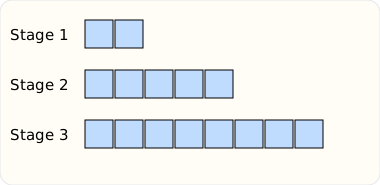
The first stage contains two tiles. Each following stage keeps those tiles and adds three more at the right. The next counts are five and eight. The picture therefore follows the same add-three rule as the number sequence. Count complete tiles rather than vertical edges: eight tiles have nine boundary lines across the row. The number of tiles measures the objects, while the number of edges counts a different feature.
To draw stage four, copy the eight-tile row and append three tiles, making eleven. Do not append four just because it is the fourth stage. Stage number tells when an arrangement occurs, not automatically how much is added. A visual rule should identify what stays and what changes. If the rule instead replaced each tile with two tiles, the counts would double. Both drawings would grow, but they would represent different operations.
For the rule start at seven and add four, write 7, 11, 15, 19, 23. Check each neighboring pair by subtraction: eleven minus seven is four, fifteen minus eleven is four, and so on. This check can locate a copying error. If someone writes 7, 11, 16, 20, the rule has been broken between eleven and sixteen. The later step of four does not repair that earlier mistake.
When two terms are missing, use the first missing result to calculate the second. From fifteen, adding four gives nineteen; adding four to nineteen gives twenty-three. Writing nineteen twice performs the instruction only once. It can help to draw one arrow for each addition. Then count the arrows and compare their labels. Equal additions produce equal differences, even though the values themselves become larger. Larger values do not mean the rule's step is getting larger.
Start at three and double each term. The sequence begins 3, 6, 12, 24, 48. Doubling means multiplying the current value by two, not adding two. The differences are three, six, twelve and twenty-four, so they do not stay fixed. That changing difference helps distinguish the rule from an adding pattern. Compare each term with the previous one by division: every quotient is two.
Sometimes the first step can fit more than one rule. From three to six, you could add three or multiply by two. The next step separates those rules: adding three gives nine, while doubling gives twelve. Do not decide a rule from just one transition when more information is available. In a task with an explicitly stated rule, follow that rule even if another pattern could match the first two terms. A written instruction is part of the mathematical information.
The sixth term of a sequence needs five moves after the first term. For start at four and add seven, the fifth jump contributes 5 × 7 = 35 beyond the start. Add the initial four to get thirty-nine. You can verify by listing 4, 11, 18, 25, 32, 39. There are six terms but only five spaces between neighboring terms.
A table prevents confusion: position one has zero jumps, position two has one jump, and position six has five jumps. For any later position, subtract one to find the jump count, multiply by the fixed step, then add the starting value. This shortcut applies to a repeated adding rule. It does not describe doubling, because the amounts added in a doubling pattern change. Identify the type of rule before choosing the shortcut. A remembered formula is useful only when its conditions match the pattern.
Pair counters to think about evenness. An even number has no unpaired counter, while an odd number has one. Adding an even number supplies complete pairs, so it preserves whether the current number has an unpaired counter. Starting at three and adding four therefore produces odd numbers: 3, 7, 11, 15. Starting at two with the same step produces even numbers. The starting value matters to the feature.
Adding an odd number changes the parity each time. An odd amount adds complete pairs and one extra counter. That extra counter either creates an unpaired one or pairs with the one already present. Start at four and add five: 4, 9, 14, 19, 24 alternates even and odd. The numbers do not all have the same parity or the same ones digit. What stays consistent is the alternating pattern. Explain why it continues from the rule, rather than claiming the first five examples alone prove every later case.
Start at six and add ten: 6, 16, 26, 36, 46. Each addition increases the tens amount and leaves six ones, so every term ends in six. If you add twenty instead, you still preserve the ones digit. This feature comes from adding complete tens. It does not mean every term has the same number of digits: after ninety-six, adding ten gives one hundred six. The number becomes longer, but the ones digit remains six.
Adding five can alternate the ones digit instead. Starting at two gives 2, 7, 12, 17, 22, so the endings alternate two and seven. Starting at five gives 5, 10, 15, 20, with endings five and zero. Name the start when you describe the feature. A statement such as 'adding five always makes a number end in five' fails whenever the previous ones digit is not zero. Use a counterexample to improve the sentence.
The list 2, 4, 6 can continue with eight under an add-two rule. A different rule could say repeat the three-number block, giving two next. Both match the displayed list. If a question asks you to invent a rule, state it explicitly and demonstrate its continuation. If a question supplies a rule, you are not free to replace it with another one. These are different tasks.
Avoid saying a short list proves there is only one possible next term unless the rule or other constraints establish that. In everyday investigations, observations may suggest a pattern without guaranteeing its continuation. A classroom sequence can be exact because its instruction is part of the problem. Explain whether you are following a stated rule or proposing one. That distinction keeps a prediction from being mistaken for an observed fact or an unavoidable consequence.
Suppose a row of separate triangles gains one triangle at each stage. Counting triangles produces 1, 2, 3, 4. Counting their sides separately produces 3, 6, 9, 12, because each triangle contributes three sides. If triangles share sides, however, the outside boundary follows a different count. You must know what is being counted before predicting it. A picture and a number list should refer to the same feature.
Try a repeated color pattern: red, blue, blue, red, blue, blue. The repeating block contains three positions. Position six is blue and position seven starts a new block with red. This is a repeating pattern, while the tile row is a growing pattern. Both have rules, but one cycles through a fixed block and the other changes its size. Describe the action precisely enough that someone else can draw the next stage without seeing your original picture.
First check the arithmetic between neighboring terms. Then check that position labels match the number of rule uses. Finally test a claimed feature against both the start and the operation. For example, 'all terms are multiples of three' holds for start at three and add three, but fails for start at one and add three. The equal step alone does not guarantee that every term is its multiple.
When a result is wrong, locate the first broken relationship rather than erasing the entire list. If a sequence should double and someone adds two at the third step, the later terms may be consistent with the wrong value but still incorrect. Return to the last correct term and apply the stated rule. Explain your repair in a sentence naming the operation and the term it acts on. That sentence helps distinguish a calculation slip from a misunderstanding of the rule.
A class places two markers beside the first garden bed and adds three markers for each new display stage. The first four counts are two, five, eight and eleven. These counts follow a planned display rule, not a claim about how plants grow. If the class needs the eighth stage, it makes seven additions after the first: seven groups of three give twenty-one extra markers, and the original two make twenty-three. Before collecting materials, another learner checks the seventh stage has twenty and adding three gives twenty-three. A drawing helps everyone distinguish stage number from marker count. If the organizer changes the rule to add four each time, the old shopping count no longer fits. Record which rule produced the estimate before using it.
A learner begins with eight tokens and earns four more after each completed reading session. Before any session, the balance is eight. After one it is twelve, after two it is sixteen, and after three it is twenty. A table labeled by completed sessions therefore starts at session zero, unlike a table whose first sequence position is called one. After six sessions, six additions contribute twenty-four tokens and the initial eight make thirty-two. Do not subtract one from six in this situation: six names the number of actions already performed, not the position of the starting balance. Compare the labels carefully. The same repeated-addition idea works, but the meaning of the given number determines whether you count positions or actions.
The first term uses zero repetitions of the rule. Adding three and multiplying by three usually give different continuations. A short visible list does not determine a unique rule without further conditions. Explain a lasting feature using the operation and the start, and check that the claim holds for both.
Read the given instruction.
Start 5; add 6
The start and operation determine the list.
Record the visible terms.
5, 11, 17
Two additions have already been made.
Find the next term.
17 + 6 = 23
Apply the rule to the current term.
Find the following term.
23 + 6 = 29
Use the newly found term as input.
Check the two new differences.
23 - 17 = 6; 29 - 23 = 6
Both steps match the rule.
Identify the stated action.
Start 4; multiply by 2
Doubling operates on the whole current value.
Calculate the second term.
4 × 2 = 8
The first doubling creates the second entry.
Calculate the third term.
8 × 2 = 16
Adding two would not follow this instruction.
Calculate the fourth term.
16 × 2 = 32
The current value doubles again.
Check products and changing gaps.
8 - 4 = 4; 16 - 8 = 8; 32 - 16 = 16
The differences grow while the multiplier stays two.
State the start and step.
Start 3; add 4
This is a fixed-addition sequence.
Count the required jumps.
9 - 1 = 8
The first position exists before any jump.
Find the total increase.
8 × 4 = 32
Eight equal jumps add thirty-two.
Include the starting amount.
3 + 32 = 35
The increase alone is not the term.
Check the predicted parity.
35 is odd
An odd start plus complete pairs remains odd.
Test against a nearby term.
Eighth term 31; 31 + 4 = 35
The predicted value fits the repeated rule.
Read the start and operation.
Start 2; add 5
Each move adds five.
Count the moves after the first term.
7 - 1 = 6
Positions count terms, not moves.
Compute the accumulated increase.
6 × 5 = 30
There are six equal additions.
Add the original starting value.
Check by moving back once.
Start at 6 and add 4 each time. Complete the next two terms.
6, 10, 14, a, b
Start at 5 and add 8. Find the fifth term.
Count the repetitions after the start.
There are four additions.
The initial term occupies the first position.
Combine the start and equal increases.
The fifth term is answer.
Add four copies of the step to the start.
Check against the previous term.
Subtract one step and compare with the fourth term.
Neighboring terms must obey the same rule.
Start at 2 and multiply by 3 each time. Complete the sequence.
2, 6, 18, a, b
Stage 1 of a tile display has 2 tiles. Each new stage adds 6 tiles. How many tiles are in stage 6?
Answer:
Start at 7 and add 6 each time. Complete the next two terms.
7, 13, 19, a, b
Start at 3 and multiply by 3 each time. Complete the sequence.
3, 9, 27, a, b
A new sequence starts at 3 and adds 2 each time. Which feature must continue?
Lesson test: one question per skill, one attempt each, no hints. Your answers are checked when you submit.
Stage 1 of a tile display has 3 tiles. Each new stage adds 5 tiles. How many tiles are in stage 7?
Answer:
You can build a sequence from a rule and describe a property of it. Without looking: start at 4 and add 5 four times. Explain why the terms alternate even and odd.
20. Reach the seventh term, step 4
2 + 30 = 32
The sequence begins above zero.
20. Reach the seventh term, step 5
32 - 5 = 27
The previous position is the sixth term.