Back to the on-screen lesson ·
Connect base-ten fractions with decimal notation and locations on a number line.
Paper packet. Every task here also exists on screen, where it is checked automatically; answers written on paper are not assessed by Nydus. When you are back at a device, enter your answers there.
Write tenths and hundredths as decimals, explain their equivalence with a grid and number line, and combine tenths with hundredths by first creating equal units.
You can rename a fraction by dividing each part into equal smaller pieces. Dividing every tenth into ten equal pieces creates hundredths, so one tenth equals ten hundredths. Decimal notation gives these particular fraction units fixed positions after the decimal point. You will connect a grid, a number line, fraction notation and decimal notation so that each representation describes the same quantity.
| Term | What it means |
|---|---|
| Tenth | One of ten equal parts of a reference whole. |
| Hundredth | One of one hundred equal parts of that whole. |
| Decimal notation | A place-value way to write whole units and fractions based on powers of ten. |
| Decimal point | The mark locating the boundary between ones and tenths. |
| Placeholder zero | A zero that keeps a digit in its intended place when another place has no contribution. |
| Equivalent notation | Different written forms naming the same value. |
The number 0.3 means three tenths, or 3/10. The number 0.47 means four tenths and seven hundredths, which together equal forty-seven hundredths, or 47/100. The decimal point fixes the ones place immediately to its left and the tenths place immediately to its right. Each next place to the right has a unit one tenth as large.
To add four tenths and seven hundredths, first rename four tenths as forty hundredths. Then combine equal units: 40/100 + 7/100 = 47/100 = 0.47. This is a specific useful case of combining fractions with different original denominators by creating a common unit. The renaming step explains the calculation; it is not a rule that the written numerator digits should simply be placed beside one another in every fraction sum.
Another way: steps
Identify the reference whole, name the tenth and hundredth contributions, rename in equal units when combining, and place each digit in the column matching its unit.
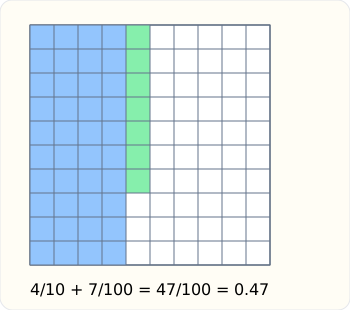
The square has ten columns and ten rows, making one hundred equal cells. One complete column is one tenth of the whole square and contains ten hundredth-cells. Four blue columns therefore represent four tenths or forty hundredths. Seven green cells contribute another seven hundredths. The total shaded region contains forty-seven of the hundred cells.
The two colors show the original addends, while the complete shaded region shows their sum. The colors do not change the unit size. Read 0.47 as forty-seven hundredths or as four tenths plus seven hundredths. Both are correct. A single shaded cell is one hundredth of the entire square, not one tenth merely because it lies in a column that contains ten cells.
Seven tenths is written 0.7. The seven belongs in the tenths place because it counts seven equal parts when the whole is divided into ten. The zero before the decimal point states that there are no complete wholes. Writing 7.0 would mean seven whole units, a quantity ten times as large.
A number greater than one can also have tenths. Fourteen tenths contains ten tenths, or one whole, plus four tenths. It is 1.4. The numerator fourteen does not mean that both digits belong after the decimal point as 0.14; that would be fourteen hundredths. Count complete groups of ten tenths before writing the decimal. The denominator tells which unit the numerator counts, and the decimal places must reflect that unit.
Forty-seven hundredths is 0.47 because four tenths contain forty hundredths and seven more hundredths fill the second decimal place. Eight hundredths is 0.08. The zero in the tenths place is essential: it says no complete tenth has been formed while keeping the eight in the hundredths column.
Writing 0.8 for eight hundredths would instead describe eighty hundredths. Read the final place name to check the numeral. If the fraction has denominator one hundred, its numerator can be organized into hundreds, tens and ones of hundredth units. One hundred twenty-five hundredths is one whole and twenty-five hundredths, written 1.25. The decimal notation preserves the original unit count even when the value exceeds one.
Six tenths equals sixty hundredths, so 0.6 = 0.60. The added trailing zero records zero additional hundredths beyond the six tenths. It does not move the six into another place. You can verify the equality with six shaded columns of a hundred-square or with one point on a number line.
This equivalence is useful before combining quantities or comparing decimals with different written lengths. It does not mean any zero can be inserted anywhere. The numeral 0.06 has the six in the hundredths place and represents only six hundredths. Keep the existing digits anchored to their units. A trailing zero adds an empty smaller place; an inserted zero may shift a digit and change the quantity.
For 3/10 + 26/100, rename the three tenths as thirty hundredths. Add thirty and twenty-six to obtain fifty-six hundredths, or 0.56. The fraction equation is 30/100 + 26/100 = 56/100. A grid could show three complete columns plus twenty-six additional cells.
Do not write 0.326 by placing the two numerator strings together. That notation names thousandths and does not represent the supplied units. The second addend may contain several tenths itself: twenty-six hundredths includes two tenths and six hundredths. Combined with three tenths, that makes five tenths and six hundredths. Unit decomposition and common-denominator addition give the same result and provide an exact cross-check.
Eight tenths plus thirty-five hundredths gives eighty hundredths plus thirty-five hundredths, totaling 115 hundredths. One hundred hundredths make one whole, leaving fifteen hundredths. The decimal is 1.15. The result exceeds one because the combined shaded quantity would fill one hundred-square and part of another.
The numerator in 115/100 is allowed to exceed the denominator. Changing the denominator to make the fraction look smaller would alter its value. Instead, regroup the counted units into wholes, tenths and hundredths. One whole, one tenth and five hundredths also describes 1.15. Check by converting back: one hundred plus ten plus five hundredths totals 115 hundredths, exactly the amount found by addition.
To locate 0.47 between zero and one, first mark tenths. The point lies between 0.4 and 0.5. Divide that tenth-length interval into ten equal smaller intervals, each one hundredth of the full unit. Starting at 0.4, count seven hundredth intervals to reach 0.47.
A zoomed line showing only 0.4 to 0.5 can make the small steps easier to see, but the labels must remain explicit. Ten small intervals across that zoomed segment still represent only one tenth of the original whole. Count spaces rather than including the starting tick as the first step. The point's distance from zero, interpreted with the scale, determines its value; the number of visible ticks on the page alone does not.
A point at 1.25 is one whole unit plus twenty-five hundredths. On a line from one to two, it is one quarter of the way through that interval because twenty-five hundredths equals one fourth. The whole interval from one to two must have the same length as the interval from zero to one.
If a line has ticks every five hundredths, 1.25 is five steps after one. If its ticks are every one hundredth, it is twenty-five steps after one. The position is the same despite a different drawing resolution. Read the scale before counting. A tick count must be multiplied by the size of one interval to find the measured distance, just as equal groups require both a group count and a group size.
One meter contains one hundred centimeters, so one centimeter is one hundredth of a meter. Forty-seven centimeters equals 47/100 meter, or 0.47 meter. Five tenths of a meter is fifty centimeters because five tenths equals fifty hundredths. These relationships connect a familiar measuring scale with the decimal unit structure.
A decimal number without a unit does not specify a physical length. The value 0.47 meter differs from 0.47 centimeter. Before comparing or combining measured quantities, use the same unit or convert explicitly. In this lesson, the supplied measurements are treated as exact values for the arithmetic. A real ruler reading can involve measurement limitations, so writing two decimal places alone does not prove the reading was accurate to that level.
Fractions with denominator ten or one hundred have direct decimal names using tenths or hundredths. Some other fractions can be renamed exactly with these denominators: one half is fifty hundredths, one fourth is twenty-five hundredths and three fourths is seventy-five hundredths. Equivalent-fraction reasoning justifies those conversions.
Not every fraction has an exact whole-number count of hundredths. One third is not exactly 0.33, even though thirty-three hundredths is close. Three copies of 0.33 total 0.99, leaving one hundredth short of a whole. The tasks here use exact tenths and hundredths or fractions that can be renamed exactly in those units. State whether a written decimal is exact or approximate when the distinction matters, rather than silently treating a rounded representation as equality.
Suppose a learner writes six hundredths as 0.6. Read the proposed numeral back: it means six tenths, or sixty hundredths. That does not match the original six-hundredth quantity. Insert the required zero in the tenths place to write 0.06, then read it back again. This reverse translation locates the exact place-value error.
For a sum, check by decomposing the final decimal. The result 0.56 contains fifty-six hundredths. Removing the twenty-six hundredths from the second addend leaves thirty hundredths, equal to the original three tenths. A correct check connects the result to the original quantities and their units. Merely saying that a decimal 'looks reasonable' does not establish that its digits were placed correctly.
A student measures a model strip as forty-seven centimeters. Since one meter contains one hundred centimeters, the record can also state forty-seven hundredths of a meter or 0.47 meter. The whole-meter reference must remain explicit. Writing 0.47 centimeter would describe a different and much shorter length. On a meter number line, the point lies seven hundredths beyond 0.4 meter and three hundredths before 0.5 meter. This checks the decimal's location as well as its notation. The translation assumes the original measurement is accepted as given; it does not improve the precision of the measuring process. Equivalent notation changes how the value is expressed, not how accurately the object was measured.
A classroom model combines three tenths of a liter with twenty-six hundredths of a liter. Rename three tenths as thirty hundredths, then add to obtain fifty-six hundredths of a liter, written 0.56 liter. Both amounts use the same liter reference, so their hundredths are equal-sized volume units. A container holding one liter has enough capacity for the stated total under the assumption that volumes simply combine in this model. If the first amount had been three whole liters instead of three tenths, the result would be very different. Reading the units and decimal places before calculating prevents that scale error. The arithmetic describes the supplied measurements without making a claim about an unstated physical mixture.
Six hundredths is 0.06, while six tenths is 0.6. Rename tenths as hundredths before adding their counts. A trailing zero can preserve value, but shifting a digit changes its contribution. Exact equalities require exact fraction-to-decimal conversions.
Name the given unit.
47/100 counts hundredths
The denominator determines the decimal place.
Group complete tenths.
40 hundredths = 4 tenths
Ten hundredths make one tenth.
Count the remaining hundredths.
47 - 40 = 7
These belong in the second decimal place.
Write the decimal form.
0.47
There are zero wholes, four tenths and seven hundredths.
Check the reverse translation.
0.47 = 40/100 + 7/100 = 47/100
Both forms describe the same quantity.
Identify the addends.
3/10 + 26/100
The original pieces differ in size.
Rename the tenths.
3/10 = 30/100
Each tenth splits into ten hundredths.
Combine equal-part counts.
30 + 26 = 56
Both counts now use hundredths.
Write the fraction and decimal total.
56/100 = 0.56
The final digit belongs in the hundredths place.
Check by decomposition.
0.56 = 0.30 + 0.26
The final quantity reconstructs both original addends.
Read the two quantities.
8/10 + 35/100
Both use the same reference whole.
Create matching fractional units.
8/10 = 80/100
The tenths become eighty hundredths.
Add the numerator counts.
80 + 35 = 115
The total contains more than one hundred pieces.
Collect one complete whole.
115 hundredths = 1 whole + 15 hundredths
One hundred hundredths make one.
Write the decimal.
1.15
The remaining fifteen hundredths occupy two decimal places.
Verify the complete count.
100 + 10 + 5 = 115 hundredths
The decimal's whole, tenth and hundredth contributions agree.
Identify the containing tenth interval.
0.4 < 0.47 < 0.5
Forty-seven hundredths lies between forty and fifty hundredths.
Subdivide that interval.
Ten equal spaces
Each space is one hundredth of the full unit.
Count from the lower landmark.
Seven spaces after 0.4
Forty plus seven hundredths is forty-seven.
Label the point.
Check the remaining distance.
Write 37/100 as a decimal.
Answer:
Rename 4 tenths as hundredths before adding seven hundredths.
Identify the unit exchange.
Each tenth equals ten hundredths.
The whole is repartitioned into ten times as many equal pieces.
Rename all original tenths.
There are h hundredths before the addition.
Multiply the tenth count by ten.
Add the remaining amount.
Combine that count with seven hundredths.
The renamed quantities now use equal units.
Add 9/10 + 75/100. Give the total hundredths count and decimal value.
Hundredths n; decimal d
Write 195/100 as a decimal.
Answer:
Add 5/10 + 46/100. Give the total hundredths count and decimal value.
Hundredths n; decimal d
A meter scale begins at 2/5 meter and has ticks every 0.01 meter. A point is 6 intervals to the right of that starting tick. Give its position as a hundredths fraction and as a decimal in meters.
Numerator over 100 n; decimal d
A model border uses 3 pieces, each 3/10 meter long. An additional 7/100 meter is needed for a connector. What is the total length in meters? Enter a decimal, keeping the tenths and hundredths contributions exact.
Answer:
Lesson test: one question per skill, one attempt each, no hints. Your answers are checked when you submit.
Add 4/10 + 55/100. Give the total hundredths count and decimal value.
Hundredths n; decimal d
Write eight hundredths as a decimal and explain its zero. Then find 3/10 + 26/100 and locate the result between two neighboring tenths.
22. Locate forty-seven hundredths, step 4
0.47 = 47/100
The two names identify the same position.
22. Locate forty-seven hundredths, step 5
Three hundredths before 0.5
Seven and three small intervals fill the tenth.