Back to the on-screen lesson ·
Compare quantities by equal copies and by their additive difference.
Paper packet. Every task here also exists on screen, where it is checked automatically; answers written on paper are not assessed by Nydus. When you are back at a device, enter your answers there.
Compare quantities by their number of copies and by their difference. Use a bar model and an equation to find a compared amount, a reference amount or a missing factor, and explain which quantity your answer measures.
You know multiplication as counting equal groups and subtraction as finding a difference. A comparison can use either relationship. Thirty-five is twenty-eight more than seven, but it is also five times as many as seven. The two statements use the same pair of numbers and answer different questions. Identify whether the question asks for an extra amount or for the number of copies of a reference amount.
| Term | What it means |
|---|---|
| Multiplicative comparison | A comparison describing one quantity as a number of copies of another. |
| Additive comparison | A comparison describing the difference between two quantities. |
| Reference amount | The quantity treated as one copy in a comparison. |
| Scale factor | The number of copies of the reference amount. |
| Unknown factor | A missing factor in a multiplication equation. |
| Difference | The additional amount separating two quantities. |
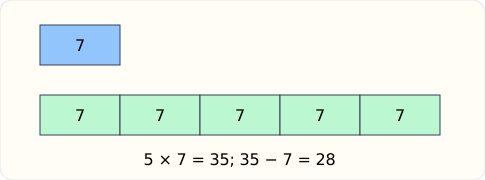
If Jo has seven counters and Mina has five times as many, Mina has five copies of Jo's count. The multiplication relationship is 5 × 7 = 35 counters. To ask how many more counters Mina has, subtract the reference count: 35 - 7 = 28 counters. Five is the number of copies; twenty-eight is a count of extra counters. They are not interchangeable answers.
The phrase times as many describes a multiplicative relationship, but it does not mean that every question containing it is solved by multiplication. If the larger count and the factor are known, divide to find the reference amount. If both counts are known, divide to find the factor. Locate the unknown in the relationship before deciding which calculation will recover it.
Another way: steps
Identify the reference amount, factor and compared amount; mark the unknown; solve the corresponding multiplication relationship; then check its meaning and units.
The short bar represents seven counters. The long bar contains five equal sections, each matching the short bar, so it represents thirty-five. The number five counts all the sections in the long bar. The extra part beyond one short bar contains only four of those sections, giving twenty-eight more counters.
This explains a common off-by-one error. Five times as many includes the reference-sized portion as one of the five copies. It does not mean five extra copies in addition to that portion. If five extra copies were added to the original seven, the total would be six copies, or forty-two. Use the bar model to distinguish the whole compared amount from the portion that sticks out beyond the reference bar.
A short ribbon measures six centimeters. A longer ribbon is four times as long. Four copies of six centimeters laid end to end make twenty-four centimeters, so the longer length is 4 × 6 = 24 centimeters. The factor four is a count of copies, not a length to add to the six centimeters.
Check the relationship by dividing twenty-four by four to recover six. You can also estimate its size: the result must be greater than six because four positive copies exceed one. A result of ten centimeters comes from adding four to six and would describe four centimeters longer, not four times as long. Naming the unit reveals the confusion: four copies and four centimeters play different roles.
A ribbon measures twenty-four centimeters and is four times as long as a shorter piece. Let s be the shorter length. The relationship is 4 × s = 24. Divide the long ribbon's length into four equal copies to get s = 6 centimeters. Multiplying twenty-four by four would find a still longer length, not the reference piece described in the problem.
A bar split into four equal sections makes the division clear. The full bar is labeled twenty-four, and each section is unknown. Sharing the total equally among the four sections determines the size of one copy. After finding six, substitute it into the original statement: four times six equals twenty-four. This exact check is more informative than merely observing that six is smaller than twenty-four.
One collection contains nine counters and another contains fifty-four. To find how many times as many are in the larger collection, ask how many groups of nine fit into fifty-four. The quotient is six, because 6 × 9 = 54. Report six times as many, rather than six counters. The factor compares two counts and is a number of copies.
If the question instead asks how many more counters, calculate 54 - 9 = 45 counters. Both answers are correct for their respective questions. A useful two-column record can list the multiplicative factor and the additive difference for several pairs. Notice that knowing one type of comparison does not automatically supply the other without the reference amount. 'Six times as many' has different extra-count consequences when one copy contains two counters rather than nine.
The relationship 5 × 8 = 40 can represent three different questions. If five and eight are known, find the total forty. If five and forty are known, find the reference amount eight. If eight and forty are known, find the factor five. A box or letter can mark the missing quantity in each version.
Draw the same comparison bars for all three questions but change which label is hidden. This shows that multiplication and division belong to one relationship rather than unrelated keyword rules. The story's wording identifies the roles, and the location of the unknown determines the operation needed. Read the completed equation in words afterward: forty is five copies of eight. That sentence verifies which number represents the factor and which represents one copy.
If thirty is five times as many as six, it does not follow that six is five times as many as thirty. The direction of the comparison matters. Thirty is the compared amount and six is the reference amount in that sentence. Reversing them changes the relationship. In this lesson the scale factors are positive whole numbers, usually greater than one, so the compared amount is larger than one positive copy.
The two factors in the multiplication equation can be reordered without changing the product, but their story roles remain distinct. Writing 5 × 6 or 6 × 5 gives thirty numerically. Saying 'five copies of six counters' identifies a different grouping description from 'six copies of five counters.' Explain the intended role rather than assuming the order of written factors alone communicates the context.
A model mast is twenty centimeters tall and another is five centimeters tall. The taller mast is four times as tall because twenty divided by five is four. It is fifteen centimeters taller because twenty minus five is fifteen. These statements use matching centimeter units, allowing a fair comparison.
If one length is written in meters and the other in centimeters, first express both in the same unit. Two meters compared with fifty centimeters means two hundred centimeters compared with fifty, so the factor is four. Comparing the written numbers two and fifty without their units would reverse the apparent size and produce a meaningless conclusion. A multiplicative comparison describes quantities, not bare numerals detached from their measures.
A factor of one means equal amounts: one copy of eight is eight. The additive difference is then zero. This boundary shows why 'times as many' need not always mean a strictly larger amount. A factor greater than one makes a positive reference amount larger, while one leaves it unchanged.
If the reference amount is zero, any whole-number number of copies is still zero. Knowing only that both amounts are zero does not determine one unique comparison factor. The independent tasks here use positive reference quantities so that dividing the compared amount by the reference identifies a definite factor. Stating the boundary prevents a rule about division from being extended carelessly to a zero divisor. The bar model's one-copy length must be positive when it is used as a measuring unit.
Suppose a reference collection has seven objects. A collection three times as large has twenty-one, and one four times as large has twenty-eight. Increasing the factor by one adds one complete reference-sized group, or seven objects. It does not add one object. The size of the reference group determines how much the compared amount changes.
Now keep the factor four but increase the reference count from seven to eight. The compared total increases from twenty-eight to thirty-two, a change of four objects, because each of the four copies gains one. These neighboring cases help check a model. They also connect multiplication to distributive reasoning: four copies of seven plus one each contain four copies of seven plus four extra ones. Use concrete bars or counters to explain the change before compressing it into an equation.
A learner says that eighteen is three times as many as six because eighteen minus six is twelve. The final comparison is true, but the stated calculation finds the additive gap rather than the factor. Repair the justification by showing 18 divided by 6 = 3 or 3 × 6 = 18. Keep the difference calculation if the learner also wants to say twelve more.
Another learner says eighteen is three more than six. That claim fails because six plus three is nine, not eighteen. The countercheck tests the actual wording. A good explanation includes a quantity relationship that supports the exact claim made, not merely any correct arithmetic involving the same numbers. When you report two comparisons, label the factor as times as many and label the difference with the counted or measured unit.
A classroom drawing shows one tower twelve centimeters tall and another thirty-six centimeters tall. The second is three times as tall because three copies of twelve centimeters reach thirty-six. It is also twenty-four centimeters taller. A report should label these two comparisons so that a reader does not mistake the factor three for an extra three centimeters. The height comparison does not say that the second tower has three times the floor area or three times the mass. Those properties depend on other dimensions and materials. Keep the conclusion tied to the measured height. If the drawing uses different scales for the two towers, compare the labeled actual heights rather than the lengths of ink on the page.
One group needs eight counters for a demonstration. Another group asks for five times as many, so its request is forty counters. If the first eight counters are already set aside for that second group's request, thirty-two more are needed to complete the forty. The distinction between the total five-copy request and the four additional copies prevents an extra group from being ordered by mistake. Draw five equal boxes of eight and mark the one already supplied. The remaining boxes show what is still needed. This model assumes the request describes a total amount, not five additional copies beyond an existing amount. Read that condition carefully and restate it before calculating the remaining supply.
Times as many identifies a multiplication relationship, but division may be needed to find the reference amount or factor. A factor counts copies; a difference counts extra units. Five times as many includes five total copies, not five additional copies beyond the reference.
Identify the reference count.
7 counters
This is one copy.
Identify the comparison factor.
5 times as many
The larger collection contains five equal copies.
Construct the multiplication.
5 × 7
The factor counts copies of the reference.
Calculate and label the total.
35 counters
The product is a count of objects.
Check the original relationship.
35 divided by 7 = 5
The total contains exactly five reference groups.
Identify the known compared amount.
24 cm
This is the complete longer ribbon.
Identify the number of copies.
4
Four shorter pieces would match the longer one.
Write the unknown-factor equation.
4 × s = 24
The reference length is unknown.
Divide to find one copy.
s = 24 divided by 4 = 6 cm
Equal sections recover the reference amount.
Check by multiplication.
4 × 6 = 24 cm
The found length satisfies the stated comparison.
Identify the two collections.
9 counters and 54 counters
The smaller count is the reference.
Construct the factor question.
9 × f = 54
The unknown is how many copies fit.
Find the multiplicative factor.
f = 54 divided by 9 = 6
Six copies of nine make fifty-four.
Construct the difference question.
54 - 9
This asks for the extra objects beyond one copy.
Find and label the gap.
45 counters
The larger collection has forty-five more.
Check both statements independently.
6 × 9 = 54; 9 + 45 = 54
The factor and difference support different claims.
Name the compared quantities.
8 cm and 48 cm
Both lengths use centimeters.
Write the multiplicative relationship.
8 × f = 48
The missing factor counts reference-length copies.
Find the factor by division.
48 divided by 8 = 6
Six eight-centimeter pieces fit the longer length.
State the comparison in words.
Contrast the additive gap.
A number is 5 times as large as 10. Find the number.
Compared amount p
A length of 20 cm is 5 times a shorter length. Find that shorter length.
Identify the number of copies.
The long length contains 5 equal shorter lengths.
The factor describes repeated copies.
Recover the reference length.
The shorter length is s cm.
Divide the total by the number of copies.
Check the original comparison.
Multiply the shorter length by 5 to recover 20 cm.
The answer must satisfy the stated relationship.
A quantity 24 is 3 times a reference quantity. Find the reference quantity.
Reference amount r
Mina has 7 times as many counters as Jo, who has 11. Which calculation gives Mina's count?
A number is 4 times as large as 14. Find the number.
Compared amount p
Two model strips measure 27 cm and 9 cm. Report how many times as long the first is and how many centimeters longer it is.
Times as long t; centimeters longer g
Lesson test: one question per skill, one attempt each, no hints. Your answers are checked when you submit.
A quantity 56 is 7 times a reference quantity. Find the reference quantity.
Reference amount r
Compare 48 with 8 in both ways: how many times as many, and how many more? Then explain why finding a reference amount can require division even when a story says times as many.
21. Find how many copies, step 4
48 cm is 6 times as long as 8 cm
The factor is not a length.
21. Find how many copies, step 5
48 - 8 = 40 cm
Forty centimeters longer answers a different question.